Morehouse Parish Louisiana North Louisiana Cotton Festival
Bastrop, the parish seat of Morehouse Parish in northeast Louisiana, sits in country where cotton once set the rhythm of the year, and the Morehouse Parish Louisiana North Louisiana Cotton Festival belongs to that rhythm. In the layers read the event is published as the North Louisiana Cotton Festival and Fair, a fall fair held in October celebrating the crop that shaped the parish’s fields and markets. The clearest dated evidence comes from the late nineteen seventies: a newspaper-archive layer attests an October 1977 edition, and an artist’s resume layer records student art-competition awards at the festival in 1978 and 1979. No venue is printed in the layers read and no founding year is recorded in them, so this article works only from what the layers do say: a chamber layer calls it the parish’s annual fall fair, visitor-guide layers place it in October, and the organiser, the North Louisiana Cotton Festival Association, also hosts the Crawfest event.
About
The North Louisiana Cotton Festival and Fair is, at its heart, a parish fair built around a single crop. Cotton gave Morehouse Parish its working identity for generations: the fields around Bastrop, the gins, and the market days that brought farm families into town all turned on the harvest. The fair takes that harvest as its theme and turns it into a gathering, with rides, games, music, exhibits, and food, and with local products and regional food given a prominent place. A chamber layer describes the event as the parish’s annual fall fair, drawing visitors from Morehouse Parish and the surrounding parishes, and visitor-guide layers agree that it happens each October.
The sheet title, Morehouse Parish Louisiana North Louisiana Cotton Festival, is never printed exactly in the layers read. The published forms are “North Louisiana Cotton Festival and Fair” and the shorter “North Louisiana Cotton Festival”, and the body of this article uses those published forms, with the sheet title kept only on the first line and in the outlook section. The longer form is the one the organiser and the chamber use, and it carries the word “Fair” that tells a visitor what kind of event to expect: a fairground gathering with a midway, exhibits, and food, not a single-day concert or a street parade.
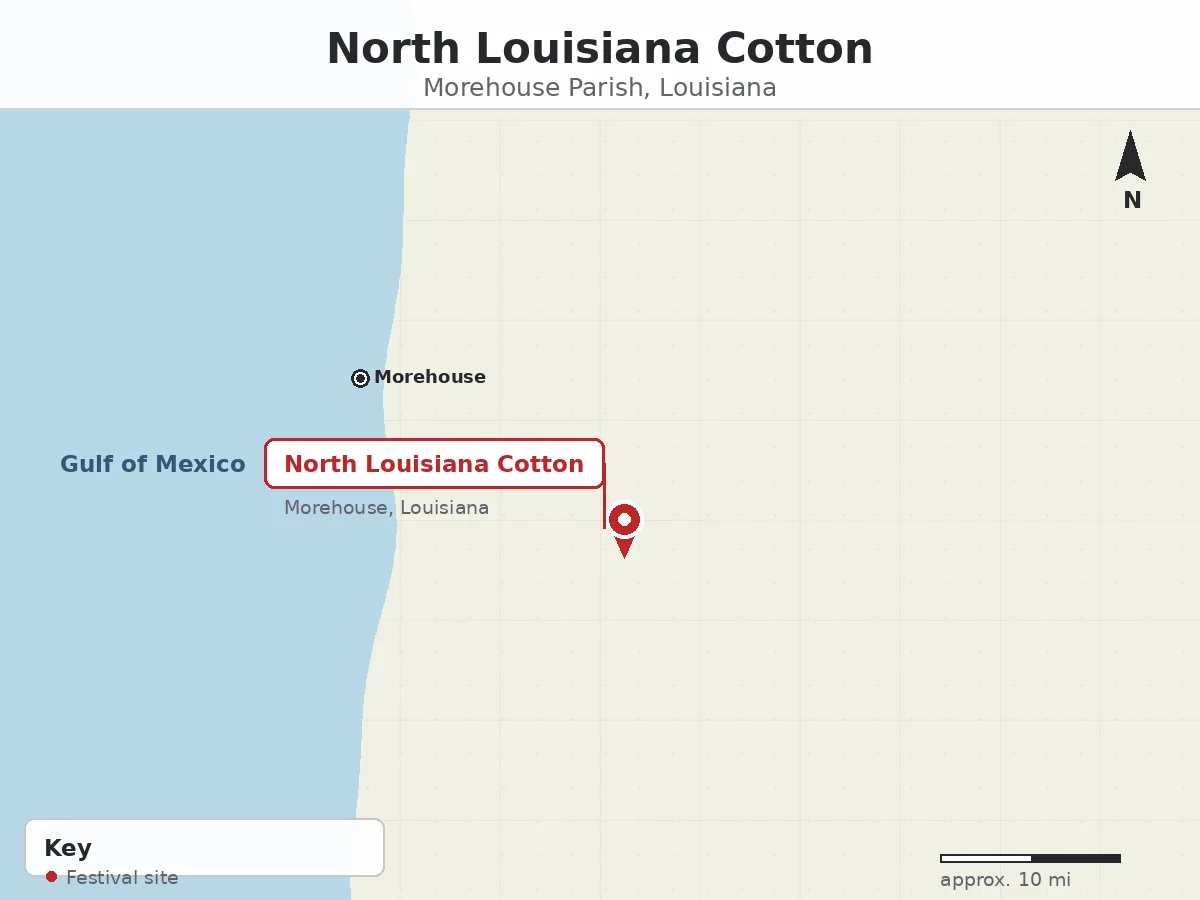
Bastrop is the parish seat, confirmed by reference layers including a state health-profile layer, and the fair belongs to the parish seat’s calendar. The organiser is the North Louisiana Cotton Festival Association, named in chamber and visitor-guide layers, and the same association also hosts the Crawfest event, which gives the fair a sibling in the parish’s calendar. No venue is printed in the layers read: the layers describe the event, its season, and its programme, but none of them names the ground where it is held.
Quick Facts
| Item | Detail |
| Published name | North Louisiana Cotton Festival and Fair |
| Shorter published form | North Louisiana Cotton Festival |
| Host town | Bastrop, the parish seat of Morehouse Parish |
| Venue | No venue is printed in the layers read |
| Organiser | North Louisiana Cotton Festival Association |
| Usual timing | Fall, in October each year |
| Programme | Rides, games, music, exhibits, and food |
| Theme | Celebration of the region’s farming heritage |
| Earliest dated edition | October 1977, attested by a newspaper-archive layer |
| Admission | No gate price or free status is stated in the layers read |
History
The documented history of the North Louisiana Cotton Festival and Fair begins, in the layers read, in the late nineteen seventies. A newspaper-archive layer dated 29 September 1977 attests an October 1977 edition, and an artist’s own resume layer records student art-competition awards at the festival in 1978 and 1979. Those three points are the firm dated evidence in the record, and they place the fair firmly in the late nineteen seventies as a going concern with a student art competition already part of its programme.
For a useful comparison, see the Madison Parish Louisiana Teddy’s Bear Festival for another county festival.
Beyond those dated points the record turns to pattern rather than dates. A chamber layer says the fair is held in the fall each year, and visitor-guide layers say it happens each October, but no recent dated edition with a specific date was found in any layer read. That gap is the central fact about the fair’s recent history: the event is attested as an annual fall fair, yet the layers give no dated edition from recent years and no founding year, so the fair’s beginnings cannot be dated from the evidence available. The fair’s history is therefore a history of a long-running annual pattern rather than a dated chronology.
The student art competition deserves a closer look, because it is the most specific programme detail the older record preserves. In 1978 and 1979, student art-competition awards were given at the festival, which means the fair already gave the parish’s schools and young artists a visible part. A fair that makes room for student art is a fair that sees itself as a community gathering rather than a purely commercial midway. The chamber layer’s description of the event as the parish’s annual fall fair fits the same picture.
What to Expect
A visitor to the North Louisiana Cotton Festival and Fair should expect a traditional parish fair, built around rides, games, music, exhibits, and food. The chamber and visitor-guide layers describe the programme in those broad terms, and the emphasis falls on the fair as a celebration of the region’s farming heritage, with local products and regional food given a prominent place. The rides and games give the fair its midway energy, the music gives it its sound, and the exhibits give it its substance.
The farming-heritage theme is what sets this fair apart from a generic carnival. Cotton is the crop the fair is named for, and the celebration of the region’s farming heritage means the fair is, in part, a showcase for what the parish grows and makes. Local products and regional food are the concrete form that theme takes: the food on offer is the food of the region, and the exhibits are the place where the parish’s agricultural life is put on display.
The student art competition of 1978 and 1979 points to another part of the fair’s character. Exhibits at a parish fair are often the place where the community shows its own work, and the fair’s record of student awards suggests that the exhibit halls mattered to the event from an early date. The layers read do not give a recent programme in detail, so the picture here is drawn from the fair’s described character rather than a dated schedule, and a visitor should treat the programme as the fair’s established pattern rather than a fixed list of named acts.
Planning Your Visit
Planning a visit to the North Louisiana Cotton Festival and Fair starts with its season. The chamber layer says the fair is held in the fall each year, and visitor-guide layers say it happens each October, so October is the month to watch, and Bastrop, the parish seat, is the town to aim for. Because no recent dated edition with a specific date was found in the layers read, a visitor should confirm the dates for the coming year through local sources before travelling.
No venue is printed in the layers read, which makes the practical planning different from most festivals in this series. The layers describe the event as the parish’s annual fall fair but none of them names the ground where it is held, so a visitor should confirm the location as well as the dates before setting out. Bastrop is the parish seat and the fair’s home town, so the town itself is the right base.
No layer states a gate price or a free status, so this article takes no position on admission. The layers read give no admission figure at all, which means a visitor should confirm whether there is a gate charge before budgeting for the day. A visitor should allow a full day for the fair rather than an hour or two.
Sample Itinerary
A day at the fair can be shaped around its established pattern, even without a dated schedule to follow. Arrive in Bastrop in the morning, when the fairgrounds are opening and the exhibit halls are at their quietest, and begin with the exhibits, where the parish’s agricultural life and the student art tradition are on display. The exhibits give the day its context: this is a fair about a crop and a community, not only a midway.
By midday, move to the food, where the regional cooking is the fair’s most direct expression of its farming-heritage theme. A midday meal at the fair is the best way to taste what the parish grows. After lunch, take in the music and the midway, with the rides and games giving the afternoon its energy.
Comparison
The North Louisiana Cotton Festival and Fair is easily confused with the Louisiana Cotton Festival in Ville Platte, in Evangeline Parish, and the two should be kept firmly apart. The Ville Platte festival is a different event in a different parish, held each October since the nineteen fifties, and it does not rescue or confuse the Bastrop fair: each belongs to its own parish, its own organiser, and its own record. The parish name is the surest way to tell them apart — Morehouse Parish for the Bastrop fair, Evangeline Parish for the Ville Platte festival.
The fair’s closest relative is not another cotton festival but the Crawfest event, which the same organiser, the North Louisiana Cotton Festival Association, also hosts. The two events share an organiser and a parish, and together they show the association as a year-round presence in the parish’s calendar rather than a single-event body.
One layer read deserves a warning rather than a comparison. A content-farm layer claiming a Louisiana cotton festival in Monroe since nineteen thirty is disowned wholesale in the research behind this article, because it conflates the Ville Platte and Bastrop events. The Monroe claim belongs to neither festival, and the record behind it is unreliable.
Checklist
- Confirm the October dates and the fairground location before travelling.
- Aim for Bastrop, the parish seat, as the base for the visit.
- Confirm whether there is a gate charge, since no layer states a price or a free status.
- Allow a full day for rides, games, music, exhibits, and food.
- Make time for the exhibits and the student art tradition.
- Taste the regional food, the fair’s most direct expression of its harvest theme.
- Keep the Ville Platte festival in mind as a different event, and do not confuse the two.
Beyond the Festival
Beyond the fair itself, the visit belongs to Bastrop and to Morehouse Parish, and the fair’s theme is the parish’s theme. Cotton shaped the parish’s fields and its working life, and the fair is the one moment in the year when that history is gathered into a single place. A visitor who comes for the fair will see a community that still measures its year by the harvest and still gathers to mark it.
The parish’s farming heritage is not a museum piece but a living part of its economy, and the fair’s emphasis on local products and regional food is the most direct way to meet it. The exhibits, the food, and the student art competition all point in the same direction: a fair that is about what the parish grows and what its people make.
Significance
The significance of the North Louisiana Cotton Festival and Fair lies in what it preserves. A parish fair built around a single crop is a record of a working life, and the fair’s long annual pattern — attested in the late nineteen seventies and described by a chamber layer as an annual fall fair — shows a community that has kept returning to the same celebration across the decades. The student art competition of 1978 and 1979 carries a large meaning: the fair was already, in those years, a place where the parish’s young people had a visible part, and that community role is what makes a fair more than a midway.
The fair also matters as a piece of Morehouse Parish’s identity. Bastrop is the parish seat, and the fair is the parish’s annual fall fair, drawing visitors from the parish and the surrounding parishes. In a parish where cotton set the rhythm of the year, a fair named for cotton is a statement about what the community values.
Frequently Asked Questions
What does the fair celebrate, and why cotton?
The fair celebrates the region’s farming heritage, with cotton as its named crop. Cotton shaped Morehouse Parish’s fields, markets, and working life for generations, and the fair gathers that history into a fall fair with rides, games, music, exhibits, and food, with local products and regional food given a prominent place.
Why do the layers call the event by two different names?
The published forms are “North Louisiana Cotton Festival and Fair” and the shorter “North Louisiana Cotton Festival”, and the sheet title drops the “and Fair” element. The longer form is the one the organiser and the chamber use, and its word “Fair” tells a visitor the event is a fairground gathering rather than a single-day concert.
Why does this article give no venue for the fair?
No venue is printed in the layers read. The chamber layer describes the event as the parish’s annual fall fair, but none of the layers names the ground where it is held, so a visitor should confirm the location locally before travelling, using Bastrop as the base.
How far back does the documented record go?
The firm dated evidence begins in the late nineteen seventies: a newspaper-archive layer dated 29 September 1977 attests an October 1977 edition, and an artist’s own resume layer records student art-competition awards at the festival in 1978 and 1979. No founding year is recorded in the layers read.
What to Expect From the Next Morehouse Parish Louisiana North Louisiana Cotton Festival
How often is Morehouse Parish Louisiana North Louisiana Cotton Festival held?
The chamber layer describes it as the parish’s annual fall fair, and visitor-guide layers place it in October.
When is the next Morehouse Parish Louisiana North Louisiana Cotton Festival?
No recent dated edition with a specific date was found in the layers read, so no coming date can be given. The pattern points to October in Bastrop, but the exact dates should be confirmed through local sources before travelling.
Will the dates change?
The layers read give no dated edition beyond the older record, so nothing in them fixes a coming date or shows a move. The fair’s established pattern is an October fair in Bastrop, and any change to that pattern would need to be confirmed locally.
The North Louisiana Cotton Festival and Fair is a fair whose roots run deep and whose paper trail runs thin, and that combination is part of its story. It belongs to Bastrop, to Morehouse Parish, and to the cotton country that gave it its name, and it endures as the parish’s annual fall fair, where the harvest, the community, and the farming heritage of the region come together each October.