Montgomery County Alabama Alabama Shakespeare Festival
Most festival titles in this series point to a fairground weekend or a single harvest Saturday, but this one names something larger and more permanent. The Alabama Shakespeare Festival, known everywhere by its initials ASF, is a fully professional regional theatre that started life in 1972 as a summer Shakespeare festival in Anniston and grew into a year-round producing organisation. Since December 1985 it has been permanently housed in the Carolyn Blount Theatre in Montgomery, the county seat of Montgomery County and the capital of Alabama. So the honest way to frame this title is not as a short annual fair-style event at all: it is a working theatre with a full season, a national reputation, and a home in a 250-acre cultural park. The sections below set out what is documented about its founding, its rescue and relocation, its two performance spaces, and the layered figures that surround it, keeping conflicting published numbers separate rather than blending them into one tidy claim.
About the Alabama Shakespeare Festival
The festival is its own producing organisation, and its identity has two distinct eras. The first belongs to Anniston in Calhoun County, where ASF began in 1972 as a summer-stock venture under founding Artistic Director Martin Platt, who led the company from 1972 to 1989. The second era belongs to Montgomery, where the organisation now stages around ten productions each season, mixing Shakespeare with Broadway musicals, children’s productions, American classics and world premieres. In 1977 it was designated the State Theatre of Alabama, a title it still carries in the published record. Alongside its mainstage work, the theatre runs educational and outreach programmes and develops new writing through the Southern Writers Festival, and it performs in association with Actors’ Equity Association, the Stage Directors and Choreographers Society and United Scenic Artists. Anyone arriving at this title expecting a weekend festival should adjust their picture early: this is a permanent institution whose original summer-festival shape explains its name, not its modern calendar.
Quick Facts
| Item | Documented detail |
| Event | Alabama Shakespeare Festival (ASF), a fully professional regional theatre |
| Host city | Montgomery, county seat of Montgomery County and state capital |
| First home | Anniston, Calhoun County, from 1972 to 1985 |
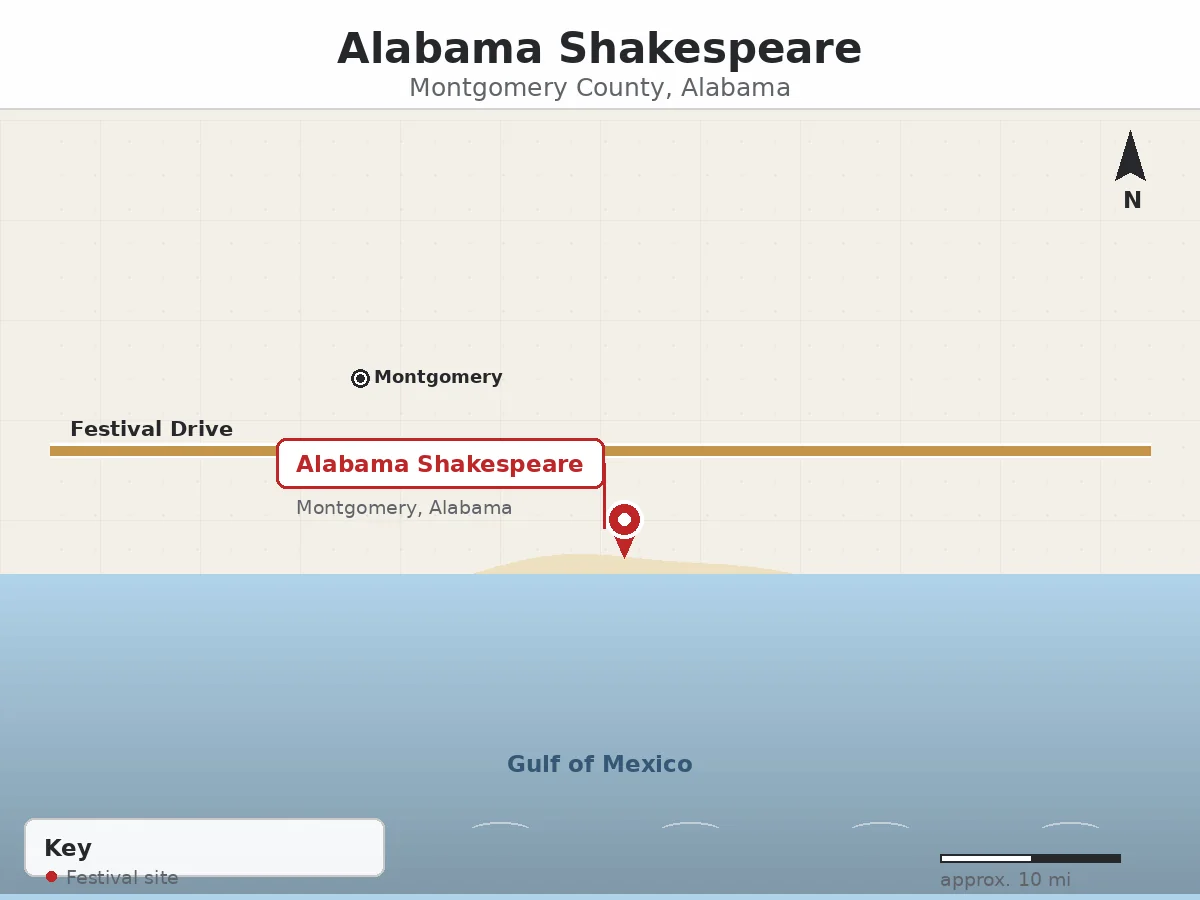
| Current venue | Carolyn Blount Theatre, 1 Festival Drive, Montgomery, Alabama |
| Setting | Winton M. Blount Cultural Park, also written Blount Cultural Park, 250 acres |
| Founding artistic director | Martin Platt, 1972 to 1989 |
| Honour | Designated the State Theatre of Alabama in 1977 |
| Festival Stage capacity | Published as 792 seats in some sources and 750 seats in others |
| World ranking | Published variously as among the ten largest, the sixth largest and the seventh largest Shakespeare festival in the world |
| Season shape | Year-round, with around ten productions each season |
History of the Alabama Shakespeare Festival
The company’s first performance took place in the Anniston High School auditorium in 1972, played before a single critic and his wife, who predicted the venture would not survive. That prediction has been quoted ever since precisely because it proved so wrong. Through its Anniston years the festival worked as a summer operation, with plays running for six weeks during the summer months. Growth brought strain as well as success: by the early 1980s the festival faced bankruptcy and had outgrown the facilities available to it, and its future in its original home looked doubtful.
The rescue came from within its own board. Carolyn Blount and her husband, whose first name appears as Winton in most layers and as Wynton in some, paid the festival’s debts and gave it a purpose-built Montgomery home. Their gift of a performing-arts complex amounted to twenty-one million five hundred thousand dollars, repeatedly described in theatre coverage as the largest single gift in the history of American theatre, and it was set in the 250-acre Winton M. Blount Cultural Park. The Carolyn Blount Theatre opened its doors on December 7, 1985, with a production of A Midsummer Night’s Dream, and the move changed the organisation’s shape permanently: from that point ASF operated year-round, with more than four hundred performances scheduled each year. Accumulated totals credited to the company record 491 plays and musicals produced since its founding, more than one hundred new scripts developed through the Southern Writers Festival, and the entire Shakespearean canon completed. A separate documented layer concerns its university ties: on April 25, 2008, ASF announced that its relationship with the University of Alabama would be phased out after the current class graduated in August 2009. One modern gap also belongs in the record: there was no 2020 season, so that year should never be presented as an ordinary season in the company’s life.
What to Expect
Expect a repertory theatre rather than a festival midway. A season holds around ten productions, and the mix is deliberately broad: Shakespeare sits alongside Broadway musicals, productions for children, American classics and world premieres, so two visits in different months can feel entirely unlike each other. The building itself rewards attention before any curtain rises. The complex contains more than 100,000 square feet of space, over one million bricks went into its construction, and its two stages serve different scales of work. The Festival Stage is the larger room, published at 792 seats in encyclopedia and newspaper sources and at 750 seats in Playbill and a fandom source; the Octagon Theatre is the smaller space, published at 225 seats in encyclopedia and Playbill sources and at 262 seats in a newspaper source. Those figures conflict in print, and this article records them side by side instead of choosing one. Outside, the park setting is part of the experience: landscaped English-style grounds and a lake, planned by landscape architect Russell Page, surround the theatre, and the Montgomery Museum of Fine Arts shares the same cultural park. Current activity is documented in seasonal listings rather than a single festival weekend; a tourism authority Halloween guide, for example, lists The Play That Goes Wrong running October 1 to 25 at the Alabama Shakespeare Festival in Montgomery, which is a listing layer for its autumn 2026 programming and not a complete season announcement.
For a useful comparison, see the Montgomery County Alabama Spring Chicken Festival for another county festival.
Planning Your Visit
Build the visit around a chosen production rather than around a date on a festival calendar, because the theatre works throughout the year and individual shows open and close on their own schedules. Ticket prices vary by production, and no single admission price is fixed across the sources checked, so treat any one figure quoted elsewhere with care and confirm the price for the specific performance you want. Allow time before the show to walk the grounds of the cultural park, since the lake and lawns are a genuine part of what the Blount gift created, and consider pairing an evening performance with a daytime visit to the Montgomery Museum of Fine Arts in the same park. Published attendance claims deserve the same layered treatment as the seat counts: older Playbill and fandom layers speak of more than 300,000 annual visitors drawn from all fifty states and over sixty countries, and those numbers are recorded here as those sources’ claims rather than as a current verified figure. If you are travelling from Anniston or elsewhere in Calhoun County, remember that the festival left its first home in 1985; every modern performance happens in Montgomery.
A Sample Day Around a Performance
A relaxed day might begin with a slow morning in the cultural park, walking the landscaped grounds and the lakeside before the crowds for the matinee arrive. Late morning can go to the Montgomery Museum of Fine Arts, which sits in the same park and turns the trip into a fuller arts outing rather than a single ticket. Take lunch in Montgomery, the state capital, where the county seat’s downtown gives you a second, contrasting setting of government buildings and riverfront history. Return to the theatre in good time for the afternoon performance, choosing whichever of the season’s productions is playing, and use the interval to look properly at the building’s brickwork and scale. If an evening show suits you better than a matinee, reverse the pattern: museums and park first, a unhurried meal, then the performance under lights, with the grounds quieter on the way out than they were on the way in.
How It Compares With Other Shakespeare Festivals
Comparisons are published about this company more often than measurements agree about it. One encyclopedia layer places it among the ten largest Shakespeare festivals in the world; Playbill calls it the sixth largest; a fandom layer calls it the seventh largest. All three rankings sit unmerged in this article because no checked source reconciles them. What can be said without contradiction is narrower and more durable: few American Shakespeare companies moved from a high-school auditorium and a six-week summer run into a purpose-built complex of this scale, and fewer still hold a formal state-theatre designation dating to 1977. Against a typical seasonal festival that assembles for a few weeks and then packs away, ASF’s distinguishing feature is permanence, a salaried year-round operation in its own building, with education work and new-play development running beside the mainstage season rather than around a single annual gathering.

Planning Checklist
- Choose a production first, then fix your date, since the season runs year-round
- Confirm the ticket price for that specific performance before travelling
- Decide between the larger Festival Stage and the smaller Octagon Theatre experience
- Leave time to walk the Blount Cultural Park grounds and lake before the show
- Pair the trip with the Montgomery Museum of Fine Arts in the same park
- Treat published seat counts and world rankings as conflicting claims, not settled facts
- Do not plan around Anniston, which hosted the festival only from 1972 to 1985
- Check seasonal listings for current titles rather than expecting one festival weekend
Beyond the Theatre
Montgomery rewards the visitor who treats the performance as one part of a wider stay. The city is both a county seat and a state capital, so the same trip can take in Alabama’s civic landmarks, its civil rights history and its riverfront, all within a short distance of the cultural park. The park itself is the gentlest extension of the visit: 250 acres of landscaped grounds planned with an English-style character, where a post-show walk by the lake costs nothing but time. For theatre lovers travelling further, the company’s own history offers a thoughtful detour in Anniston, where the high-school auditorium of the first performance marks how far the organisation travelled between 1972 and its December 1985 opening in Montgomery. That contrast between a borrowed school hall and a complex built from over one million bricks is, in its own way, the whole story of the institution told in two buildings. School and student audiences form another thread beyond the mainstage, since the company’s educational and outreach programmes carry its work into classrooms as well as onto its two stages.
Why the Alabama Shakespeare Festival Matters
The festival matters because it demonstrates what sustained patronage and a permanent home can do for regional theatre in America. A summer venture that one critic expected to fold instead became the State Theatre of Alabama, completed the entire Shakespearean canon, and developed over one hundred new scripts through the Southern Writers Festival, which means it looks forward to new writing as well as back to the classical repertoire. Its career total of 491 plays and musicals, its four-hundred-plus performances a year after the Montgomery move, and its survival through both the bankruptcy threat of the early 1980s and the missing 2020 season give it a documented resilience that the larger claims about rankings only decorate. For Montgomery County, it anchors a cultural park that pairs theatre with a fine arts museum, and for Alabama it stands as the clearest example of a festival name that outgrew the festival format entirely.
Frequently Asked Questions
Is the Alabama Shakespeare Festival still only a summer event?
No. It began as a summer festival in Anniston, where plays ran for six weeks during the summer months, but after the move to Montgomery in December 1985 it began year-round operations, with more than four hundred performances scheduled each year.
What kinds of plays does a season at ASF include?
A season holds around ten productions mixing Shakespeare, Broadway musicals, children’s productions, American classics and world premieres, alongside educational and outreach programmes and new-play development through the Southern Writers Festival.
Why do published seat counts for the theatre disagree?
Because the sources genuinely differ. The Festival Stage appears as 792 seats in encyclopedia and newspaper sources and as 750 seats in Playbill and a fandom source, while the Octagon Theatre appears as 225 seats in some sources and 262 seats in another, so this article records each figure with its layer rather than merging them.
Who saved the festival from bankruptcy in the 1980s?
Board member Carolyn Blount and her husband, whose first name is published as Winton in most layers and Wynton in some, paid the festival’s debts and gave the performing-arts complex in Montgomery, a gift of twenty-one million five hundred thousand dollars that opened the Carolyn Blount Theatre on December 7, 1985.
What to Expect From the Next Montgomery County Alabama Alabama Shakespeare Festival
How often is Montgomery County Alabama Alabama Shakespeare Festival held?
It is not held as a single annual gathering in the way its name suggests. Since December 1985 the organisation has operated year-round in Montgomery, staging around ten productions each season, so its rhythm is a continuous theatrical calendar rather than one recurring weekend.
When is the next Montgomery County Alabama Alabama Shakespeare Festival?
There is no single next edition to wait for, because performances run throughout the year. Seasonal listings document current programming as it is announced; a tourism guide, for instance, lists The Play That Goes Wrong from October 1 to 25 as part of its autumn 2026 Montgomery programming.
Will the dates change?
Individual production dates are set production by production and can shift with each season’s scheduling, while the underlying pattern of year-round operation in the Carolyn Blount Theatre has held since 1985. Checking the current listings for the month of your visit is the reliable approach.
The Alabama Shakespeare Festival rewards anyone who approaches it on its own terms: not a tent, a midway or a harvest weekend, but a permanent company whose name preserves the memory of a 1972 Anniston summer. Come for a single play and you will still feel the scale of what the Blount gift built; come across a season and you will understand why a festival that began before an audience of two now anchors one of Alabama’s most significant cultural parks. Either way, Montgomery is where that story continues, all year round.