Marion County Alabama Mule Day Festival
Late September brings an unusual guest of honour to downtown Winfield: the mule. For one weekend, judging rings, a parade route and carnival rides take over the streets around Bankhead Highway and Main Street, mule and horse shows anchor the programme, and a small city hosts what its own government calls the largest festival in Marion County. Mule Day is Winfield’s signature celebration, an annual fixture the Encyclopedia of Alabama traces back to 1975, built around an animal that rewards patience, strength and a good judge’s eye.
About the Festival
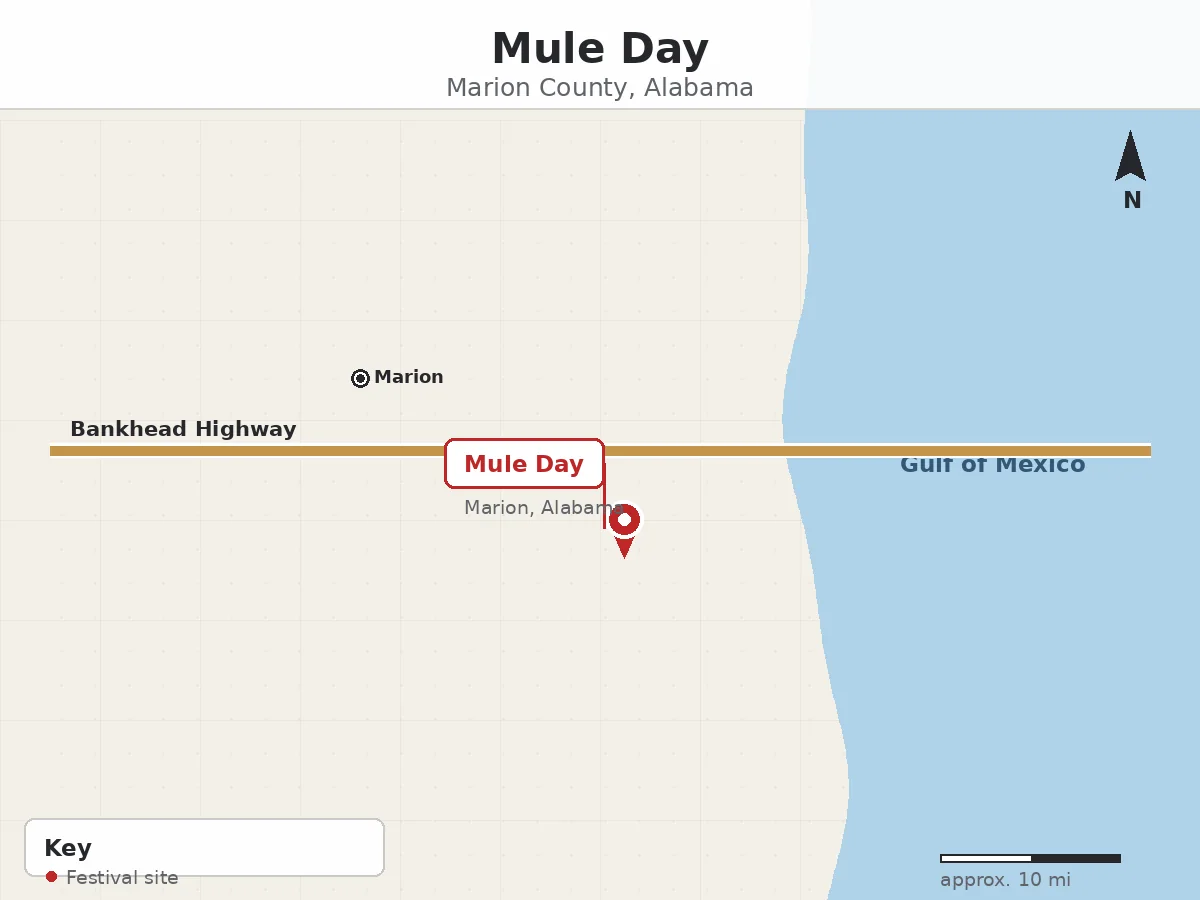
Mule Day is held each September in downtown Winfield, in southeastern Marion County. The Encyclopedia of Alabama describes it plainly: since 1975, Winfield has hosted the annual Mule Day celebration on the last weekend in September, with a carnival, mule judging contests, a car show, a fun run and a parade down Main Street. The City of Winfield’s official festival page goes further, calling Mule Day the largest festival in Marion County. Winfield is a small city of 4,845 people at the 2020 census, and it also extends into neighbouring Fayette County. It is not the county seat of Marion County; Hamilton holds that role and is the county’s largest city.
Responsibility for the festival appears in the record in layers rather than under one name. The Winfield Chamber of Commerce publishes the festival’s materials, and its 2026 Mule Day documents name chamber president Dana Peoples and chair people Sandy Spann, Antonia Tindell and Amanda Edge. A 2026 listing names the Marion County Cooperative Extension System as host of the mule and horse show. The City of Winfield publishes the festival’s official rule and history page, and a news layer names Ryan Sanderson (DVM) as the Winfield Mule Day Director. Each of those roles belongs to its own source, and this article keeps them in their layers instead of merging them into a single organiser of record. A listing gives the setting as Winfield Downtown, Bankhead Highway, Winfield, AL 35594.
Quick Facts
| Item | Detail |
| Festival name | Mule Day |
| Host city | Winfield, Alabama |
| County | Marion County |
| County seat | Hamilton (Winfield is not the county seat) |
| Setting | Downtown Winfield, around Bankhead Highway and Main Street |
| Season | Last weekend in September |
| 2026 dates | Friday, September 25 and Saturday, September 26, 2026 |
| Anniversary billing | Chamber materials give both 52nd Annual and 53rd Annual for 2026 |
| Admission | Free entry for visitors |
| Centrepiece events | Mule judging contests, mule and horse shows, parade |
History
The anchor of Mule Day’s history is a single authoritative sentence. The Encyclopedia of Alabama’s Winfield entry states that the town has hosted the celebration since 1975, on the last weekend in September, and its list of ingredients, a carnival, mule judging contests, a car show, a fun run and a parade down Main Street, still reads like a summary of the modern programme. That 1975 starting point is the encyclopedia’s own statement, and this article records it as such.
The anniversary numbers that surround the festival are less tidy, and they are best left untidied. A tourism layer billed the 2025 event as Mule Day’s 51st year. For 2026, the Winfield Chamber of Commerce’s own materials disagree with each other: the chamber homepage bills the 52nd Annual Mule Day, while the chamber’s vendor-page header for the same season reads 53rd Annual Mule Day. Both forms come from the chamber itself, so both are recorded here exactly as published, and neither is blended into a settled ordinal. What the billings agree on is the shape of the tradition, a celebration that has marked Winfield’s September for decades, whichever count a given page prefers.
For a useful comparison, see the Marion County Alabama Jerry Brown Arts Festival for another county festival.
The festival’s working shape is documented in the chamber’s vendor rules: sellers may set up on the Friday before, and the main festival will be Saturday only. That rule, read alongside the encyclopedia’s last-weekend framing and other listings that describe the fourth Saturday in September, shows a festival that has grown a Friday fringe around a Saturday core without ever moving its centre of gravity.
What to Expect
The mules come first. Judging contests and mule and horse shows are the festival’s centrepiece, with the Marion County Cooperative Extension System named as the show host in the 2026 listing. Owners bring animals in early: the same listing gives mule check-in times of five in the afternoon on Friday and half past six in the morning on Saturday, a reminder that the show day starts long before the crowds arrive.
Around the judging, downtown fills with the classic apparatus of a Southern street festival. There is a parade down Main Street, a carnival, a car show, live entertainment, food vendors and arts-and-crafts sellers, plus a children’s area for younger visitors. Judged events reach beyond the mule pens: the festival rules’ judging layer covers beauty pageants, the car show and parade floats. A fun run gives the morning an athletic start, documented in a race-listing layer as a 5K run setting off at eight in the morning from 22 Bankhead Highway.
Each year’s fringe adds its own touches. A 2026 listing includes a Faith and Family night among the festival’s activities. A 2025 news layer described mule and horse shows with a full day of festival and fireworks planned after the game on Friday night. The pattern to expect is a dependable core, the shows, the parade, the carnival and the vendors, dressed each year with a few extras of its own.
Planning Your Visit
Build your visit around Saturday. The chamber’s own rules state that the main festival will be Saturday only, with Friday given to vendor set-up, mule check-in and evening elements such as the Faith and Family night listed for 2026. A visitor with one day to spend should spend it on the Saturday, arriving early enough to see the judging before the parade crowds peak.
Entry will not trouble your budget: the chamber’s homepage for 2026 advertises free entry in capital letters, and the tourism layer for 2025 likewise lists free admission. The fees that appear in the festival’s paperwork belong to sellers, not visitors. The flea-market application fee is twenty-five dollars, vendor applications for 2026 had to be in by September 16, 2026, and acceptance letters go out by post at least two weeks before Mule Day, all of which matters only if you plan to trade rather than attend.
Dates deserve one careful check before you travel. The encyclopedia’s form is the last weekend in September; other listings phrase the timing as the fourth Saturday in September. The documented 2026 dates, Friday September 25 and Saturday September 26, are the last Friday and Saturday of that month. The 2025 record shows why confirmation matters: one news layer gave September 25 to 27, while the tourism association and a ministry newsletter gave September 26 to 27, framing September 27 as Festival Day. Confirm the current year’s span and day-by-day schedule in the chamber’s materials before you book anything around them.

A Sample Day at Mule Day
Friday rewards an early arrival. Walk the downtown streets as vendors set up, watch the mules arrive for the five o’clock check-in, and stay for the evening programme, which the 2026 listing fills with a Faith and Family night; the 2025 pattern added fireworks after the Friday night game.
Saturday begins before most festivals wake. Runners gather for the 5K at eight in the morning on Bankhead Highway while exhibitors finish the half-past-six check-in and the judging rings come to life. Give the late morning to the mule and horse shows, when the centrepiece contests are in full swing, then drift through the car show, the craft stalls and the children’s area as the parade assembles. The parade down Main Street is the day’s natural climax, and the carnival and food vendors carry the celebration into the evening.
Mule Day Compared
Most fall festivals in small Southern towns are built around a crop, a craft or a stage. Mule Day is built around an animal, and more precisely around judging it, which gives the weekend a working character that a midway cannot imitate. The contests reward breeding, condition and handling, and the crowd watches skills that were once everyday economics in the region rather than re-enactment.
Set against a conventional county fair, the shape is also distinctive: instead of spreading a programme evenly across many days, Mule Day concentrates its main festival into a single Saturday, with Friday serving as a supporting day of set-up, check-ins and evening events. And set against music-led street festivals, its parade is not decoration but one judged element among several, sharing the bill with the shows, the car show and the pageants. The result is a festival whose largest-in-the-county billing rests on substance rather than scale alone.
Planning Checklist
- Confirm the current year’s dates and daily schedule in the Winfield Chamber of Commerce materials
- Plan your main visit for the Saturday, when the chamber’s rules place the main festival
- Arrive early on Saturday to catch the mule and horse judging before the parade
- Remember that entry is free, and that vendor and flea-market fees apply only to sellers
- Note the mule check-in times if you are exhibiting: Friday afternoon and early Saturday morning
- Bring cash for food vendors and arts-and-crafts stalls in a small downtown setting
- Allow time for the car show, beauty pageants and children’s area between the shows and the parade
- Check the evening programme for the year, which has included a Faith and Family night and Friday fireworks
Beyond the Festival
A Mule Day trip shows you Winfield whole. The city sits in southeastern Marion County and spills across the line into Fayette County, so the festival crowd gathers in a place that already lives between two county identities. Its 4,845 residents, counted at the 2020 census, host a weekend that the city’s own festival page ranks above every other in Marion County, which means the visitor sees a small city performing well above its size.
The wider county completes the picture. Hamilton, the county seat and largest city, is the civic counterweight to Winfield’s festival energy, and a slower pass through Marion County after the parade lets you take in both: the seat where the county’s business is done, and the town where its best-known celebration happens. Mule Day may last a weekend, but it is the clearest introduction the county offers to itself.
Why Mule Day Matters
Mule Day matters because it keeps a working tradition in public view. Mule judging is not nostalgia staged for visitors; it is a competitive discipline with exhibitors, check-in times, host organisations and standards, and Winfield has staged it every September since 1975, on the Encyclopedia of Alabama’s account. A festival that can fill a downtown around that discipline is preserving knowledge as much as it is throwing a party.
It also matters as a portrait of how a small city organises joy. The chamber publishes and promotes, the Cooperative Extension System hosts the shows, the city publishes the rules and the history, and named local people chair the work year by year. That the festival’s own anniversary count cannot be stated in one settled number is, in its way, part of the portrait: Mule Day has been run by generations of Winfield hands, and the record they left is human, layered and still going.
Frequently Asked Questions
Why do the chamber’s own materials give two anniversary numbers for 2026?
Because they genuinely differ. The Winfield Chamber of Commerce homepage bills the 52nd Annual Mule Day, while the chamber’s vendor-page header for the same season reads 53rd Annual Mule Day. Both forms are the chamber’s own, so this article records both exactly as published and does not pretend one settled ordinal exists for 2026.
Which day should a first-time visitor choose?
Choose the Saturday. The chamber’s vendor rules state that the main festival will be Saturday only, and the judging, parade, carnival and vendor programme all centre on that day. Friday is still worthwhile for vendor set-up, the afternoon mule check-in and evening elements such as the Faith and Family night listed for 2026, but Saturday carries the festival itself.
Do sellers pay fees even though visitors get in free?
Yes, and the two things are separate. Visitor entry is free, advertised as free entry by the chamber for 2026 and as free admission in the 2025 tourism layer. The charges in the festival’s paperwork belong to traders: a flea-market application fee of twenty-five dollars, a vendor application deadline of September 16, 2026, and acceptance letters sent by post at least two weeks before the festival.
What are the mules actually judged on, and who runs the shows?
The record names the disciplines rather than the scorecards: mule judging contests and mule and horse shows are the festival’s documented centrepiece, with check-in times set for Friday afternoon and early Saturday morning. A 2026 listing names the Marion County Cooperative Extension System as the show host, while the chamber publishes the wider festival and the city publishes its official rules and history.
What to Expect From the Next Marion County Alabama Mule Day Festival
How often is Marion County Alabama Mule Day Festival held?
Mule Day returns to downtown Winfield every September, fixed to the end of the month: the Encyclopedia of Alabama describes it on the last weekend in September, and other listings phrase the same anchor as the fourth Saturday. Its main festival day is the Saturday, with Friday serving as the supporting day.
When is the next Marion County Alabama Mule Day Festival?
The documented 2026 edition falls on Friday, September 25 and Saturday, September 26, 2026. Following the festival’s established end-of-September pattern, the next edition after that will land on the last weekend of September 2027, but its exact dates, anniversary billing and day-by-day programme will only be settled when the chamber publishes them, so treat the pattern as a guide and the chamber’s announcement as the authority.
Will the dates change?
The anchor is unlikely to move: the last weekend in September, and specifically its Saturday, has defined Mule Day across every layer of the record, from the encyclopedia’s description to the chamber’s rules. What can shift is the shape around that anchor, whether the published span runs two days or three and which evening elements are added, as the differing 2025 date ranges show. Expect the weekend to hold and the details to be confirmed fresh each year.
Mule Day endures because Winfield never treated it as a theme; it is the town’s own animal, its own streets and its own Saturday, renewed each September since the encyclopedia’s record begins in 1975. Come for the judging, stay for the parade, and you will understand why the largest festival in Marion County belongs to a city of fewer than five thousand people.