Livingston Parish Louisiana Hungarian Harvest Dance Festival
In a quiet corner of Livingston Parish, a small community keeps a Hungarian harvest tradition alive with dancing, food, and song. The Hungarian Harvest Dance, held in Springfield each autumn, belongs to Hungarian Settlement, a rural community near Albany whose founders crossed an ocean to plant new roots in Louisiana soil. It is a community evening built around a dance floor, a shared dinner table, and the red, white, and green colours of the Hungarian flag, and it has returned each first Saturday of October since becoming an annual event by 1921.
The published name of the gathering is the Hungarian Harvest Dance, the name the community itself uses. The sheet title of this article is the catalogue title under which the event is listed, and it is never printed exactly as the name of the event in the layers read. In the pages that follow, the event is called the Hungarian Harvest Dance, except in the title line above and in the outlook section at the end.
About the Hungarian Harvest Dance
The Hungarian Harvest Dance is an autumn folk dance and dinner held in Springfield, in Livingston Parish, Louisiana, organised by the Árpádhon Hungarian Settlement Cultural Association, also printed without the accent as the Arpadhon Hungarian Settlement Cultural Association. At its heart is a folk dance performance by the community dance group in red, white, and green costume, with a Hungarian dinner, folk songs, a wine auction, and a raffle around it.
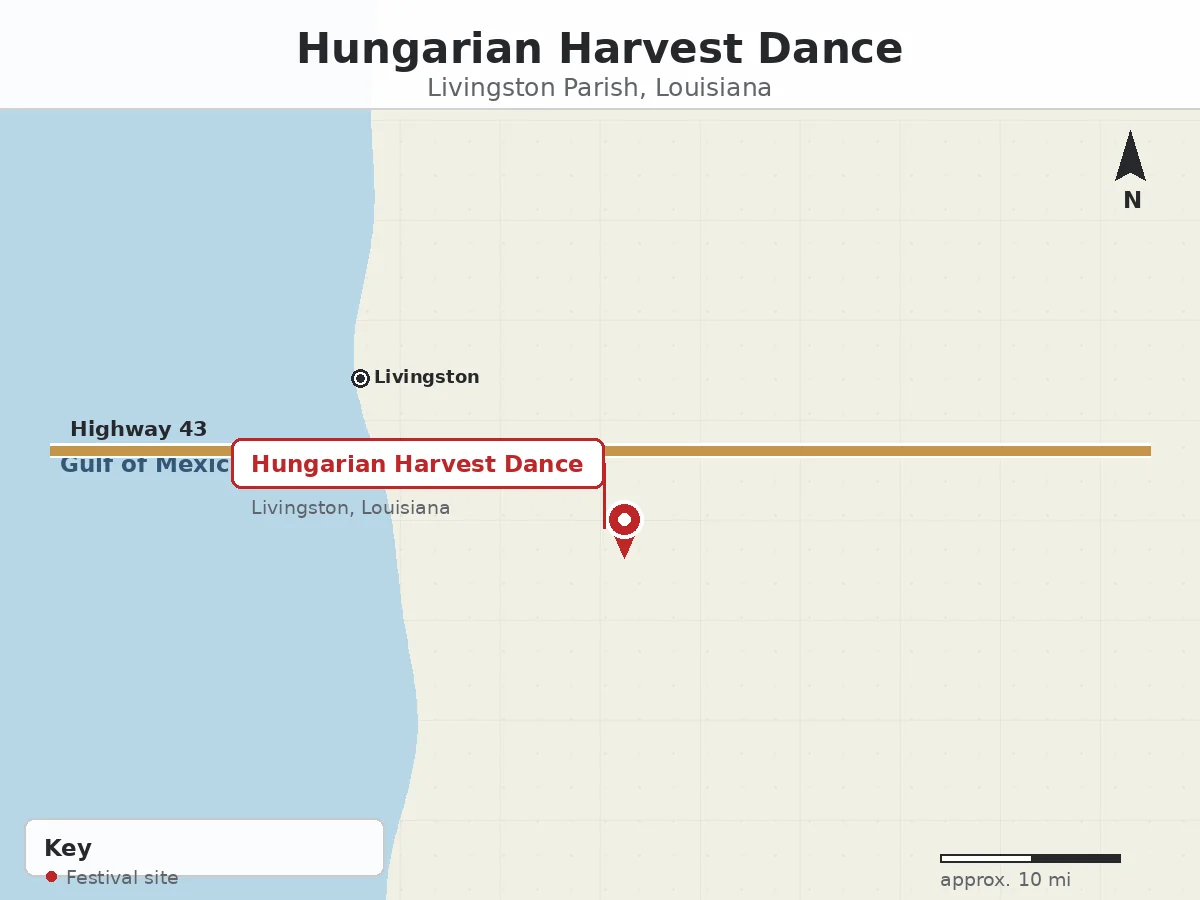
For many years the dance was held at the American Legion Hall in Springfield, on Highway 43. The 2025 edition moved to the Springfield Fire Station, with doors at four in the afternoon and dancing from seven in the evening. Visitors sit close to the dancers in a hall where everyone can see the floor.
Hungarian Settlement is a rural community near Albany, and the dance is held in Springfield, a neighbouring town. Neither is the parish seat; the seat of Livingston Parish is the town of Livingston.
For a useful comparison, see the Livingston Parish Louisiana Spring Festival for another county festival.
The organiser’s own site layer and a regional magazine layer both place the dance on the first Saturday of October each year. Two dated editions are documented: Saturday 3 October 2009, doors at half past five in the evening at the American Legion Post on Highway 43, and Saturday 4 October 2025, doors at four in the afternoon at the Springfield Fire Station, dancing from seven in the evening.
The only admission price documented is twelve dollars for adults, belonging to the 2009 edition as printed in a state magazine layer. No current figure is documented, so no present-day price is given here. Visitors should check the year’s arrangements with the association before the evening.
Quick Facts
| Detail | Information |
| Event name | Hungarian Harvest Dance |
| Catalogue title | Livingston Parish Louisiana Hungarian Harvest Dance Festival |
| Host community | Hungarian Settlement, near Albany |
| Dance town | Springfield |
| Parish seat | Livingston |
| Venue | American Legion Hall, Springfield, on Highway 43; Springfield Fire Station in 2025 |
| Organiser | Árpádhon Hungarian Settlement Cultural Association |
| Usual timing | First Saturday of October |
| Dated editions | Saturday 3 October 2009; Saturday 4 October 2025 |
| Admission | Twelve dollars for adults in 2009; no current figure documented |
History
The history of the dance begins with the history of Hungarian Settlement itself. The settlement, first known as Árpádhon, was established near Albany in 1896 by three immigrant farmers, according to a regional magazine layer. According to the organiser’s own site layer, the tradition began in the very early years of the settlement and became an annual event by 1921. That date is recorded here as printed; it is not a founding year for the festival as a whole, and no founding year is claimed.
The early decades were a time of hard work and careful preservation. The founding farmers and the families who followed them kept Hungarian language and customs alive far from the country they had left. After the crops were in, neighbours could meet, eat together, dance, and sing, and the evening gave the year’s labour a communal ending.
Over the decades, the settlement changed. Hungarian faded from daily use, the farms gave way to other work, and the community became part of the wider life of Livingston Parish. Yet the dance continued, kept going by the cultural association as a deliberate act of memory.
The settlement’s story is unusual in Louisiana, where the dominant cultural threads are French, Spanish, African, and Anglo-American. Hungarian Settlement is a reminder that the state’s immigrant history is wider than the familiar stories, and the dance is its most public expression.
Two related events should not be confused with the dance. The first-annual Hungarian Harvest Festival, held 25 to 27 September 2026 at Fayard Field in Springfield, is a new and different event, according to a travel magazine layer, and Hungarian Heritage Day, held in April or May, is a separate association event.
What to Expect
Doors open in the late afternoon: in 2025 at four in the afternoon at the Springfield Fire Station, with dancing from seven in the evening, and in 2009 at half past five at the American Legion Post on Highway 43. Visitors arrive, find seats, greet neighbours, and settle in before the dancing begins. Dinner is served as part of the evening.
The folk dancing is the centrepiece. The dance group performs traditional Hungarian folk dances in red, white, and green costume, and the closeness of the hall means the steps, the music, and the colours are easy to see and hear. It is a community performance in a community hall, and the audience is part of the room.
The dinner is Hungarian in the most direct sense: cabbage rolls, cucumber salad, Hungarian sausage, and homemade bread and pastries. Cabbage rolls, filled and slow-cooked, reward a community kitchen, and the sausage and the bread carry the flavours of the old country. Cucumber salad offers a cool counterpoint to the rich main dishes, and the homemade pastries end the meal on a sweet note.
Folk songs run through the evening as well, connecting the dancing and the dinner into a single cultural evening. The songs are Hungarian folk songs, sung in a hall where many know the melodies even if they no longer speak the language. A wine auction and a raffle round out the programme and support the association’s work.
The atmosphere is warm and unhurried. There is no midway, no carnival rides, and no long row of vendor booths. The pleasures are the dancing, the dinner, the songs, and the company, and the small scale is the point.
Planning Your Visit
Springfield is a small town on Highway 43, and a visit to the dance is best planned as a quiet evening trip. The dance is held on the first Saturday of October, with doors opening in the late afternoon, so visitors should arrive by mid-afternoon. The venue has changed before, from the American Legion Hall on Highway 43 to the Springfield Fire Station in 2025, so confirm the year’s venue with the association before travelling.
Parking and seating are community-hall matters rather than festival-ground logistics. The halls hold a gathered crowd, but neither is a large arena, and arriving early is the best way to secure a good seat near the dance floor. Groups should arrive together, since seating is informal.
The dinner is part of the evening, and visitors should arrive hungry. The Hungarian meal of cabbage rolls, cucumber salad, Hungarian sausage, and homemade bread and pastries is served to the crowd.
The only admission figure documented is twelve dollars for adults, belonging to the 2009 edition, and no current figure is documented, so visitors should not assume a price. The wine auction and the raffle are separate from admission, and visitors who wish to take part should bring cash.
A Sample Itinerary
A good visit begins in the early afternoon. Arrive in Springfield by mid-afternoon and take a short drive along Highway 43 to get a feel for the town. Stop at a local spot for a coffee or a cold drink, then head to the venue by late afternoon and confirm the doors time for the year.
Once inside, find seats with a clear view of the dance floor. Before the dancing begins, greet neighbours, look over the raffle items, and settle in. When dinner is served, enjoy the cabbage rolls, the cucumber salad, the Hungarian sausage, and the homemade bread and pastries, and take time over the meal.
When the dancing begins, at seven in the evening in the 2025 edition, give the dance group your full attention. The folk dances in red, white, and green costume are the centrepiece of the night. Stay for the wine auction and the raffle, and consider taking part as a way of supporting the association.
A Comparison
Compared with the large parish fairs and food festivals of south Louisiana, the Hungarian Harvest Dance is a small and focused event. A parish fair fills a fairground with rides, livestock shows, and a midway, and a food festival fills a street with vendor booths and stages. The dance fills a single hall with a dance floor, a dinner table, and a crowd that knows one another, and its pleasures are cultural rather than commercial.
Compared with other cultural celebrations in Livingston Parish, the dance stands out for its specificity. The parish’s fall and spring festivals in Denham Springs celebrate the antique district and the changing seasons. The dance celebrates a single immigrant community and its traditions, and its Hungarian dinner and folk dancing have no parallel elsewhere in the parish.
Compared with Hungarian heritage events elsewhere in the United States, the Springfield dance is notable for its longevity and its setting. Many Hungarian-American communities hold harvest dances and cultural days, but few trace their tradition to a settlement founded in 1896 by three immigrant farmers.
Checklist
- Confirm the year’s venue before travelling, since the dance has used both the American Legion Hall on Highway 43 and the Springfield Fire Station
- Plan to arrive in Springfield by mid-afternoon on the first Saturday of October
- Arrive early enough to secure seats with a clear view of the dance floor
- Bring cash for the wine auction and the raffle
- Check the year’s admission arrangements with the association in advance, since no current figure is documented
- Arrive hungry for the Hungarian dinner of cabbage rolls, cucumber salad, Hungarian sausage, and homemade bread and pastries
- Do not confuse the dance with the first-annual Hungarian Harvest Festival at Fayard Field or with Hungarian Heritage Day in the spring
Beyond the Dance
The dance is the most visible expression of Hungarian Settlement’s heritage, but the settlement’s story extends beyond a single evening. The community near Albany, first known as Árpádhon and established in 1896 by three immigrant farmers, is a reminder of the many small immigrant settlements that shaped Louisiana. The cultural association works through the year to keep that heritage alive, and Hungarian Heritage Day in the spring is another of its occasions, separate from the October dance.
The parish around Springfield offers its own quiet attractions. Livingston Parish is a place of pine woods, small towns, and slow rivers, and a visit to the dance pairs well with an afternoon exploring the area. For visitors who enjoy food traditions, the Hungarian dinner is a rare chance to taste a cuisine that is uncommon in Louisiana, cooked by the community itself.
Why the Dance Matters
The dance matters because it keeps a small and specific heritage alive in a place where it could easily have disappeared. Hungarian Settlement was founded by three immigrant farmers in 1896, and the dance became an annual event by 1921. More than a century later, it still gathers the community on the first Saturday of October, still dresses its dancers in red, white, and green, and still serves the food of the old country.
The dance also matters as a piece of Louisiana’s wider immigrant history. The state’s story is often told through French, Spanish, African, and Anglo-American threads, and the Hungarian thread is easily overlooked, yet the settlement near Albany is a genuine part of that story, and the dance is its most public expression.
The dance matters, finally, because it is a community evening in the truest sense. It is not organised by a tourism board or a commercial promoter. It is organised by the Árpádhon Hungarian Settlement Cultural Association, held in a community hall or a fire station, and attended by the settlement’s families and their neighbours.
Frequently Asked Questions
What makes the Hungarian Harvest Dance different from other Louisiana festivals?
The dance is a heritage evening for a single immigrant community, Hungarian Settlement, rather than a parish fair or a food festival. Its centrepiece is folk dancing in red, white, and green costume, accompanied by folk songs and a Hungarian dinner, held in a community hall in Springfield rather than on a fairground or a main street.
Is the dance held in the parish seat of Livingston?
No. The dance is held in Springfield, and Hungarian Settlement is a rural community near Albany. Neither is the parish seat; the seat of Livingston Parish is the town of Livingston.
What food is served at the dance?
The layers read describe Hungarian dinners of cabbage rolls, cucumber salad, Hungarian sausage, and homemade bread and pastries. The dinner is a central part of the evening, served to the gathered crowd in the hall.
Can visitors take part in the wine auction and the raffle?
Yes. The wine auction and the raffle are part of the programme, and visitors are welcome to take part. Both support the association’s work, and visitors should bring cash.
What to Expect From the Next Livingston Parish Louisiana Hungarian Harvest Dance Festival
How often is Livingston Parish Louisiana Hungarian Harvest Dance Festival held?
The Hungarian Harvest Dance is held on the first Saturday of October each year. The dance became an annual event by 1921, and the first-Saturday pattern is the guide for the next gathering.
When is the next Livingston Parish Louisiana Hungarian Harvest Dance Festival?
The next gathering should fall on the first Saturday of October, following the annual pattern the layers describe. The venue has changed before, so visitors should confirm the year’s venue and hours with the association before travelling.
Will the dates change?
The first Saturday of October is the pattern the layers describe, and the dated editions sit on that pattern: Saturday 3 October 2009 and Saturday 4 October 2025 were both first Saturdays. The venue and the hours have varied, so the practical details are the part to confirm, while the October timing itself is the steady element.
The Hungarian Harvest Dance is a small evening with a long memory. It began in the very early years of a settlement founded by three immigrant farmers in 1896, became an annual event by 1921, and still gathers in Springfield each first Saturday of October.