Lenoir County North Carolina Agricultural Fair Festival
Every fall, Kinston turns its fairgrounds over to five days of agricultural exhibits, midway rides, cookery contests, and a demolition derby that has drawn crowds for generations. The Lenoir County Agricultural Fair is a working county fair: farm families bring livestock and produce to be judged, children compete in tractor driving and baking, and an all-volunteer association runs the whole show. Its charm is the honest, hands-on character of a fair that has survived dormancy, a move across town, and a change of hands, and still opens its gates each autumn in the county seat.

About the Fair
The Lenoir County Agricultural Fair is held yearly each fall at the Lenoir County Fairgrounds in Kinston, the county seat of Lenoir County. The fair’s own pages describe it as five days of fair fun, with rides, exhibits, and entertainment for all people. The current event is operated and managed by the all-volunteer Lenoir County Fair Association, whose legal form appears on the Association’s own derby paperwork as Lenoir County Fair Association, Incorporated. The shorter name Lenoir County Fair appears on the fair’s own ticketing page and news headlines, while the full form is the name on the fair’s own site and in the state agriculture department’s fair list.
Kinston has been the county seat of Lenoir County since the county’s formation in 1791, and the fair belongs to Kinston: the grounds, the volunteers, and the exhibitors are local, and the programme is built around the county’s farms, schools, and kitchens. The fair runs Tuesday through Saturday in its modern shape, and its season sits at the turn from September into October, so some years it opens in late September and others in early October.
Quick Facts
| Item | Detail |
| Event | Lenoir County Agricultural Fair, a five-day fall county fair |
| Location | Lenoir County Fairgrounds, 401 Fairgrounds Road, Kinston, North Carolina 28504 |
| Host town | Kinston, county seat of Lenoir County since 1791 |
| Operator | Lenoir County Fair Association, an all-volunteer body |
| Season | Fall, late September to early October |
| 2026 dates | October 6 to October 10, 2026 |
| 2025 dates | September 30 to October 4, 2025 |
| Admission | No gate price published in the fair’s own pages |
| Daily hours | Not published in the fair’s own pages |
| Camping | No camping offer documented for the fair |
History
The fair’s own history begins with roots as deep as 1915, when the Chamber of Commerce formed the first Kinston Fair Association. The Great Kinston Fair was created first as a regional fair and included ten counties: Lenoir, Jones, Onslow, Pender, Wayne, Greene, Duplin, Carteret, Pitt, and Craven. It stood on fourteen acres rented from the Abbott Farm about a mile out of town going toward Goldsboro, in the area today known as Fairfield because it was the site of the Kinston fair for many years. That regional beginning is told here exactly as the fair’s own pages tell it, not as a founding year for the present event.
The Great Kinston Fair continued for several years before becoming dormant in the 1920s, which is why no unbroken run can honestly be claimed. It was revived in the early 1950s by the Lenoir County Jaycees, who ran it near Summit Avenue until 1963, when property was purchased at the present location of 401 Fairgrounds Road. The Jaycees created the Lenoir County Fair Association in the 1970s as their members aged out, and the two bodies co-managed the property and the fair until 2010, when the Jaycees ceased to exist and all property passed to the Association. The fair is now managed by that all-volunteer Association, whose members visitors meet at the gates, in the halls, and around the derby arena.
For a useful comparison, see the Lee County North Carolina Regional Fair Festival for another county festival.
Two age billings sit side by side in the record and are left unreconciled. A magazine feature called the fair a 110-year-old tradition in its September 2025 layer and a 111-year-old tradition in its 2026 update, both counting from the 1915 roots. Because the fair’s own history records a dormancy in the 1920s, neither billing sustains an uninterrupted annual run, and no edition number for any year is published by the fair itself. A 2006 press account described the Association as running the fair since 1971, a detail that does not sit neatly against the fair’s own account of a 1970s creation and shared management, and the two wordings are left standing. The fair’s own news layer was active in 2023, but no 2023 dates were published in a fair-side source, so none are supplied here.
What to Expect
Exhibits and Competitions
Agricultural exhibits and competitions are the fair’s backbone. The exhibit halls hold art, handicrafts, produce, and baked goods, and the cookery layer runs through the week: cake and cookie baking from the fair’s own contest list, and a casserole cook-off counted among the fair’s fixtures by a magazine feature. In the 2026 fair week, the Chamber calendar fences a Casserole Cookoff to October 7, with entry from half past five to six in the evening and a direction to look for the red, white, and blue balloons. A talent show for county school kids and a cheer competition give local children and school squads a stage of their own.
The Midway and the Animal Barn
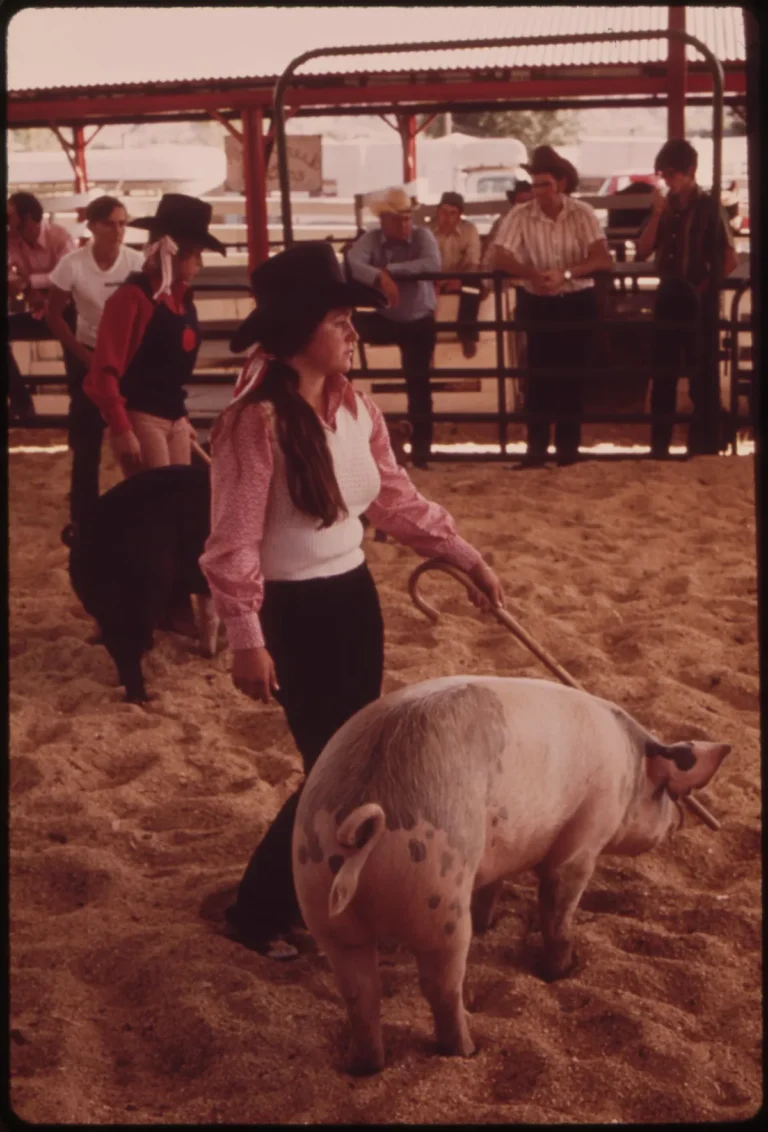
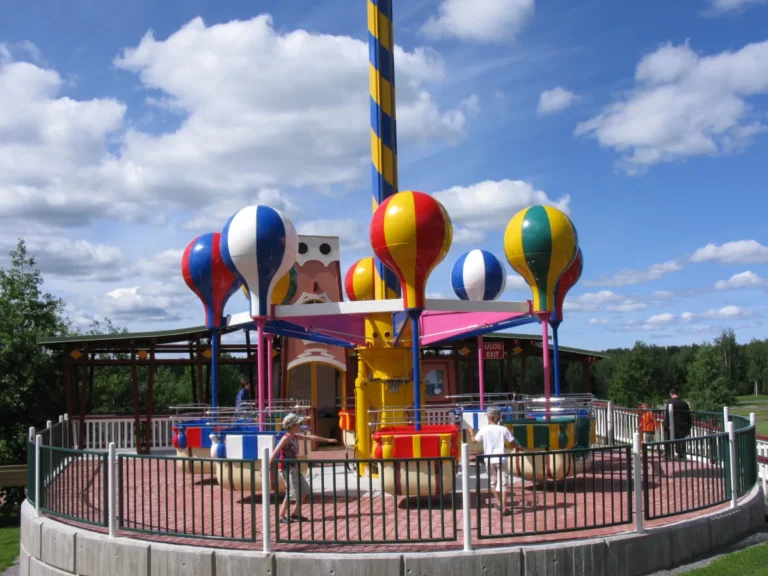
The midway carries the amusement rides, and the Animal Barn carries the livestock presence that makes this a county fair rather than a carnival. Horses, sheep, ducks, geese, turkeys, and cattle are penned there during the fair, and the barn is where farm families meet visitors who may never have stood beside a show animal. The grounds also hold a Commercial Exhibit Hall and midway rentals, and the demolition derby takes place in a concrete-clad arena. Live music runs through the week; a magazine description of the fair’s musical character traces rootsy country in the 1940s and 1950s, beach and soul in the 1960s and 1970s, and a present-day mix, a character sketch rather than a named lineup for any year.
Contests, Music, and the Derby
The contest list on the fair’s own homepage names tractor driving, the demolition derby, cake and cookie baking, and the Diaper Derby. The youth tractor-driving contest helps promote tractor safety on and off the farm, a practical, skills-based event that separates a county fair from a midway alone. The demolition derby is a generations-long fixture, and the fair’s own 2025 registration form fences that year’s derby to October 4, 2025, with classes for youth four-cylinder, full size, adult four-cylinder, Power Wheels, and V6 compact cars, belonging to 2025 only. No parade or pageant is documented for this fair, and none is described as part of its programme.
Planning Your Visit
Getting There
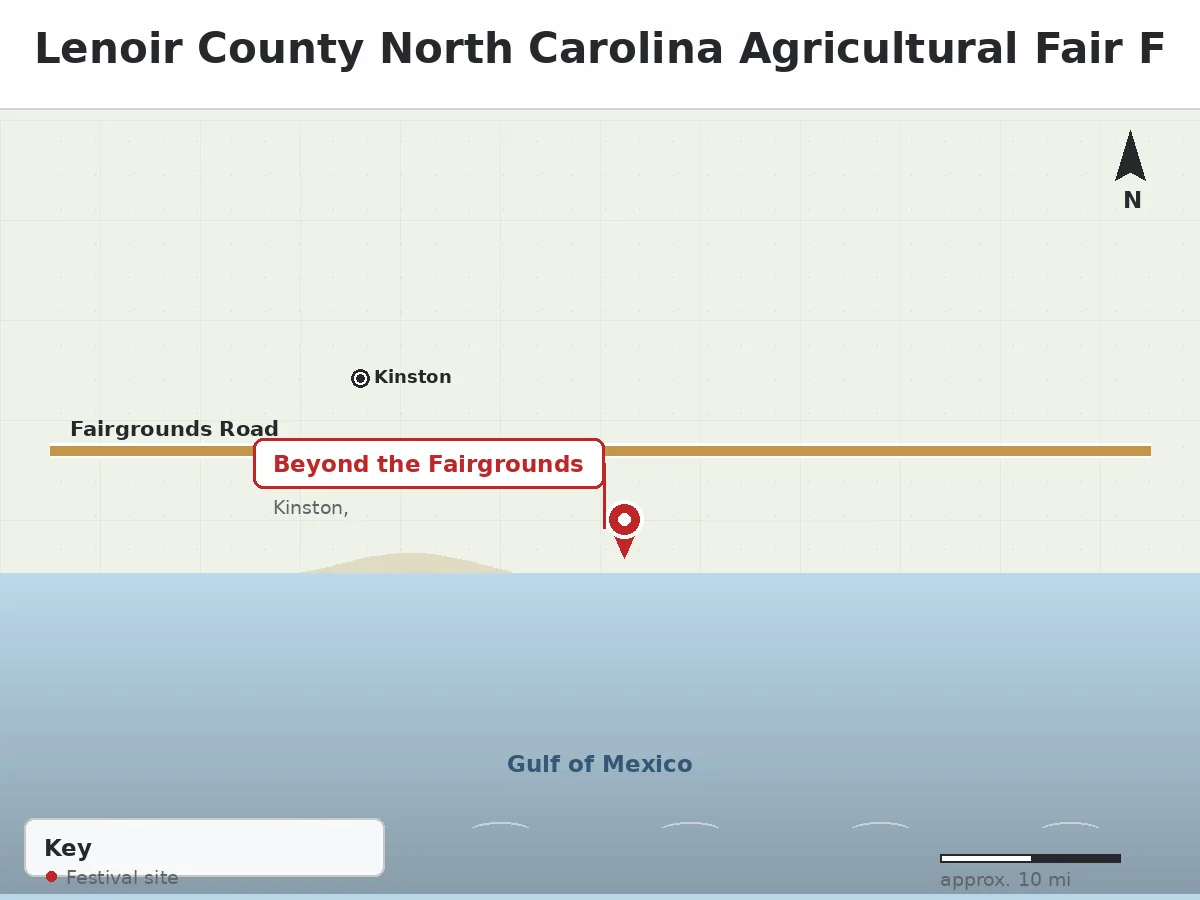
The fairgrounds stand at 401 Fairgrounds Road, Kinston, North Carolina 28504, just off NC 11 South. The fair’s own pages publish the address in both a shortened form and the spelled-out form used here. The present site was purchased in 1963 after the fair’s run near Summit Avenue, and the historic Abbott Farm site near Fairfield is history, never the current grounds. The Association’s mailing address in a nonprofit directory, and the separate livestock arena address in an older entry packet, are neither one the venue.
Admission and Money
The honest practical point comes first: no gate price appears in the fair’s own homepage, About page, or ticketing page, so this article states no admission figure and does not describe the fair as free. A state newsletter’s fairs roundup carried a cost line against the Lenoir entry, but its two-column layout interleaves neighbouring items and no fair-side source corroborates it, so it is not treated as the fair’s price. A places listing’s machine-written summary is likewise not a published price ladder. The fair’s own homepage sells ride wristbands online, but no wristband price appears in its own pages, and wristbands are a ride purchase, never gate admission. An older entry packet for affiliated livestock shows set exhibitor fees per animal, but those shows do not take place at the fairgrounds. Parking terms are likewise unpublished, so no parking price or free-parking claim is made here.
Making the Most of Five Days
Daily opening hours are not published in the fair’s own pages either, and secondary listings disagree with each other, so no daily hours are printed here. The fair’s dates are firm while its daily clock is not documented in its own pages, so plan around the five-day shape: slow walks through the halls, an unhurried Animal Barn visit, and good time allowed for the closing-day derby crowd.
A Sample Day at the Fair
A full day might begin in the exhibit halls, where the baking, produce, and handicraft competitions show what county kitchens and workshops produced. From there, the Animal Barn gives the livestock side of the fair its weight. The afternoon belongs to the midway and to the youth contests, where the tractor-driving competition and the cheer squads show the fair’s school and farm roots. The evening belongs to the derby arena when the derby is on the card, and to live music and the midway lights after dark. The shape is unhurried: linger in the halls and the barn rather than racing from ride to ride.
How It Compares
The fair’s own history invites one comparison, between the fair it began as and the fair it is now. The Great Kinston Fair of 1915 was a regional fair spanning ten counties on rented farmland outside town, built for farm families from across eastern North Carolina. The present fair is a county fair on its own purchased grounds in Kinston, run by county volunteers, with the same agricultural spine but a smaller, steadier footprint. What survived is the point: the exhibits, the livestock, the cookery, and the derby outlasted the regional scale, the dormancy, and the move. A ten-county regional fair needed rented acres and a chamber of commerce to launch it; a five-day county fair needs volunteers, exhibit halls, and a fairgrounds it owns. The fair feels both old and local at once because its roots are regional but its present life is unmistakably Lenoir County’s.
Visitor Checklist
- Check the year’s dates, since the fair moves between late September and early October
- Expect a five-day, Tuesday-through-Saturday shape built around exhibits, the barn, and the derby
- Do not rely on gate prices or daily hours in secondary listings; the fair’s own pages publish neither
- Remember that no camping offer is documented, so overnight stays are a separate arrangement
- Keep the derby’s year in mind: the 2025 derby’s classes and date belong to 2025 alone
Beyond the Fairgrounds
Kinston itself rewards a visit beyond the fairgrounds. The county seat since 1791, Kinston holds the fair’s story in its streets: Fairfield marks where the original fair stood, and the present fairgrounds off NC 11 South mark where the fair settled in 1963. The fair’s own history also names the ten counties of the original regional fair, a reminder that Kinston once drew farm families from across the coastal plain. A visitor who walks the town after the fair will find the same agricultural county the fair celebrates. The fairgrounds’ other year-round uses are separate from the fair.
Why It Matters
The Lenoir County Agricultural Fair matters because it is still, after a dormancy and a revival, a fair run by the people it serves. An all-volunteer association keeps the gates open, the halls judged, and the derby arena full, and the fair’s own pages measure recent attendance in averages of over fourteen thousand across the week. County fairs have faded when their volunteer base thinned or their grounds were sold; this fair’s survival through dormancy, revival, and a 2010 handover says something about a community that kept choosing to stage it. For a visitor, the fair offers a direct encounter with a working agricultural county: livestock judged in a barn, cakes judged in a hall, children driving tractors for safety’s sake, and cars meeting in a concrete arena. It is not nostalgia staged for tourists. It is a county showing its work.
Frequently Asked Questions
Where exactly is the Lenoir County Agricultural Fair held?
The fair is held at the Lenoir County Fairgrounds, 401 Fairgrounds Road, Kinston, North Carolina 28504, just off NC 11 South. Kinston is the county seat of Lenoir County and hosts the fair. The historic Abbott Farm site near Fairfield is not the current grounds, and neither the Association’s mailing address nor the separate livestock arena address is the fairgrounds.
Why does the fair publish no gate price in its own pages?
No gate price, age ladder, or free-admission statement appears in the fair’s own homepage, About page, or ticketing page, so no admission figure is stated in this article and the fair is not described as free. Ride wristbands sold online are a separate ride purchase with no price published in the fair’s own pages.
Does the fair run every year without a break?
No unbroken run is claimed. The fair’s own history records roots in 1915, a dormancy in the 1920s, and a revival in the early 1950s, and magazine billings of a 110-year-old tradition in 2025 and a 111-year-old tradition in 2026 both count from those roots across the dormancy. No edition number is published by the fair itself, and none is calculated here.
Is overnight camping part of the fair?
No camping, recreational vehicle, or overnight-stay offer is documented for the fair in its own pages, its derby form, the state fair list, or the chamber calendar layers. The fair is a five-day fairground event, and any overnight stay is a separate arrangement, never a fair offer.
What to Expect From the Next Lenoir County North Carolina Agricultural Fair Festival
How often is the Lenoir County North Carolina Agricultural Fair Festival held?
The fair is held yearly each fall, in the fair’s own words, as a five-day event running Tuesday through Saturday. Its season sits at the turn from September into October, so the exact dates move from year to year within that window.
When is the next Lenoir County North Carolina Agricultural Fair Festival?
The most recent documented editions are September 30 to October 4, 2025, and October 6 to October 10, 2026. No later edition’s dates are published in the fair’s own pages in the record used here, so confirm the next edition’s dates against the fair’s own announcement when it appears.
Will the dates change?
Yes, in the ordinary sense: the fair’s dates already move within its fall window, from late September in 2025 to early October in 2026, and the five-day Tuesday-through-Saturday shape is the standing pattern rather than a fixed date. Check the year’s dates rather than assuming last year’s.
The Lenoir County Agricultural Fair endures because a county keeps staging it: volunteers run the halls, farm families fill the barn, children learn tractor safety in a contest, and the derby closes the week in a concrete arena. Come for the exhibits, stay for the derby, and leave understanding why a five-day fall fair still matters to the county seat that hosts it.