Knox County Maine North Atlantic Blues Festival
The blues arrive in Rockland each July with a straightforward promise: two days of music on the waterfront, played loud enough to carry across the harbor and loose enough to spill onto Main Street after dark. The North Atlantic Blues Festival has kept that promise since 1994, when Paul Benjamin founded it, and the gathering has grown into one of the town’s best-known summer weekends without losing its shape. Fifteen or more blues artists take the stage across the two days, the Public Landing fills with listeners, and Saturday night moves indoors for a club crawl along Main Street. This guide explains what the festival is, how it has changed, and how to plan a visit around it.
About the Festival
The North Atlantic Blues Festival is a two-day blues gathering held in mid-July in Rockland, on the waterfront of Penobscot Bay. Its published name is printed exactly as the sheet title, with no variant forms seen in the layers read. The festival’s home is the Public Landing and Harbor Park, a stretch of open ground beside the working harbor where the stage, the crowd, and the water sit close together. Rockland itself is the seat of Knox County, so visitors arriving for the music are already standing in the town that serves as the county’s seat of government.
Paul Benjamin founded the festival in 1994, and the organiser’s own layer presents him as its founder-organiser. Later layers describe the gathering as a long-running Rockland institution, and that description fits: more than thirty years after its first edition, the festival still follows the same two-day mid-July pattern, still books fifteen or more blues artists, and still ends its Saturday with a club crawl on Main Street. The organiser’s own layer prints attendance of fifteen to sixteen thousand in a 2020 statement, a figure that gives a sense of the weekend’s scale without overstating what the record supports.
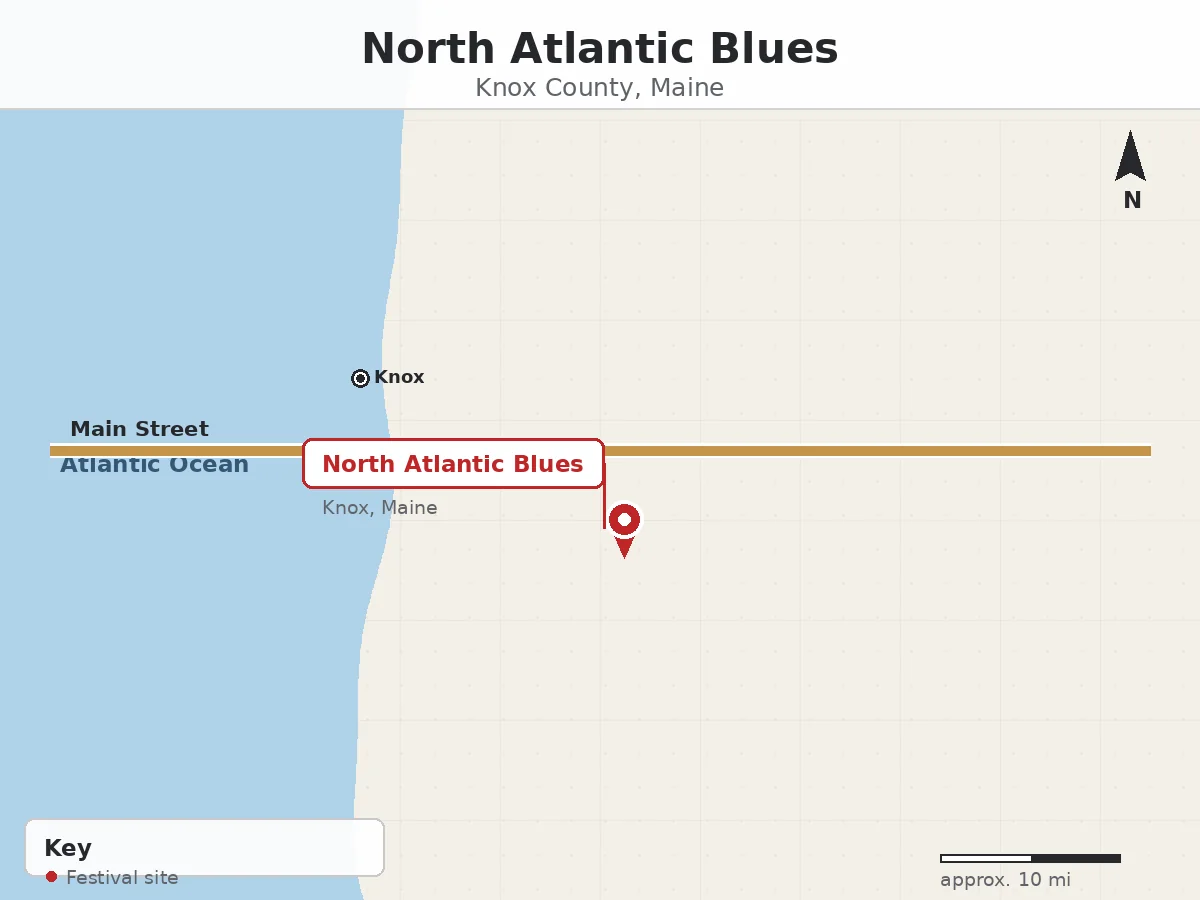
What sets the festival apart is its compactness. Everything happens within a short walk: the waterfront stage at the Public Landing, the Harbor Park grounds, and the Main Street clubs that host the Saturday-night crawl. A visitor can hear a full afternoon of sets, wander the harbor, and finish the night in a club without ever needing a car.
Quick Facts
| Item | Detail |
| Festival | North Atlantic Blues Festival |
| Host town | Rockland, Knox County |
| County seat | Rockland serves as the seat of Knox County |
| Venue | The Public Landing and Harbor Park on the Rockland waterfront |
| Founded | 1994 |
| Founder | Paul Benjamin |
| Usual timing | Two days in mid-July |
| Most recent edition | 11–12 July 2026 |
| Next edition | 17–18 July 2027, as printed by the organiser |
| Admission | No organiser figure found; a travel-guide layer prints sixty dollars at the gate and one hundred dollars for a weekend pass, with no year attached |
History
The festival began in 1994, when Paul Benjamin founded it in Rockland. The organiser’s own layer is the source for both the year and the founder, and no other founding-year claim appears in the layers read. From that start, the gathering settled into a mid-July rhythm that has held for decades: two days of blues on the waterfront, with the Saturday-night club crawl on Main Street as the weekend’s second act. The layers describe it as a long-running Rockland institution, and the span of dated editions in the record supports that description.
For a useful comparison, see the Knox County Maine Maine Lobster Festival for another county festival.
The one break in the run came in 2020, when the edition was cancelled for COVID-19. The organiser’s own layer documents the cancellation, and the festival returned afterward to its usual July pattern. The 2025 edition ran 12–13 July, according to a real-estate blog layer, and the 2026 edition followed on 11–12 July, printed by the organiser’s own layer and a music-listing layer. Looking ahead, the organiser’s own layer prints 17–18 July 2027 as a future edition, so the calendar already reaches beyond the most recent gathering.
Little about the festival’s shape has changed across those years: the same venue, the same two-day pattern, and the same Saturday-night crawl.
What to Expect
A visit to the North Atlantic Blues Festival means two days of live blues beside the harbor. The stage at the Public Landing carries the main programme, with fifteen or more artists appearing across the weekend. Sets run through the afternoon and into the evening, and the crowd gathers on the open ground of Harbor Park, where the music competes only with the sound of the working waterfront. The atmosphere is closer to a town gathering than to a fenced-off concert ground, and listeners drift between the stage, the harbor edge, and the food and drink vendors nearby.
Saturday night changes the shape of the weekend. After the waterfront sets end, the festival moves onto Main Street for its club crawl, with music continuing inside the town’s clubs and bars. The crawl is part of the organiser’s own description of the programme, and it gives the second day a different texture from the first: the open-air listening of the afternoon gives way to the smaller rooms and closer crowds of the evening. A visitor who plans around both halves of the weekend gets the fullest version of the festival.
Sunday carries the second day of waterfront music, usually at a gentler pace than Saturday, and the weekend closes with the final sets at the Public Landing.
Planning Your Visit
Rockland in mid-July is a working harbor town at the height of summer, so plan for warm days, cool evenings off the water, and crowds on the waterfront. The festival’s venue is the Public Landing and Harbor Park, both on the harbor, and Main Street runs a short distance inland from the water. Arriving early in the day gives the best choice of listening spots on the open ground, and the afternoon sets are the heart of the programme.
Admission needs a careful note. No organiser-layer admission figure was found in the layers read, so there is no published gate figure from the festival itself to quote. A travel-guide layer prints a gate figure of sixty dollars and a weekend pass figure of one hundred dollars, but that layer attaches no year to the figures, and they are a guide-layer figure only, not a current gate price. Anyone planning a budget should check the organiser’s own layer for the current edition before travelling, rather than treating the guide-layer figures as settled.
Rockland’s size works in a visitor’s favour. The town is small enough to cross on foot, the waterfront and Main Street sit close together, and the festival’s two halves — the open-air stage and the club crawl — are both reachable without a car. Staying in town puts the whole weekend within walking distance, and the harbor setting means that even the time between sets has something to look at.
Sample Itinerary
Shape a two-day stay around the festival’s own rhythm. On Saturday, arrive at the Public Landing in the late morning and settle in on the Harbor Park grounds for the afternoon sets, when the stage carries the bulk of the day’s artists. Between sets, walk the harbor edge and the nearby streets, then return to the stage for the evening music as the light fades over the water. When the waterfront programme ends, follow the crowd onto Main Street for the club crawl, moving between clubs for the rest of the night.
On Sunday, come back to the Public Landing for the second day of music, which runs at a steadier pace than Saturday. The afternoon sets are the main draw, and the open ground fills again with listeners. A slower morning in town, a look at the harbor, and an afternoon at the stage make a fitting close to the weekend, with the final sets bringing the gathering to an end.
Comparison
Rockland hosts more than one large summer gathering, and the blues festival is easy to confuse with its neighbours if the dates are not kept straight. The Maine Lobster Festival uses the same town and the same waterfront area, but it is a different event: a five-day lobster celebration in early August, built around lobster dinners, a parade, and a coronation, where the blues festival is a two-day music gathering in mid-July. The two share a venue area and a town, not a programme.
The Resurgam Music and Arts Festival is another Rockland music event that appears on concert-listing layers, and it is likewise a different event from the blues festival, with its own dates and its own shape. Rockland’s calendar carries several music gatherings across the summer, and the North Atlantic Blues Festival is the one built around two days of blues at the Public Landing, with the Saturday club crawl on Main Street.
Checklist
- Check the organiser’s own layer for the current edition’s dates and admission before travelling.
- Arrive early on Saturday for the best listening spots on the Harbor Park grounds.
- Bring layers for cool harbor evenings after warm afternoons.
- Plan for the Saturday-night club crawl on Main Street after the waterfront sets end.
- Keep Sunday open for the second day of music at the Public Landing.
- Remember that the guide-layer ticket figures carry no year and are not a current gate price.
- Do not confuse the festival with the Maine Lobster Festival or the Resurgam Music and Arts Festival.
Beyond the Festival
Rockland rewards a visitor who stays past the last set. The working waterfront is the town’s centre, with fishing boats, ferries, and the harbor itself a short walk from the festival grounds. Main Street runs inland from the water with shops, galleries, and places to eat, and the town’s compact size makes it easy to explore on foot between sets. The festival’s own setting — the Public Landing and Harbor Park — sits at the meeting point of the harbor and the town, so the walk from the stage to Main Street is part of the weekend’s texture.
For a longer stay, the wider Knox County coast offers the same combination of harbor towns and open water that brings visitors to Rockland in the first place.
Significance
The North Atlantic Blues Festival matters to Rockland because it has lasted. Founded in 1994 by Paul Benjamin, it has run for more than three decades, surviving the 2020 cancellation and returning to its mid-July pattern without changing its shape. The organiser’s own layer prints attendance of fifteen to sixteen thousand in a 2020 statement, and the festival’s description in later layers as a long-running Rockland institution reflects that staying power.
Its significance is also musical. A two-day gathering built around fifteen or more blues artists, with a Saturday-night club crawl that carries the music onto Main Street, gives the town a summer weekend that belongs to the blues rather than to any single headliner. The festival’s steadiness — the same venue, the same timing, the same two-day shape — is what has made it a fixture, and the 2027 dates already printed by the organiser suggest that fixture will continue.
Frequently Asked Questions
How does the Saturday club crawl fit into the weekend?
The club crawl is the Saturday-night half of the festival. After the waterfront sets at the Public Landing end, the music moves onto Main Street, where clubs and bars host performances through the evening. It is part of the organiser’s own description of the programme, and it gives Saturday a different character from the open-air listening of the afternoon.
What do the guide-layer ticket figures actually mean?
A travel-guide layer prints a gate figure of sixty dollars and a weekend pass figure of one hundred dollars, but it attaches no year to those figures. They are a guide-layer figure only, and they are not treated as a current gate price. No organiser-layer admission figure was found in the layers read, so anyone budgeting for a visit should check the organiser’s own layer for the current edition.
Why does the festival skip a year in its record?
The 2020 edition was cancelled for COVID-19, according to the organiser’s own layer. That cancellation is the only break in the run documented in the layers read. The festival returned afterward to its usual mid-July pattern, with the 2025 edition on 12–13 July and the 2026 edition on 11–12 July.
How is this gathering different from Rockland’s lobster weekend?
The Maine Lobster Festival is a different event that shares the same town and the same waterfront area. It is a five-day lobster celebration in early August, built around lobster dinners, a parade, and a coronation. The blues festival is a two-day music gathering in mid-July, built around fifteen or more blues artists and a Saturday-night club crawl. The venue area is shared; the programme is not.
What to Expect From the Next Knox County Maine North Atlantic Blues Festival
How often is Knox County Maine North Atlantic Blues Festival held?
The festival returns each summer for a two-day weekend in mid-July. The dated editions in the record follow that pattern: 12–13 July in 2025 and 11–12 July in 2026, with the next edition printed for 17–18 July 2027. The only break documented in the layers read is the 2020 cancellation.
When is the next Knox County Maine North Atlantic Blues Festival?
The organiser’s own layer prints 17–18 July 2027 as the next edition. That is the future date in the record, and it follows the festival’s usual mid-July timing. Visitors should confirm the dates with the organiser’s own layer as the edition approaches, since the record carries no later announcement.
Will the dates change?
The dates have shifted by a day or two from year to year within mid-July: 12–13 July in 2025, 11–12 July in 2026, and 17–18 July 2027 as printed for the next edition. A visitor planning a trip should check the organiser’s own layer for the current edition rather than assuming the previous year’s dates will repeat exactly.
The North Atlantic Blues Festival has kept its shape for more than thirty years: two days of blues on the Rockland waterfront, fifteen or more artists, and a Saturday night that moves onto Main Street. The 2027 dates are already printed, the venue is unchanged, and the town that hosts it is the same one that has hosted it since Paul Benjamin founded it in 1994. For anyone who loves the blues, mid-July in Rockland remains the weekend to plan around. Plan around it, and the weekend rewards the effort.