Kenton County Kentucky River Valley Viking Festival
For one late summer weekend in two thousand twenty-six, the Kenton County Fairgrounds in Independence, Kentucky, are documented as the setting for a gathering built around steel weapons, a living-history encampment, thrown axes and spears, a mead hall, and a new contest to crown a champion. The event is published simply as the River Valley Viking Festival, and every layer gathered for this record prints that shorter name. No source prints the longer county-prefixed title used as this article’s heading, so treat that heading as a filing label rather than the festival’s own billing.
What the record supports is precise but narrow. A single edition, running from Friday the twenty-first of August to Sunday the twenty-third of August in two thousand twenty-six, is documented in full by the organiser-side festival page, and the same weekend is corroborated by a city magazine layer and by a regional newspaper layer published in July of that year. Earlier editions are only thinly attested: passing references from two thousand twenty-five describe the event as an annual Kentucky festival, and a state festival-guide layer carries an asterisked listing whose date the guide itself marks as unconfirmed. This article therefore describes that edition in detail and says plainly, everywhere else, what the layers do not establish.
About
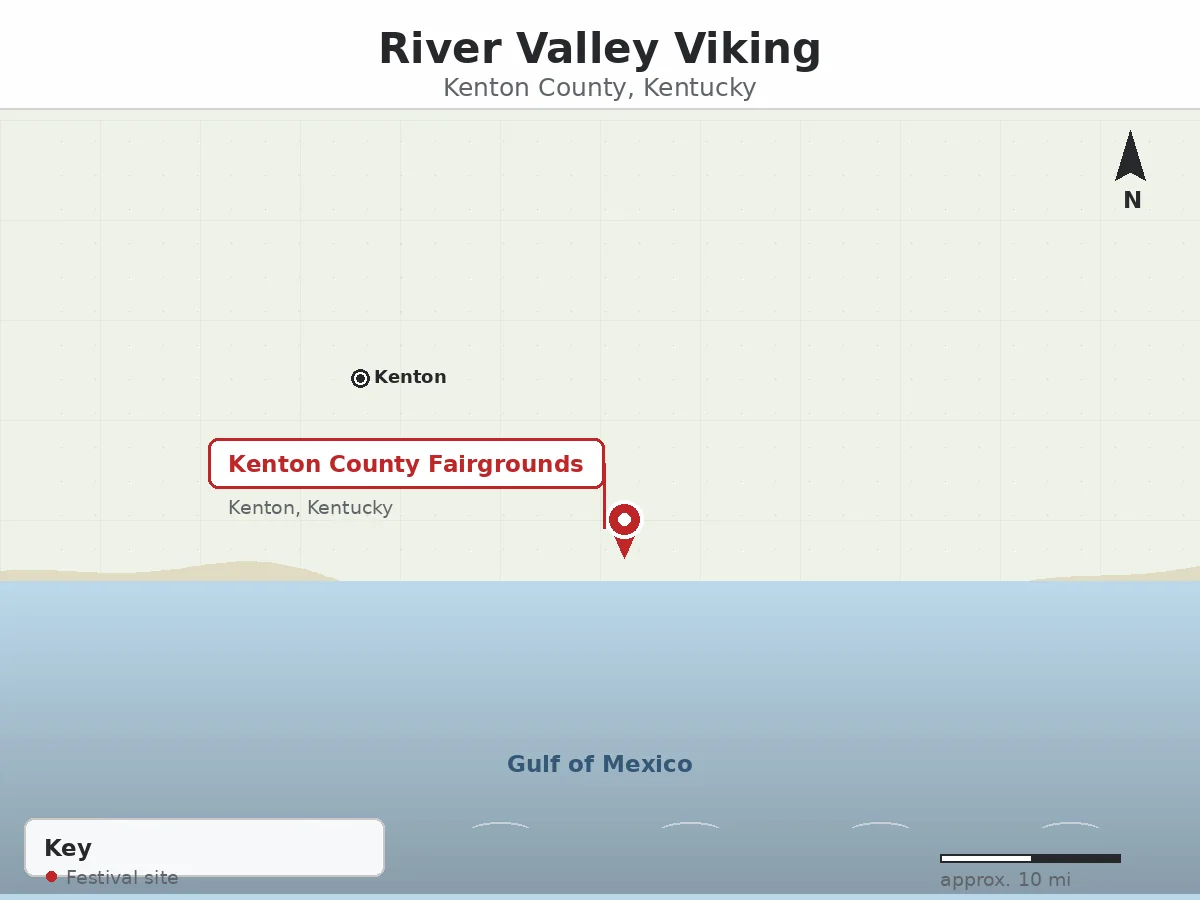
The organiser-side event map shortens the published name to the abbreviation RVVF. The host town is Independence, in Kenton County, in northern Kentucky. Independence carries a long civic standing in the county: a towns-and-villages reference layer records it as a county seat of Kenton County from eighteen forty, first as a co-seat, and as the sole official seat since the twenty-fourth of November two thousand ten. The venue is the Kenton County Fairgrounds in Independence, a setting named consistently by the organiser-side festival page, by the city magazine layer, and by the regional newspaper layer. Those layers print a street address for the fairgrounds, noted here by existence only and not reproduced.
The organiser picture is deliberately left unmerged, because the layers give it in separate forms. The festival page is hosted on the website of a historical Viking re-enactment organisation, which the record does not name, and the page centres on the Vatnsdal Vikings, a living-history group described there as local to Northern Kentucky and Cincinnati. A ticketing-platform layer, meanwhile, lists the two thousand twenty-six event under the Kenton County Fair Association and names Crowder Media and Merchandise as its information source. These forms sit side by side in the record; no single incorporated organiser is asserted, and the re-enactment group stands as the human centre of the event as documented.
Quick Facts
| Item | Detail |
| Published name | River Valley Viking Festival, shortened to RVVF on the event map |
| Host town | Independence, Kenton County, Kentucky |
| Venue | Kenton County Fairgrounds |
| Documented edition | Friday the twenty-first to Sunday the twenty-third of August, two thousand twenty-six |
| Friday hours | Four in the evening to nine in the evening |
| Saturday hours | Eleven in the morning to seven in the evening |
| Sunday hours | Ten in the morning to six in the evening |
| Admission | Ticketed; ticket prices vary by day, age, and group size |
| Central group | Vatnsdal Vikings living-history group |
| Signature contest | Ultimate Viking Challenge, whose winner is named Drengr of RVVF |
History
Anyone looking for a founding story will have to accept an honest gap. No layer read for this record states a founding year for the River Valley Viking Festival, and no layer makes a first-edition claim, so none is offered here. The documentary trail begins, in practical terms, with the fully described two thousand twenty-six edition. Before that, the evidence is fragmentary. Passing references dating from two thousand twenty-five describe the event as an annual Kentucky festival, which suggests a recurring gathering, but those references are not tied to any dated edition and are not relied on here as proof of one. A state festival-guide layer lists River Valley Viking Festival – Independence for the twentieth to the twenty-second of August with an asterisk, and the guide’s own convention marks that date unconfirmed. The listing is consistent with an earlier edition falling in late August, yet no year is hung on it and it is not merged with the confirmed two thousand twenty-six dates.
For a useful comparison, see the Kenton County Kentucky St. Cecilia Labor Day Festival for another county festival.
The one genuinely new development the record does identify belongs to two thousand twenty-six itself. The festival page frames the Ultimate Viking Challenge as launching this year, meaning the two thousand twenty-six edition, so the contest that ends with a winner named Drengr of RVVF is presented by its own organisers as a fresh addition rather than a long-standing tradition. Beyond that launch, the layers support no claims about the festival’s beginnings, and this article invents none.
What to Expect
Combat sits at the top of the documented programme. The organiser-side festival page describes combat demonstrations with steel weapons performed by the Vatnsdal Vikings and friends, with battle tactics reviewed from historical sources, so the fighting is presented as studied reconstruction rather than improvised theatre. Beside the field stands a living-history encampment housing a museum: replica pieces are displayed alongside actual Viking-age finds, and the encampment includes a recreation of a Viking grave, a quieter, object-based counterweight to the demonstrations.
Participation runs through the rest of the day. The page lists spear and axe throwing, a keg toss sponsored by a local brewery, and a tug-of-war against the Viking crew, so spectators can test themselves against the re-enactors rather than only watching them. Children get their own set piece in a kids-versus-Vikings sword and water-balloon fight. The Ultimate Viking Challenge, new in two thousand twenty-six, gives the weekend a competitive spine, with its winner named Drengr of RVVF. A mead hall run by a local meadery pours for the grounds, food trucks feed the crowd, a printed vendor list covers artisan sellers, and music acts perform, including a band on the main stage. A city magazine layer’s weekend picks for the same three days add costume contests, a kids area, and games to the picture, and vendor applications were open for the two thousand twenty-six edition.
Planning Your Visit
Admission is the first thing to get right, because the record gives a rule rather than a number. A city magazine layer states that ticket prices vary by day, age, and group size, which confirms the event is ticketed, but no layer read prints a specific price, and no figure is asserted here. Families should therefore expect pricing to depend on which day they attend and who is in their party, and should confirm current prices through the festival’s own channels before setting a budget. Vendor arrangements, which the record also mentions, are a separate matter from gate admission and say nothing about what a visitor pays to enter.
The shape of the weekend rewards a little planning. Friday is an evening-only session, running from four in the evening to nine in the evening, while Saturday is the longest day, from eleven in the morning to seven in the evening, and Sunday runs from ten in the morning to six in the evening. The regional newspaper layer of July two thousand twenty-six confirms both the fairgrounds venue and the twenty-first to twenty-third of August weekend, so the dates rest on more than the organisers’ own page. The festival page also links to further information and a vendor application download; those routes exist, though their content is not reproduced here.
A Sample Itinerary
A Friday arrival suits visitors who want atmosphere first. Gates open at four in the evening, leaving time to walk the encampment, study the museum pieces and the recreated grave, and then take in an evening combat demonstration before the nine o’clock close. Saturday, the long day, can carry the participatory programme: axe and spear throwing in the morning, the tug-of-war and keg toss around midday, the Ultimate Viking Challenge as the afternoon builds, and the main-stage music before the seven o’clock finish. Sunday’s ten-to-six span fits a family pace, with the kids-versus-Vikings fight, the kids area and games noted by the city magazine layer, and a final unhurried pass through the vendor rows before the grounds close. None of this is a published schedule; it is a sensible arrangement of documented elements across the documented hours.
How It Compares
Two neighbouring events appear in the record only to be fenced out of it, and the contrast is instructive. The Fenrir Viking Festival at Eminence is listed in the same state festival guide, which makes the two Kentucky Viking festivals easy to confuse, yet they are different events in different towns, and nothing from the Eminence record is used here. The Ohio Renaissance Festival enters the layers only because the city magazine layer invokes it as a comparison, not because it has any organisational connection to Independence. Against those names, the River Valley Viking Festival’s documented identity rests on narrower, more specific ground: a single county fairgrounds, a named living-history group at its centre, a museum mixing replicas with actual Viking-age finds, and a contest invented, on the record, in two thousand twenty-six. Its scale is harder to judge, because only one edition is fully documented.
Visitor Checklist
- Confirm the current ticket prices for your day and party size before travelling
- Note that Friday is evening-only, from four to nine
- Give Saturday the longest programme, since it runs eleven to seven
- Watch at least one steel-weapon combat demonstration by the Vatnsdal Vikings
- Walk the encampment museum to see replica pieces beside actual Viking-age finds
- Find the recreation of a Viking grave inside the encampment
- Try the spear and axe throwing, the keg toss, or the tug-of-war
- Catch the Ultimate Viking Challenge and the naming of the Drengr of RVVF
- Bring the children to the sword and water-balloon fight and the kids area
- Stop at the mead hall and the food trucks between events
Beyond the Festival Grounds
Independence itself is part of the story. A town that has held county-seat status in Kenton County since eighteen forty, first sharing the role and then, since the twenty-fourth of November two thousand ten, holding it as the sole official seat, gives the fairgrounds weekend a civic backdrop older than the festival by well over a century. The Vatnsdal Vikings, described on the festival page as local to Northern Kentucky and Cincinnati, anchor the event in its own region rather than importing its character from elsewhere, and the regional newspaper layer’s meadery feature, which confirmed the fairgrounds weekend, points to the same local craft culture that supplies the mead hall. The layers gathered here describe the town’s civic role more fully than its attractions.
Why It Matters
The significance of the River Valley Viking Festival, as far as the record allows one to judge, lies in the seriousness of its living history. Battle tactics reviewed from historical sources, actual Viking-age finds placed where families can study them, and a grave recreated as an exhibit all point to re-enactment treated as public education rather than costume play. A county fairgrounds is a fitting stage for that ambition, because it puts the material in front of a general audience rather than a specialist one. The launch of the Ultimate Viking Challenge in two thousand twenty-six also shows an event still inventing its own traditions, which is a healthy sign in a festival whose earlier history is only thinly documented.
Frequently Asked Questions
Which weekend in August two thousand twenty-six is fully documented?
The edition documented in full runs from Friday the twenty-first of August to Sunday the twenty-third of August, two thousand twenty-six, at the Kenton County Fairgrounds in Independence, with the organiser-side festival page supplying the particulars and a city magazine layer and a regional newspaper layer corroborating the same weekend.
What happens inside the living-history encampment?
The encampment houses a museum in which replica pieces are displayed alongside actual Viking-age finds, and it also contains a recreation of a Viking grave, so visitors can move from the combat field to close study of the objects.
Do ticket prices stay the same for every visitor?
On the record, no. A city magazine layer states that ticket prices vary by day, age, and group size, which means the amount depends on when you attend and who is admitted with you. No layer read prints a specific figure, so none can be quoted here.
What does the winner of the Ultimate Viking Challenge earn?
The winner is named Drengr of RVVF. The challenge itself is documented as launching in two thousand twenty-six, the year of the fully described edition, so its first champion belongs to that edition on the organiser-side page’s own framing.
What to Expect From the Next Kenton County Kentucky River Valley Viking Festival
How often is Kenton County Kentucky River Valley Viking Festival held?
Passing references from two thousand twenty-five describe the event as an annual Kentucky festival, and the two thousand twenty-six edition is fully documented, but the record gathered here firmly establishes only that single dated edition. An annual rhythm is suggested by the layers rather than proven by a run of dated programmes.
When is the next Kenton County Kentucky River Valley Viking Festival?
The layers read for this record carry no date for an edition after the twenty-first to the twenty-third of August, two thousand twenty-six. The asterisked guide listing for the twentieth to the twenty-second of August is unconfirmed and is not assigned to any year here, so anyone planning ahead should watch for an announcement rather than rely on that listing.
Will the dates change?
They could, and the record itself shows why caution is warranted: a state festival-guide layer prints one set of August dates with an asterisk marking them unconfirmed, while the organiser-side page documents a different, confirmed weekend for two thousand twenty-six. Dates should be treated as settled only when the festival’s own page carries them without qualification.
Closing
The River Valley Viking Festival arrives in the record as one vivid, well-attested weekend: steel combat and studied tactics, an encampment museum with genuine finds, thrown axes, a tug-of-war against the crew, a mead hall, and a new champion named Drengr of RVVF, all at the Kenton County Fairgrounds in Independence. Its past is thinly documented and its founding is unrecorded, and this article has left those gaps exactly as the layers leave them. What is documented is enough: a living-history group from Northern Kentucky and Cincinnati building a festival that treats the Viking age as something to demonstrate, handle, and argue with, rather than merely to dress up as.