Juneau City and Borough Alaska Celebration Festival
Every second June, downtown Juneau fills with drumming, regalia and song as Celebration brings Tlingit, Haida and Tsimshian people together in Alaska’s capital city. The event’s own name is simply Celebration, and its organiser, Sealaska Heritage Institute, describes it as the largest gathering of Tlingit, Haida and Tsimshian peoples in the world and as one of the largest cultural events in Alaska. Unlike most festivals, it does not return every year: Celebration follows a biennial pattern, arriving in early June of even-numbered years. The Institute explains that the gathering follows the pattern of a traditional ceremonial, while stressing that it is not a potlatch and not a memorial party. Entry is by ticket, with four-day passes and daily admission sold for each edition, and crowds measured in the thousands make it a landmark on the Juneau calendar.
About Celebration
Celebration is presented by Sealaska Heritage Institute, often shortened to Sealaska Heritage or SHI. One Institute release describes the organisation as a private nonprofit founded in 1980 to perpetuate and enhance Tlingit, Haida and Tsimshian cultures of Southeast Alaska, while another Institute layer characterises it as a non-profit tribal organization founded in 1980. A reference source calls the Institute the non-profit cultural arm of Sealaska Corporation, though the corporation is the parent body rather than the organiser of the event itself. Juneau hosts the gathering in its downtown core. The City and Borough of Juneau is a consolidated city-borough, a unified municipality in which Juneau serves as the borough seat while also holding the separate role of Alaska’s state capital. Performances and gatherings spread across several nearby venues, most of them within a few blocks of one another, so the whole of downtown becomes the festival ground for a few days.
Quick Facts
| Item | Detail |
| Event’s own name | Celebration |
| Organiser | Sealaska Heritage Institute |
| Location | Downtown Juneau, City and Borough of Juneau, Alaska |
| Frequency | Held every two years, in early June of even-numbered years |
| Duration | Billed by the Institute as a four-day festival; a reference source describes a five-day program of activities |
| First held | 1982 |
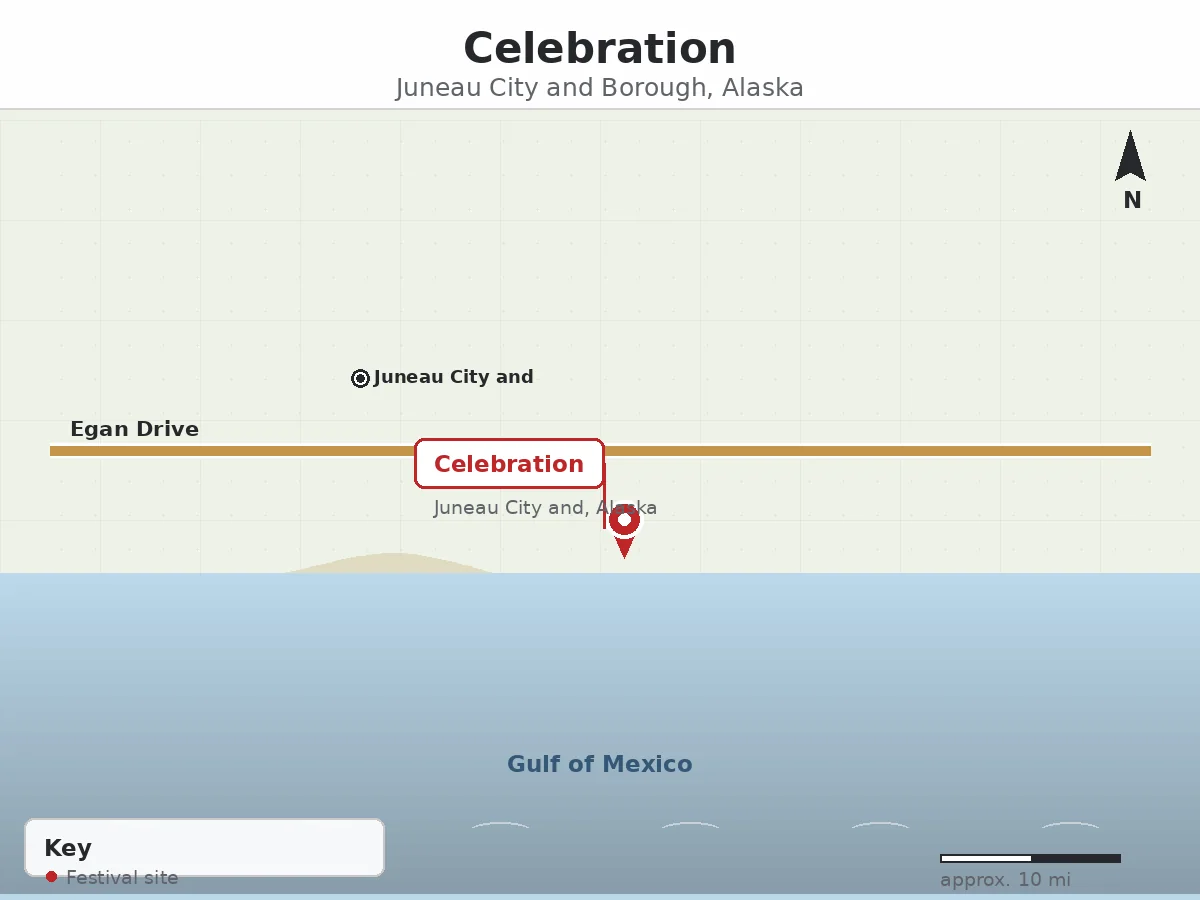
| Main venue | Centennial Hall, 101 Egan Drive |
| Other venues | Elizabeth Peratrovich Hall, the Sealaska Heritage Arts Campus, and the Walter Soboleff Building |
| Cultures honoured | Tlingit, Haida and Tsimshian |
| Admission | Ticketed; four-day passes and daily tickets, with children ages six and under admitted free |
History
The first Celebration took place in 1982, when the fledgling Sealaska Heritage Institute staged a dance-and-culture festival so that Native elders could pass songs and dances on to younger generations. The Institute’s own history recalls that a couple of hundred Native people gathered in Juneau for that first edition, a modest beginning beside the thousands who attend now. Growth in the years since has been considerable, and a study by the McDowell Group measured the economic impact of Celebration 2012 at two million dollars. The pandemic interrupted the in-person pattern in 2020, when Celebration was held virtually only, and the June 2022 edition became its first in-person gathering in four years. That 2022 festival carried the theme Celebrating 10,000 years of cultural survival, and a newspaper account billed it as marking the festival’s 40-year anniversary. During the same edition, the Sealaska Cultural Values Totem Pole, described as the first 360-degree totem pole in Alaska, was unveiled in Juneau. The most recent edition ran from June 3 to June 6, 2026, under the theme Enduring Strength, with the Institute’s kickoff release describing it as marking 44 years since the inception of the popular dance-and-culture festival. The lead dance group in 2026 was Lepquinm Gumilgit Gagoadim Tsimshian Dancers, whose name translates as Our Own Dance in Our Hearts, a multigenerational group from Anchorage formed in 2005.
What to Expect
The emotional centre of Celebration is dance. The programme opens with a Grand Entrance of the assembled dance groups and closes with a Grand Exit, and between those two bookends the halls host days of dance performances. Reported figures for 2026 vary by source: the Institute spoke of about 5,000 people including more than 2,000 dancers, one local news outlet counted more than 1,800 dancers from 34 dance groups, and the visitor authority, looking ahead to 2028, described over 1,600 dancers representing more than 35 dance groups. A Juried Art Show and Competition anchors the visual arts side of the programme; the show began in 2002, and contemporary art was recognised as its own category from the second show onward. Young artists exhibit in the Juried Youth Art Exhibit, while the Toddler Regalia Review presents the smallest dancers in their regalia; an earlier form of that review was called the Baby Regalia Review when it started in 2006. An Indigenous Fashion Show, film screenings, poetry gatherings and canoe racing round out the schedule, alongside workshops covering Tlingit, Haida and Tsimshian language, Northwest Coast art and regional cultures. Food contests celebrate Indigenous ingredients, including soapberry and black seaweed competitions. The Native Artist Market runs under strict eligibility rules: participating artists must be members of federally recognised tribes meeting the Indian Arts and Crafts Act of 1990, or Tlingit, Haida or Tsimshian Canadian citizens. On the day before opening, traditional canoes arrive carrying over one hundred paddlers, and in 2026 the whole edition was also carried on local television and by webcast for those who could not attend.
Planning Your Visit
Because Celebration comes around only once every two years, travel and lodging in Juneau deserve attention well ahead of time. The headline venue is Centennial Hall at 101 Egan Drive, the main and largest facility. Elizabeth Peratrovich Hall, about two blocks away, offers a more intimate setting and sits along Willoughby Avenue, although no street number for the hall is published in the sources. The Sealaska Heritage Arts Campus, likewise two blocks from Centennial Hall, hosts the Native Artist Market. The Institute’s 2026 venue list also named the Walter Soboleff Building, the Arts Campus plaza, the Juneau Arts and Humanities Council, and the Alaska State Libraries, Archives and Museum. The Institute itself is based at 105 Heritage Way in downtown Juneau, which is its office address rather than a performance venue. Tickets are sold as four-day passes or as daily admission. At the prices the Institute published for 2026, a four-day pass cost thirty-five dollars for general admission, twenty dollars for youth ages seven to twelve, and twenty dollars for elders ages sixty-five and over, while children ages six and under entered free. Daily admission was twenty dollars general, ten dollars for youth and ten dollars for elders, again with the youngest children free. Passes were sold at the Sealaska Heritage Store on the Monday and Tuesday before opening, after which daily tickets and passes were available only at Centennial Hall and Elizabeth Peratrovich Hall. The Institute’s wording that everyone is welcome to attend and that the event is open to the public describes who may come, not a free-admission policy, so visitors should budget for tickets.
For a useful comparison, see the Haines Borough Alaska Beer Festival for another county festival.
A Sample Celebration Itinerary
The day before opening
Reach Juneau in time for the canoe arrival, when traditional canoes bring over one hundred paddlers into the city ahead of the opening day. Use the afternoon to collect passes, walk between the downtown venues, and settle into the neighbourhoods around Centennial Hall and the Arts Campus.
Opening day
The Institute’s release scheduled the Grand Entrance for 5 p.m. on Wednesday, June 3, 2026, at Centennial Hall, when the dance groups process in together. One local news account instead described the Grand Entrance procession as beginning at Elizabeth Peratrovich Hall, moving along Willoughby Avenue and ending at Centennial Hall; the two route descriptions are recorded side by side rather than reconciled, so check the current programme on the day.
The middle days
Divide the middle days between dance performances in the halls, the Native Artist Market at the Arts Campus, the juried art exhibitions, and a workshop on language or Northwest Coast art. Fit in the fashion show, a film screening and the food contests, and leave gaps simply to watch regalia move through the downtown streets.
Closing day
The Grand Exit was scheduled for 5 p.m. on Saturday, June 6, 2026, closing the edition as the groups process out together. Keep the final afternoon uncommitted so the closing ceremony, rather than a departure deadline, ends the trip.
How Celebration Compares
Most large festivals ask their audience to plan annually, but Celebration’s two-year cycle changes the calculation: miss an edition and the wait for the next one is measured in years, not months. Its scale also sets it apart, since the Institute presents it as the largest gathering of Tlingit, Haida and Tsimshian peoples in the world. Even basic descriptions of the event come in layers that are best kept separate. The Institute consistently bills a four-day festival, while a reference source describes a five-day program of activities, and neither wording is merged into the other here. Attendance reporting is layered in the same way, with the Institute’s roughly 5,000 people and more than 2,000 dancers for 2026 standing alongside a local count of more than 1,800 dancers from 34 groups. Celebration also differs from a ceremonial gathering in the strict sense: it follows the pattern of a traditional ceremonial, yet the Institute is explicit that it is not a potlatch or a memorial party, and that distinction shapes how visitors should understand what they are witnessing.
Celebration Planning Checklist
- Book Juneau lodging early, because the festival returns only every second year
- Decide between a four-day pass and daily tickets before you arrive
- Buy passes at the Sealaska Heritage Store on the Monday or Tuesday before opening
- Allow time to watch the canoe arrival on the day before the festival opens
- Be in place ahead of the Grand Entrance on opening day
- Set aside an unhurried visit for the Native Artist Market at the Arts Campus
- Check the workshop listings for language and Northwest Coast art sessions
- Keep the final afternoon free for the Grand Exit procession
Beyond the Festival Halls
Downtown Juneau stays part of the experience between sessions. The venues stand within a few blocks of one another, so a walk from Centennial Hall to the Sealaska Heritage Arts Campus takes visitors past the Arts Campus plaza, one of the spaces named in the Institute’s 2026 venue list. The Alaska State Libraries, Archives and Museum also appeared on that 2026 list, giving the programme a foothold in the state collections building. The Institute’s own home at 105 Heritage Way anchors the organisation in the same downtown blocks year-round, long after the dance groups have gone home. Because Juneau is both the borough seat and the state capital, the government quarter and the festival quarter overlap, and an early June visit doubles as a look at the city in its working role as well as its celebratory one.
Why Celebration Matters
Celebration was founded on an act of transmission: elders passing songs and dances to young people before those teachings could be lost. That purpose still defines the event, from the Toddler Regalia Review at one end of the age range to the multigenerational dance groups that lead the processions. The 2022 theme, Celebrating 10,000 years of cultural survival, states the deeper claim plainly, framing four days of dancing as evidence of cultures that have endured on this coast for millennia. The gathering also carries practical weight for Juneau, whose businesses felt a two-million-dollar impact from the 2012 edition alone, according to the McDowell Group study. For the Tlingit, Haida and Tsimshian communities of Southeast Alaska and beyond, though, the significance is simpler: it is the recurring occasion when the largest gathering of their peoples in the world assembles in one place, dances in public, and hands the repertoire on again.
Frequently Asked Questions
Is Celebration a potlatch?
No. Sealaska Heritage Institute explains that Celebration follows the pattern of a traditional ceremonial, but it is explicit that the festival is not a potlatch and not a memorial party. Visitors should treat it as a public cultural festival built on ceremonial patterns, rather than as a ceremonial occasion itself.
Which dance group leads the 2028 edition?
The Institute has named Ḵéex̱’ Ḵwáan as the lead dance group for 2028. It is a multigenerational group from Kake, and its name translates to Mouth of the Dawn Peoples. In 2026 the lead role was held by Lepquinm Gumilgit Gagoadim Tsimshian Dancers from Anchorage.
Can anyone shop at the Native Artist Market?
The market is open to festivalgoers, but the artists selling there must meet strict eligibility rules. Sellers must be members of federally recognised tribes meeting the Indian Arts and Crafts Act of 1990, or Tlingit, Haida or Tsimshian Canadian citizens. The market is hosted at the Sealaska Heritage Arts Campus, about two blocks from Centennial Hall.
Why did the 2020 edition look different from other years?
The 2020 edition was held virtually only, because of the COVID-19 pandemic. When Celebration returned to Juneau in June 2022, it was the festival’s first in-person edition in four years, and it carried the theme Celebrating 10,000 years of cultural survival.
What to Expect From the Next Juneau City and Borough Alaska Celebration Festival
How often is Juneau City and Borough Alaska Celebration Festival held?
Celebration runs on a two-year cycle, taking place in early June of even-numbered years. It is a biennial event rather than an annual one, so there is no edition in odd-numbered years, and each gathering is separated from the last by a full two years of anticipation and preparation.
When is the next Juneau City and Borough Alaska Celebration Festival?
The next edition is scheduled for June 7 to June 10, 2028, following the 2026 festival that ran from June 3 to June 6. The Institute has already named the lead dance group for 2028: Ḵéex̱’ Ḵwáan, a multigenerational group from Kake whose name translates to Mouth of the Dawn Peoples.
Will the dates change?
The pattern across recent editions is consistent: early June in even-numbered years, with the 2026 dates falling on June 3 to June 6 and the announced 2028 dates on June 7 to June 10. The exact days shift slightly from edition to edition, so the June window is dependable while the precise dates are set by the Institute for each cycle and are best confirmed against its announcements as 2028 approaches.
Celebration rewards the traveller who plans around its two-year heartbeat. It began in 1982 with a couple of hundred people and a determination that elders would teach the young while there was still time, and it has grown into the largest gathering of Tlingit, Haida and Tsimshian peoples in the world. The next chance to stand in Centennial Hall as the Grand Entrance begins comes in June 2028, and on the evidence of every edition so far, it will be worth the wait.