Jefferson County Kentucky Louder than Life Festival
Louisville closes out its summer with one of the largest rock gatherings documented in Kentucky, an event the layers read print under the name Louder Than Life. The sheet title for this article adds a county prefix and a trailing word that no source uses, so the record is best introduced plainly: a multi-stage rock festival in Jefferson County, staged in recent documentation on the Highland Festival Grounds at the Kentucky Exposition Center. What gives the event its weight is a documented arc, running from a two-day debut at Champions Park in the autumn of two thousand fourteen, through a change of home in two thousand nineteen, to a four-day edition in two thousand twenty-six spread across seven stages with nearly two hundred bands. Festival-guide and concert-archive layers carry the modern scale, while reference and contemporary newspaper layers carry the beginnings.
About
Louder Than Life is the published name, printed in that capitalised form across the layers read, and the festival it names belongs to Louisville, the county seat of Jefferson County. Behind the event stand two credits that the sources word differently and that this article keeps apart. Festival-guide and news layers name Danny Wimmer Presents as the producer. Separately, reference and contemporary newspaper layers credit the festival’s creation to Danny Wimmer personally. Both forms are recorded here as printed, since the layers themselves draw that distinction.
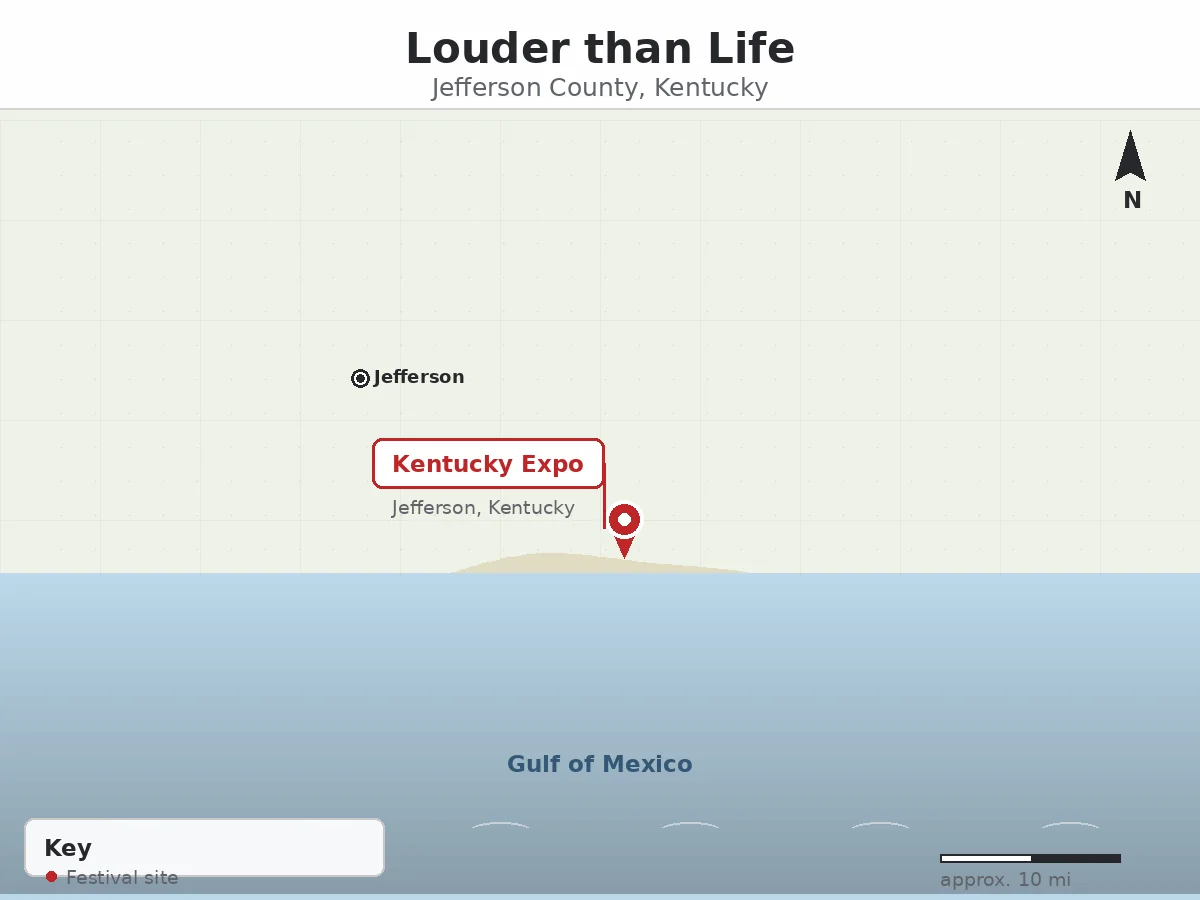
The setting has two chapters. The first editions stood at Champions Park in Louisville, where reference and contemporary newspaper layers place the debut. The current home is the Highland Festival Grounds at the Kentucky Exposition Center, the venue festival-guide and concert-archive layers give for the two thousand twenty-six edition. Admission runs through tickets, as festival-guide and ticket layers describe the event, although no price from any layer is carried in this article. One charge is documented precisely, and it belongs to the journey rather than the gate: the festival’s own parking layer puts daily parking at forty dollars, a parking charge never to be mistaken for the price of entry.
Quick Facts
| Item | Detail |
| Published festival name | Louder Than Life |
| County | Jefferson County, Kentucky |
| Host city | Louisville, the county seat |
| Producer as printed | Danny Wimmer Presents |
| Creation credited to | Danny Wimmer, in reference and contemporary newspaper layers |
| First edition | The fourth to the fifth of October, two thousand fourteen, at Champions Park |
| Debut billing | A music, whiskey and “gourmet man food” festival |
| Venue change | The two thousand nineteen edition moved the festival to the Kentucky Exposition Center |
| Two thousand twenty-six edition | The seventeenth to the twentieth of September, four days on seven stages |
| Present venue | Highland Festival Grounds at the Kentucky Exposition Center |
History
The documented history opens on the fourth and fifth of October in two thousand fourteen, when the first edition stood at Champions Park in Louisville. A reference layer and contemporary newspaper layers agree on that debut, and the contemporary billing is vivid: the event arrived describing itself as a music, whiskey and “gourmet man food” festival, a formula that put guitars, Kentucky whiskey and hearty food on the same poster from the start. Those same layers credit the creation of the festival to Danny Wimmer, and that is the founding statement this article makes, because it is the one the record supports.
The second fixed point in the timeline concerns ground rather than music. A regional newspaper layer records that the edition of the twenty-seventh to the twenty-ninth of September in two thousand nineteen was the one for which the festival moved from Champions Park to the Kentucky Exposition Center, where the modern editions documented in guide and archive layers now stand.
For a useful comparison, see the Jefferson County Kentucky Bourbon and Beyond Festival for another county festival.
Between and around those fixed points, the record is left as the layers present it. The producer credit carried by festival-guide and news layers, Danny Wimmer Presents, sits alongside the personal creation credit without either being rewritten into the other. The two thousand twenty-six edition, documented below, then shows what the festival had become in its exposition center home: a four-day production on seven stages with nearly two hundred bands.
What to Expect
Scale is the first thing the two thousand twenty-six documentation insists on. Festival-guide and concert-archive layers describe an edition running from the seventeenth to the twentieth of September, four days in length, arranged across seven stages and featuring nearly two hundred bands. A bill of that size changes how a day at the grounds feels: at almost any hour, several performances compete for attention, and moving between stages becomes part of the rhythm of attendance.
The top of the bill is set out day by day in those same layers. Iron Maiden headline the Thursday. My Chemical Romance take the Friday. Limp Bizkit lead the Saturday, and Tool close the run on the Sunday. Around and beneath those four names sits the long undercard implied by the overall band count, filling the earlier hours on each stage and rewarding anyone willing to wander rather than stay in one spot.
The flavour of the original billing still colours how the event presents itself. Whiskey and food were not side notes at the debut; the contemporary layers for two thousand fourteen billed them as pillars alongside the music, under the deliberately unpretentious banner of “gourmet man food”. Readers should hold that billing where the record puts it, as a description of the first edition’s pitch, while recognising that the guide and archive layers for two thousand twenty-six concentrate on the music: the stages, the bands and the headliners named above.
Planning Your Visit
Begin with the shape of the weekend rather than with any single band. The two thousand twenty-six edition occupies four consecutive days, Thursday through Sunday, in the middle of September, on the Highland Festival Grounds at the Kentucky Exposition Center in Louisville. Anyone travelling in should treat that full span as the unit of planning, because the headliners are spread across it, one anchoring each day, so a single-day ticket is also a choice about which of the top names matters most.
Entry is ticketed. Festival-guide and ticket layers describe the event on that basis, and ticket routes exist through the festival’s own channels, although this article carries no prices, since none are recorded in the facts behind it. Parking deserves its own line in any budget: the festival’s own parking layer sets daily parking at forty dollars, a charge for leaving a vehicle at the grounds, entirely separate from admission. Ticket and parking contact routes both exist and are noted here by existence only.
Practical habits follow from the documented scale. Seven stages and nearly two hundred bands reward a loose plan: note the headliner for each day, leave the afternoons open for movement between stages, and expect the walk between performances to take real time on grounds of exposition center size. Late September in Louisville also argues for layers of clothing, since a day that begins in warm afternoon sun can end after dark with the headliner still to come.
A Sample Day at the Grounds
A first day built around the Thursday of the two thousand twenty-six edition might start with arrival and orientation, parking the car under the daily arrangement described in the festival’s own parking layer and taking an unhurried circuit of the Highland Festival Grounds to learn where the seven stages sit. The early sets on a bill of nearly two hundred bands are where the wandering happens, with short stops at whichever stage is loudest or least crowded.
By evening, the day narrows to its point. Iron Maiden headline the Thursday, so the late hours belong to the main draw, and a sensible visitor drifts toward that stage well before the closing set. The same pattern repeats with different names across the weekend: My Chemical Romance on the Friday, Limp Bizkit on the Saturday, and Tool bringing the four days to an end on the Sunday, each night offering a natural full stop around which the looser daytime exploring can be arranged.
How It Compares
The closest relative in the record is Bourbon & Beyond, and the comparison needs care, because the two festivals are genuinely separate events that share a great deal of scaffolding. Both stand in Louisville, both are documented on the Highland Festival Grounds in two thousand twenty-six, and the producer’s name runs through both stories. What separates them is emphasis: Louder Than Life is the rock production, documented across seven stages with nearly two hundred bands and headliners drawn from metal and alternative rock, while its sibling is treated under its own title elsewhere in this batch and is not imported here.
A second comparison is internal. Set the Champions Park debut beside the modern edition and the growth is measurable in the record’s own terms: two days against four, a single park site against seven stages on exposition grounds, and a first bill remembered for its whiskey and food slogan against a two thousand twenty-six bill counted in the hundreds of bands. The move documented in two thousand nineteen is the hinge between those two versions.
Checklist
- Decide which days matter most, since each of the four days carries its own headliner
- Arrange tickets through the festival’s own channels before travelling
- Budget separately for daily parking, recorded at forty dollars in the festival’s own parking layer
- Learn the layout of the Highland Festival Grounds on arrival, before the evening sets begin
- Keep afternoons loose for moving between the seven stages
- Carry clothing for both warm afternoons and cooler nights in late September
- Leave time at the end of each night for the headline set rather than arriving at the main stage late
- Remember that similar festival names in other states describe different events, not this one
Beyond the Festival Grounds
Louisville itself frames the trip. The city is the county seat of Jefferson County, and the Kentucky Exposition Center, whose Highland Festival Grounds host the modern festival, is one of its defining large venues, built for gatherings on a scale a park cannot hold. The contrast with Champions Park, where the first editions stood, gives a visitor two different Louisvilles in one story: the park where a two-day experiment in music, whiskey and food began, and the exhibition grounds where its descendant now deploys seven stages.
A traveller with spare time can treat the venue change as a small itinerary, seeing the park that held the debut and then the exposition center that received the festival from two thousand nineteen onward. The record behind this article goes no further than those places and dates; the honest beyond-the-gates story here is the geography of the festival’s own two homes.
Why This Festival Matters
Within the documented record, Louder Than Life matters because its growth is traceable rather than merely asserted. The layers preserve a dated beginning, the fourth and fifth of October in two thousand fourteen; a named creator, credited to Danny Wimmer in reference and contemporary newspaper layers; a producing organisation, Danny Wimmer Presents, carried by festival-guide and news layers; a dated relocation in two thousand nineteen; and a two thousand twenty-six edition whose scale is stated in hard terms of days, stages and bands.
The event also holds a particular place in Jefferson County’s calendar as the rock production among the major festivals staged on the exposition grounds. Its identity stays distinct in the record: a September weekend built around volume and endurance, nearly two hundred bands deep, that began life selling whiskey and “gourmet man food” alongside the music and never entirely lost that appetite.
Frequently Asked Questions
Which acts headline each day of the two thousand twenty-six edition?
Festival-guide and concert-archive layers name Iron Maiden for the Thursday, My Chemical Romance for the Friday, Limp Bizkit for the Saturday and Tool for the Sunday, across an edition running from the seventeenth to the twentieth of September on seven stages with nearly two hundred bands.
How did the festival’s home ground change over its documented life?
Reference and contemporary newspaper layers place the first editions at Champions Park in Louisville, beginning with the debut of the fourth and fifth of October in two thousand fourteen. A regional newspaper layer records that the two thousand nineteen edition moved the festival to the Kentucky Exposition Center, where the two thousand twenty-six edition stood on the Highland Festival Grounds.
Is parking part of the ticket, or is it charged on its own?
It is charged on its own. The festival is ticketed, as festival-guide and ticket layers describe it, while the festival’s own parking layer sets daily parking at forty dollars. That forty dollars buys parking for a day at the grounds; it is not the price of admission, and no ticket prices are carried in this article.
Who stands behind the festival in the published record?
Two credits appear, and they are kept separate here as the layers print them. Festival-guide and news layers name Danny Wimmer Presents as the producer, while reference and contemporary newspaper layers credit the festival’s creation to Danny Wimmer personally.
What to Expect From the Next Jefferson County Kentucky Louder than Life Festival
How often is Jefferson County Kentucky Louder than Life Festival held?
The layers consulted document dated editions in two thousand fourteen, two thousand nineteen and two thousand twenty-six, with the modern edition placed in the middle of September. That spread shows the festival returning across the years rather than appearing once, and the recent documentation fixes its rhythm to a four-day September run.
When is the next Jefferson County Kentucky Louder than Life Festival?
The most recent edition documented in the record is the one of the seventeenth to the twentieth of September in two thousand twenty-six, at the Highland Festival Grounds. The sources behind this article print no date beyond that edition, so a future visitor should watch the festival’s own channels for the next announcement rather than rely on any date guessed here.
Will the dates change?
They could. The documented editions sit in different parts of the early autumn, with the debut in October in two thousand fourteen and the later editions in September, and the move between venues shows the organisers willing to change fundamentals as the festival grows. Anyone planning around a future edition should confirm the dates afresh each year.
Closing
Louder Than Life earns its place in the Jefferson County record on documented evidence: a Louisville debut in two thousand fourteen under a billing of music, whiskey and “gourmet man food”, a creation credited to Danny Wimmer, production carried by Danny Wimmer Presents, a move to the Kentucky Exposition Center in two thousand nineteen, and a two thousand twenty-six edition of four days, seven stages and nearly two hundred bands. Held to what the layers actually say, that is a complete story, needing nothing added to it.