Graves County Kentucky Wingo Trade Day Festival
In the small community of Wingo, in the western Kentucky county of Graves, one Saturday each June belongs to a gathering that has been drawing neighbours, sellers and visitors together for generations. The sheet title above calls it the Graves County Kentucky Wingo Trade Day Festival, yet no layer in the research record prints that full form, and none adds the word Festival to the event’s name at all. What the sources actually publish is simpler: Wingo Trade Day, in a state transportation bulletin, a local newspaper layer and a festival-guide layer, with one travel-blog layer printing the plural form Wingo Trade Days. That difference is kept visible throughout this article. A state agency bulletin, a local newspaper report and several listing layers cover four separate years, from two thousand twenty-two through two thousand twenty-five, and they agree on the essentials: the Wingo Lions Club hosts and sponsors the day, a state highway through town closes for it, and the programme mixes a parade with vendors, yard sellers, food trucks and amusements. Only one listing breaks ranks, placing the two thousand twenty-six edition in April rather than June, and that conflict is carried openly below.
About
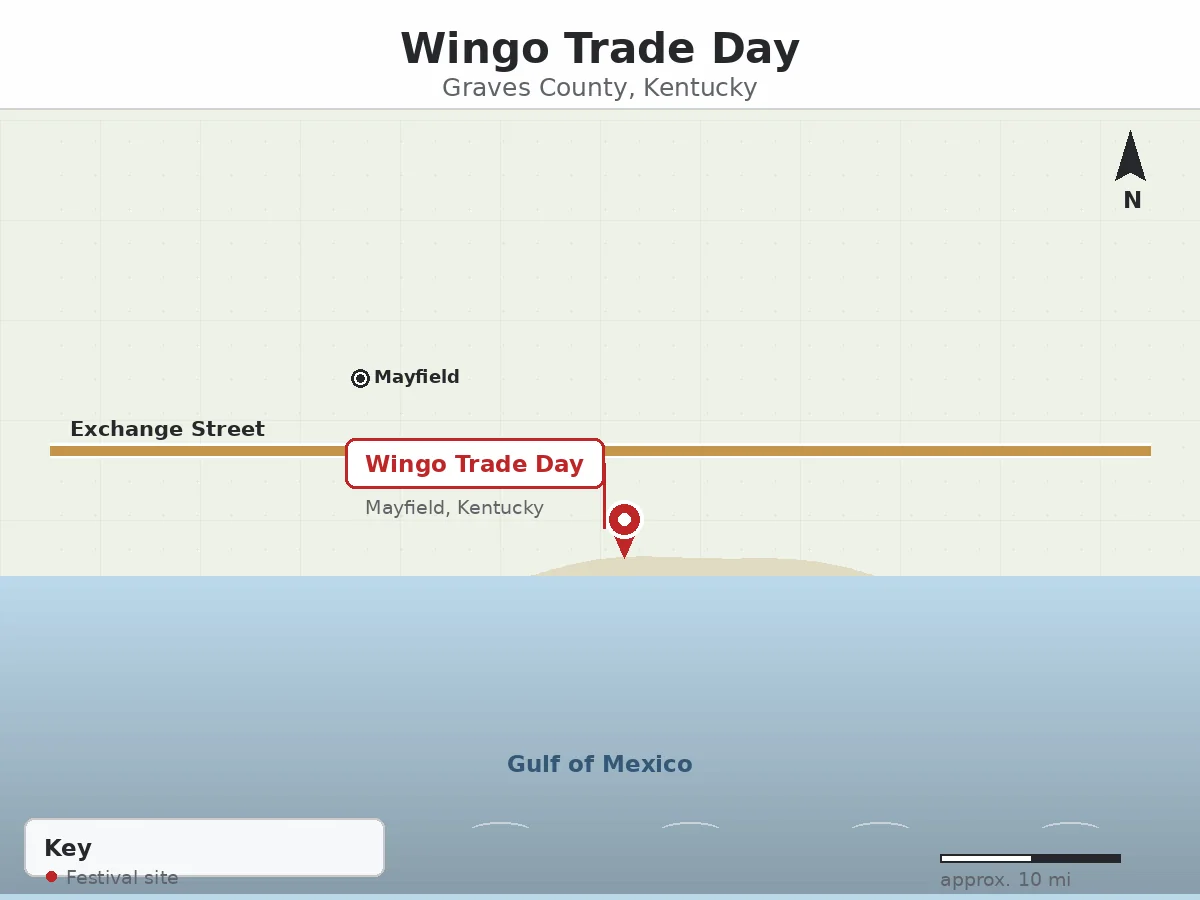
Wingo Trade Day is presented in every layer as the work of the Wingo Lions Club, which appears as host and sponsor in the bulletin, newspaper and listing layers alike. The gathering belongs to the Wingo community itself, set along its main street area; an event-listing layer places the two thousand twenty-five edition on Exchange Street in Wingo, and the street number printed in that listing is not reproduced here. Wingo is not the county seat. Mayfield holds that position for Graves County, a point verified in an encyclopedia reference layer, marking the Trade Day as a small-community event rather than a courthouse-town production. The record behind this article is moderate in depth: a state transportation bulletin covering two thousand twenty-two and a local newspaper layer reporting on two thousand twenty-three, supported by a festival-guide layer for two thousand twenty-four, an event-listing layer for two thousand twenty-five and a travel-blog layer that uses the plural name form. The tourism and listing layers print contact and sign-up routes for the Lions Club, whose details are not reproduced here, and no registry identifiers were recorded in any layer read.
Quick Facts
| Item | Detail |
| Published name | Wingo Trade Day, with Wingo Trade Days printed by a travel-blog layer |
| Host community | Wingo, Graves County, Kentucky |
| County seat | Mayfield; Wingo is not the seat |
| Host and sponsor | Wingo Lions Club |
| Setting | Wingo’s main street area; the two thousand twenty-five listing names Exchange Street |
| Earliest edition in this record | Saturday the eleventh of June, two thousand twenty-two, billed as the 90th annual |
| Most recent edition in this record | Saturday the seventh of June, two thousand twenty-five, billed as the 93rd, one in the afternoon to eight in the evening |
| Programme highlights | Parade, vendors, yard sellers, food trucks, bouncy castles, corn hole tournament |
| Admission | No layer read states a gate price, and none states that entry is free |
| Conflicting listing | A festival-guide layer lists the twenty-fourth and twenty-fifth of April, two thousand twenty-six, against the June pattern |
History
The deepest roots claimed for this gathering come from a travel-blog layer, which says the festivities commemorate a Trade Day tradition that has drawn people for nearly a century. That wording is the layer’s own claim, recorded as a claim and nothing more. The printed billings point in a similar direction without pinning anything down: the state transportation bulletin bills the two thousand twenty-two edition as the 90th annual, and the event-listing layer bills the two thousand twenty-five edition as the 93rd. Those two billings sit three years and three editions apart, consistent with a yearly count, but they remain billings only. No layer read states a founding year in words, and this article derives none from the arithmetic. A more human piece of history surfaces in the local newspaper layer’s account of two thousand twenty-three, which notes that the Lions Club had been at risk of dissolving during COVID-19. The club survived that period and was still fielding the Trade Day afterwards, with a parade, more than a dozen vendors, food trucks, bouncy castles and a corn hole tournament that year. For a small community, the event’s continuation after that threat is part of its story.
What to Expect
A Trade Day in Wingo is built around the street itself. In two thousand twenty-two, according to the state transportation bulletin, a state highway through Wingo closed for the day so the gathering could take over the road — the clearest sign of how completely the event occupies the community. The local newspaper layer’s description of two thousand twenty-three gives the fullest picture of the programme: a parade, more than a dozen vendors, food trucks, bouncy castles and a corn hole tournament. The event-listing layer for two thousand twenty-five adds yard sellers to the mix, along with food trucks again, and records that the Lions Club was calling for vendors, yard sellers, food trucks and churches to take part, suggesting a broad community sign-up rather than a closed roster. The travel-blog layer, writing about Wingo Trade Days under its plural form, adds classic fair food to the picture. Hours are documented only for two thousand twenty-five, when the listing gives one in the afternoon to eight in the evening, so visitors should treat that span as that year’s arrangement rather than a permanent schedule. Nothing in the record describes stages or headline performers; the documented draw is the street fair itself, the parade and the chance to browse what neighbours have brought to sell.
Planning Your Visit
June is the month the record supports. Editions are documented on Saturday the eleventh of June in two thousand twenty-two, during June in two thousand twenty-three, on Saturday the eighth of June in two thousand twenty-four and on Saturday the seventh of June in two thousand twenty-five, so a traveller would watch for Lions Club announcements as June approaches. The one conflicting listing, a festival-guide layer placing Wingo Trade Day on the twenty-fourth and twenty-fifth of April in two thousand twenty-six, stands unmerged in this record and is not adopted here; confirm the date through local announcements before travelling any distance. Drivers should remember the two thousand twenty-two precedent, when a state highway through Wingo closed for the day, and be ready for diversions around the main street area. Because the documented hours for two thousand twenty-five ran from one in the afternoon to eight in the evening, an early-afternoon arrival fits the pattern the record shows. Sellers and groups hoping to take part should use the contact and sign-up routes the tourism and listing layers print for the Lions Club, since the two thousand twenty-five listing shows the club actively recruiting vendors, yard sellers, food trucks and churches. Nothing in the layers read states a gate price, and nothing states that entry is free, so visitors should not budget around either assumption.
For a useful comparison, see the Graves County Kentucky Lights Festival for another county festival.
A Sample Itinerary
A visit shaped by the documented two thousand twenty-five pattern might begin with an unhurried drive into Graves County, timing arrival in Wingo for the early afternoon as the stalls open. The first hour suits a full walk along the main street area, taking in the yard sellers and vendor tables while the widest choice is still out. Mid-afternoon is the natural window for the parade and the family amusements the newspaper layer describes, with bouncy castles for children and the corn hole tournament drawing its own crowd of onlookers. Food trucks and the classic fair food mentioned by the travel-blog layer cover an early supper without leaving the grounds. The closing stretch, toward eight in the evening on the two thousand twenty-five schedule, allows a second, slower pass for anything missed and a last purchase from a neighbour’s table. This shape is built from documented elements, not a published schedule, and any year may arrange its pieces differently.
How It Compares
Two nearby names deserve separating from this event. A county-guide layer describes weekly Monday Trade Days at the Mayfield-Graves County Fairgrounds in Mayfield; despite the similar wording, that is a different, recurring market event in the county seat, and it is not the Wingo gathering this article covers. Searches also surfaced other Kentucky Lions Club festivals, including events connected with Morganfield, Hanson and Logan County — different towns’ occasions entirely. Within its own record, the Wingo day stands out for the way official and community sources combine: a state transportation bulletin documents the highway closure and the annual billing, a local newspaper supplies the lived detail of the programme, and listing layers carry the dates forward year by year. Compared with larger county fairs, the documented Wingo programme is modest — a parade, stalls, food and simple amusements on a closed main street — and its appeal rests on that scale.
Checklist
- Confirm the year’s date through local announcements before travelling, given the conflicting April listing for two thousand twenty-six
- Plan around a possible closure of the highway through Wingo, following the two thousand twenty-two precedent
- Arrive in the early afternoon, matching the one-to-eight span documented for two thousand twenty-five
- Leave time for a full first walk past the vendor and yard-seller tables
- Try the food trucks and classic fair food rather than planning a separate meal
- Watch for the parade as the centrepiece of the street programme
- Sellers should follow the Lions Club sign-up routes printed in the tourism and listing layers
- Make no assumption about a gate price or free entry, since the record states neither
Beyond the Festival
Wingo sits within a county whose seat, Mayfield, runs its own weekly Monday Trade Days at the Mayfield-Graves County Fairgrounds, as a county-guide layer records. A visitor already in Graves County for the Wingo Saturday could therefore find a related but separate market tradition continuing in the county seat on the following Monday, though the two events should never be confused with each other. The wider point the record supports is modest: this corner of Kentucky maintains more than one trade-day tradition, and the Wingo edition is distinguished by its Lions Club stewardship, its closed-highway setting and its June position in the calendar. The layers read offer little about surrounding attractions, and this article invents none; travellers should build around the Trade Day itself and research anything else separately.
Why It Matters
For a community of Wingo’s size, a gathering billed in the nineties of its annual run — the 90th annual in two thousand twenty-two and the 93rd in two thousand twenty-five, as the layers print them — represents a long chain of local effort. The travel-blog layer’s claim that the tradition has drawn people for nearly a century, if taken as the community’s own memory, explains why the day still closes a state highway and still fills the main street with sellers. The Lions Club’s brush with dissolution during COVID-19, reported by the local newspaper layer, gives that continuity a sharper edge: the event’s survival was not automatic, and the post-pandemic editions documented here show a small organisation choosing to keep its town’s tradition alive. Events like this rarely leave thick records, which is why the bulletin, the newspaper report and the listings matter: together they preserve a picture of rural Kentucky celebrating itself on its own street.
Frequently Asked Questions
Which name does the event actually appear under in print?
Sources publish it as Wingo Trade Day, in a state transportation bulletin, a local newspaper layer and a festival-guide layer, while a travel-blog layer prints Wingo Trade Days. No layer read uses the longer sheet title above, and none adds the word Festival to the name.
Why does the road through Wingo close for the gathering?
The state transportation bulletin for two thousand twenty-two records that a state highway through Wingo closed for the day while the Lions Club hosted the event. The festival occupies the community’s main street area, so the closure is what makes room for the parade, stalls and crowds.
What programme did the local newspaper report for two thousand twenty-three?
The local newspaper layer reports that year’s Trade Day as already held, with a parade, more than a dozen vendors, food trucks, bouncy castles and a corn hole tournament. The same report notes the Lions Club had earlier been at risk of dissolving during COVID-19.
Who runs the Trade Day, and how do sellers join in?
Every layer that names an organiser names the Wingo Lions Club as host and sponsor. The two thousand twenty-five listing shows the club calling for vendors, yard sellers, food trucks and churches, and the tourism and listing layers print sign-up routes, though their details are not reproduced here.
What to Expect From the Next Graves County Kentucky Wingo Trade Day Festival
How often is Graves County Kentucky Wingo Trade Day Festival held?
The documented pattern is a yearly gathering in June: editions appear in two thousand twenty-two, two thousand twenty-three, two thousand twenty-four and two thousand twenty-five, and the printed billings count them as the 90th annual and later the 93rd, which fits an annual rhythm without proving anything beyond the years the layers cover.
When is the next Graves County Kentucky Wingo Trade Day Festival?
On the June pattern the record documents, the next edition would be expected in June two thousand twenty-six, but no confirmed June date appears in the layers read. A festival-guide layer instead lists the twenty-fourth and twenty-fifth of April two thousand twenty-six, which conflicts with every other layer; that listing is recorded unmerged, so the honest answer is to watch for a Lions Club announcement.
Will the dates change?
They might, and the record itself shows why caution is sensible. Four documented editions sit in June, yet one guide layer places the two thousand twenty-six event in late April, and hours are documented only for two thousand twenty-five. Until the Lions Club’s own announcements settle the question, travellers should treat both month and hours as unconfirmed for any future year.
Closing
Wingo Trade Day, as the sources name it, is a small event with a long memory: a Lions Club street fair in a Graves County community that is not the county seat, documented by a state bulletin, a hometown newspaper and a run of yearly listings. Read the record on its own terms — June Saturdays, a closed highway, a parade and neighbours selling to neighbours — and it needs no longer title to be worth the trip.