Franklin County Maine Rangeley Birding Festival
Each June, as the warblers settle into the spruce and fir around Rangeley Lake, the town of Rangeley turns its attention skyward. The Rangeley Birding Festival gathers birdwatchers for several days of guided walks, lake paddles, mountain hikes and evening talks, all built around the boreal birds that make the Rangeley Lakes region one of the most rewarding places in New England to look for northern species. It is a small festival by design, and it rewards patience and an early start.
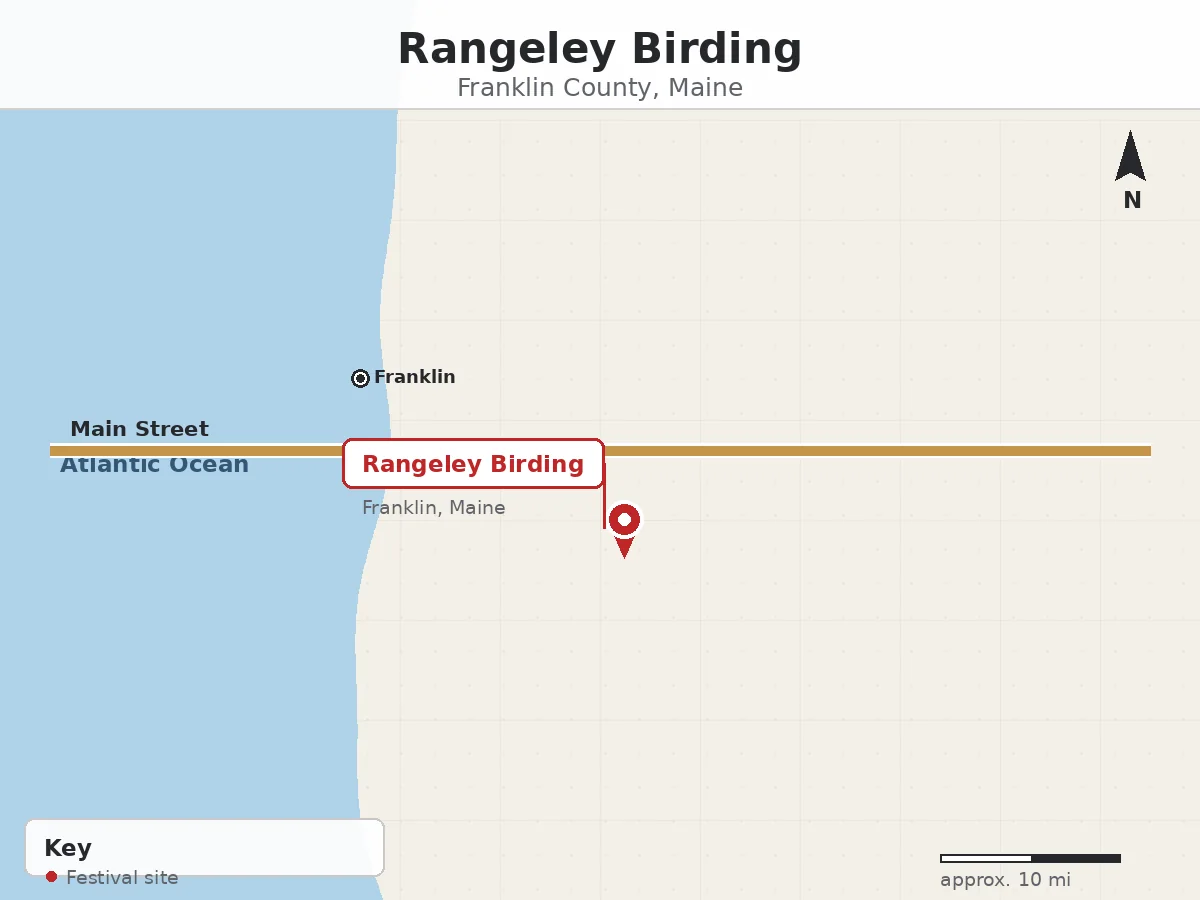
The festival takes place in Rangeley, a lakeside town in Franklin County in the western mountains of Maine. Rangeley is not the county seat — that distinction belongs to Farmington, about forty miles to the southeast — but it is the natural centre of the Rangeley Lakes region. The festival is timed for the peak of the breeding season, when the region’s boreal birds are singing and easiest to locate.
About the Festival
The Rangeley Birding Festival is a multi-day gathering devoted to the birds of the Rangeley Lakes region, held each year in early June in the town of Rangeley. The published name is “Rangeley Birding Festival”, printed exactly in the layers read. The centre of the weekend is the trust headquarters on Main Street in Rangeley, where participants gather before the day’s trips.
The programme has a consistent shape across the editions documented in the layers read: guided trips into the spruce-fir forest, along lakeshores and up mountain slopes in search of the region’s signature species — the Boreal Chickadee, the Bicknell’s Thrush, loons and a suite of boreal warblers. The Loon Paddle takes participants onto the water, where loons can be watched at close range. Bicknell’s Thrush hikes climb toward the high-elevation habitat where that elusive thrush sings at dawn and dusk. Chairlift rides at Saddleback Mountain carry festival-goers above the treeline. Expert talks between outings cover the ecology of the region’s birds and the conservation work that protects their habitat.
The festival is deliberately small: guided trips are limited to ten participants plus two guides, a cap that keeps groups quiet enough to hear birdsong and small enough that everyone can see the bird the guide has found, and places fill quickly, so early booking is rewarded. The organiser forms have changed once, and the layers record the two forms without merging them: through the 2025 edition the festival was organised by the Rangeley Lakes Heritage Trust, the local land trust that protects land and water around the Rangeley Lakes, and for the 2026 edition Western Maine Audubon with Maine Audubon took it on, with an Audubon chapter layer recording that the trust “passed along” the event. The venue and the programme carried across the change.
For a useful comparison, see the Franklin County Maine Under the Oaks Music Festival for another county festival.
Quick Facts
| Detail | Information |
| Festival name | Rangeley Birding Festival |
| Host town | Rangeley, Franklin County, Maine |
| County seat | Farmington, not Rangeley |
| Main venue | Rangeley Lakes Heritage Trust headquarters, Main Street, Rangeley |
| Other sites | Saddleback Mountain and guided-trip locations around the lakes |
| Organiser through 2025 | Rangeley Lakes Heritage Trust |
| Organiser for 2026 | Western Maine Audubon with Maine Audubon |
| Usual timing | Early June |
| Group size | Ten participants plus two guides per guided trip |
| Signature birds | Boreal Chickadee, Bicknell’s Thrush, loons, boreal warblers |
History
No founding year is stated in the layers read, and the record does not pin down a first edition. What the layers give is a run of dated editions, each with its own particulars, and two annual billings recorded exactly as printed, without being turned into a founding year by arithmetic.
The earliest dated edition is the second annual festival, held virtually on June 4–5, 2020. An Audubon layer records that edition as the 2nd annual. A June 10–11, 2022 edition, listed in a trail-listing layer, documents the return to the field.
The 2023 edition ran June 9–11, per a trail-listing layer and a news layer. The 5th annual festival concluded on June 10, 2023, and the John Bicknell Award was presented during that edition. The 6th annual festival followed on June 7–9, 2024, per an events layer, and the 2025 edition ran June 5–8, per a birding-trail layer, still under the trust.
The 2026 edition brought the change of organiser, with Western Maine Audubon and Maine Audubon taking the festival on after the trust passed it along. Two layers give the 2026 dates in slightly different forms — a birding-trail layer lists June 4–7, 2026, while the Audubon layer lists June 5–7, 2026 — and both forms are recorded here, unmerged, exactly as the layers state them. That run of editions, from a virtual second annual in 2020 through a sixth annual in 2024 and a handover in 2026, is the history the layers support.
What to Expect
A day at the festival begins early: the guided trips are the heart of the weekend, and they set out in the morning when the birds are most active. Each trip is limited to ten participants plus two guides, so the group moves quietly. Bring binoculars, wear sturdy shoes, and expect forest trails and uneven ground. The guides choose routes by season and bird: a spruce stand for Boreal Chickadees, a high slope for Bicknell’s Thrush, a lakeshore cove for loons.
The Loon Paddle is one of the festival’s signature outings: from the water, loons can be watched at a distance the shore rarely allows. The Bicknell’s Thrush hikes are the most demanding part of the programme, climbing toward the high-elevation forest where the thrush sings. The chairlift rides at Saddleback Mountain offer a gentler way up, above the trees, for a broad view across the lakes and ridgelines.
Between outings, expert talks cover the ecology of the region’s birds, the conservation of their habitat and the practical craft of finding northern species. The festival’s base is the Rangeley Lakes Heritage Trust headquarters on Main Street, where participants gather and compare notes at the end of the day. Admission is fenced to its years: a 2023 listing layer records a price of forty dollars, while the 2026 Audubon layer describes a la carte pricing, with participants paying for the outings and events they choose. No single gate price covers the weekend, so the cost depends on how many trips and talks a participant books.
Planning Your Visit
Book early: ten participants plus two guides is the limit on each outing, and the most popular trips — the Loon Paddle and the Bicknell’s Thrush hikes — fill first. The 2026 layers describe a la carte pricing, so choose the trips and talks that match your interests and fitness, and reserve them as soon as booking opens.

Plan for early mornings and mountain weather. June in the western Maine mountains can be cool at dawn and warm by midday, and rain is always possible, so layers and a waterproof shell belong in the pack with binoculars, a field guide and a notebook. The Bicknell’s Thrush hikes climb, so sturdy footwear matters; the Loon Paddle and the chairlift rides ask less of the legs and more of the eyes.
The festival’s base at the trust headquarters on Main Street is in the centre of town, and the town’s inns, lodges and restaurants are close by. The 2026 dates are listed in two forms — June 4–7 per a birding-trail layer and June 5–7 per the Audubon layer — so confirm the dates and arrive the day before your first trip, for a full first morning in the field. Binoculars are essential, a spotting scope is useful on the lake, and a field guide to northeastern birds will help you sort the warblers, which can look frustratingly alike in the canopy.
A Sample Itinerary
Arrive in Rangeley the afternoon before the festival opens, check in, and walk the shore of Rangeley Lake in the evening light. Have dinner in town.
On the first full day, rise before dawn for a guided trip into the spruce-fir forest, where the guides will look for Boreal Chickadees and boreal warblers while the morning chorus is at its peak. Return for a late breakfast, take the chairlift at Saddleback Mountain in the afternoon, attend an expert talk, and turn in early.
On the second day, join the Loon Paddle in the morning, watching loons while the lake is still calm. In the afternoon, take the Bicknell’s Thrush hike toward the high-elevation forest, listening for the thrush’s flute-like song. On the final morning, take one more guided trip — a lakeshore walk is a good choice — before driving home through the lakes region.
How It Compares
The Rangeley Birding Festival sits in a different register from the big birding festivals of the Atlantic coast. Where larger gatherings run dozens of trips a day and fill convention halls, Rangeley keeps its groups to ten participants plus two guides and its base to a land-trust headquarters on a small town’s main street — the scale is the point, built for birdwatchers who want real time with a guide in the field, not for crowds.
The festival’s focus is also narrower than most: it is built around the boreal birds of the Rangeley Lakes region — the Boreal Chickadee, the Bicknell’s Thrush, loons and boreal warblers — rather than a long list of species across many habitats. That focus draws birdwatchers who have already seen the common birds of the coast and lowlands and come for the northern species of its high forests. The change of organiser in 2026, from the Rangeley Lakes Heritage Trust to Western Maine Audubon with Maine Audubon, follows a familiar pattern: a local land trust builds an event around the place it protects, and a larger conservation organisation takes it on when the time comes. The programme carried across the change without a visible break.
Checklist
- Book guided trips as soon as booking opens — each trip is limited to ten participants plus two guides
- Bring binoculars and, if you have one, a spotting scope for the lake
- Pack a field guide to the birds of the northeast
- Wear sturdy shoes for forest trails and mountain hikes
- Dress in layers and pack a waterproof shell for mountain weather
- Confirm the edition’s dates before travelling — the 2026 dates are listed in two forms
- Arrive the day before your first trip for a full first morning in the field
- Carry water, snacks and a notebook on every outing
- Keep quiet on the trail so the group can hear birdsong
- Leave time after the festival for the lakes and hiking around Rangeley
Beyond the Festival
Rangeley is worth more than a festival weekend. The town sits on the shore of Rangeley Lake, and the lakes region around it offers paddling, fishing and hiking for the days before and after the festival. The trails climb through the same spruce-fir forest the festival’s trips explore, and a walk on your own afterwards revisits the birds you saw with a guide.
Saddleback Mountain, where the festival’s chairlift rides run, is a year-round draw, with hiking in summer and skiing in winter, and the view from the upper mountain takes in the lakes and ridgelines that frame them. Farmington, the county seat of Franklin County, lies about forty miles to the southeast and makes a natural stop on the way in or out. The drive between the two towns runs through the forested hills of western Maine, green in June, with the lakes open and birds singing from every stand of trees along the way.
Why It Matters
The Rangeley Birding Festival matters because it puts people in front of birds that are otherwise easy to miss. The Boreal Chickadee and the Bicknell’s Thrush are not birds most people stumble across: they live in high-elevation spruce-fir forest and are quiet outside the breeding season. A festival that gathers small groups with expert guides in exactly that habitat, at exactly the time of year when those birds are singing, makes those species visible — and makes the case for the forests they depend on.
The festival also matters for the place that hosts it: Rangeley is a small town whose economy rests on visitors who come for the lakes and mountains, and a festival that brings birdwatchers in early June, before the summer crowds arrive, fills rooms and tables in a shoulder season. The handover from the Rangeley Lakes Heritage Trust to Western Maine Audubon with Maine Audubon in 2026 shows the event’s value to the conservation community: two organisations saw the festival as worth carrying on, and the programme survived the change intact.
Frequently Asked Questions
How small are the guided trips at the Rangeley Birding Festival?
Guided trips are limited to ten participants plus two guides, a cap recorded in the layers read. The small size keeps groups quiet enough to hear birdsong. The most popular trips fill first, so book early.
Which birds should I hope to see in Rangeley in early June?
The festival is built around the region’s boreal birds: the Boreal Chickadee, the Bicknell’s Thrush, loons and boreal warblers. The guided trips, the Loon Paddle, the thrush hikes and the chairlift rides are all aimed at those species, and the expert talks explain the ecology behind them.
Who organises the festival now?
Western Maine Audubon with Maine Audubon organised the 2026 edition, after the Rangeley Lakes Heritage Trust passed the festival along. The trust organised it through 2025, and the venue, timing and programme carried across the change.
How does the festival’s pricing work each year?
The layers fence the figures to their years: a 2023 listing layer records a price of forty dollars, while the 2026 Audubon layer describes a la carte pricing, with participants paying for the outings and events they choose. There is no single gate price, so the cost depends on which trips and talks you book.
What to Expect From the Next Franklin County Maine Rangeley Birding Festival
How often is Franklin County Maine Rangeley Birding Festival held?
The festival is an annual early-June gathering in Rangeley, documented from a virtual second annual in 2020 through the 2026 edition.
When is the next Franklin County Maine Rangeley Birding Festival?
The 2026 edition is listed in two forms — June 4–7 per a birding-trail layer and June 5–7 per the Audubon layer — and both forms are recorded unmerged. Confirm the next edition against the organiser’s own listing before travelling.
Will the dates change?
Early June is the festival’s established window, and every dated edition in the layers read falls within it. The 2026 dates are listed in two forms, so check the organiser’s listing for the edition you plan to attend.
The Rangeley Birding Festival is a small, expert-led window onto the boreal birds of western Maine, rewarding the visitor who arrives early, books ahead, walks quietly and listens hard. The chickadees in the spruce, the thrush on the high slope and the loons on the morning lake are worth the early start, and the town of Rangeley, with its lakes and its mountains, is worth the stay.