Fayette County Kentucky Bluegrass Festival
Lexington’s best-documented bluegrass gathering never carried the name this article’s title gives it. Across public-radio, university newspaper, music-press and travel layers, the event appears as the Festival of the Bluegrass, and one environmental-education layer stretches that to Festival of the Bluegrass Music Festival. No layer read prints the plain words Bluegrass Festival as the event’s own name, so the published forms are kept exactly as they stand throughout what follows. What those layers document is substantial: a festival founded in nineteen seventy-four by Bob and Jean Cornett, settled for decades at the Kentucky Horse Park Campground, and particularised in two dated editions, June two thousand sixteen and June two thousand nineteen. They also document an ending of sorts, because a festival-status tracker layer reports that the gathering was last held in two thousand nineteen and that no edition under the name has run since.

About
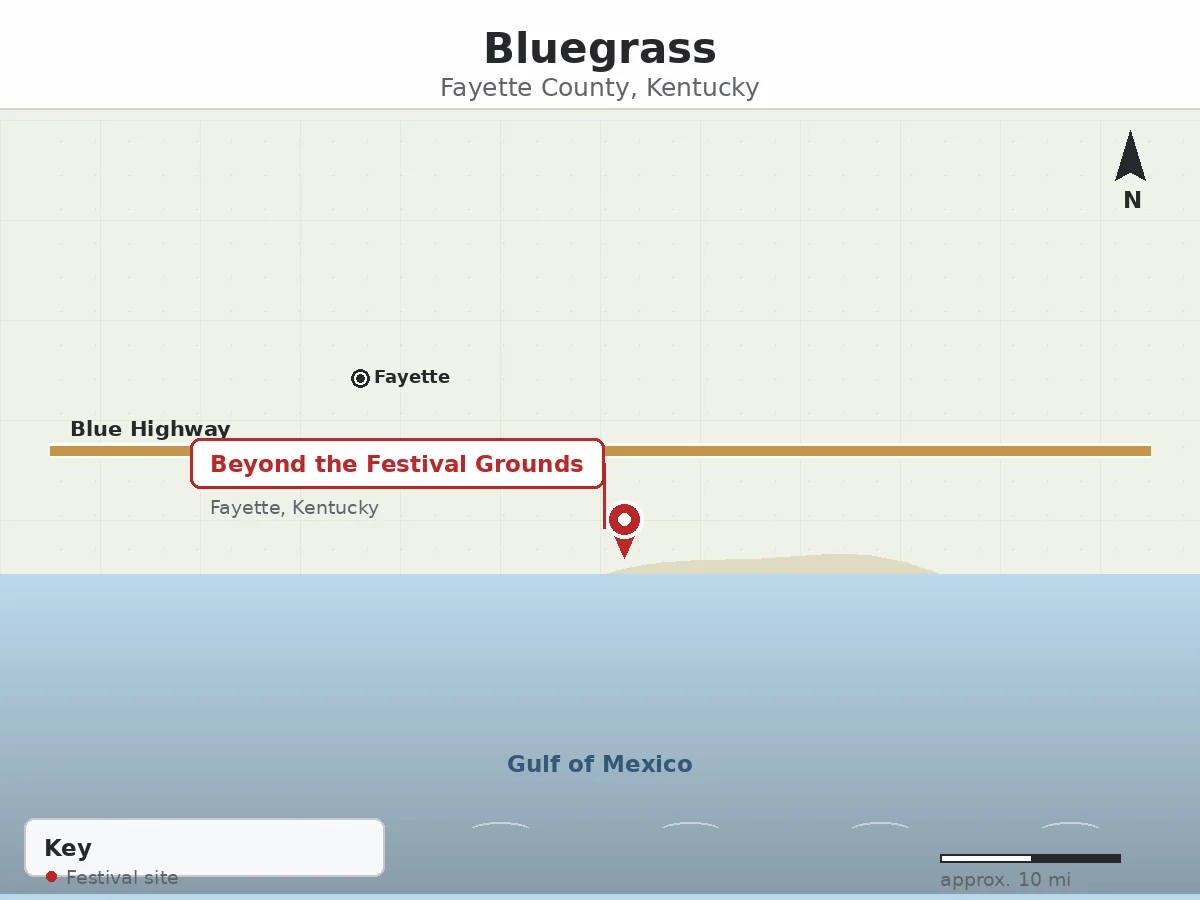
Lexington hosts the event, and reference layers identify the city as the county seat of Fayette County, the community the sheet’s county wording points toward. The venue never shifts in the record: public-radio, newspaper and venue layers all place the festival at the Kentucky Horse Park Campground, inside the Kentucky Horse Park in Lexington. Who ran it changes across the years, and the accounts are reported by period rather than blended into one credit. Music-press and travel layers credit Bob and Jean Cornett with founding the festival and running it. Later layers, a university newspaper layer and a legislative-testimony report layer among them, place other members of the Cornett family in running roles as the years advanced. No single organiser name covers the whole story, and none is imposed here. Older layers print a contact telephone number for the founders; that number is noted by its existence only and is never reproduced. The event’s shape, where the layers describe it, is a campers’ festival: several days of bluegrass at a campground, with families pitched on site and a music camp for children woven into the programme.
Quick Facts
| Item | Detail |
| Published name | Festival of the Bluegrass |
| Longer printed form | Festival of the Bluegrass Music Festival, in an environmental-education layer |
| Host city | Lexington, the county seat of Fayette County |
| Venue | Kentucky Horse Park Campground at the Kentucky Horse Park |
| Founders | Bob and Jean Cornett |
| First held | Nineteen seventy-four, per travel and music-venue layers |
| Particularised editions | Ninth to twelfth of June, two thousand sixteen; June, two thousand nineteen |
| Music camp | Kentucky Bluegrass Music Camp, whose participants opened the two thousand nineteen edition |
| Admission in two thousand sixteen | Camping weekend pass one hundred thirty-five dollars at the gate; non-camping weekend pass one hundred fifteen dollars |
| Present status | Last held in two thousand nineteen; no edition under the name since |
History
Travel and music-venue layers tell the founding story the same way. Bob and Jean Cornett started the festival in nineteen seventy-four, its first stage a farm wagon, and the early editions moved among area locations before the gathering settled at the Kentucky Horse Park in its seventeenth year. A legislative-testimony report layer adds its own anchor, stating that the event had been held at the Horse Park since nineteen ninety. Both statements are carried here as their layers print them, and neither is used to rewrite the other. The billing attached to the two thousand sixteen edition, the 43rd consecutive year, is likewise recorded as a billing only, never converted into arithmetic about the founding. Longevity, however it is counted, is plain in the record: by two thousand sixteen the festival had been a fixture of the Horse Park campgrounds for decades, long enough for a second generation of the founding family to appear in running roles in the later layers. Its final documented chapter belongs to two thousand nineteen. A public-radio layer published that June records that founder Bob Cornett had died in April of that year, weeks before the edition he had built went ahead. A festival-status tracker layer completes the arc: the festival was last held in two thousand nineteen, both founders have since died, and nothing under the Festival of the Bluegrass name has run at the campground since that summer.
What to Expect
Bluegrass on several stages anchors everything the layers describe. Public-radio, newspaper and travel layers agree on the pattern: multi-stage performances by national acts and Kentucky acts alike, spread across a four-day campground weekend. The fullest surviving bill comes from the university newspaper layer’s account of the ninth to the twelfth of June two thousand sixteen, which names Lonesome River Band, Blue Highway, Town Mountain, The Wooks, Restless Leg String Band and The 23 String Band among the acts at the Kentucky Horse Park. Children hold a distinctive place in the programme. The Kentucky Bluegrass Music Camp taught young players, and its participants opened the two thousand nineteen festival with a main-stage performance of their own; the public-radio layer counts more than seventy children, ages eight to eighteen, in that camp. Around the music, the same layers describe campground-based family activities, the texture of a weekend lived on site rather than visited for an evening. Nothing in the layers read promises a present-day version of any of this: these elements belong to the documented editions, and each detail is fenced to the years whose layers support it.
Planning Your Visit
Honesty comes first for anyone hoping to go: the layers read document no edition after two thousand nineteen, and no revival under the name is announced in them. A trip planned around this festival today would be a trip planned around a memory, however rich the record behind it is. What the documented editions show about attending is still worth setting down. The setting was the Kentucky Horse Park Campground, so the weekend was built around camping, with the music a short walk from the pitch. Ticketing was tiered by how a visitor stayed. For two thousand sixteen, a university newspaper layer prices a weekend camping pass at one hundred thirty-five dollars at the gate and a non-camping weekend pass at one hundred fifteen dollars. A separate, undated travel-guide layer prints a four-day ticket at eighty-five dollars, one-day tickets at ten to forty-five dollars, a youth four-day ticket at forty-five dollars and children twelve and under free; that layer states no year, so its figures are left exactly there, attached to no edition. Neither set of prices is treated as a rate for any other year. Families reading the older record should also note its one firm practical thread: children were never an afterthought, with a music camp of their own standing at the centre of the two thousand nineteen opening.
For a useful comparison, see the Fayette County Kentucky Kite Fest Festival for another county festival.
One Documented Day at the Campgrounds
A faithful itinerary can only follow the editions the layers preserve, so this one walks through a day shaped by the two thousand nineteen weekend, the last the record holds. Begin where that festival began: at the main stage, where participants in the Kentucky Bluegrass Music Camp, more than seventy children between eight and eighteen years old, opened the gathering with a performance, according to the public-radio layer published on the sixth of June two thousand nineteen. From there the day fans out across the campground’s stages, where the layers place national and Kentucky acts in rotation across the four days. Breaks belong to the campground itself, among the family activities the public-radio, newspaper and travel layers describe, with meals and evenings lived at the pitch rather than in town. Campers holding the two thousand sixteen style of weekend pass stayed inside that rhythm for the whole run, while day visitors in the undated travel-guide layer’s account came and went on one-day tickets. No timetable survives in the layers read, so none is invented here: the sequence above is the order the record supports, and nothing finer.
A Successor at the Same Campground
Bluegrass did not leave the Kentucky Horse Park Campground when this festival stopped. Since two thousand twenty-three, the same grounds have hosted Spirit in the Bluegrass, printed in full as Spirit in the Bluegrass Music Fest, an event the Horse Park’s own layer documents for the tenth to the thirteenth of June two thousand twenty-six. The continuities are real: the same campground, the same genre, and the Cornett family’s blessing, which the record notes the successor carries. The differences matter just as much. Spirit in the Bluegrass runs under different organisers and under its own name, making it a separate successor event rather than a continuation of the Festival of the Bluegrass. Its programme, prices and arrangements belong to it alone and are not imported into this article. A second namesake deserves the same care: the Festival of the Horse in Georgetown belongs to Scott County, a different event in a different county, and shares nothing with the Lexington gathering beyond a resemblance in wording.

A Checklist Drawn From the Record
- Treat two thousand nineteen as the last confirmed edition before making any plan
- Read every price against its own layer and year, never as a current rate
- Search older coverage under the published name, Festival of the Bluegrass
- File Spirit in the Bluegrass separately, however similar its setting feels
- Credit Bob and Jean Cornett as founders when retelling the festival’s story
- Note that older layers print a founders’ contact number belonging to the active years
- Picture a campground weekend format in the documented editions, not a single-evening concert
- Check the Horse Park’s current calendar through its own channels before travelling
Beyond the Festival Grounds
The layers that preserve this festival reach well beyond music journalism. An environmental-education layer prints the longest name form, Festival of the Bluegrass Music Festival, while a legislative-testimony report layer discusses the event’s tenure at the Horse Park, evidence that the gathering registered in civic as well as musical life. Its founding story travels too: travel and music-venue layers repeat the farm wagon first stage and the nineteen seventy-four start, a tale retold often enough to become part of the event’s identity. The wagon-stage beginnings happened at area locations that shifted from year to year, but every particularised edition in the record belongs to one ground, the Kentucky Horse Park Campground in Lexington. For the city, the practical legacy sits at that campground, where a successor festival now holds June weekends with the founding family’s blessing. The name Festival of the Bluegrass, though, belongs to the Cornett era alone, and nothing in the layers read transfers it to the events that followed.
Why the Festival of the Bluegrass Matters
A festival that ran from a farm wagon in nineteen seventy-four to a four-day campground gathering documented across public-radio, newspaper, music-press and travel layers holds a particular place in Kentucky’s musical record. It was built and run by one family, founded by Bob and Jean Cornett and carried in later years by other members of the Cornett family, a through-line the layers preserve period by period. Its programme joined national acts to Kentucky acts and gave children a stage of their own through the Kentucky Bluegrass Music Camp, whose young participants opened the final documented edition in two thousand nineteen. Its dormancy is part of its significance now. That last edition came weeks after Bob Cornett’s death in April two thousand nineteen, and a festival-status tracker layer records that both founders have since died. What survives is an unusually complete paper trail for a family festival, and a name that later events at the same campground honour without inheriting.
Frequently Asked Questions
Under what name did the event actually appear in print?
Public-radio, university newspaper, music-press and travel layers print Festival of the Bluegrass, and an environmental-education layer prints Festival of the Bluegrass Music Festival for the same event. No source read prints Bluegrass Festival as the event’s own name, which is why the published forms stand unmerged throughout this article.
Who started the gathering, and where did its first stage stand?
Travel and music-venue layers state that Bob and Jean Cornett started the festival in nineteen seventy-four, with a farm wagon serving as the first stage. The early editions moved among area locations before the festival settled at the Kentucky Horse Park in its seventeenth year, as those layers tell it.
What separates the two sets of ticket prices in the record?
One set belongs to a single dated year: a university newspaper layer prices the two thousand sixteen weekend at one hundred thirty-five dollars for a camping pass at the gate and one hundred fifteen dollars for a non-camping pass. The other set comes from an undated travel-guide layer, which states no year at all, so its eighty-five dollar four-day ticket and its one-day range of ten to forty-five dollars are recorded as printed and attached to no edition.
Is the June festival now running at the Horse Park Campground the same event?
No. The campground’s current June gathering is Spirit in the Bluegrass, documented by the Horse Park’s own layer for the tenth to the thirteenth of June two thousand twenty-six and held at the grounds since two thousand twenty-three. It runs under different organisers as a separate successor event, albeit one carrying the Cornett family’s blessing, and it is not a revival under the Festival of the Bluegrass name.
What to Expect From the Next Fayette County Kentucky Bluegrass Festival
How often is Fayette County Kentucky Bluegrass Festival held?
While it ran, the documented pattern was a June gathering stretching across four days, as the two thousand sixteen and two thousand nineteen editions both show. That pattern ended with the two thousand nineteen edition: a festival-status tracker layer records no edition under the name since, so the event cannot honestly be described as a going concern on any regular schedule.
When is the next Fayette County Kentucky Bluegrass Festival?
No next edition appears anywhere in the layers read. Both founders have died, according to the festival-status tracker layer, and no organiser announces a revival under the Festival of the Bluegrass name, so any future date would be pure speculation, and none is offered here.
Will the dates change?
Dates can only change for a festival that is scheduled, and this one is not. Should a revival ever be announced, its timing would be set fresh by whoever stages it; the June pattern of the documented editions is history rather than a promise, and nothing in the record read fixes any future weekend.
Closing Thoughts
The record of the Festival of the Bluegrass is unusually complete for a dormant festival: dated editions, named acts, prices fenced by year and layer, a founding story and a clear end. Keeping its name forms unmerged, its prices attached to their own layers and its successor firmly separate leaves that record exactly as the sources wrote it.