Cumberland County Maine Bowdoin International Music Festival
Every summer, a college campus in Brunswick becomes a working school for classical music. Students from conservatories around the world spend six weeks rehearsing, performing, and learning beside the teachers they admire, and the public is invited to hear the results night after night. The Bowdoin International Music Festival is not a single weekend of performances but a season, and its audience includes longtime subscribers, first-time listeners, and families who come for the free events scattered through the calendar. It has run in Brunswick since the nineteen sixties, growing from a college summer programme into an independent organisation with an international reach.
About
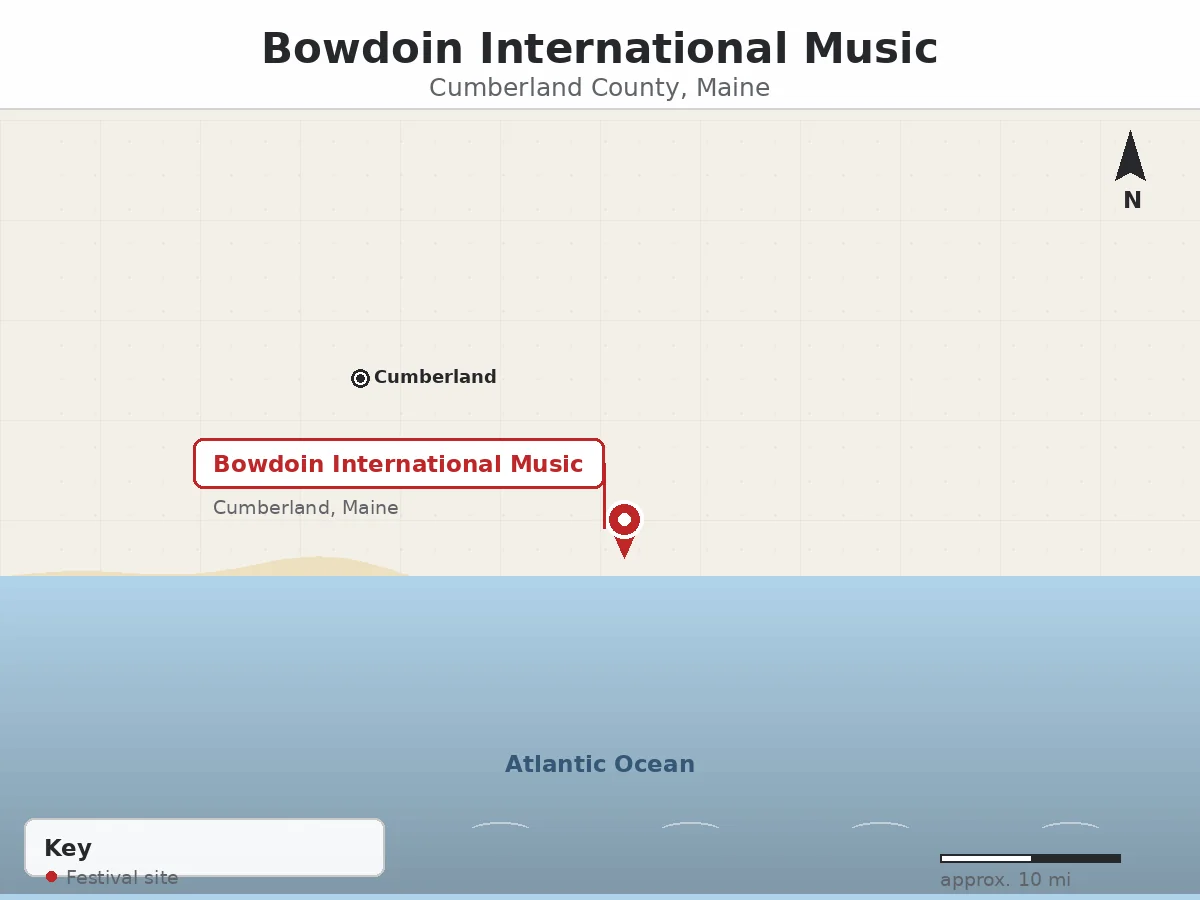
The Bowdoin International Music Festival is a six-week summer season of concerts, teaching, and community events on the campus of Bowdoin College in Brunswick, in Cumberland County. Brunswick is not the county seat; Portland holds that role. The campus provides the halls and practice rooms the season needs. Each summer about two hundred seventy-five students work with about eighty faculty and guest artists drawn from more than twenty leading conservatories.
The professional side of the season holds twenty concerts across four series, while the Young Artists Series adds more than two hundred performances by the students themselves. Subscription concerts take place in Studzinski Recital Hall, the campus hall that anchors the season, and orchestra concerts are held at Crooker Theater at Brunswick High School, a larger room suited to full ensembles. Festival Fridays form the premier Friday-night series, and the Gamper Festival of Contemporary Music, which began in nineteen sixty-five, runs as the festival’s celebration of new music, a series within the season rather than a separate event.
Around the ticketed concerts sit community concerts, masterclasses, studio classes, and lectures, many of them open to the public without charge. A travel layer counted roughly one hundred seventy-five free public events alongside the ticketed guest-artist and faculty concerts. The artistic leadership has been held since September twenty fourteen by two members of a chamber ensemble.
Quick Facts
| Detail | Information |
| Festival | Bowdoin International Music Festival |
| Host town | Brunswick, Cumberland County |
| County seat | Portland |
| Main venue | Bowdoin College campus, Brunswick |
| Subscription concerts | Studzinski Recital Hall |
| Orchestra concerts | Crooker Theater, Brunswick High School |
| Season length | Six weeks each summer |
| Founded | Nineteen sixty-four, as a programme of Bowdoin College |
| Organiser | Bowdoin International Music Festival, an independent nonprofit organisation since nineteen ninety-seven |
| Signature series | Festival Fridays and the Gamper Festival of Contemporary Music |
History
The festival began in nineteen sixty-four as a programme of Bowdoin College. In May of that year, the chair of the college music department invited Lewis Kaplan to propose a summer concert series, and Kaplan joined Robert Beckwith as the documented founders of the undertaking. The idea was modest: a summer season of concerts and teaching on a campus quiet between academic terms. The founders believed young musicians learn most from playing beside experienced artists.
For a useful comparison, see the Cumberland County Maine PortFringe Festival for another county festival.
For more than three decades the festival remained a college programme, growing steadily in reputation and in the number of students it drew. In nineteen ninety-seven it became an independent nonprofit organisation, keeping its home on the Brunswick campus. In two thousand four the name changed to the Bowdoin International Music Festival, in recognition of the worldwide reach the season had developed, with students and faculty arriving from conservatories far beyond Maine.
The Gamper Festival of Contemporary Music, which began in nineteen sixty-five, belongs to the earliest years of the festival’s life, and it has run through the decades as the season’s home for new music. Living composers have had a place in the programme since the beginning. Artistic leadership has been steady, with two members of a chamber ensemble serving as artistic co-directors since September twenty fourteen, a tenure the outgoing board chair acknowledged during the twenty twenty-five season.
The recent record shows a season in good health. The twenty twenty-five season opened to a packed Studzinski Recital Hall, and the summer before that, an audience member writing in a travel layer described attending young-artist concerts in the twenty twenty-four season. The twenty twenty-six season is the next documented edition, with a conflict in the layers: a state arts layer dates the season from the twenty-ninth of June through the seventh of August, while the organiser’s own applications layer dates it from the twenty-seventh of June through the eighth of August.
What to Expect
A visit to the festival means stepping into a working music school that happens to be open to the public. Days on campus hold rehearsals, masterclasses, and studio classes, some of them open to listeners, and evenings bring the ticketed concerts that form the core of the season. In twenty twenty-six the ticketed concerts fall on Monday, Wednesday, and Friday evenings, along with two Sunday matinées, according to a state arts layer, and Festival Fridays stand out as the premier Friday-night series. Orchestra concerts move to Crooker Theater at Brunswick High School, while the subscription concerts stay in Studzinski Recital Hall.
The Young Artists Series is where the festival’s teaching mission becomes audible. More than two hundred student performances fill the season, carrying a different energy from the faculty evenings: young players, many still in conservatory training, performing repertoire they prepared with their teachers during the week. Some are free. The Gamper Festival of Contemporary Music adds another colour, with programmes of new work.
Free events run through the whole season. Community concerts, open rehearsals, lectures, and masterclasses give visitors many ways in, and the travel layer’s count of roughly one hundred seventy-five free public events suggests a visitor who plans carefully can hear music nearly every day without a ticket. Students receive free tickets to faculty concerts under the organiser’s handbook. The atmosphere is studious: listeners arrive early and applause is warm but measured.
Planning Your Visit
Choose your week first, and confirm the dates before you book anything. The twenty twenty-six season is dated differently by two layers, with a state arts layer giving the twenty-ninth of June through the seventh of August and the organiser’s own applications layer giving the twenty-seventh of June through the eighth of August, so check the dates with the organiser. Once the dates are settled, decide which evening suits you: a Friday-night Festival Fridays concert, a Monday or Wednesday faculty concert, or a Sunday matinée. Orchestra concerts need a separate trip across town.
Brunswick is a walkable college town, and the campus sits close to the town centre, so a visitor staying nearby can reach most events on foot. Arrive early for the popular evenings, since the twenty twenty-five opening night packed Studzinski Recital Hall. Dress is informal; the halls are air-conditioned, so a light layer helps. Read the programme notes before the music begins.
Tickets cover the Monday, Wednesday, and Friday evening concerts and the two Sunday matinées in twenty twenty-six, while many other events are free, so a mixed week can balance a few ticketed evenings with free daytime events. Students get free tickets to faculty concerts, and the free community concerts and open masterclasses need no ticket at all. A contact address for admissions exists in the layers; its details are not printed here.
A Sample Itinerary
Arrive in Brunswick on a Thursday afternoon and settle in before an evening walk through the town centre, where the college campus and the main street sit within easy reach of one another. On Friday, spend the late afternoon at a free community concert or an open masterclass, then take your seat for the Festival Fridays concert in the evening, the premier series of the season. Saturday morning suits exploring Brunswick before an afternoon lecture or student performance.
Sunday offers the matinée, one of the two Sunday performances in the twenty twenty-six season, a daytime concert that suits visitors who prefer not to be out late. Monday brings a faculty concert in the evening, and the daytime hours can be spent at a studio class or a rehearsal open to listeners. Tuesday suits the free events. Wednesday evening returns to the concert hall for another faculty performance, and Thursday can close the week with an orchestra concert at Crooker Theater at Brunswick High School.
How It Compares
Summer music festivals in Maine come in many shapes, and the Bowdoin season is distinct among them for the way it joins a school to a concert series. Other summer music festivals in the region present performances without the teaching that sits behind them, and their audiences hear artists who arrive, play, and leave. At Bowdoin, the artists stay for weeks, teach during the day, and perform in the evening, so the audience hears musicians who have been working in the same rooms all week.
Bowdoin College’s own separate events are different undertakings from the festival, even though they share the campus, and the distinction matters for a visitor reading listings. Academic-year college concerts belong to the college’s own calendar, not to the festival. The Gamper Festival of Contemporary Music sits on the other side of that line: it is a series within the festival, not a separate festival, and its programmes belong to the same season.
The festival also differs from the large outdoor summer festivals that fill Maine’s calendar, where music shares the weekend with food stalls, craft vendors, and family activities. Its pleasures are quieter, centred on the concert hall and the classroom. A listener who wants six weeks of serious music will find little else like it in the state.
Checklist
- Confirm the twenty twenty-six dates with the organiser, since two layers date the season differently
- Choose your ticketed evenings: Monday, Wednesday, and Friday concerts, or a Sunday matinée
- Plan a separate trip to Crooker Theater at Brunswick High School for orchestra concerts
- Arrive early for popular evenings, since the twenty twenty-five opening night filled Studzinski Recital Hall
- Add free events to your week: community concerts, masterclasses, and lectures
- Bring a light layer for air-conditioned halls
- Read the programme notes before the music begins
- Leave daytime hours open for student performances in the Young Artists Series
- Keep the Gamper Festival of Contemporary Music on your list for new work
- Remember that Brunswick is not the county seat; Portland holds that role
Beyond the Festival
Brunswick rewards a visitor who stays beyond the concert hall. The town centre sits close to the campus, with shops, cafés, and restaurants within walking distance, and the riverfront offers a quieter place to walk between events. The college quadrangles are worth an unhurried look. Day trips from Brunswick can reach the coast, where the harbours of midcoast Maine lie a short drive away, and Portland, the county seat, offers a larger city’s museums, restaurants, and concert halls.
The festival’s own reach extends beyond Brunswick in another sense: its students and faculty come from more than twenty leading conservatories, and the connections made during six weeks of shared work travel home with them. Young artists heard here may be encountered again years later on stages far from Maine. That reach is why the name changed in two thousand four, recognising a worldwide scope.
Why It Matters
The festival matters because it keeps a demanding form of music alive in a place where it might easily have faded. Classical music depends on institutions that train young players and give them stages, and the Bowdoin season does both at once. A student who spends six weeks rehearsing and performing beside faculty artists leaves Brunswick a better musician, and audiences hear those students grow across a season.
It also matters to Brunswick itself, which gains a summer identity from the festival that it would not otherwise have. The town’s streets fill with musicians carrying instrument cases, the halls fill with listeners, and the conversation in cafés and shops turns to the evening’s programme. The Gamper Festival of Contemporary Music adds a further dimension, keeping new music in the programme since nineteen sixty-five and insisting that a festival with a long history should still listen to the present. A season honouring its founders, Robert Beckwith and Lewis Kaplan, while making room for composers writing today understands its own purpose.
Frequently Asked Questions
Which evenings carry the season’s ticketed concerts?
In twenty twenty-six, the ticketed concerts fall on Monday, Wednesday, and Friday evenings, along with two Sunday matinées. Festival Fridays form the premier Friday-night series, and orchestra concerts are held at Crooker Theater at Brunswick High School.
How can a visitor hear music without buying a ticket?
Many public events are free, and a travel layer counted roughly one hundred seventy-five free public events alongside the ticketed guest-artist and faculty concerts. Students receive free tickets to faculty concerts.
What makes the Gamper programmes different from the rest of the season?
The Gamper Festival of Contemporary Music began in nineteen sixty-five and serves as the festival’s celebration of new music. It is a series within the season, not a separate festival, and its programmes feature living composers and recent work.
Why do two sources give different dates for the twenty twenty-six season?
A state arts layer dates the twenty twenty-six season from the twenty-ninth of June through the seventh of August, while the organiser’s own applications layer dates it from the twenty-seventh of June through the eighth of August. Visitors should confirm the dates with the organiser before making travel plans.
What to Expect From the Next Cumberland County Maine Bowdoin International Music Festival
How often is Cumberland County Maine Bowdoin International Music Festival held?
The festival gathers each summer for a six-week season, a rhythm kept since its founding in nineteen sixty-four. Each season brings about two hundred seventy-five students together with about eighty faculty and guest artists, and the public programme pairs twenty concerts in four professional series with more than two hundred Young Artists Series performances.
When is the next Cumberland County Maine Bowdoin International Music Festival?
The next documented edition is the twenty twenty-six season, and its dates are carried in two forms that have not been reconciled: a state arts layer gives the twenty-ninth of June through the seventh of August, while the organiser’s own applications layer gives the twenty-seventh of June through the eighth of August. The organiser is the source to check before booking travel.
Will the dates change?
The dates for the coming season should be treated as provisional until the organiser confirms them, since the two layers already disagree by two days at each end of the twenty twenty-six season. Confirm the exact days close to the season.
The Bowdoin International Music Festival endures because it asks something serious of everyone involved: students who practise through the summer, faculty who teach as well as perform, and audiences who listen with attention. Brunswick gives it a home and the college gives it halls. A visitor who stays for a week will hear a school at work.