Catron County New Mexico Fair Festival
The Catron County Fair is documented the way few fairs are: not by posters or ticket pages, but by the paper trail of the volunteer board that runs it. Its record lives in published meeting agendas, in minutes kept at the Catron County Fairgrounds, in a rules document revised line by line, and in a line of the county commission’s own notices fixing five days in late August. The fair is real, current and verifiable in Reserve, the county seat of the largest and one of the emptiest counties in New Mexico — and its record declines to publish a gate price, a founding year or a carnival. Everything below stays inside that record.
About a Fair That Publishes Its Minutes
The Catron County Fair is held at the Catron County Fairgrounds in Reserve, and Reserve is both the fair town and the county seat, a pairing that holds throughout this article: unlike most counties in this series, Catron keeps its courthouse and its fair in the same small community. The body behind the fair is the county’s fair board. Its papers style the organisation two ways — the Catron County Fair Board on its meeting mastheads, and the Catron County Fair Association in its bylaws, tax-status and policy business — and those are two styles for one body, never two organisations. The board’s work is unusually visible: its June 2026 agenda names its officers, President Arden Ward, Vice-President Cindy Waldron, Secretary Misty Werkman and Treasurer Shelby Saulsberry, alongside its directors, and its 2026 business runs to agendas, minutes, a code of ethics, bylaws and compliance work, all conducted at the fairgrounds it governs. Alongside the board, the New Mexico State University Cooperative Extension office for Catron County, based in Reserve, carries the 4-H side of the fair as programme partner. Extension is not the organiser, and the board is not a county department: the fair is a volunteer board’s undertaking, documented in its own hand.
Quick Facts
| Item | Detail |
| Fair name | Catron County Fair |
| Fair town | Reserve |
| County seat | Reserve (the seat hosts the fair) |
| Venue | Catron County Fairgrounds, 73 The Lane Road, Reserve |
| Organiser | Catron County Fair Board (also styled Catron County Fair Association in its own papers) |
| Season | Late August, five days, Wednesday to Sunday |
| Admission | No admission, gate or parking price is published in the fair’s record |
| Camping | No fair-week camping is published in the record |
| Signature events | Ranch Rodeo; Junior Rodeo; livestock and exhibits under the fair’s rules |
| 4-H partner | New Mexico State University Cooperative Extension, Catron County |
A History Written in Paperwork
Most fair histories begin with a founding year. This one cannot, because the fair’s own record contains none: no founding date, no edition number and no anniversary billing appears anywhere in the board’s papers as they stand. Rather than borrow a beginning from county folklore, this article takes the history the record actually offers, which is a governance story. The board’s 2026 papers document a young formal structure being built carefully around an established county fair — bylaws attended to, a code of ethics adopted, the Association’s registration and tax-exempt compliance brought up to date, and the standing rules document, the Catron County Fair Rules and Regulations, revised for the 2026 edition, eligibility rules included. A board does that work for a fair it expects to keep. The same season’s business also initiated something new: a fair royalty programme, begun by board action and effective for the 2026 fair, giving the event a queen layer in its first year. So the documented history here runs the other way from most — not an old fair acquiring paperwork late, but a fair whose newest chapter is the paperwork itself.
What to Expect
The Ranch Rodeo and Its Working Teams
The signature contest of the fair is its Ranch Rodeo, a team event for four-man teams of working cowboys rather than professional rodeo hands. Its one published price belongs entirely to contestants: entry costs five hundred dollars per team, payable in cash only. That figure is an entry fee for the teams in the arena, and it is repeated in this article only in that fence — it is not a spectator price, not a gate charge, and no reader should budget it as the cost of watching.
The Junior Rodeo and Its Buckles
The Junior Rodeo gives the county’s young riders their own arena programme, organised in age-group events with All-Around buckles at stake for the best overall performers across them. Entries run through the fair’s own forms, with the Extension office in Reserve standing as the documented contact point in the rodeo layer. Together the two rodeos frame the fair’s character: one arena for the working adults of a ranching county, one for the children growing up into that work.
For a useful comparison, see the Bernalillo County New Mexico Albuquerque International Balloon Fiesta Festival for another county festival.
Livestock and Exhibits Under the Board’s Rules
The fair’s exhibition core — its livestock and its entered exhibits — is governed by the 2026 Catron County Fair Rules and Regulations, the board’s standing document, revised for the 2026 edition. The rules reach beyond the county line in a measured way: their eligibility provisions distinguish in-county exhibitors from out-of-county and out-of-state ones, so the barns and tables are a county showcase with defined terms for neighbours, not an open free-for-all. What the record does not contain matters here too: no concert bill, no carnival and no midway appears in any fair-side source, and this article invents none of them.
4-H Shows and a First Year of Royalty
Through the Extension partnership, 4-H showing runs through the fair as its youth exhibition backbone, the programme side of a fair whose arena side belongs to the rodeos. New in 2026 is the royalty programme, initiated in the board’s own business and effective for that year’s fair — the first year the Catron County Fair has carried a queen layer under its documented record. A first-year programme is a modest thing by design: its significance is that the board chose to start it, and started it the same season it was tightening its bylaws and rules.
Planning Your Visit
Reaching Reserve
Reserve sits deep inside a very large county, and the practical fact of this fair is distance: Catron County is the largest county in New Mexico by area and among its least populous, so most visitors are driving a long way on rural highways to reach a small community. Treat the fairgrounds address — 73 The Lane Road in Reserve — as the destination, allow generous time, and plan fuel, food and lodging around the county’s sparsity rather than expecting services at the gate. County context like that is background, not a fair statistic, but for this fair it shapes the whole trip.
The Question of Admission, Answered Honestly
No admission, gate or parking price for this fair is published by the fair board, by the county or by Extension in any source behind this article. The fair is therefore not described here as free, however common free gates are at rural fairs, because this record does not say so; nor is any figure quoted, because none exists to quote. The correct plan is to carry cash, expect the question to be settled at the grounds themselves, and to distrust any website that confidently names a price for getting in.
Entering Rather Than Watching
For exhibitors and contestants, the fair’s paperwork is the planning document. Rodeo entries run through the fair’s own forms, the ranch rodeo’s team entry is five hundred dollars in cash, and livestock and exhibit entries sit under the 2026 rules and their eligibility tiers for in-county, out-of-county and out-of-state exhibitors. Reading the current rules before loading animals or work is not a courtesy here; the board revised them for 2026, and last year’s assumptions are exactly what a revision exists to correct.
A Sample Day at the Fair
Begin in the morning among the livestock and exhibits, while the barns are at their busiest and the judging under the fair’s rules is under way. Give the middle of the day to the Junior Rodeo’s age-group events and the 4-H showing, and keep the day’s second half for the Ranch Rodeo, the arena’s senior programme. Because the fair’s record publishes no food programme, plan meals in Reserve itself rather than counting on fairground concessions, and leave time in the day simply to read the grounds — in a county this size, the fair crowd is the county, gathered in one place.
How This Fair Differs From the Big New Mexico Shows
Scale is the whole comparison. New Mexico’s famous festivals publish attendance in the hundreds of thousands and sell sessions, passes and parking in elaborate tiers. The Catron County Fair publishes minutes. It occupies the opposite end of the state’s fair spectrum: five days in late August, one fairgrounds in the county seat, a volunteer board whose officers are named in its own agendas, and a programme of two rodeos, livestock, exhibits and 4-H showing. Neither end of that spectrum is the other’s rival. What this fair offers that a giant event cannot is legibility — a visitor can learn who runs it, under what rules, and to whom the board answers, from documents the board itself puts in front of its neighbours.
A Checklist for the Trip
- Confirm the current year’s dates and rules on the fair board’s own publications before travelling, since the board revises them.
- Carry cash: the record publishes no gate price, and the one published fee, the ranch-rodeo team entry, is cash only.
- Allow a long drive; Reserve is a small community deep inside New Mexico’s largest county.
- Plan meals and lodging in and around Reserve, as the fair’s record publishes no food or camping offer.
- Exhibitors: read the current rules document, including the eligibility tiers, before entering.
- Do not fold the county’s other events — a July rodeo at Luna, a September pie festival at Pie Town — into this fair’s programme; they are separate occasions.
- Expect no midway or concert bill; none appears in the fair’s record.
Beyond the Fairgrounds
Reserve itself is the first stop beyond the grounds: the county seat’s small streets hold the courthouse and the everyday services of a ranching community. The county’s other named places each keep their own occasions, separate from the fair and listed here only as neighbours — Luna, up the road, holds its own rodeo in July; Pie Town, on the county’s eastern highway, keeps a pie festival in September; and Glenwood and Datil anchor the county’s southern and eastern ends as its other small communities. The surrounding country is the real excursion: high, dry, forested ranch land running to the Arizona line, where the drive between villages is measured in tens of miles and the fair week’s gathering is all the more concentrated for it.
Why a Fair Like This One Matters
In a county with more land than almost anywhere in the state and very few people spread across it, a county fair is not entertainment laid on top of community life; it is one of the few occasions the community physically assembles. This fair matters because it does that assembling with unusual openness about its own workings — a board that publishes its agendas, revises its rules in the open and starts a royalty programme by recorded decision. Its barns and rodeos measure the county’s working skills; its paper trail measures its civic ones.
Frequently Asked Questions
Where is the Catron County Fair held, and who runs it?
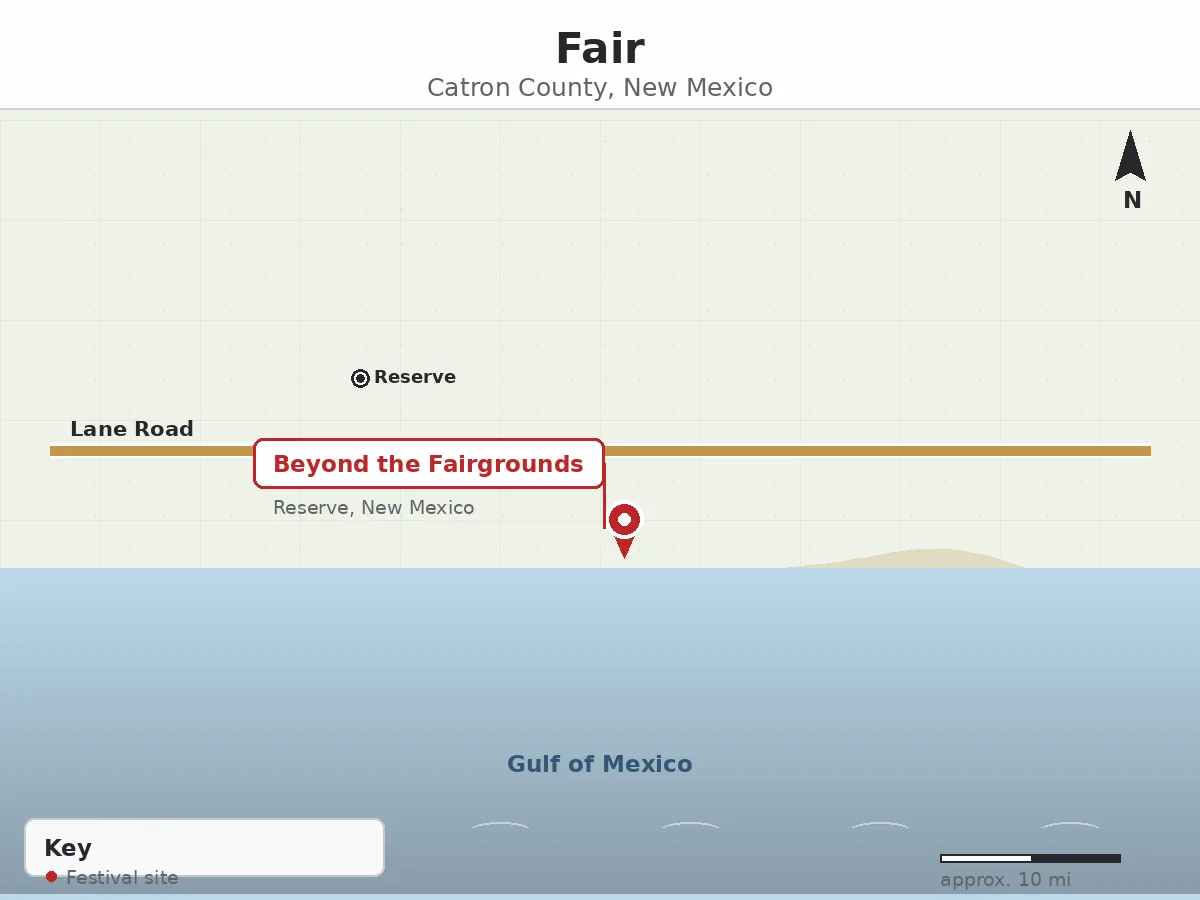
It is held at the Catron County Fairgrounds, 73 The Lane Road, in Reserve, which is also the county seat — the fair town and the seat are the same community. It is run by the county’s fair board, whose papers also style the body the Catron County Fair Association; the two forms are one organisation, and New Mexico State University Cooperative Extension for Catron County partners on the 4-H programme without organising the fair.
Has the fair published what entry costs?
The honest answer is that the fair’s record does not say. No admission, gate or parking price is published by the fair board, the county or Extension, so this article neither calls the fair free nor invents a figure. The only price anywhere in the record is the ranch rodeo’s five-hundred-dollar entry for a four-man contestant team, cash only — a fee for competing, never a cost of attending.
Is there a carnival or concerts at the fair?
None appears in the fair’s own record. The documented programme is the Ranch Rodeo, the Junior Rodeo, livestock and exhibits under the board’s rules, 4-H showing and, from 2026, a royalty programme. No midway, carnival or concert bill is published by the board, and visitors should not travel expecting one on the strength of template listings elsewhere.
Can I exhibit or compete if I live outside the county?
The fair’s rules contemplate it directly. The 2026 Catron County Fair Rules and Regulations set exhibitor-eligibility terms in tiers — in-county, out-of-county and out-of-state — so outside exhibitors are a defined category, governed by the current document rather than by custom. Read the current rules and use the fair’s own entry forms, since the board revises the document and the terms move with it.
What to Expect From the Next Catron County New Mexico Fair Festival
How often is the Catron County New Mexico Fair Festival held?
On its documented record it is an annual county fair: the board works to a yearly cycle of rules revision, meetings and a late-August edition, and the 2026 fair stands in that cycle as a current, county-noticed event.
When is the next Catron County New Mexico Fair Festival?
Expect the next edition in the fair’s established season, late August, across five days from Wednesday to Sunday, unless the board publishes otherwise. The season is the stable fact; the specific span for a future year rests on the board’s and the county’s own notices, which is where it should be confirmed.
Will the dates change?
They are set year by year, not fixed to the calendar. The fair’s anchor is late August rather than a settled span, and each edition’s exact days come through the board’s work and the county’s notices, so a future fair may begin earlier or later within that late-summer window than the last one did.
A Fair at Its Real Scale
The Catron County Fair asks to be taken as it documents itself: a five-day, late-August county fair in Reserve, run by a named volunteer board out of its own fairgrounds, with working rodeos, judged livestock and exhibits, 4-H showing and a royalty programme in its first year. It publishes no gate price and claims no founding year, and this article has supplied neither. What it does publish — its officers, its rules, its revisions and its dates — is enough to plan a trip on, and enough to show a small county running its fair in the open.