Cassia County Idaho Magic Valley Folk Festival
For one stretch of high summer, Burley becomes a meeting place for dance traditions that have travelled a very long way to share a single stage. The Magic Valley Folk Festival brings international performing groups to Cassia County for a week of workshops, school performances and evening galas, and it does so in a town that serves as the county seat. What the published record offers is a clear shape — a July week anchored at a high school arts centre — alongside some honest gaps, including the absence of any printed ticket price and of day-specific dates for the most recent years.
About
The published name is Magic Valley Folk Festival, the form carried by a chamber layer from the Mini-Cassia Chamber of Commerce and by a local television news layer. The festival carries a former name as well: the chamber layer describes the event as “formerly known as Idaho International Dance Festival,” and that older name is recorded here strictly as a former name, never as a second festival running alongside the present one.
Burley is the host town, and Burley is the county seat of Cassia County, a point the chamber’s own cities page states plainly and encyclopedic layers support. One component of the week sits outside the host town entirely: the opening parade kickoff is held in Rupert, which lies in neighbouring Minidoka County. Rupert is a component location in the record, nothing more, and the festival is not relocated there.
No layer read names a distinct organiser body for the festival. The chamber promotes the event and sells its tickets, and the chamber layer directs readers onward to the festival’s own website for more. That promotional and ticketing role is all the record supports; who formally organises the week is a stated gap, and no organiser is invented here to fill it.
Quick Facts
| Item | What the record shows |
| Published name | Magic Valley Folk Festival, in chamber and television news layers |
| Former name | Idaho International Dance Festival, per the chamber layer’s “formerly known as” wording |
| Host town | Burley, the county seat of Cassia County |
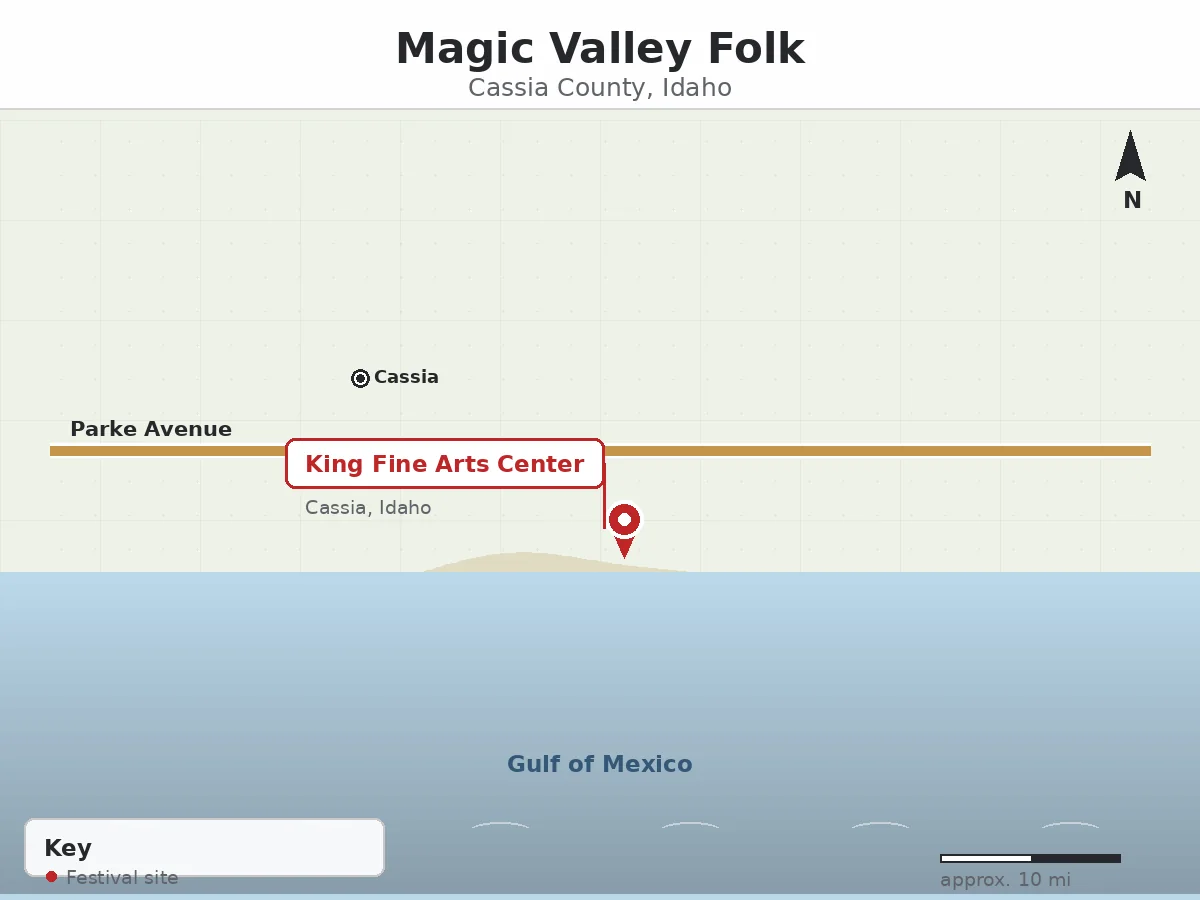
| Main venue | The King Fine Arts Center at Burley High School (chamber layer) |
| Opening component | A parade kickoff in Rupert, in neighbouring Minidoka County |
| Timing | The third week of July (chamber layer); six days in July per a regional destination layer |
| Recent dated record | A television news layer reported it “coming soon” on July 16, 2024 |
| Tickets | Sold at the door before galas, through the chamber and a local book store; no price printed in any layer read |
| Performer claim | As many as two hundred performers, a chamber claim about performers rather than spectators |
| Public face | The Mini-Cassia Chamber of Commerce promotes the festival and sells tickets; no organiser body is named |
History
The written history of this festival is shorter than its actual history probably is, and the difference matters. No layer read states a founding year, and this article does not supply one. The single piece of historical framing the record contains comes from the chamber layer, which calls the event “the fifteenth anniversary of this amazing event formerly known as Idaho International Dance Festival.” That sentence is recorded here exactly as the framing it is. No year is attached to the chamber page in the text read, so the anniversary cannot be placed on a calendar, and it is not converted into a start year by arithmetic.
For a useful comparison, see the Caribou County Idaho Soda Springs Fall Festival for another county festival.
What can be said from the layers is structural rather than chronological. At some point the event stopped travelling under the Idaho International Dance Festival name and took up the Magic Valley Folk Festival name, and the chamber layer treats the two as one continuous event rather than as a death and a birth. Beyond that, the documentary trail is thin: a state arts agency listing carries the festival, a regional destination layer describes it, and local television news has reported it as an approaching fixture of the July calendar. A reader looking for founders, first lineups or a year-by-year chronicle will not find them in these layers, and pretending otherwise would manufacture a past the sources do not contain.
What to Expect
The week opens away from the main stage. The chamber layer gives the festival a parade kickoff in Rupert, the neighbouring county’s town, before the programme settles into Burley. A regional destination layer describes “non-stop action over six days in July, starting with a parade,” and it also supplies the festival’s core image: international performing groups appearing in song, dance and traditional dress.
The daytime centre of the week is Youth Culture Day at Burley High School, where workshops and school performances run at the King Fine Arts Center. The chamber layer times those sessions from 10:00 a.m. to noon and again from 1:00 to 3:00 p.m., a split day that leaves the middle hour open. The evenings belong to the gala performances, which begin with a pre-show at 6:30 p.m. ahead of a 7:00 p.m. performance. Friday night is the week’s deliberate variation: the chamber layer notes that Friday’s performance is a wholly different show, built from new dances and new music rather than a repeat of an earlier evening. A ticket-resale layer prints an address for the centre on Parke Avenue; that is a weak resale layer’s form only, recorded as such, and it is not treated as the chamber’s own statement of the venue.
Planning Your Visit
Begin with the one firm anchor the record gives you, which is the third week of July. Within that week, the pattern of days matters more than any single date: Youth Culture Day sessions occupy the late morning and early afternoon, and the galas own the evenings, so a visitor can plausibly do both in the same day. Anyone hoping to catch both gala programmes should protect Friday evening, since its show is deliberately different from the others.
Tickets exist, and the chamber layer names the routes to them: they are sold at the door before gala performances, through the chamber, and at a local book store. No ticket price is printed in any layer read, so no price is quoted here, and the festival should not be described as free. Resale listings for other events at the King Fine Arts Center are not this festival’s prices and say nothing about its admission. Exact dates for the coming edition, when they are set, are the kind of detail the festival’s own website carries, according to the chamber layer that points readers there.
A Sample Itinerary: The Documented Shape of the Week
The itinerary below follows the week’s documented structure as the chamber layer gives it. It is expressly not a dated edition, because no day-specific dates were captured for any recent year in the layers read.
- Opening: travel to Rupert for the parade kickoff that starts the week, then return to Burley, which hosts everything that follows.
- A Youth Culture Day morning: reach the King Fine Arts Center for the workshop and school performance session running 10:00 a.m. to noon.
- Midday: take the open hour between sessions for lunch in Burley before the afternoon session begins at 1:00 p.m.
- Afternoon: stay for the second Youth Culture Day session, ending at 3:00 p.m., then keep the late afternoon uncommitted.
- Evening: arrive for the 6:30 p.m. pre-show and settle in for the 7:00 p.m. gala performance.
- Friday evening: return for the Friday gala, a wholly different show with new dances and music, rather than assuming a repeat.
- Across the week: treat the destination layer’s six-days description as the outer frame and let the festival’s own published schedule fill in the remaining days.
How This Festival Compares
The name invites one confusion worth clearing away at once. The Magic Valley Festival of Giving, held in Twin Falls in November, is an unrelated charity event that happens to share the regional words Magic Valley. It is not a sister event, not an offshoot and not part of this festival’s record, and nothing about it is imported here.
Set against the wider run of county festivals, this one is unusual in two respects. Its stage programme is international by design, with visiting groups performing in traditional dress, yet its documentary footprint is modest: no printed prices, no firmly dated recent edition in the layers read, and no named organiser. It also spreads itself across a county line, opening with a parade in Minidoka County before settling into its Cassia County home, which makes Burley the host in fact even though the week begins elsewhere.
Week-of-Visit Checklist
- Confirm the exact July dates on the festival’s own website before booking travel, since the layers read give only the third-week pattern.
- Plan Rupert as a separate trip for the parade kickoff, not as part of a Burley day.
- Hold Friday evening open for the gala that the chamber layer describes as a wholly different show.
- Buy gala tickets at the door, through the chamber, or at the local book store the chamber layer names.
- Keep Youth Culture Day’s split hours in mind: sessions end at noon and resume at 1:00 p.m.
- Do not budget around any ticket price found on a resale site; no official price appears in the record.
- Remember that the two hundred figure in the chamber layer counts performers, not the size of any audience.
Beyond the Festival Week
Burley carries its county-seat role year-round, and the King Fine Arts Center at Burley High School is a working school arts venue outside festival week as well, hosting events that have nothing to do with this festival. That distinction matters when reading listings: an event at the centre is not automatically part of the folk festival, and resale pages for the hall’s other programmes belong to those programmes alone. Rupert, for its part, enters this story only at the opening parade; the rest of its calendar is its own. For a visitor, the practical consequence is simple: the festival week is the moment when the hall, the workshops and the visiting companies coincide, and outside that week the same buildings serve quieter, separate purposes.
Why the Festival Matters in the Magic Valley
A chamber claim puts the performer count at as many as two hundred, and even treated carefully — as a claim, about performers, from a promotional layer — it sketches the festival’s scale on stage. For a county seat of Burley’s size, a week in which school students share a building with international companies is a significant piece of cultural infrastructure. Youth Culture Day is the clearest expression of that: workshops and school performances place local students inside the programme rather than leaving them in the audience. No spectator attendance figure is published in any layer found, so the festival’s reach has to be judged by its structure — six days in the destination layer’s description, two different gala shows, sessions built for schools — rather than by crowd numbers nobody has put on record.
Frequently Asked Questions
Was the festival always called the Magic Valley Folk Festival?
No. The chamber layer describes the event as “formerly known as Idaho International Dance Festival,” so the present name replaced an earlier one. The former name belongs to the same single event’s past; it is not a separate festival, and the record does not support building it a separate history of its own.
Why are there no exact dates or ticket prices to plan around?
Because the layers read do not print them. The chamber layer fixes the timing as the third week of July and names where tickets are sold — at the door before galas, through the chamber and at a local book store — but no ticket price appears anywhere in the record, and no firmly dated edition with day-specific dates was captured for 2025 or 2026. Those details are the kind the festival’s own website carries, and they are not guessed at here.
Does everything happen in Burley, or does part of the week start somewhere else?
Most of the week is in Burley, the Cassia County seat, at the King Fine Arts Center. The exception is the opening parade kickoff, which takes place in Rupert, a town in neighbouring Minidoka County. Rupert hosts that one component only; it is not a co-host town, and the festival’s home remains Burley.
Who organises the festival?
The record does not say. No distinct organiser body is named in any layer read. The Mini-Cassia Chamber of Commerce promotes the festival and sells its tickets, and its layer points readers to the festival’s own website, but promotion and ticket sales are not the same thing as organisation, and the chamber is not promoted into a role the sources do not give it.
What to Expect From the Next Cassia County Idaho Magic Valley Folk Festival
How often is Cassia County Idaho Magic Valley Folk Festival held?
The documented rhythm is a single July gathering each year, placed in the third week of the month by the chamber layer and described by a regional destination layer as six days of activity starting with a parade. The pattern is consistent across the layers read, even though those layers stop short of pinning recent editions to exact calendar dates.
When is the next Cassia County Idaho Magic Valley Folk Festival?
No dated future edition appears in the record. Going by the chamber layer’s third-week-of-July pattern, the next edition would be expected in that same July window, but expectation is not announcement. Firm dates are the kind of detail the festival’s own website publishes, and until they appear there, no specific days should be treated as confirmed.
Will the dates change?
They could, in the limited sense that the record never fixes them very far in advance. The third week of July is a stated pattern rather than a guarantee, the destination layer’s six-days description leaves the exact span open, and earlier layers give no day-specific dates at all for the most recent years. Checking the festival’s own published schedule remains the only reliable way to lock a trip down.
Closing
The Magic Valley Folk Festival asks a little more of its readers than most festivals do, because its record is a shape without a price list or a pinned calendar. What is documented is worthwhile: an international week of dance and music, a youth programme at its centre, two distinct gala shows, and a name that carries an earlier identity behind it. The gaps — no founding year, no named organiser, no printed prices, no firmly dated recent edition — are stated here rather than papered over, so that what the festival claims for itself and what others claim for it can be weighed on their merits.

One Comment