Butler County Alabama Medieval Festival
Butler County’s medieval festival is the Alabama Medieval Fantasy Festival at Greenville, a costumed gathering built around jousting, craft demonstrations, music, and market stalls on rural grounds outside the town centre. It held its last verified edition in 2024, and no later holding has been documented.
That point matters most, because the festival’s own website now says there would be no faire in 2025 and that the site is for sale. This article is therefore a record of a finished event, not a guide to a coming weekend. Greenville anchors the story, as both host community and county seat.
About the Festival
The Alabama Medieval Fantasy Festival presented itself as an immersive historical fair rather than a street festival with a medieval theme added at the edges. Its grounds suggested an earlier settlement, and its entertainment mixed combat, skilled work, performance, and trading to fill a full day outdoors.
No event is literally named Butler County Medieval Festival, yet the City of Greenville lists the Alabama Medieval Fantasy Festival on its own Community Events page, which is why it stands as the county’s medieval festival for practical purposes. The article carries the queue title, while the event is presented inside under its own name.
The organiser appears in its own materials in several exact name forms that should not be blended into one invented version. The public name is Alabama Medieval Fantasy Festival, shortened in its own usage to ALMFF, while the legal form printed in its 2023 merchant application reads OAKSENJ INC. (DBA ALABAMA MEDIEVAL FANTASY FESTIVAL), a wording that shows the business sitting behind the pageantry.
For a useful comparison, see the Bullock County Alabama Arts and Crafts Festival for another county festival.
Two contacts were named in that application, with Nancy Ardoin listed for merchant information and Deborah Haire for vendors. A state magazine portrait named the royal personae and explained that the queen shared the land with her real-life husband Greg Ardoin, styled as King Gregory the Grey.
Quick Facts
| Item | Detail |
| Festival name | Alabama Medieval Fantasy Festival |
| Host town | Greenville |
| County | Butler County, Alabama |
| County seat | Greenville |
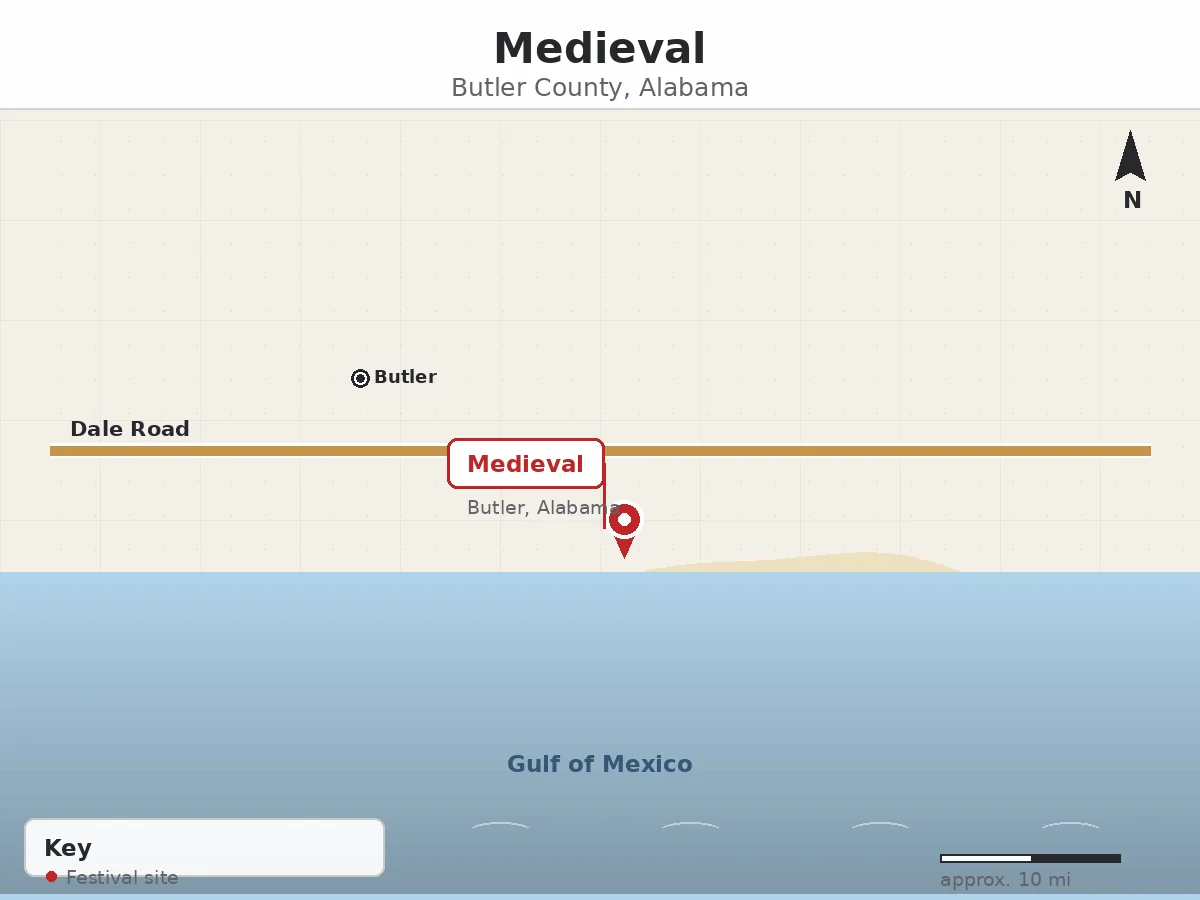
| Grounds address as published | 4776 Fort Dale Rd. Greenville, Al 36037 |
| Grounds setting | More than thirty-five acres about five miles from downtown Greenville |
| Name used inside the grounds | Kingdom of Dragon Croft |
| Last verified edition | Saturday March 2 and Sunday March 3 2024 |
| Present status | No faire hosted in 2025, with the site offered for sale |
History
The surviving public record is strongest near the end of the festival’s life, when regional coverage described a mature event with an established audience rather than a tentative first attempt. A state magazine feature written ahead of the March 2024 gathering billed that edition as now in year seven, and that billing is recorded here exactly as printed without turning it into a calculated founding date.
Year seven, in that phrasing, tells readers that organisers and audience understood 2024 as part of a sequence with depth behind it. It does not prove when the first edition happened or how it compared with the developed fair of 2024.
By 2024 the festival had a defined home, royal characters, a merchant structure, and a site identity separate from its legal address. The grounds carried the invented name Kingdom of Dragon Croft, layering a fictional kingdom over a real Butler County address. The 2023 merchant application added NO MAIL HERE for the site address and gave a separate mailing office in Theodore, Alabama, while the current website footer gives the same grounds address.
Recognition had also arrived from closer to home, according to the magazine account, which reported that the local paper had given the festival two Best in Butler (County) Readers’ Choice Awards. One named it Best Local Attraction and the other named it Best Local Event, although the account does not state the year of those honours and no year should be attached to them here.
Against that evidence of local standing, the ending arrived with unusual directness because it came from the festival rather than from rumour or a lapsed listing. The current notice on its own website states that a faire would not be hosted in 2025, announces that the site is for sale, and bids farewell with the line Fair winds and following seas to all who made the magic happen. No 2025 edition and no 2026 edition has been documented, which leaves 2024 standing as the final verified chapter.
What to Expect
Anyone picturing the festival should picture the 2024 edition specifically, because that weekend is the benchmark the evidence supports. Public gates on both Saturday March 2 and Sunday March 3 ran from ten in the morning until five in the afternoon, and the event was presented as going ahead rain or shine.
Combat supplied the loudest spectacle, with jousting matches and sword fights giving visitors a clear focal point between wandering the lanes. Those set pieces offered the scene many people hope to find at a medieval fair, where armour, choreography, and crowd reaction combine into a lasting memory.
Quieter skills balanced the arena through blacksmithing and other historical demonstrations showing how objects were made rather than merely how warriors fought. Watching hot metal worked by hand gave the day a slower rhythm and reminded visitors that medieval life involved labour far more often than battle.
Merchants and craftspeople filled another large part of the experience, and food kept families on site through the middle of the day. Medieval games, face-painting, dance, and song widened the appeal beyond committed history enthusiasts, so children, casual visitors, and devoted costumed regulars could each find a different route into the same grounds.
The magazine framed the recreated setting as life of 800 A.D., a broad evocation rather than a museum claim. Accuracy mattered most in demonstrations, while the wider grounds aimed for atmosphere and the pleasure of stepping outside the present century. Rain or shine billing also meant sturdy footwear, because the lanes were real Butler County ground before they were scenery.
Planning Your Visit
There is no festival visit to plan at the Greenville grounds now, and pretending otherwise would mislead anyone hoping to attend a future edition. The land connected with the Alabama Medieval Fantasy Festival is not open as a faire following the organiser’s closure notice, so a drive to the published address should not be treated as a way to tour the Kingdom of Dragon Croft.
What remains possible is a visit to Greenville itself, approached as the living county seat that hosted the event rather than as a substitute festival site. Time in town gives context for the fair’s scale and helps explain why a rural property a few miles out could draw a regional crowd.
Anyone hoping for news should watch the festival’s own channels rather than trusting undated listings that recycle old dates as fresh announcements. Only the organiser can confirm a revival, a sale outcome, or a new event on the land, and none is promised by the closure notice.
Preserving personal records is another practical step, because programmes, photographs, and merchant receipts may become the clearest evidence of what an edition felt like. Travellers passing through Butler County should build plans around places currently operating, keeping the festival as local history rather than as a reason to set a date.
A Day at the 2024 Edition, Hour by Hour
A representative day in 2024 might have begun before the ten o’clock opening, when costumed staff and merchants finishing their stalls created a sense of a settlement waking up. Entering at the start gave a family the full seven hours and avoided a rushed afternoon.
Late morning suited a first circuit of the Kingdom of Dragon Croft, noting where food and crafts clustered and stopping for blacksmithing before the lanes grew busier. That loop also helped children choose games or face-painting to revisit later.
Midday gathered around food, music, and merchants, with dance and song at the social heart of the site. A visitor could eat and browse handmade work while listening for announcements drawing the crowd toward the next staged action.
The afternoon lent itself to the headline spectacles, especially jousting and sword fights. Watching them after a morning among craftspeople created a useful contrast, because the same imagined world produced cloth, tools, and cooking alongside armour and weapons.
By the final hour before the five o’clock close, the pace was a last purchase, one more game, and a slow walk through familiar lanes. Leaving with the crowd carried its own satisfaction, part tiredness and part reluctance to hand the borrowed century back.
How Greenville’s Medieval Weekend Compared
Compared with a county fair built around agriculture judging and midway rides, this festival asked visitors to enter a story as well as attend an event. Livestock barns celebrate a county’s present working life, whereas the Greenville grounds rearranged a rural property to suggest a settlement from many centuries earlier.
It also differed from a purely theatrical performance because trading, making, eating, and playing occupied as much ground as scripted encounters. A visitor who never followed the royal personae could still enjoy merchants and demonstrations, while a visitor drawn by combat could treat the market as colour around the arena.
Against a museum exhibition, it traded quiet labels for weather, noise, dust, and direct conversation with people practising older skills. That openness made the experience less tidy but more social, especially for children learning by watching sparks rise and asking questions in the moment.
A Checklist for Readers and Former Visitors
- Accept the closure notice at face value and remove any assumed 2025 or 2026 date from your plans.
- Keep the festival’s own website at the centre of any revival check rather than relying on copied event listings.
- Record the year on your own photographs from Greenville so family memories stay attached to the correct edition.
- Save programmes, merchant cards, and artwork labels while those paper traces are still easy to find at home.
- Note the exact organiser name forms if you research old applications or coverage, and do not merge them into one name.
- Treat any admission figure attached to an Irongate event as belonging elsewhere, since no Greenville admission price has been verified here.
- Plan any present-day Greenville trip around places confirmed open at the time, with the festival kept as background history.
- Share closure information with friends who may still expect the faire to return automatically each March.
- Remember the 2024 dates as the last verified holding when you describe the festival to others.
Beyond the Festival
Greenville itself remains the natural extension of the story, because the county seat supplied the festival with its local audience and the roads that brought visitors out to Fort Dale Road. Exploring the town with that connection in mind shows how a modest community can host an idea much larger than its population.
Butler County’s wider appeal rests on small towns, rural distances, and wooded land, the same setting that made an outdoor historical fair plausible there. The drive through the county was part of the experience long before the first sword was lifted.
Former merchants and performers carry the festival beyond its grounds, since the skills displayed at Dragon Croft continue in workshops, markets, and other fairs. Closure ends a gathering place, but it does not erase the network of makers who learned, traded, and performed there.
For history keeping, the merchant application, magazine coverage, municipal listing, and closure notice form a compact archive. Together they prevent the festival from shrinking into a vague memory of people in costumes somewhere near Greenville.
Why the Greenville Faire Mattered
The festival mattered because it gave Butler County an attraction unlike the agricultural and musical events dominating many rural calendars, proving historical imagination could draw a crowd outside a small county seat. Its local awards point to affection at home, often harder to earn than a single visit from outsiders.
It also created a temporary meeting ground where merchants, demonstrators, performers, families, and costumed enthusiasts depended on one another to make the illusion work. Remove any group and the kingdom thins, so the achievement lies in coordination as much as in any joust or song.
Finally, the clarity of its ending gives the story unusual completeness, even though regulars may regret it. The organiser thanked those who made the magic happen rather than letting dates quietly lapse, leaving a definite point where gratitude and disappointment meet.
Frequently Asked Questions
Did the Alabama Medieval Fantasy Festival really close after the March 2024 weekend in Greenville?
Yes, on the evidence published by the organiser, because its own website later announced that no faire would be hosted in 2025 and that the site was for sale. No later edition has been verified, so March 2024 remains the last confirmed holding.
Why does a Butler County title sit on a festival with a different public name?
The queue title describes the county and the type of event, while Alabama Medieval Fantasy Festival is the name the organiser actually used. Greenville’s own Community Events page listed that festival, which makes it the documented medieval festival belonging to Butler County.
Which parts of the 2024 programme would a first-time visitor have noticed most?
Jousting and sword fights supplied the biggest spectacles, but the texture of the day came equally from blacksmithing, historical demonstrations, merchants, food, medieval games, face-painting, dance, and song. The grounds presented those elements as a recreated settlement rather than as isolated acts on a stage.
Could the Greenville faire come back under the same organiser one day?
Nothing in the closure notice promises a return, and the statement that the site is for sale points away from a simple pause between editions. A revival is possible only as speculation until the organiser announces one directly, so readers should treat the festival as closed rather than resting.
What to Expect From the Next Butler County Alabama Medieval Festival
How often is Butler County Alabama Medieval Festival held?
It is not held at present, whatever rhythm its earlier editions may have followed before the organiser ended the run. The honest current answer is that there is no active schedule to describe, because the festival’s own notice cancelled any expectation of a 2025 faire.
When is the next Butler County Alabama Medieval Festival?
No next edition has been announced, and no date should be carried forward from the March 2024 weekend as if it were a placeholder. Anyone waiting for news needs a fresh statement from the organiser, not a recycled listing built from an old year.
Will the dates change?
The question has no practical dates to attach to while the festival remains closed and its site is offered for sale. If an organiser ever revived the event, every detail would need to be confirmed from that new announcement rather than inferred from the final verified edition in 2024.
The festival leaves Butler County a bounded story: a county seat, land renamed as the Kingdom of Dragon Croft, and a final verified gathering in March 2024. The respectful way to remember it is to honour both halves of its farewell, the magic and the ending.