Bibb County Georgia Macon-Bibb Hispanic Festival
Macon was a river town before it was anything else. The bluffs above the Ocmulgee gave traders a landing, the landing became a market, and by 1823 a grid of streets had been laid across the ridge and named for Nathaniel Macon, the North Carolina statesman. Bibb County had been created a year earlier and named for William Wyatt Bibb, and Macon became its seat. From there the town did what river towns do: it reinvented itself, first as a cotton port, then as a rail hub, and eventually as a recording city whose studios carried Southern soul and rock around the world.
That history now sits inside a single consolidated government. The city and county merged their operations in 2014, and the 2020 census counted 157,346 people living across Bibb County’s 255 square miles — a spread that runs from the historic core near Cherry Street and Cotton Avenue out through suburban subdivisions and rural stretches toward the county line. Almost everything that carries the Bibb County name happens within the city that shaped it.
The Macon-Bibb Hispanic Festival is one of the newer threads in that long weave. It belongs to a middle Georgia that has changed considerably over the past three decades, as Hispanic families put down roots in Macon and the surrounding towns, opened businesses, filled classrooms and congregations, and brought food, language, and music into the daily rhythm of a county that once thought of itself almost entirely in terms of cotton and chords.
Bibb County Georgia Macon-Bibb Hispanic Festival: The Essentials in One Table
Before the details, here is the short version — the facts a visitor needs to place the festival on a map and in a calendar.
| Host town | Macon, Georgia |
| County | Bibb County |
| County seat | Macon |
| County population | 157,346 (2020 census) |
| County land area | 255 square miles |
| Region | Central Georgia, on the Ocmulgee River |
| Typical timing | Held annually; the date is set each year by organizers |
| Admission | Typically free to attend, with food and goods sold by vendors |
| Setting | Central Macon, within walking distance of the historic downtown core |
| Signature features | Hispanic food stalls, live music and dance, family programming, craft and community vendors |
What the Macon-Bibb Hispanic Festival Actually Celebrates
The Macon-Bibb Hispanic Festival is a community-run celebration of Hispanic and Latino culture staged in the seat of Bibb County. Its purpose is straightforward: to make public, joyful room for traditions that Hispanic families in middle Georgia carry with them and pass on. That means food cooked on site, music loud enough to fill a block, dance performances, arts and crafts vendors, and programming built so children can take part rather than simply watch.
It is also unmistakably a Macon event. The festival draws its audience from a county of 157,346 people spread across 255 square miles, and that audience reflects the mix — Hispanic families who have been in Georgia for generations, newer arrivals, neighbors from across Bibb County, and day-trippers from Atlanta, Warner Robins, and the smaller towns that ring the county. Admission is typically free, which means money changes hands at food stalls and vendor tables rather than at a gate, keeping the day within reach for families with children in tow.
Because the festival is organized locally, its exact shape shifts from year to year. Vendors rotate, performers change, and the footprint expands or contracts depending on the site and the season. What stays constant is the formula: a plaza or closed street, a stage, a row of cooking smells, and a crowd that is as much neighborly as it is festive.
From River Crossroads to Main Street: Hispanic Life in Macon
To understand why a Hispanic festival fits Macon, it helps to remember how often the city has absorbed new arrivals. The Ocmulgee corridor was a trading and ceremonial center for centuries before the town existed. Nineteenth-century Macon grew fat on cotton moving downriver and later on rail lines that fanned out across the state. In the twentieth century, the city became a music capital, and the studios and clubs that grew here pulled in musicians, engineers, and entrepreneurs from well beyond Georgia.
The Hispanic presence in middle Georgia arrived on a different current. Beginning in the late twentieth century, families from Mexico, Central America, the Caribbean, and South America moved into the region for work in agriculture, food processing, construction, and services. Many settled first in rural counties and then gravitated toward larger towns like Macon, where schools, clinics, churches, and shops were within reach. Over time, that presence stopped being a story about labor and became a story about permanence: second-generation students, family-owned restaurants, bilingual congregations, quinceañeras, and neighborhood grocery stores stocking ingredients that were once hard to find.
Festivals tend to appear at the moment a community decides it wants to be seen. The Macon-Bibb Hispanic Festival grew out of that impulse — a desire among local families, business owners, and cultural organizations to claim a public square for a day, and to invite the wider county in. Early editions were modest affairs built on volunteer effort: borrowed sound equipment, folding tables, and food prepared by people who had been cooking for their own families for years. As the audience grew, so did the ambition, with fuller performance schedules, more vendor space, and programming designed to speak to both Spanish-speaking and English-speaking visitors.
The arc is familiar across the South, but the Macon version carries a particular character. This is a county that has always been proud of its own story — the mounds, the music, the historic houses — and the Hispanic festival has gradually been folded into that self-image rather than set apart from it. It sits alongside the city’s older traditions as one more thing Macon does in public, on the street, with food and music.
What a Festival Day in Macon Feels Like
Expect a walkable, open-air day. The festival is built for strolling, eating, and stopping to watch whatever is happening on the stage or in the middle of the street. Here is how the main pieces usually break down.
Food: Tacos, Tamales, and the Longest Lines of the Day
Food is the center of gravity. Vendors typically serve tacos, tamales, pupusas, elote, grilled meats, empanadas, and sweet items like churros and flan, alongside aguas frescas, horchata, and soft drinks. Some stalls are run by established Macon restaurants; others are one-day operations by home cooks who bring family recipes out for the occasion. Lines build fastest around midday and again in the early evening, so first-timers do well to eat early or late. Cash remains useful even where card readers are available, and smaller bills move faster in a crowd.
Music and Entertainment: Banda, Salsa, and a Stage That Never Sits Still
The performance schedule generally leans on live bands and dance. Regional Mexican styles such as banda and norteño share billing with salsa, cumbia, bachata, and contemporary Latin pop, and DJ sets often fill the gaps between acts. Folklorico dance troupes, youth performance groups, and local singers are common, giving the program a strong community flavor rather than a purely commercial one. Because the site is compact, the sound carries — you can hear the stage from the food row, which is exactly the point.
Family Activities: Kid-Friendly Corners and Hands-On Fun
Families are the core audience, so programming usually includes children’s crafts, face painting, games, and occasional piñata moments. Plazas and closed streets give kids room to move without traffic, and there are generally shaded spots where parents can park a stroller and take a breather. Bilingual announcements and signage are common, which matters in a county where many households move between two languages daily. If you are bringing young children, aim for the earlier part of the day when the heat and the crowds are milder.
Planning a Macon Weekend Around the Festival
Macon is easy to reach and easy to walk, which makes the festival a natural anchor for a fuller weekend in Bibb County. A few logistics are worth sorting out in advance.
Getting to Macon and Bibb County
Macon sits where Interstate 75 and Interstate 16 meet, roughly 85 miles south of Atlanta, with Interstate 475 offering a bypass around the city’s western edge. Drivers coming from Atlanta, Savannah, or Columbus will find the approach simple. The nearest major airport is Hartsfield-Jackson Atlanta International, about an hour and a half north depending on traffic. Once downtown, most festival activity is within walking distance, so many visitors park once and leave the car alone for the day.
Where to Stay in and Around Macon
Downtown Macon has a cluster of hotels within a short walk or ride of the historic core, which is the most convenient base if you plan to spend the evening at the festival. A second ring of chain hotels sits near the interstate exits, offering easier parking and lower rates at the cost of a drive in. The city’s historic districts also hold a number of bed-and-breakfasts and short-term rentals for travelers who want architecture with their overnight stay. Festival weekends fill rooms, so booking a few weeks out is wise.
Parking Downtown
Expect to use a parking deck, a surface lot, or metered street parking, then walk. Decks near the downtown core are the simplest option, and street closures around the festival footprint mean the closer you try to park, the more likely you are to hit a barricade. Arriving before the busiest hours makes everything easier. Rideshare drop-offs work well for anyone staying nearby, and they remove the end-of-night parking search entirely.
Admission, Food, and What Things Cost
Admission is typically free, which keeps the festival accessible and puts the spending where visitors choose it: food, drinks, crafts, and merchandise. Budget for a few food items per person, plus whatever the children talk you into at the vendor tables. Bringing cash in small denominations speeds up transactions, and a card is worth having as backup. Because prices are set by individual vendors, costs vary from stall to stall rather than following a single festival-wide scale.
Weather in Middle Georgia
Middle Georgia runs hot and humid through the summer, with mild, pleasant stretches in spring and autumn. Afternoon thunderstorms are a real possibility in the warmer months, often brief but heavy. Plan on sunscreen, a hat, and a refillable water bottle, and keep an eye on the forecast in the days before you go. Comfortable shoes matter more than anything else — the day involves far more standing and walking than most visitors expect.
A Sample Festival Weekend, Friday to Sunday
Friday evening. Arrive in Macon and check in downtown, then take an unhurried walk through the historic core. Grab dinner at a local restaurant — the city has a deep bench of Southern, soul food, and international kitchens — and get a feel for the streets you will be wandering the next day. If a Friday-night festival event is scheduled, treat it as a warm-up rather than the main course.
Saturday. Start early with coffee and a walk along the Ocmulgee River or through one of the historic districts while the air is still cool. Head to the festival late morning, eat before the longest lines form, and stay through the afternoon performances. Break for a rest at the hotel if the heat is heavy, then return in the evening when the stage is busiest and the crowd is at its most relaxed. Finish with a late dinner nearby.
Sunday. Take a slower morning — brunch downtown, a museum, or a drive out to the mounds east of the river. Use the afternoon to see the parts of Bibb County you missed on Saturday, then head home before the evening traffic builds on the interstate. If you have time for only one extra stop, choose the Ocmulgee Mounds; it is the county’s oldest story and the best possible counterweight to a weekend of modern celebration.
How Macon-Bibb Compares With Nearby Georgia Festivals
Visitors who have been to Hispanic celebrations in metro Atlanta will notice the difference in scale immediately. Atlanta’s events sprawl across multiple venues and draw crowds that require serious planning, shuttle rides, and patience. Macon’s version is a county-seat festival: compact, walkable, and possible to enjoy in a single afternoon without a strategy document.
Smaller communities to the south and east — Perry and Warner Robins in Houston County, Milledgeville in Baldwin County, and the towns along the I-75 corridor — host their own cultural and community events, often built around a fairground, a high school campus, or a single main street. Those gatherings tend to be intimate and hyper-local. Macon sits between the two scales: bigger and more varied than a small-town celebration, but far less overwhelming than anything in the metro.
The practical advantage is parking and proximity. In Macon you can park once, walk to the food, the stage, and a museum in the same afternoon, and be back on the interstate within fifteen minutes. That combination is hard to beat in a region where most large festivals require a full day of logistics.
Your Pre-Festival Checklist for Macon
Confirm the date and location through the festival’s official channels before you travel, since the schedule is set annually and street closures shift with it. Then pack for a warm-weather street festival: comfortable walking shoes, sunscreen, a hat, a refillable water bottle, and a light layer for the evening. Bring cash in small bills, a charged phone, and a portable battery if you plan to take photos all day.
Decide your parking plan in advance and pick a meeting point for your group in case cell service gets sluggish in the crowd. Leave pets at home unless the organizers have confirmed they are welcome, and check ahead if you need accessibility details or a quieter place to sit. Finally, keep the day flexible. Festivals like this one reward wandering — the best food stall is usually the one you did not plan to visit.
Staying Longer: Ocmulgee Mounds, Music, and More in Bibb County
Bibb County rewards an extra day. East of downtown, the Ocmulgee Mounds National Historical Park preserves earthworks built by Indigenous people centuries before Macon existed, and the visitor experience there is both quiet and genuinely remarkable. Downtown, the city’s music heritage is on display at Capricorn Sound Studios and in the story of the Allman Brothers Band, whose sound was forged in Macon clubs and studios.
Culture seekers can spend an afternoon at the Tubman Museum, one of the largest institutions in the country devoted to African American art, history, and culture, or tour the Hay House and the Cannonball House for a look at nineteenth-century Macon wealth and architecture. Outdoors, Amerson River Park and the Ocmulgee River greenway offer trails and river views, while Rose Hill Cemetery draws visitors for both its landscaping and its rock-and-roll graves. In spring, the city’s cherry blossom season transforms the historic districts into one long pink corridor.
What the Macon-Bibb Hispanic Festival Means to Middle Georgia
A festival is never only a festival. For Hispanic residents of Bibb County, a public celebration is a statement of belonging in a place where that belonging was once assumed to be temporary. For the county as a whole, it is an invitation to show up, eat, listen, and recognize neighbors who have been part of the community for years.
The economic effect is modest but real: food vendors, craft sellers, restaurants, and hotels all see a lift, and small businesses get a storefront-free audience for a day. The cultural effect runs deeper. Children see their language and traditions treated as an asset rather than a curiosity, and longtime residents get a version of Macon that reflects the county’s current population rather than its past one. In a place that has spent two centuries absorbing new arrivals, that is a familiar and healthy pattern.
Where in Macon the Festival Takes Place
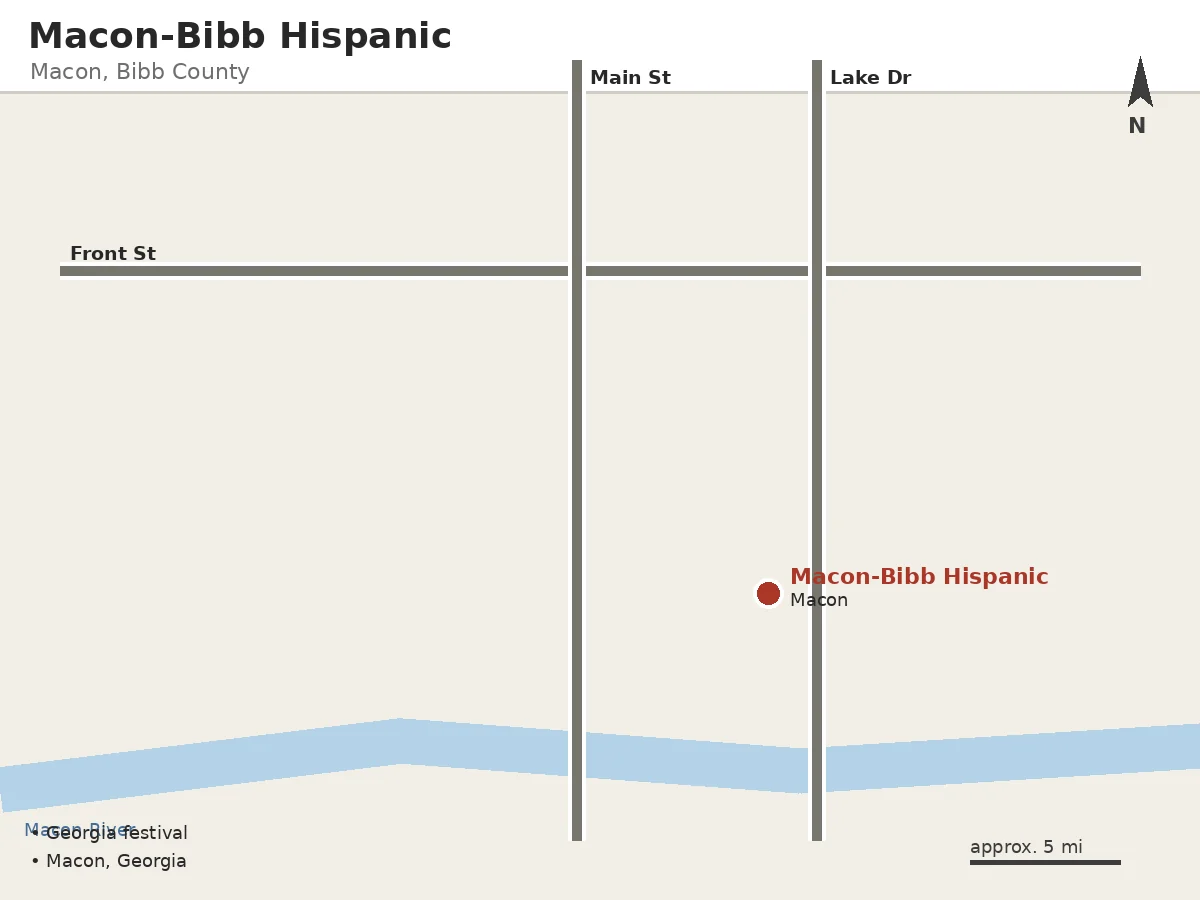
The Macon-Bibb Hispanic Festival is held in central Macon, Georgia, within the historic downtown core of the Bibb County seat.
Macon-Bibb Hispanic Festival: Practical Answers
Is the festival free to attend?
Admission is typically free. You pay only for what you buy — food, drinks, crafts, and merchandise from individual vendors. Because there is no gate charge, the festival stays accessible to families, and the money spent goes directly to the people running the stalls.
When does the festival take place each year?
It is held annually, with the date set by organizers and announced ahead of time. Because the timing is not fixed to a single weekend every year, the reliable approach is to check the festival’s official listings and the City of Macon-Bibb calendar before booking travel or requesting time off.
Where exactly in Macon should I go?
The festival takes place in central Macon, within walking distance of the historic downtown core. Exact streets and venues can change between editions, so confirm the current footprint on the official event page before you set out, especially if you are meeting people at the site rather than traveling together.
Is there parking near the festival?
Yes — downtown Macon has parking decks, surface lots, and metered street spaces. Street closures around the event mean the closest blocks may be inaccessible, so plan to park a few blocks away and walk. Arriving earlier in the day makes finding a space considerably easier.
Is the festival suitable for young children?
It is built with families in mind. Expect children’s activities, crafts, games, and plenty of open space to move around, plus food that most kids will happily eat. Strollers work well on the paved downtown streets, and earlier hours are easier for younger children than the crowded evening stretch.
Should I bring cash or card?
Bring both, but lean on cash. Many vendors accept cards, though smaller stalls and one-day operations sometimes do not, and cash in small denominations keeps lines moving. An ATM run in the middle of a festival crowd is never the plan you want.
Can I bring my dog?
Policies vary by venue and by year, so check with the organizers before assuming pets are welcome. Crowded food areas, loud music, and warm pavement are hard on animals regardless, and many visitors find it easier to leave dogs comfortably at home or at their hotel.
What if it rains?
Middle Georgia thunderstorms are often brief, and outdoor festivals typically continue through light rain while pausing for lightning or severe weather. Check the organizers’ social channels on the day for any schedule changes, and keep a light rain jacket or compact umbrella in your bag as insurance.
What Comes Next for the Festival in Bibb County
The festival’s future is tied to the county’s demographics and to the willingness of local organizations to keep funding and staffing a free public event. Bibb County’s population of 157,346, spread across 255 square miles, includes a Hispanic community that is now established rather than arriving, and established communities tend to expect more from their public celebrations: better stages, more vendors, more bilingual programming, and a site that can hold a growing crowd.
The likeliest direction is steady expansion rather than reinvention — a longer performance schedule, a wider vendor row, stronger partnerships with schools and downtown businesses, and closer ties to the city’s other cultural institutions. Downtown Macon has been investing in its walkable core for years, and a festival that fills those blocks fits the broader plan. For visitors, that means the fundamentals will probably stay the same: free entry, good food, live music, and a county seat that knows how to host a crowd.
Last updated: October 2026
Whether you come for the tacos, the banda, or simply the chance to see downtown Macon at its most animated, the Macon-Bibb Hispanic Festival offers something increasingly rare in American travel: a celebration that belongs to the people who live there, staged in a place with enough history to give it weight. Come early, eat well, stay for the music, and leave time for the mounds.

One Comment