Barnstable Massachusetts County Fair Festival
For seven days each July, the Cape Cod Fairgrounds in East Falmouth becomes the working heart of Barnstable County’s farm calendar. The Barnstable County Fair brings livestock barns, harness racing, exhibition halls and a full midway together on one ground, carrying forward a tradition that began in 1844. The sheet title behind this article adds a word the event itself never uses: every layer read prints the name as Barnstable County Fair, with no Festival attached. Readers searching under the longer title are looking for the same week-long fair, run by the Barnstable County Agricultural Society on its permanent home along Nathan Ellis Highway, where summer crowds trade beach hours for show rings, race calls and fried fair food.
About
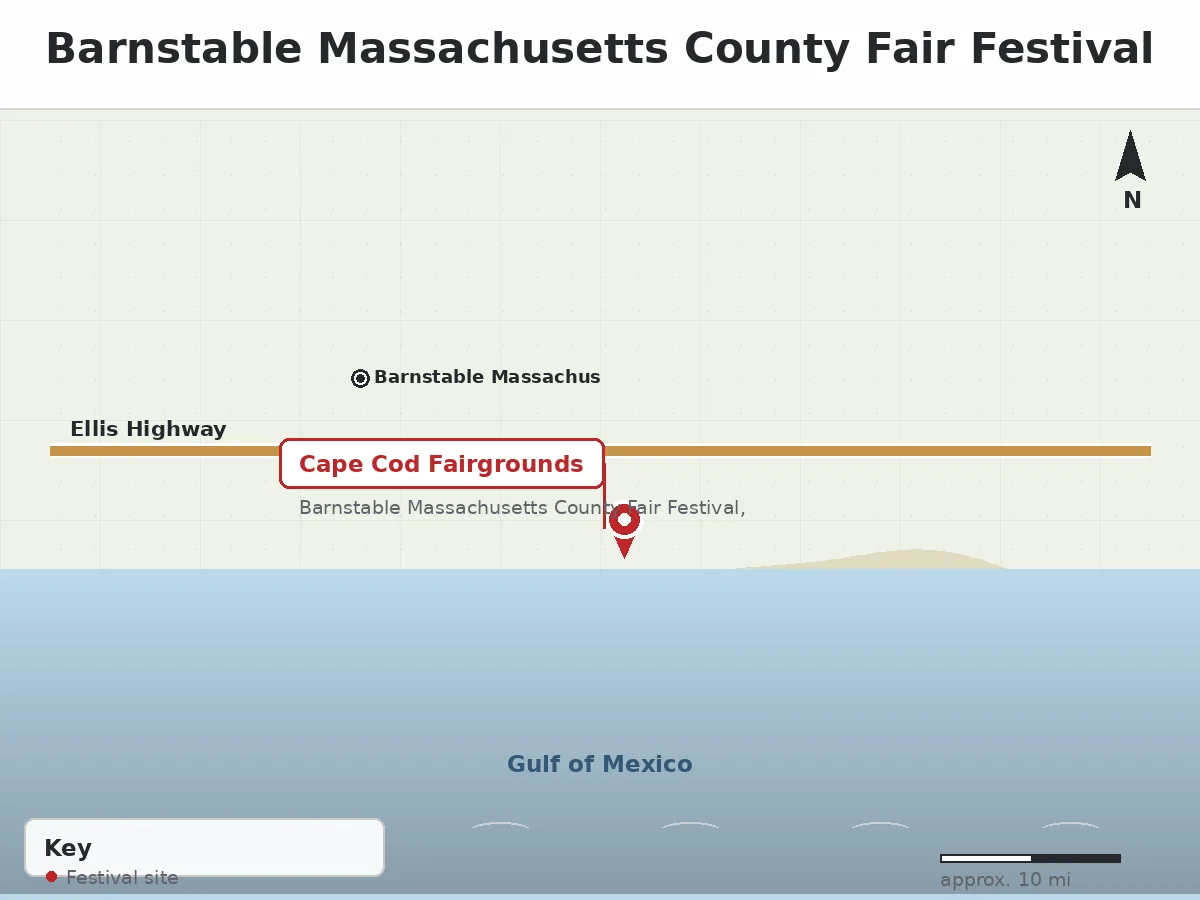
The published name is Barnstable County Fair, and it belongs to the Barnstable County Agricultural Society, Inc., the organiser named across the layers read. The fair’s home is the Cape Cod Fairgrounds in East Falmouth, reached by Nathan Ellis Highway, also signed as Route 151. East Falmouth hosts the week, but it does not hold the county seat; that honour stays with the town of Barnstable, where the fair’s own story began. The 2026 edition runs from Monday 20 July through Sunday 26 July, seven days in all. Weekday evenings open at four and close at nine from Monday to Thursday, while Friday and Saturday stretch from noon until nine at night and Sunday runs from noon to eight, with the midway staying open later than the posted gate hours. The 2026 week is the latest chapter in a long sequence: the society staged its one hundred seventh fair in July 1973, the first held on the present fairgrounds, and the only modern interruption came in 2020, when the fair was not held because of the COVID-19 pandemic. Across its seven days the fair mixes the oldest elements of the county-fair form with modern fairground spectacle. Livestock shows and judged exhibits sit alongside harness racing, a demolition derby and more than fifty midway rides, and the whole programme is framed by the agricultural society that owns the ground and has presented the fair since the middle of the nineteenth century.
Quick Facts
| Item | Detail |
| Published name | Barnstable County Fair |
| Host town | East Falmouth, Massachusetts |
| County seat | Barnstable (East Falmouth is not the seat) |
| Venue | Cape Cod Fairgrounds, Nathan Ellis Highway (Route 151) |
| Organiser | Barnstable County Agricultural Society, Inc. |
| 2026 dates | Monday 20 July to Sunday 26 July 2026 |
| 2026 hours | Four to nine Monday to Thursday; noon to nine Friday and Saturday; noon to eight Sunday; midway later |
| Admission 2026 | Twenty dollars per day; fifteen dollars for sixty-five and older or military identification; ten dollars for children six to eleven with a paid adult; five and under free |
| Established | 1844 |
| First fair at current fairgrounds | The one hundred seventh fair, July 1973 |
History
The fair’s roots reach back to 1844, when it began as a gathering of farmers who brought their prized livestock and handcrafts to show at the County Courthouse in Barnstable Village. That courthouse setting placed the young fair in the county seat itself, among the farmers whose work it existed to celebrate. A show that started with animals and handmade goods judged in a civic yard carried the county’s agricultural pride in its simplest form: neighbours comparing cattle, crops and craft, and going home determined to do better the following year.
Over the generations that followed, the exhibition grew well beyond a courthouse yard. For a long stretch the fair was held at Marstons Mills, on the grounds of the Cape Cod Airfield, where livestock judging and handcraft displays shared space with the routines of a working airfield. The move that defines the modern fair came in the spring of 1973, after the society purchased the former Chesterbrook School property in Falmouth. That July, the one hundred seventh fair opened on the new ground, the first edition staged at what is now the Cape Cod Fairgrounds.
The Falmouth site gave the society room it had never owned before: space for a half-mile harness racing oval, livestock barns, exhibition halls and a midway broad enough for dozens of rides. Through the decades since, the fair has kept its agricultural core while the grounds around it matured into a permanent fairground rather than a borrowed field. The single break in the modern run came in 2020, when the pandemic forced a year without a fair. Layers describing the event call it one of the oldest agricultural fairs in New England, a standing earned through more than one hundred eighty years of continuity, surviving changes of venue, century and custom alike.
For a useful comparison, see the Worcester County Maryland Wine on the Beach Festival for another county festival.
What to Expect
Agriculture still leads the programme, and the barns are the fair’s centre of gravity. Agricultural exhibits and livestock shows run through the week, with animals presented by the farmers and young handlers who raised them. The 4-H youth competitions give that work its next generation, and the 2026 schedule includes a 4-H Dog Showcase on Thursday 23 July, where young handlers put their dogs through their paces in front of a crowd. Exhibition halls carry the handcraft and produce side of the tradition, the direct descendant of those first courthouse displays in Barnstable Village.
Beyond the barns, the fairground’s oval hosts harness racing, trotters and pacers circling the half-mile track in the sport’s old county-fair tradition. Wednesday 22 July 2026 brings the week’s loudest hour, a demolition derby with up to fifty drivers set to crumple metal in the infield. The midway supplies the modern fairground noise: more than fifty carnival rides, games and lights that stay on after the gates’ posted closing. A main stage carries live entertainment across the week, and fair food threads through everything, from the stands along the midway to the vendors near the barns. A visitor can move from a quiet livestock aisle to a race call to a spinning ride within a few minutes’ walk, and that contrast is the fair’s signature.
The judging deserves a slower look than most visitors give it. In the show rings, animals are assessed against the standards of their breeds, and the ribbons awarded there close out months of feeding, grooming and practice for the families involved. The exhibition halls run a parallel contest for the county’s makers, where handcrafts and garden produce are laid out for the judges in rows. Between the rings and the halls, the fair keeps a double character: part competition, part celebration, with the competitive half taken entirely seriously by everyone who enters it.
Planning Your Visit
Pick your day against the clock first, because the 2026 hours change shape across the week. Monday through Thursday are evening fairs, opening at four and closing at nine, which suits visitors who spend the day elsewhere on the Cape and arrive for the cooler hours. Friday and Saturday open at noon and run to nine, and Sunday runs noon to eight, so weekend days allow a full afternoon in the barns before the evening programme. The midway stays open later than the posted hours, which rewards anyone who saves the rides for last.
Admission for 2026 is twenty dollars per day at the gate. Visitors sixty-five and older, and those showing military identification, pay fifteen dollars. Children aged six to eleven enter for ten dollars when they come with a paid adult admission, and children five and under enter free. Ride tickets on the midway are sold separately from admission, so a family that plans heavy riding should budget for both parts of the day rather than treating the gate price as the whole cost. Two dated anchors help shape a plan: the demolition derby falls on Wednesday 22 July, and the 4-H Dog Showcase on Thursday 23 July, so an evening visit aimed at either one should be fixed before the week begins. Anyone travelling to the fairground should aim for Nathan Ellis Highway, the Route 151 corridor where the Cape Cod Fairgrounds stands, and should expect the grounds to be busiest on the full weekend days and around the headline events. A sensible order for any visit is barns and exhibition halls first, while attention is fresh, then the oval and the stage, and the midway last, saving its lights for the end of the evening.
A Sample Thursday at the Fair
A weekday evening visit in 2026 might run like this. Arrive at the Cape Cod Fairgrounds as the gates open at four, while the light is still good, and walk the livestock barns first, when the animals are being fed and settled and the aisles are at their calmest. From the barns, drift to the 4-H Dog Showcase, the Thursday highlight, and watch young handlers work their dogs with a seriousness that belies their age. Take supper from the food stands after the showcase, choosing among the fairground staples along the midway. Spend the next stretch in the exhibition halls, where the handcrafts, produce and judged displays carry the fair’s oldest thread. As the evening deepens, claim a spot near the main stage for the live entertainment, then finish on the midway, which keeps spinning after the rest of the ground begins to close at nine. The drive home along Nathan Ellis Highway ends a compact evening that still touches every layer of the fair.
How the Fair Compares
The fairgrounds host other gatherings during the year, and the best known of them, the Naukabout Music Festival, is a different event altogether: a music festival that borrows the same East Falmouth ground without sharing the fair’s agricultural purpose. Set the two side by side and the distinction is plain. The music festival is built around stages and sets; the county fair is built around animals, judging and a society that has run it since 1844. Against other Massachusetts county fairs, Barnstable’s edition stands out for its age and its setting. Few fairs anywhere in New England can point to a founding in 1844, and fewer still occupy a permanent ground their own society bought and developed, with a harness racing oval and room for more than fifty rides inside the fence. The week’s shape also differs from the shorter weekend fairs common elsewhere in the state: seven days, weekday evenings included, give Barnstable’s fair the feel of a season in miniature rather than a single weekend’s outing, and let visitors choose between a quiet evening session and the full press of a Saturday crowd.
Beyond the Fairgrounds
The fair’s geography tells its own story even after a visitor leaves the ground. East Falmouth, in the town of Falmouth, holds the modern fair, but the event’s memory reaches across the county: to Barnstable Village, where farmers once showed livestock at the courthouse, and to Marstons Mills, where the fair shared ground with an airfield. A visitor with extra days can read the county through those three stops, courthouse village, old airfield ground and present fairground, and understand how a farm show grew into a week-long institution. The fair also sits inside a Cape summer, so a fair evening pairs naturally with days spent elsewhere in the county, returning to the fairgrounds as the light fades and the midway lamps come on.
Why the Fair Matters
A fair founded in 1844 that still fills its barns is more than a summer attraction; it is a working record of what Barnstable County grows, raises and makes. The agricultural society’s ownership of the ground matters here, because the fair answers to a farming organisation rather than to a passing promoter, and its programme keeps livestock, handcrafts and youth competition at the centre. The 4-H competitions carry that mission forward in the most practical way possible, training the young handlers who will bring animals to this same ground in decades to come. Surviving a change of venue, a move across the county and a lost pandemic year, the fair has become one of the oldest agricultural fairs in New England by the simplest method available: it has never stopped being about the county’s own work.
Frequently Asked Questions
Which days carry the longest hours at the 2026 fair?
Friday and Saturday run from noon to nine in the evening, the longest spans of the week. Sunday runs noon to eight, while Monday through Thursday are evening sessions, four to nine, and the midway remains open later than the posted closing each night.
What happens at the fair on Wednesday and Thursday of fair week?
Wednesday 22 July 2026 brings the demolition derby, with up to fifty drivers. Thursday 23 July features the 4-H Dog Showcase, where young handlers present their dogs as part of the week’s youth competitions.
Does the gate price cover the carnival rides?
No. Admission covers entry to the fair, its barns, exhibits and grounds, while midway ride tickets are sold separately. A visitor planning to ride several attractions should expect to pay for both admission and ride tickets.
Has the fair always stood on the East Falmouth ground?
No. It began in 1844 at the County Courthouse in Barnstable Village, later spent a long period at Marstons Mills on the Cape Cod Airfield grounds, and moved to the present Cape Cod Fairgrounds in 1973, where the one hundred seventh fair was the first edition on the site.
What to Expect From the Next Barnstable Massachusetts County Fair Festival
How often is Barnstable Massachusetts County Fair Festival held?
The fair is staged each summer as a seven-day July week at the Cape Cod Fairgrounds, with evening sessions early in the week and full days toward the weekend, a rhythm the society has maintained across its modern history on the Falmouth ground.
When is the next Barnstable Massachusetts County Fair Festival?
The layers read document the edition of 20 to 26 July 2026 in full detail, and a later edition’s dates had not been published in the material consulted. Working from the established pattern, the next fair would be expected in July of the following year, and the society’s own announcements are where its confirmed dates will appear.
Will the dates change?
The fair’s dates rest on a stable pattern: a week in July, anchored to the same fairground since 1973. The one modern break came in 2020, when the fair was not held at all because of the pandemic, which shows that extraordinary circumstances can interrupt the run even where the calendar itself stays settled.
Seven days, three homes across one hundred eighty years, and a ground bought by the farmers’ own society: the Barnstable County Fair in East Falmouth remains what it was in the courthouse yard in 1844, a county showing its best work to itself, now with a midway glowing beside the barns.





2 Comments