Washington County Maryland Western Maryland Blues Festival
Some festivals fade quietly and stay gone, but Hagerstown’s blues weekend refused that ending. After a run of twenty-three annual editions, the gathering fell silent following its 2018 staging, and for eight years downtown Hagerstown had no blues festival at all. Then, on the weekend of 6 and 7 June 2026, the music returned: twenty-two acts across two stages at Hub City Brewery, with Eric Gales headlining the Saturday and George Porter Jr. the Sunday. The comeback gave the Western Maryland Blues Festival a second life, and it gave this article an unusual shape, because the story divides cleanly into a long first era, a gap, and a revival.
The documented record reaches back to a first annual edition on 1 June 1996 at the Maryland Theatre, where Otis Rush topped the bill, and forward through an eighteenth annual edition in 2013 and a twenty-third annual edition in 2018. Between 2019 and 2025 the layers assembled here record nothing, and then the trail resumes with the brewery-based return. Everything below keeps those eras separate, because the organisers, the venues and the ticket prices all changed across them.
About the Festival
The name itself arrives in three printed shapes, and this article keeps all three rather than tidying them into one. Layers call the event the Western Maryland Blues Fest, the Western Maryland Blues Festival and, in its shortest form, simply Blues Fest. The sheet title behind this page uses the full middle form, and that form is genuinely printed, so readers searching under any of the three wordings are looking for the same Hagerstown weekend.
Hagerstown anchors everything that follows. The city hosts the festival, and it also holds the county seat for Washington County, which places the event in the county’s civic and commercial centre rather than in one of its smaller towns. A reference layer confirms that seat status, and it matters for visitors, because the seat is where the county’s theatres, breweries and downtown streets cluster together.
Two organisational eras stand behind the name. The earlier editions were a City of Hagerstown production, staged by the municipality itself across downtown ground. The 2026 return came from different hands: Hub City Brewery and Church Street Distilling Co. presented the revived weekend, led on the ground by a festival director. That handover, from city hall to a brewery and distillery partnership, explains much of what changed about the festival’s footprint when it came back.
For a useful comparison, see the Washington County Maryland Augustoberfest Festival for another county festival.
The venues tell the same two-era story. The very first edition played indoors at the Maryland Theatre. The mature city-run festival spread through the downtown Arts and Entertainment District and the Central Lot. The 2026 revival contracted to a single home, Hub City Brewery, where the two stages stood within one host business’s ground. Each setting shaped a different kind of weekend.
Quick Facts
| Item | Detail |
| Published name forms | Western Maryland Blues Fest, Western Maryland Blues Festival, Blues Fest |
| Host town | Hagerstown, Maryland |
| County seat | Hagerstown holds the seat for Washington County |
| First documented edition | First annual, 1 June 1996, at the Maryland Theatre |
| Earlier venues | Downtown Arts and Entertainment District and the Central Lot |
| Return venue | Hub City Brewery, downtown Hagerstown |
| Earlier organiser | City of Hagerstown |
| Return organisers | Hub City Brewery and Church Street Distilling Co. |
| Most recent documented edition | 6 and 7 June 2026, twenty-two acts on two stages |
| Return admission | Thirty-five dollars one-day general admission to one hundred dollars two-day VIP |
History
The earliest fixed point in the record is a strong one. The first annual Western Maryland Blues Festival took place on 1 June 1996 at the Maryland Theatre, and the headliner was Otis Rush, one of the defining guitarists of Chicago blues. Booking an act of that stature for a first edition signalled ambition from the very beginning: this was no picnic with a band, but a festival that meant to matter on the regional blues calendar. The theatre setting suited that ambition, giving the opening chapter a formal character later outdoor editions would trade for street energy.
By 2013 the festival had settled into a long early-summer run. Its eighteenth annual edition stretched across four days, from 30 May to 2 June 2013, and the surviving ticket details from that year, set out in the planning section below, show a mature event with advance and gate pricing, a free Sunday and concessions for young children. An eighteen-edition streak does not happen by accident; it implies returning audiences, a city willing to keep presenting, and a downtown that had learned to absorb a blues crowd each year.
The twenty-third annual edition, held on 1 and 2 June 2018, opened with one of the most evocative gestures in the festival’s documented life: a Second Line Parade that processed from the Maryland Theatre to the Central Lot. Borrowing that New Orleans tradition tied the festival’s present to its past, since the parade literally walked the crowd from the theatre where the first edition had played to the open lot where the modern festival gathered. Nobody reading the record then knew it was also a farewell. After 2018 the festival was cancelled, and a tradition the layers describe as annual for twenty-three years simply stopped.
The silence lasted through seven summers. When the revival finally came, it arrived under new management and at a new address: Hub City Brewery hosted the return on 6 and 7 June 2026, the first edition since 2018, presented by the brewery together with Church Street Distilling Co. The comeback programme was no token gesture either, with twenty-two acts across two stages and headline names in Eric Gales and George Porter Jr. The layers give the return a fully documented date, venue and bill, which is why this article treats 2026 as a genuine new chapter rather than a rumour of one.
What to Expect
Blues in its full range is the core offer, and the documented bills mix national names with regional and local acts, so a single day moves between headline polish and hometown grit. The 2026 return makes the scale concrete: twenty-two acts shared two stages across the Saturday and Sunday, so the music ran in near-constant parallel and nobody waited through long gaps. Eric Gales carried the Saturday headline slot, and George Porter Jr., whose bass lines helped define New Orleans funk, closed the Sunday.
Food vendors formed part of the documented programme in the festival’s earlier life, and a brewery home naturally keeps eating and drinking close to the music. Visitors to the revived edition should picture a working brewery yard as much as a concert field: stages at either end, a crowd drifting between them with glasses and plates in hand, and the host business’s own taps pouring a few steps from the merchandise and vendor stalls.
The atmosphere differs sharply by era. The city-run editions belonged to downtown at large, spilling through an arts district and a central lot with a parade to open proceedings. The brewery return is a tighter, ticketed enclosure built around one host. Both are recognisably the same festival in name and musical spirit, but the ground underfoot changed completely with the revival.

Planning Your Visit
Tickets for the 2026 return were sold in two broad bands: one-day general admission cost thirty-five dollars, while a two-day VIP ticket reached one hundred dollars. Anyone budgeting from older information should treat that scale as the current one, because the prices from the festival’s first era belong to a different decade and a different organiser.
Those older prices are still worth recording, fenced firmly to their year. In 2013, a Friday ticket cost twenty dollars in advance or twenty-five dollars at the gate, the Saturday cost thirty-five dollars in advance or forty dollars at the gate, and the Sunday was free. Children aged six to twelve were charged seven dollars, and children of five and under entered free. The free Sunday and the child concessions show how the city-run festival priced itself as a family weekend, a contrast with the flat two-band structure of the ticketed revival.
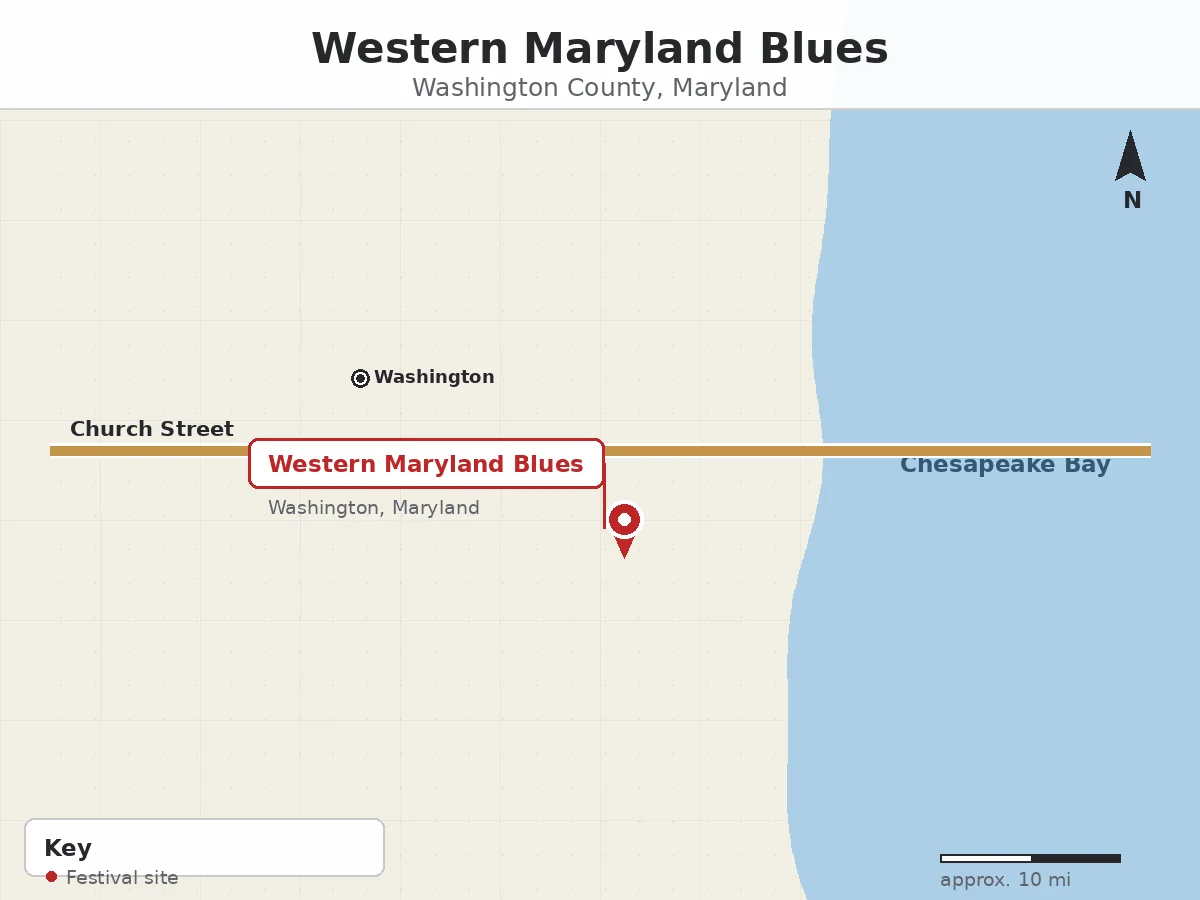
Getting oriented is simple, because everything documented sits in downtown Hagerstown, the county seat. The Maryland Theatre, the Central Lot and the brewery all belong to the same compact centre, so a visitor who finds one landmark is close to the others. Arriving early on a festival Saturday secures the best of both stages, and anyone hoping to volunteer or trade at a future edition should know that the organisers’ own layer carries a contact route for volunteers and vendors.
A Sample Itinerary for the Weekend
A Saturday built around the 2026 pattern might begin with a late-morning arrival in downtown Hagerstown, leaving time to settle in before the first sets. The middle of the day belongs to the two stages in rotation: catch a regional act on one, drift to the other for a national name, and let the food vendors handle lunch between sets. By evening the crowd thickens toward the headline hour, and Eric Gales, whose Saturday billing topped the return weekend, rewards those who stayed the course.
Sunday can run gentler. A slower start, a second pass at whichever stage you neglected, and a final set from George Porter Jr. to close the festival gives the weekend a proper full stop. Visitors with an extra hour can walk to the Maryland Theatre and the Central Lot, the two places where the festival’s first era began and flourished, before heading home.
Comparing Downtown Sounds
One confusion is worth clearing away directly: Hangarfest is not this festival. That annual fundraiser takes place in a hangar at Hagerstown Regional Airport, and it shares nothing with the blues weekend beyond a similar-sounding name and the same host city. Anyone handed airport directions while looking for the blues has been pointed at the wrong event entirely.
The more interesting comparison runs inside this festival’s own life. The city-era event was free in part, spread across public ground, and priced to pull whole families downtown, down to its free Sunday. The brewery-era return is a commercial ticketed weekend, more compact and more focused, with craft drink at its centre. Neither model is a betrayal of the other; they are two answers, thirty years apart, to the question of how a mid-sized Maryland city keeps a blues tradition alive.
Beyond the Brewery
A blues weekend in the county seat offers more than the stages themselves. The Maryland Theatre, where Otis Rush headlined the first edition in 1996, remains the natural pilgrimage point for anyone who cares about the festival’s origins, and the streets of the old Arts and Entertainment District still hold the ground the city-era crowds filled each summer. Walking that downtown triangle, from theatre to lot to brewery, is the quickest way to read the festival’s whole biography in one stroll.
Hagerstown also works as a base for the wider county. Washington County’s towns, battlefields and river country sit within easy reach of the seat, so a visitor travelling for the music can stretch the trip into a fuller weekend. The festival supplies the anchor date; the county fills the rest of the itinerary.
Why the Return Matters
Plenty of cancelled festivals leave behind nothing but old posters, so a documented revival carries real weight. The Western Maryland Blues Festival’s return in 2026 reconnected Hagerstown with a tradition that had run for twenty-three years, and it did so with a full-scale bill rather than a tentative tribute night. Twenty-two acts and two headline names told returning audiences that the organisers meant the comeback seriously.
The revival also shows how traditions survive their institutions. The city that created the festival no longer presents it, yet the name, the early-June timing and the downtown setting all carried across the gap. A brewery and a distillery now hold what a municipality built, and the music came through the handover intact.
Frequently Asked Questions
Which acts topped the bill when the festival came back in 2026?
Eric Gales headlined the Saturday of the return weekend, and George Porter Jr. headlined the Sunday. They led twenty-two acts across two stages at Hub City Brewery on 6 and 7 June 2026, the first edition since 2018.
Where in Hagerstown did the revived edition take place?
The 2026 return was hosted by Hub City Brewery in downtown Hagerstown. Earlier editions used different ground: the first annual festival played the Maryland Theatre in 1996, and the mature city-run event spread through the downtown Arts and Entertainment District and the Central Lot.
How did ticket prices compare between 2013 and 2026?
The 2026 return charged thirty-five dollars for one-day general admission and one hundred dollars for a two-day VIP ticket. Back in 2013 the scale ran lower and more graduated: twenty dollars in advance for the Friday, rising to forty dollars at the gate on the Saturday, with the Sunday free and small charges for children aged six to twelve.
What happened to the festival after its 2018 edition?
The twenty-third annual edition in June 2018 turned out to be the last of the first era. The festival was cancelled after that year and stayed away through seven summers, until Hub City Brewery and Church Street Distilling Co. brought it back in June 2026.
What to Expect From the Next Washington County Maryland Western Maryland Blues Festival
How often is Washington County Maryland Western Maryland Blues Festival held?
Across its documented life the festival kept an annual rhythm, reaching a twenty-third annual edition by 2018, before cancellation broke the run. The 2026 revival restored the event to the calendar, although the layers gathered here cover that single comeback weekend rather than a confirmed ongoing series.
When is the next Washington County Maryland Western Maryland Blues Festival?
The record assembled for this article ends with the return weekend of 6 and 7 June 2026, and it carries no confirmed date beyond that edition. Any future date would be announced by the brewery partnership that presented the revival, so their announcements are the place a confirmed date will surface first.
Will the dates change?
Movement is nothing new for this festival. Its documented editions cluster in early June, from the first edition on 1 June 1996 through the 2018 weekend at the start of that month, while the 2013 edition opened in late May. A future organiser could shift the weekend again, particularly given the eight-year interruption, so early June is a pattern rather than a promise.
This festival has already survived the worst thing that can happen to an annual event: it stopped, for years, and then it started again. Hagerstown kept the name alive in memory long enough for new presenters to pick it up, and the June 2026 weekend proved the audience had survived the gap as well. Whether the second era runs for another twenty-three years is a question only future summers can answer.