Talbot County Maryland Tilghman Island Day Festival
On the third Saturday of October, the working waterfront of Tilghman Island becomes a fairground for a day. Fishing boats that spend the rest of the month earning a living are raced, docked at speed and shown off in front of a crowd, while the island’s volunteer firefighters run a festival that doubles as their community’s biggest fundraiser. A hotel layer dates the 2026 edition to Saturday 17 October, with the grounds open from ten in the morning until seven in the evening, and a campground-guide layer confirms the standing pattern behind that date: the celebration returns every year on October’s third Saturday.
The day travels under two printed names. A travel-guide layer gives the full form, Tilghman Island Day Festival, while a hotel layer, an island-guide layer and a local-news layer all use the shorter Tilghman Island Day. Both labels describe the same single October gathering on the same island. Admission is set at five dollars per person, and the money raised supports the island’s fire company, so the ticket in a visitor’s hand is also a contribution to the crew that answers the island’s emergency calls.
About the Festival
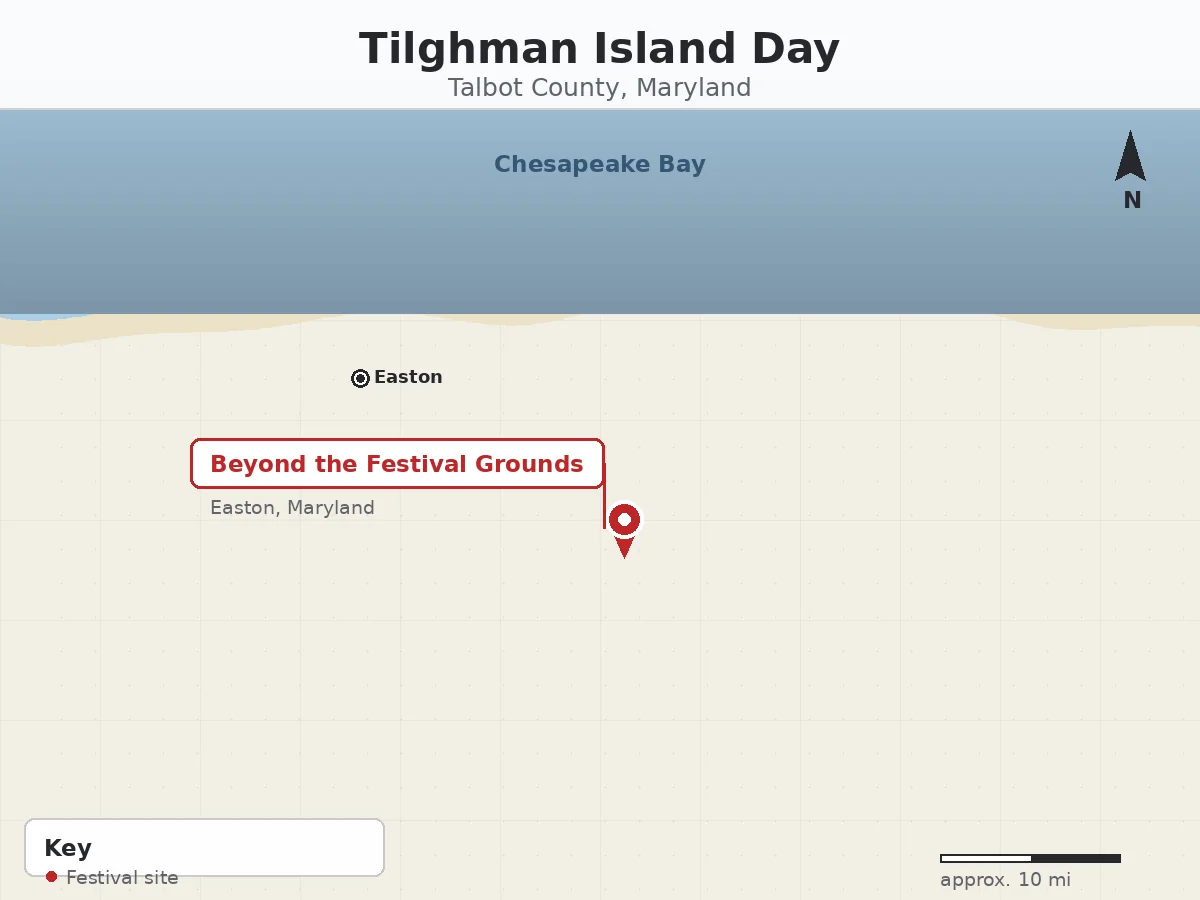
Tilghman Island sits at the southern tip of Talbot County, a waterman’s village where the working boat is not scenery but the basis of local life. The festival grounds gather around the Tilghman Volunteer Fire Company and Kronsberg Park, according to a travel-guide layer and a state tourism layer, which puts the action in the middle of the village rather than on some detached showground. The county seat is Easton, over on the mainland, and Tilghman Island is its own community with its own identity; visitors who picture a county-seat fair will find something quite different here, a harbour village turning itself inside out for one autumn day.
The organising body is the Tilghman Volunteer Fire Company, named as organiser in a farm-magazine layer and a local-news layer. That single fact shapes the character of the whole event. The contests are judged by the standards of people who actually work the water, the seafood is the island’s own catch handled the island’s own way, and the proceeds flow back into the volunteer service that the island depends on all year.
Quick Facts
| Item | Detail |
| Published names | Tilghman Island Day; Tilghman Island Day Festival |
| Host community | Tilghman Island, Maryland |
| County seat | Easton, the Talbot County seat; Tilghman Island is a separate island community |
| Venue | Grounds around the Tilghman Volunteer Fire Company and Kronsberg Park |
| Organiser | Tilghman Volunteer Fire Company |
| 2026 edition | Saturday 17 October 2026, ten in the morning to seven in the evening |
| Usual timing | The third Saturday of October each year |
| Admission | Five dollars per person |
| Beneficiary | Proceeds support the Tilghman Volunteer Fire Company |
History
The founding account comes from a farm-magazine layer, which records that the day was launched in 1971 by the Tilghman Island Volunteer Fire Company as a fundraiser and a cultural celebration. That wording matters, because the founding layer prints a slightly longer name for the company than the organiser form used elsewhere: later layers call the organiser the Tilghman Volunteer Fire Company, dropping the word Island from the title. The two forms are kept separate in this article exactly as their layers give them, one attached to the founding story and one attached to the present-day running of the event, rather than merged into a single tidy version that no layer actually prints.
For a useful comparison, see the Talbot County Maryland St. Michaels Running Festival for another county festival.
The dual purpose written into the 1971 launch, raising money while celebrating the island’s culture, still describes the festival accurately more than five decades later. The island beneath it is far older than the event: a property-guide layer describes Tilghman Island as a waterman’s village settled in 1650, perched at the southern tip of Talbot County. A celebration invented in the nineteen seventies is, by the standards of a settlement reaching back to the sixteen fifties, a recent tradition, yet it has had time to settle into the island’s calendar as firmly as the oyster season itself.
The trail of documented editions shows that staying power. The farm-magazine layer that tells the founding story was itself published on 22 October 2024, covering that year’s edition of the day. A local-news layer documents an edition held on October 15, although that layer, as read, does not state which year the October 15 gathering belonged to, and this article leaves that gap open rather than guessing at it. With the 2026 edition fixed for 17 October, the third-Saturday pattern threads the documented years together: a festival that began as a fire-company fundraiser has become the island’s fixed autumn appointment.
What to Expect
The water hosts the headline contests. A boat docking contest tests how fast and how cleanly a skipper can bring a working vessel in, a skill that looks easy from the dock and is anything but. Workboat races put the island’s commercial fleet into outright competition, and a rowboat race slows the same contest down to oar power. An anchor throw rounds out the maritime tests, turning a heavy piece of everyday gear into a throwing event. A hotel layer, a travel-guide layer and a local-news layer document this whole waterfront programme, and it is the part of the day no mainland fair can copy, because the equipment, the crews and the skills all belong to this one harbour.
The contests continue on shore with crab picking and oyster shucking competitions, where the fastest hands on the island race through the work that picking houses and shucking stands do at production speed. Live music plays through the day, nautical artisans sell work shaped by the bay, and a live auction gives the fundraiser a second engine beyond the gate. The auction is worth remembering when the five-dollar admission seems modest: the day’s fundraising happens all across the grounds, not only at the entrance.
Then there is the food, which on Tilghman Island means the catch itself. Layers list raw oysters and steamed oysters, oyster fritters, oyster stew, crab cakes, crab soup, and both steamed crabs and softshell crabs. A visitor could build the entire day around eating: oysters raw at the stand, stew warm from the pot, a crab cake at midday and a softshell before the evening close. For anyone who wants to understand why the island celebrates the working waterfront, the menu is the shortest explanation on offer.
Planning Your Visit
The shape of the day is generous: gates at ten in the morning, a seven in the evening close, and the third Saturday of October as the date to ring. Because the island is a village rather than a fairground complex, the sensible approach is to arrive with time to spare and let the day unfold around the fire company grounds and Kronsberg Park. The marquee contests on the water are the fixed points most visitors will plan around, so positioning for the docking contest and the workboat races early in the visit protects the rest of the day from hurry.
Admission is five dollars per person, charged at a level a family can absorb without arithmetic, and every dollar of it supports the Tilghman Volunteer Fire Company. Bringing an appetite is the other essential preparation, since the seafood stands serve the island’s own specialities from raw oysters to softshell crabs. October on the Chesapeake can turn cool once the sun drops toward the seven o’clock close, and the final hour of music and eating is more comfortable with a warm layer in hand.
One caution belongs in any plan: Tilghman Island hosts more than one festival, and the names are close enough to confuse. The day described here is the October event. A July seafood festival on the same island and an October oyster event with a similar name are separate gatherings, covered in the comparison below.

A Sample Itinerary
A workable shape for the day begins at the ten o’clock opening, when the grounds around the fire company and Kronsberg Park are still fresh and the first contests are forming up. Give the morning to the waterfront: the boat docking contest and the workboat races reward early positioning along the harbour, and the rowboat race and anchor throw fill the gaps between the bigger spectacles.
Midday belongs to the seafood stands. Work through the island’s list deliberately, raw oysters first while the palate is fresh, then oyster stew or crab soup, holding the crab cakes and steamed crabs for a proper sit-down pause. The afternoon then opens up for the shore contests, the crab picking and oyster shucking races, where standing close enough to watch the technique is half the pleasure.
Later in the day, drift through the nautical artisans’ stalls and time a bid or two at the live auction. Live music carries the grounds toward the seven o’clock close, and a final softshell crab or a bowl of oyster fritters makes a fitting last order before the island quietens down again.
How It Compares
The island’s own calendar creates the closest comparisons. The Tilghman Island Seafood Festival occupies July on the same island, run by the same fire company, and shares the October day’s devotion to the local catch. The difference is emphasis: the autumn event wraps its seafood inside a contest programme built on working skills, docking, racing, picking and shucking, and it carries the 1971 founding story as a fundraiser and cultural celebration in equal measure.
Harder to separate by name is the Tilghman Island Day OysterFest, a different October event on the same island whose title borrows pieces of this festival’s. The two are not the same gathering, and treating them as one would scramble both records. The Tilghman Island Day Festival documented here is the third-Saturday event organised by the fire company with the five-dollar gate; any listing that does not match that shape belongs to something else.
Further afield, the Waterfowl Festival fills Easton, the county seat, in November with a very different brief, art and conservation around the bay’s bird life rather than its working boats. Between the two, a visitor can read Talbot County’s relationship with the Chesapeake: the island festival celebrates the people who work the water, while the mainland event celebrates the wildlife above it.
Beyond the Festival Grounds
The festival ends at seven, but the island rewards anyone who does not rush for the road. Tilghman Island has been a waterman’s village since 1650 by the property-guide layer’s account, and the harbour that hosts the docking contest is a working waterfront on every other day of the year. Watching the fleet sit at rest after the crowds leave, with the day’s noise draining away, gives the contests a context that the programme alone cannot.
The grounds themselves, around the fire company station and Kronsberg Park, sit inside the village rather than apart from it, so a slow walk after the close keeps a visitor inside the community the festival exists to support. And because the county seat, Easton, lies back across the county on the mainland, the trip home passes through the wider Talbot County landscape of farms, creeks and small towns.
Why This Day Matters
A volunteer fire company on a small island has to fund itself somehow, and in 1971 Tilghman Island’s firefighters chose to do it by staging the island’s own skills as public entertainment. That choice turned out to be durable. Docking a workboat fast, shucking an oyster clean, picking a crab at speed: these are working competencies that usually stay invisible inside the daily round, and the festival puts them in front of an audience that pays five dollars a head to watch and to eat the results.
The cultural half of the founding purpose carries equal weight. A settlement dating to 1650 could easily become a museum of itself, yet this day keeps the emphasis on practice rather than nostalgia, on contests still run by the standards of the working harbour. The proceeds argument and the heritage argument point the same way, toward a village maintaining its own services and its own story with the same event.
Frequently Asked Questions
Which Saturday in October does the festival use?
The campground-guide layer describes the day as an annual fixture on the third Saturday of October, and the hotel layer’s 2026 date fits that pattern exactly: Saturday 17 October, from ten in the morning until seven in the evening.
What does a ticket for the island day cost?
Admission is five dollars per person, a figure given by both a travel-guide layer and a local-news layer. The proceeds benefit the Tilghman Volunteer Fire Company, so the gate money goes straight to the island’s volunteer emergency service.
Which competitions happen on the water?
The documented waterfront programme includes a boat docking contest, workboat races and a rowboat race, with an anchor throw among the shore-side tests. On land, the crab picking and oyster shucking contests take over the competitive spotlight.
Is this the same event as the island’s July seafood festival?
No. The Tilghman Island Seafood Festival is a separate July gathering on the same island under the same fire company, and the Tilghman Island Day OysterFest is a separate October event again. The festival in this article is the third-Saturday October day founded in 1971.
What to Expect From the Next Talbot County Maryland Tilghman Island Day Festival
How often is Talbot County Maryland Tilghman Island Day Festival held?
The pattern in the layers is a single October date every year, fixed to the third Saturday of the month. A campground-guide layer states the arrangement plainly, and the dated editions, from the 2024 gathering covered that October to the 2026 edition on 17 October, all sit comfortably inside it.
When is the next Talbot County Maryland Tilghman Island Day Festival?
After the documented edition of Saturday 17 October 2026, the guide for the following gathering is the standing pattern rather than a freshly printed date: the third Saturday of October in the next year. Anyone planning that far ahead should confirm the day against the fire company’s own announcements nearer the time.
Will the dates change?
The date already moves by design, because the festival is pinned to the third Saturday rather than to a fixed number on the calendar, so one year it falls earlier in October and another year later. What stays constant is the slot itself, the month, the Saturday and the rhythm the island has kept since the pattern took hold.
For a small island at the end of Talbot County, one Saturday each October now carries a double load: it entertains the crowds who cross over for the races and the oysters, and it pays for part of the volunteer service those same residents rely on. Tilghman Island Day has held that balance since 1971, and the harbour, the fire company and the seafood stands show every sign of holding it for many Octobers to come.