St. Landry Parish Louisiana Juneteenth Folklife Celebration Festival
On a Saturday in mid-June, the pavilion at the Opelousas farmers market fills with live music, the smell of food cooking nearby, and folk art laid out for visitors to study up close. The gathering is the Juneteenth Folklife Celebration, an annual event in the seat of Saint Landry Parish that keeps its focus on the folk art, heritage and traditions of African-American culture in the parish. Its programme is built around demonstrations, dancing, liturgical music and shared food, in a public market pavilion rather than a gated fairground.
The celebration takes its name from Juneteenth, the day that marks the moment enslaved people in Texas first heard news of their freedom, and the event in Opelousas pays tribute to that date. The Creole Heritage Folklife Center organises the gathering, and the centre’s owner hosts it. Where the record is silent — on admission, on a founding year — this article says so plainly rather than filling the gap.
About the Festival
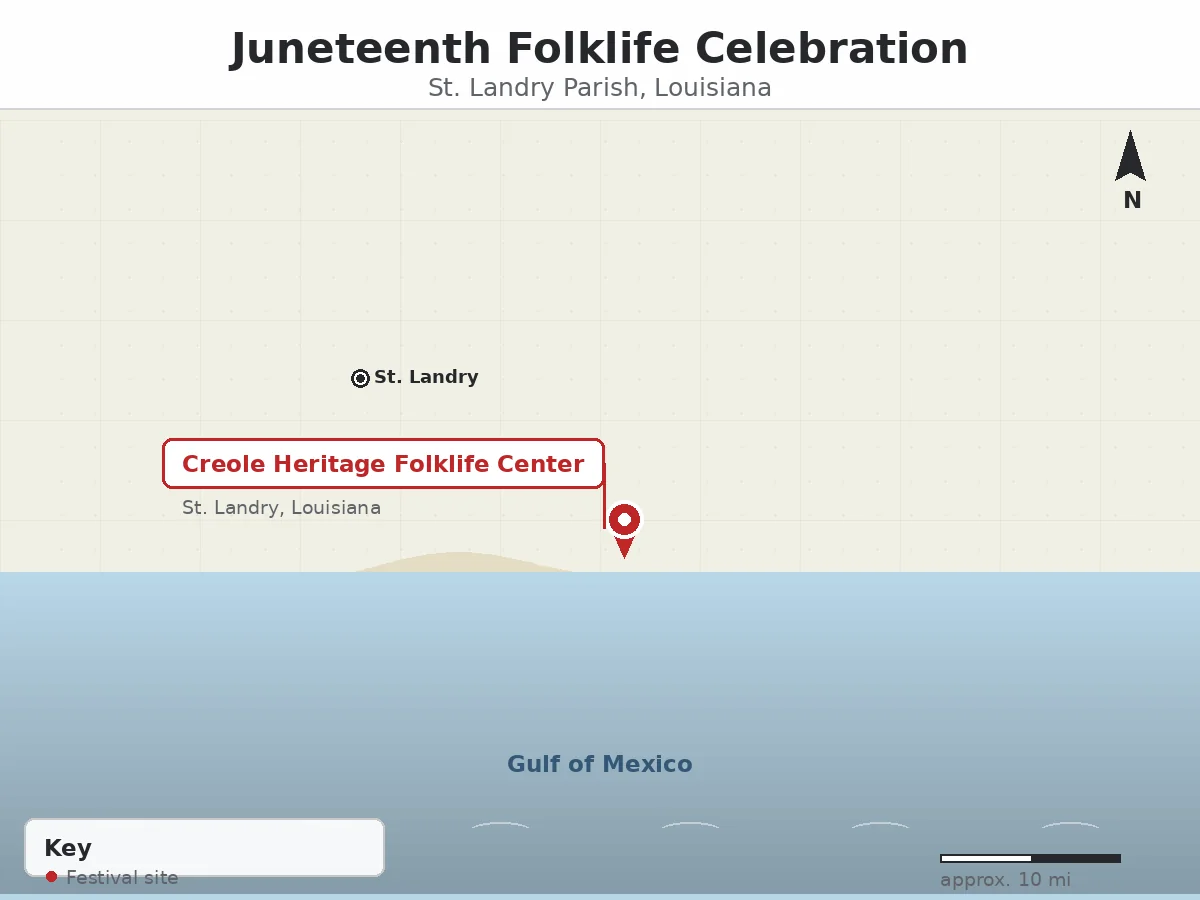
The Juneteenth Folklife Celebration is held in Opelousas, the parish seat of Saint Landry Parish, at the Opelousas Farmers Market Pavilion. The published name is the Juneteenth Folklife Celebration, also billed as the Annual Juneteenth Folklife Celebration, and the sheet title for this article is printed as the event’s name. The celebration is a one-day gathering, held on the Saturday before Father’s Day, and its hours have run from midday into the late afternoon or early evening, depending on the edition.
What sets the event apart is its subject matter. Rather than a general summer festival with a Juneteenth label attached, the celebration is devoted to folklife: the folk art, heritage and traditions of African-American culture in Saint Landry Parish. Folk-art demonstrations give visitors a chance to watch work being made rather than merely displayed. Traditional dancing and live music carry the rhythm of the day. Liturgical music brings a sacred thread into the programme, and food anchors the gathering in the shared table. The event is family-friendly, and no alcohol is sold or allowed on site, which gives the day the feel of a community homecoming rather than a street party.
The organiser is the Creole Heritage Folklife Center, and the event is hosted by the centre’s owner.
For a useful comparison, see the St. Landry Parish Louisiana Cracklin Festival for another county festival.
Quick Facts
| Detail | Information |
| Event | Juneteenth Folklife Celebration |
| Full billing | Annual Juneteenth Folklife Celebration |
| Host town | Opelousas, the parish seat of Saint Landry Parish |
| Venue | Opelousas Farmers Market Pavilion |
| Organiser | Creole Heritage Folklife Center |
| When it is held | The Saturday before Father’s Day |
| Documented edition | Saturday 17 June 2023, noon to six in the evening |
| Later listing | A Saturday edition in 2026, noon to four in the afternoon |
| Programme | Folk art, traditional dancing, live music, liturgical music, food |
| Atmosphere | Family-friendly, with no alcohol sold or allowed on site |
History
The celebration pays tribute to the date when enslaved people in Texas first heard news of their freedom. That date, the nineteenth of June, is the heart of Juneteenth, and the Opelousas gathering takes its meaning from it.
No founding year is stated in any layer read, and this article does not invent one. The documented record begins with a dated edition on Saturday 17 June 2023, running from noon to six in the evening, and continues with a later listing for a Saturday edition in 2026, running from noon to four in the afternoon and posted in May 2026. A parish heritage guide places the celebration on the Saturday before Father’s Day, which fits the 2023 date — Father’s Day in 2023 fell on the Sunday after that Saturday.
The Creole Heritage Folklife Center stands behind the event, and the centre’s owner hosts it. A centre devoted to Creole heritage and folklife brings a curatorial eye to the programme: the folk art is not a craft-fair afterthought, the dancing is not a filler act, and the liturgical music is not background noise. Each element is chosen because it belongs to the tradition the event honours. Opelousas has long been a crossroads of Creole culture in Louisiana, and the celebration draws on that inheritance. The folk art comes from hands that learned their craft within families and neighbourhoods. The dancing carries steps passed down rather than choreographed for a stage. The liturgical music reaches back to the churches where so much of the community’s musical life has always lived.
What to Expect
Visitors arriving at the Opelousas Farmers Market Pavilion will find a covered, open-air setting with room to move between the different parts of the programme. Folk-art demonstrations are the centrepiece: makers at work, showing how pieces are made, answering questions, and letting visitors see the process rather than only the finished object.
Live music runs through the day, and traditional dancing gives the music a visible form. The dancing is not a performance set apart from the crowd; it is part of the gathering’s rhythm, and visitors should expect to see dancers moving in the pavilion space with the music carrying them. Liturgical music adds a different register, a sacred sound that connects the celebration to the churches and congregations that have sustained Black musical life in the parish for generations.
The atmosphere is family-friendly, and no alcohol is sold or allowed on site. That rule shapes the whole day: children move freely, elders sit and talk, and the pavilion feels like a reunion ground. Visitors should expect a pace that is unhurried. This is not an event built around a tight schedule of headline acts; it is a day built around presence,
Planning Your Visit
Opelousas is the parish seat of Saint Landry Parish, and the Opelousas Farmers Market Pavilion sits in town, so reaching the celebration is straightforward for anyone already in the parish. Plan to arrive around midday, when the day’s programme begins, and allow several hours — the 2023 edition ran from noon to six in the evening, and the 2026 listing gives a window from noon to four in the afternoon, so a midday arrival catches the full span of the day.
Because the celebration is held on the Saturday before Father’s Day, the weekend around it is a natural time to visit. Check the current year’s listing before travelling, since the exact Saturday moves with the calendar and the hours have varied between editions. The event takes place under a pavilion, which gives shade and shelter, but Louisiana in June is warm, so light clothing, water, and sun protection are sensible.
No admission price or free status is stated in any layer read, so this article takes no position on whether entry is charged. Visitors should check the current listing for any admission information before they go, rather than assuming either way. Bring cash in small amounts for food and any art on offer, and bring patience: the demonstrations reward visitors who stop and look rather than hurry past.
A Sample Itinerary
Arrive at the pavilion just before midday and take a first slow walk through the whole space, noting where the folk-art demonstrations are set up and where the music will be. Find a seat near the demonstrations and spend the first hour watching makers at work, asking questions, and learning how a piece takes shape.
In the early afternoon, move toward the music and dancing. Listen to a set of live music, watch the traditional dancing, and let the liturgical music carry the day into its more reflective register. Take a break for food in the middle of the afternoon, and use the meal as a chance to talk with other visitors and with the people behind the stalls.
In the late afternoon, return to the demonstrations for a second look, now with a better eye for the craft, and pick up any folk art that caught your attention earlier. Stay until the programme winds down, whether that is four in the afternoon or six in the evening,
How It Compares
The Juneteenth Folklife Celebration is a small, focused gathering, and comparing it with other Juneteenth events in Louisiana shows what makes it distinct. The Southwest Louisiana Juneteenth Festival in Lake Charles and the Shreveport Juneteenth celebration are different events in other parishes, and neither one is this celebration. The Opelousas celebration, by contrast, is built around a single centre — the Creole Heritage Folklife Center — and a single pavilion, and its programme stays close to folklife: folk art, dancing, liturgical music, food.
That focus is the point of comparison that matters. A visitor looking for a large festival with rides and a long vendor row would find the Opelousas gathering quieter than expected. A visitor looking for a day spent with makers, dancers and singers, in a setting where the traditions themselves are the attraction, would find it exactly right. The celebration does not compete with the bigger Juneteenth festivals on scale; it offers something they cannot, which is intimacy and a programme shaped by one centre’s care for Creole heritage.
Checklist
- Check the current year’s listing for the exact Saturday and hours before travelling
- Arrive around midday to catch the full span of the programme
- Wear light clothing and bring water and sun protection for a warm June day
- Wear comfortable shoes for standing at demonstrations and moving around the pavilion
- Bring small amounts of cash for food and any folk art on offer
- Plan to spend several hours rather than rushing through
- Ask questions at the folk-art demonstrations — watching and asking are the point
- Respect the family-friendly atmosphere and the rule against alcohol on site
- Leave time for a second look at the demonstrations before the day ends
Beyond the Pavilion
The celebration sits in Opelousas, the parish seat, and a visitor with time to spare can use the day to see something of the town around the pavilion. Opelousas is one of Louisiana’s older towns, and its streets carry the layered history of the parish — Creole, French, Spanish and American threads woven together over centuries.
The Creole Heritage Folklife Center, which organises the celebration, is the natural next stop for anyone whose interest has been caught by the day. A centre devoted to Creole heritage and folklife does its work year-round, not only on the Saturday of the celebration, and learning about its programmes gives the event a context beyond a single afternoon. The folk art seen at the pavilion comes from a living tradition, and the centre is one of the places that keeps that tradition in view.
Why It Matters
The Juneteenth Folklife Celebration matters because it gives a public day to traditions that are often carried in private — in homes, in churches, in families. Folk art made by hand, dancing learned by watching, liturgical music sung in congregation: these are the ways a community keeps its memory, and a celebration that puts them at the centre says that this memory is worth gathering around.
The celebration also matters because of where and when it happens. Held in Opelousas, the parish seat, on the Saturday before Father’s Day, in the middle of June, it places the tribute to emancipation at the civic centre of the parish and in the middle of the community’s calendar. The date honoured — the day enslaved people in Texas first heard news of their freedom — belongs to American history, and the Opelousas gathering brings that history home to Saint Landry Parish through the art, music and food of its own Black community.
There is a quieter significance too. The celebration is family-friendly, alcohol is not sold or allowed on site, and the programme is built around watching, listening and sharing rather than buying and consuming. In a festival landscape that often measures success by scale, the Juneteenth Folklife Celebration measures it by attention: the attention of a visitor watching a maker at work, the attention of a dancer following the music, the attention of a listener hearing a hymn sung the way it has always been sung.
Frequently Asked Questions
How does the celebration connect to Juneteenth itself?
The celebration pays tribute to the date when enslaved people in Texas first heard news of their freedom, which is the heart of Juneteenth. Its programme — folk art, traditional dancing, liturgical music and food — expresses that tribute through the heritage and traditions of African-American culture in Saint Landry Parish.
What makes this gathering different from other Juneteenth festivals in Louisiana?
Its focus is folklife. The event is organised by the Creole Heritage Folklife Center and built around folk-art demonstrations, traditional dancing, liturgical music and shared food in a single pavilion, rather than around a large midway or a broad commercial programme.
Is the celebration suitable for children?
Yes. The event is family-friendly, and no alcohol is sold or allowed on site. Children can watch the folk-art demonstrations, listen to the music and dancing, and share the food,
When should I plan to arrive?
The celebration is held on the Saturday before Father’s Day, and its hours have run from midday into the late afternoon or early evening — noon to six in the evening in 2023, and noon to four in the afternoon in the 2026 listing. Arriving around midday catches the full span of the day
What to Expect From the Next St. Landry Parish Louisiana Juneteenth Folklife Celebration Festival
How often is St. Landry Parish Louisiana Juneteenth Folklife Celebration Festival held?
The celebration is an annual event, held on the Saturday before Father’s Day. The documented record shows a dated edition in 2023 and a later listing for a Saturday edition in 2026, and the heritage guide places it on the Saturday before Father’s Day each year.
When is the next St. Landry Parish Louisiana Juneteenth Folklife Celebration Festival?
The most recent listing in the record is a Saturday edition in 2026, running from noon to four in the afternoon at the Opelousas Farmers Market Pavilion and posted in May 2026. Beyond that 2026 listing, the material consulted carries no confirmed date for a later gathering, so visitors should check the current listing before travelling.
Will the dates change?
The celebration is tied to the Saturday before Father’s Day, so the calendar date moves from year to year with the holiday, and the hours have varied between editions — noon to six in the evening in 2023 and noon to four in the afternoon in the 2026 listing. Visitors should confirm the current year’s date and hours before travelling.
A day at the Juneteenth Folklife Celebration is a day spent with the living traditions of Saint Landry Parish — folk art made by hand, dancing carried by music, liturgical song, and food shared under a pavilion roof in Opelousas. The celebration is small, focused and family-friendly, and it asks little of its visitors beyond attention: watch the makers, listen to the singers, taste the food, and remember what the day honours.