McCracken County Kentucky Lower Town Arts and Music Festival
Some festivals announce themselves with a parade or a ribbon cutting. This one announced its return with something quieter and, for the people of Paducah, Kentucky, far more meaningful: applications opening again after a year when the streets of the Lower Town Arts District stayed silent. The festival grew out of a neighbourhood that artists themselves rebuilt, as painters, printmakers, potters and musicians settled among the district’s old houses. It became the weekend when that working creative community opened its doors, its lawns and its stages to everyone else.
The modern story of the festival is really two stories. One belongs to the Yeiser Art Center, the local nonprofit art organisation that ran the event for years. The other belongs to the volunteers who refused to let it disappear, forming a new nonprofit called Friends of the Lower Town Arts and Music Festival after the two thousand twenty-five edition was cancelled. Between those chapters sit a documented cancellation, refunded fees, and a May two thousand twenty-six comeback that a national music-magazine review layer confirms took place.
About the Festival
The organiser’s own site presents the event under the long form Lower Town Arts and Music Festival, and event-listing layers use that same wording. A tourism layer shortens the conjunction and prints Lower Town Arts & Music Festival, while tourism and organiser material also uses the initialism LTAMF. A state business-filing layer from February two thousand twenty-five carries an assumed name in capital letters, PADUCAH LOWERTOWN ARTS & MUSIC FEST, recorded here only as evidence that such a filing exists; none of its details are reproduced. These printed forms are kept separate rather than blended into a single official style, because the layers themselves never settle on one version.
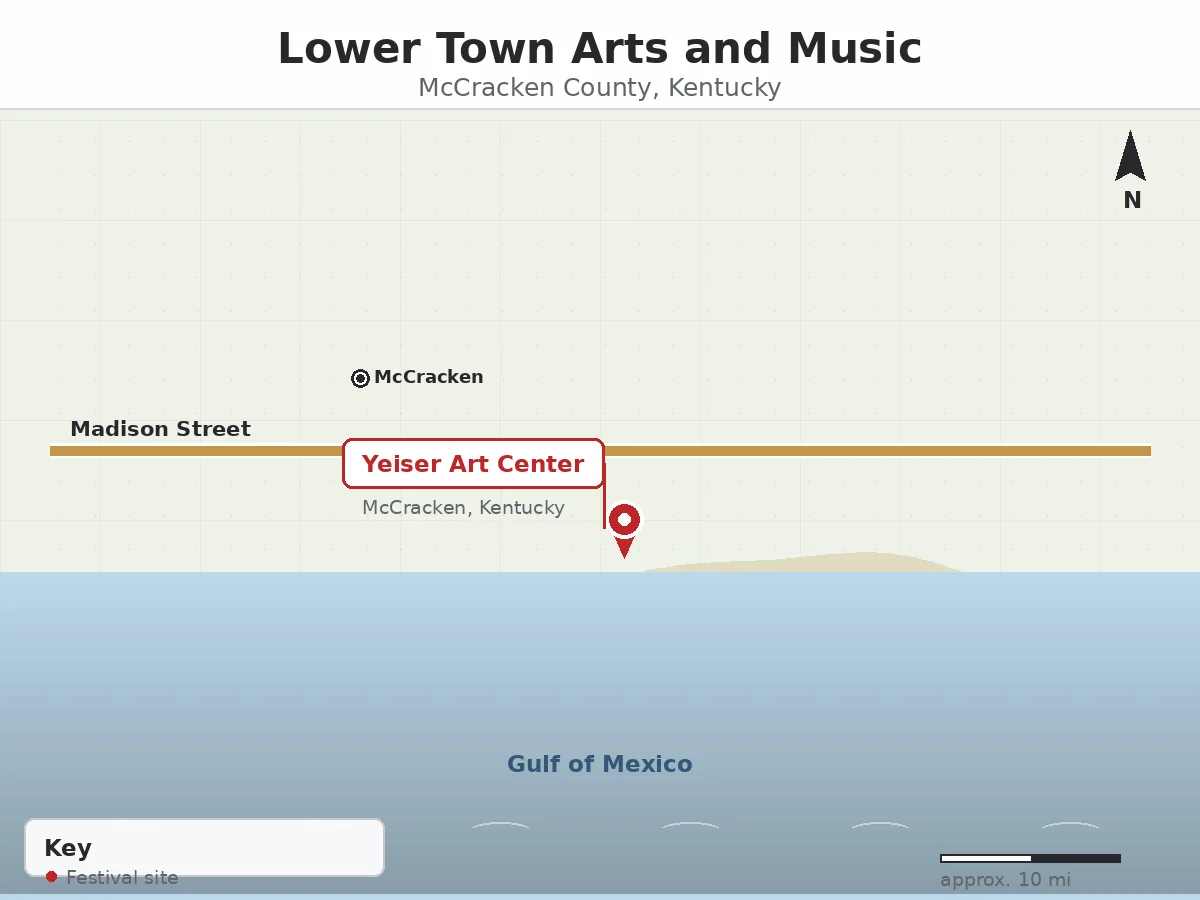
Paducah hosts the festival in McCracken County, and a county-seat reference layer confirms Paducah as the county seat. The setting matters to the programme: the historic Lower Town Arts District is a residential neighbourhood of galleries, studios and porches, so the festival unfolds on streets where many of the exhibiting artists actually live and work. In two thousand twenty-six, a tourism layer placed the main stage at the corner of Madison Street and North Seventh Street, anchoring the music programme inside the district rather than in a fenced fairground outside town.
According to the organiser’s own site, the programme combines fine-art and craft vendors, live music on multiple stages, live art demonstrations, family activities, and local food and drink. Admission carries no charge: the organiser’s own site calls the event “a free, two-day celebration”, and a newspaper layer agrees.
For a useful comparison, see the McCracken County Kentucky Paducah Dragon Boat Festival for another county festival.
Quick Facts
| Detail | Information |
| Festival name | Lower Town Arts and Music Festival |
| Other printed forms | Lower Town Arts & Music Festival; LTAMF |
| Host town | Paducah, Kentucky |
| County | McCracken County |
| Setting | The historic Lower Town Arts District |
| Two thousand twenty-six dates | Thursday the seventh of May to Saturday the ninth of May |
| Two thousand twenty-six main stage | Corner of Madison Street and North Seventh Street |
| Long-time organiser | Yeiser Art Center |
| Current organiser | Friends of the Lower Town Arts and Music Festival |
| Admission | Free to attend |
History and the Road Back
The deeper roots of the festival lie in the neighbourhood rather than in any single founding document. The organiser’s own site presents the event as a grassroots gathering grounded in the Lower Town neighbourhood’s artist-relocation and preservation history, the period when artists moved into the district’s ageing housing stock and restored it house by house. A travel layer states that the festival is held on the second weekend of May every year. Beyond those accounts, the layers read state no founding year, and none is guessed here.
For years the organisational home of the festival was the Yeiser Art Center. A neighbourhood newsletter layer and a newspaper layer both describe the art centre as the body that ran the festival across that period, which makes the events of early two thousand twenty-five a genuine turning point. In February two thousand twenty-five, the Yeiser Art Center cancelled that year’s edition, and the reporting layers record that vendor, artist and performer application fees were refunded. It was a full stop, issued months before the advertised weekend.
An event-listing layer had earlier advertised the ninth and tenth of May, two thousand twenty-five, with hours of Friday five in the evening to ten thirty at night and Saturday ten in the morning to ten thirty at night. That schedule belongs strictly to the pre-cancellation plan. It is recorded here as an artefact of what was intended, not as a description of anything that happened that spring.
The revival began when a new nonprofit, Friends of the Lower Town Arts and Music Festival, formed to organise the event after the Yeiser cancellation. The organiser’s own About page gives the body in two forms, with and without the corporate suffix, as Friends of the Lower Town Arts and Music Festival, Inc. A newspaper layer announced the two thousand twenty-six return and the opening of applications, and the comeback then played out across three days in May. A national music-magazine review layer, published on the twentieth of May, two thousand twenty-six, confirms the edition ran.
What to Expect
Fine art comes first in the billing. The organiser’s own site lists fine-art and craft vendors as a core element, and in a district built around working studios the boundary between exhibitor and neighbour is unusually thin. Visitors can watch live art demonstrations, another element the organiser’s own site names, and see techniques explained by the people practising them.
Music runs on multiple stages rather than a single platform, according to the organiser’s own site. For the two thousand twenty-six edition, a tourism layer adds that nationally touring acts appeared on the main stage at the corner of Madison Street and North Seventh Street; those acts are described generically in the layer. The weekend opened with a kickoff concert on Thursday, the seventh of May, at the Paducah Symphony Orchestra Hall, before the outdoor programme began on Friday, the eighth of May, from five in the evening. Saturday, the ninth of May, carried the longest day, running from ten thirty in the morning to ten thirty in the evening.
Family activities and local food and drink round out the organiser’s own description. Because the district is a living neighbourhood, the stages and stalls sit among homes and shaded streets, and the crowd moves on foot.
Planning Your Visit
Anchor your planning on the month of May. The travel layer’s account of a second-weekend-of-May pattern and the documented two thousand twenty-six dates, the seventh through the ninth of May, both point to that part of the calendar, while the two thousand twenty-five cancellation shows why travellers should confirm each year’s edition before booking around it.
Treat the district itself as the venue. The documented main-stage location for two thousand twenty-six was the corner of Madison Street and North Seventh Street, and the surrounding blocks hold the vendors, demonstrations and additional stages. Walking the neighbourhood is the natural way to experience the layout, since the programme spreads through residential streets rather than concentrating in one hall.
Admission money is one thing visitors do not need to budget for, because the organiser’s own site describes the festival as a free, two-day celebration. Spending instead goes toward the artwork, crafts, food and drink sold by vendors on site. Anyone hoping to exhibit or perform should watch for application announcements of the kind reported ahead of the two thousand twenty-six return.
A Sample Itinerary for the Comeback Weekend
Thursday evening belongs to the kickoff concert at the Paducah Symphony Orchestra Hall, the documented opening note of the two thousand twenty-six edition. Arrive during the day, settle in, and let the indoor concert introduce the weekend’s music before the outdoor stages open.
Friday’s programme in two thousand twenty-six began at five in the evening, leaving the daytime free for the district itself: its galleries, architecture and studios. As the evening programme starts, move between the stages, sample the local food and drink, and catch the first demonstrations while the light holds.
Saturday is the full day, documented in two thousand twenty-six as running from ten thirty in the morning until ten thirty in the evening. Start with the vendor rows, revisit a favourite demonstration, bring younger visitors to the family activities, and finish at the main stage for the closing hours of music.
How the Festival Compares
Paducah’s calendar holds other large gatherings, but this festival’s identity is tied to a single neighbourhood in a way the others are not. Its programme rests on resident artists exhibiting where they live, so the art component is woven into the streetscape instead of being trucked into a neutral venue. The multiple-stage music programme gives the weekend a scale beyond a studio tour, yet the setting keeps it intimate.
One comparison must be drawn carefully. A newsletter layer records a separate event called the Paducah Arts and Music Festival, held on the tenth and eleventh of May, two thousand twenty-five, by different organisers at a different Paducah address. Despite the similar name and the same city, that gathering is not this festival, and nothing from its record is imported here. The distinction matters most for the cancelled year: the Lower Town event did not take place in two thousand twenty-five, whatever else happened in Paducah that weekend.
A Visitor’s Checklist
- Confirm the current year’s edition and dates before travelling, remembering the two thousand twenty-five cancellation
- Note the main-stage corner of Madison Street and North Seventh Street from the two thousand twenty-six record
- Plan to walk the Lower Town Arts District rather than drive between programme elements
- Set aside Saturday for the longest documented day of programming
- Bring a budget for artwork, crafts, food and drink, since admission itself is free
- Watch for artist, vendor and performer application announcements if you hope to take part
- Keep this festival separate from the similarly named Paducah Arts and Music Festival when reading listings
Beyond the Festival Streets
The Lower Town Arts District rewards time spent outside the festival weekend’s schedule. The neighbourhood’s revival through artist relocation and preservation is the very history the organiser’s own site credits as the festival’s root, and walking the district makes that story visible in restored houses and gallery windows.
The Paducah Symphony Orchestra Hall, which hosted the two thousand twenty-six kickoff concert, belongs to the city’s year-round cultural life, and the Yeiser Art Center remains part of the local arts landscape even though a different organisation now carries the festival.
Why This Festival Matters
Survival is the festival’s most distinctive documented feature. Events that lose their organising body usually vanish without a public record of why; here, the cancellation by the Yeiser Art Center in February two thousand twenty-five, the refunding of application fees, the formation of Friends of the Lower Town Arts and Music Festival, and the confirmed two thousand twenty-six comeback are each preserved in identifiable layers. Together they make the festival a case study in how a grassroots event changes hands without losing its name or its neighbourhood.
The festival also carries the story of Lower Town itself. A district restored by the artists who moved into it gained, in this event, a recurring occasion when the whole city is invited inside that experiment, and the free admission described by both the organiser and a newspaper layer keeps the invitation genuinely open.
Frequently Asked Questions
What happened to the two thousand twenty-five edition of the festival?
The Yeiser Art Center, which had run the festival for years, cancelled the two thousand twenty-five edition in February of that year. A neighbourhood newsletter layer and a newspaper layer record the cancellation and the refunding of vendor, artist and performer application fees. An earlier listing had advertised the ninth and tenth of May with Friday and Saturday hours, but that was the plan made before the cancellation, not an event that took place.
Which organisation runs the festival now?
A newspaper layer announced the two thousand twenty-six return under a newly formed nonprofit, and the organiser’s own About page names that body as Friends of the Lower Town Arts and Music Festival, also printed with the corporate suffix as Friends of the Lower Town Arts and Music Festival, Inc.
Where in Paducah does the festival unfold?
The festival occupies the historic Lower Town Arts District, the neighbourhood of studios and galleries that gives the event its name. For the two thousand twenty-six edition, a tourism layer placed the main stage at the corner of Madison Street and North Seventh Street, while the kickoff concert used the Paducah Symphony Orchestra Hall.
What can visitors see and hear during the weekend?
The organiser’s own site describes fine-art and craft vendors, live music on multiple stages, live art demonstrations, family activities, and local food and drink. In two thousand twenty-six a tourism layer reported nationally touring acts on the main stage, and the edition opened with a Thursday kickoff concert before the Friday and Saturday outdoor programme.
What to Expect From the Next McCracken County Kentucky Lower Town Arts and Music Festival
How often is McCracken County Kentucky Lower Town Arts and Music Festival held?
A travel layer describes the festival as a fixture of the second weekend of May each year, and the documented record fits an annual rhythm interrupted once: the two thousand twenty-five edition was cancelled, and the event returned for the seventh to the ninth of May, two thousand twenty-six.
When is the next McCracken County Kentucky Lower Town Arts and Music Festival?
The layers gathered here end with the two thousand twenty-six comeback and the magazine review published on the twentieth of May that year confirming it ran. They carry no confirmed dates for a following edition. Given the second-weekend-of-May pattern described by the travel layer, the organiser’s own site is where the next dates would be posted.
Will the dates change?
They already have, in two senses: the two thousand twenty-five dates advertised in advance never became an event at all, and the two thousand twenty-six comeback opened on a Thursday with a kickoff concert before the Friday and Saturday programme. A future announcement could adjust the shape of the weekend again, so verify each year’s dates directly rather than assume the previous pattern will repeat exactly.
Closing Thoughts
The Lower Town Arts and Music Festival has been, in documented sequence, a neighbourhood celebration run for years by an art centre, a cancelled weekend with refunded fees, and a revived gathering carried by a new organisation formed for the purpose. Its next chapter will be written where the story has always lived: the streets of Paducah’s Lower Town Arts District, among the artists who made the district worth celebrating.
One Comment