Marshall County Kentucky Calvert City Coffee and Chocolate Festival
One March weekend each year turns the Calvert City Civic Center over to two of the most comforting flavours in the pantry. Coffee roasters pour beside chocolatiers, bakers stack their tables, and shoppers drift from sample to sample with a tote in hand. The gathering is documented across four annual editions in Calvert City, Marshall County, Kentucky, and it arrives under more than one printed name. Most layers call it the Purchase Area Coffee and Chocolate Festival, while the vendor-platform layer uses the Calvert City Coffee and Chocolate Festival form that this title carries. Both names point to the same Civic Center weekend, and the record behind it is unusually complete for a young event: dated editions, stated hours, named workshops, and a change of organisers all appear in print.

About the Festival
The sheet behind this article uses the Calvert City form of the name, and that wording is not an invention. A vendor-platform layer prints both Calvert City Coffee and Chocolate Festival and the shorter Calvert City Coffee and Chocolate Fest. The heavier weight of print, though, sits with the Purchase Area forms. Newspaper layers, a regional television layer, and an event-listing layer all print Purchase Area Coffee and Chocolate Festival, and a listing layer also carries Purchase Area Coffee & Chocolate Fest. The forms are kept apart here exactly as they appear, because each layer chose its own wording for the same event.
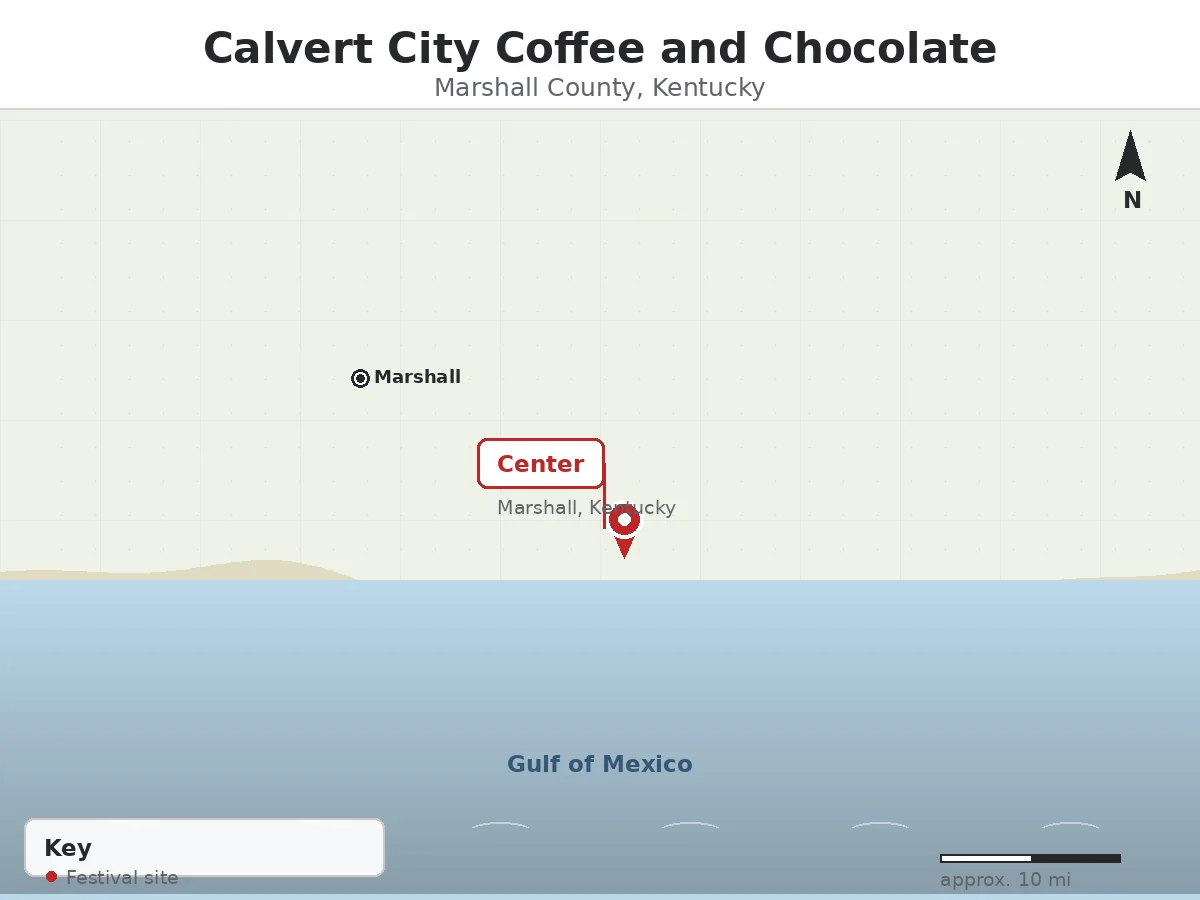
Calvert City hosts the weekend in Marshall County, Kentucky. The town is not the county seat; reference layers give that standing to Benton. The festival floor is the Calvert City Civic Center, and the teaching side of the programme sits next door, at the Calvert City branch of the Marshall County Public Library, where the workshops are held.
The festival began as the work of A Centered Space, which founded and organised it. Newspaper layers name the founder of that business in print, and the person is identified here by role alone. A public-notice newspaper advertisement layer for the two thousand twenty-six edition states that the event is co-hosted by the City of Calvert City and the Calvert Area Development Association. Between those two points sits a handover: a newspaper layer describes the two thousand twenty-five transfer of organisation from the founder to the city as “the passing of the spoon”.
Quick Facts
| Item | Detail |
| Dominant published name | Purchase Area Coffee and Chocolate Festival |
| Other printed forms | Purchase Area Coffee & Chocolate Fest; Calvert City Coffee and Chocolate Festival; Calvert City Coffee and Chocolate Fest |
| Host town | Calvert City, Marshall County, Kentucky |
| Main venue | Calvert City Civic Center |
| Workshop venue | Calvert City branch of the Marshall County Public Library, next door |
| First edition | Two thousand twenty-three |
| Documented editions | Two thousand twenty-four; two thousand twenty-five; two thousand twenty-six |
| Festival hours | Nine in the morning to two in the afternoon |
| Founder | A Centered Space |
| Current co-hosts | City of Calvert City and Calvert Area Development Association |
History
A newspaper layer fixes the beginning plainly: the festival was founded in two thousand twenty-three, by the owner of A Centered Space, and Calvert City had been home to the event for four years as of two thousand twenty-six. The founding business organised the young festival through its first editions. The two thousand twenty-four staging already carried a “Second Annual” billing in a newspaper layer, which fits the two thousand twenty-three start exactly as the layers give it.
For a useful comparison, see the Marshall County Kentucky Calvert City River Folk Festival for another county festival.
The founding account also fixes the festival’s age without embroidery: four years in Calvert City as of two thousand twenty-six, counted from the two thousand twenty-three start, with no earlier origin claimed in any layer read for this article.
The change came with the two thousand twenty-five edition. Organisation passed from the founder to the City of Calvert City and the Calvert Area Development Association, and one newspaper layer gave the transfer a phrase of its own, calling it “the passing of the spoon”. The image suits a festival built on tasting spoons and sample cups, and the wording is preserved here as the layer printed it.
Under city stewardship the event kept its March place and its Civic Center floor. A public-notice newspaper advertisement layer for two thousand twenty-six names the City of Calvert City and the Calvert Area Development Association as co-hosts, tying the printed present of the festival to the handover the earlier layer described. Four editions in four years, each one dated in print, give this young festival a documented spine that many older events never receive.
What to Expect
Two days of tasting fill the Civic Center, and the cast of sellers is consistent across the layers: local coffee roasters, chocolatiers, bakers, and artisan vendors, with product sampling, hands-on workshops and classes run with the public library, and prize drawings worked into the weekend. The two thousand twenty-four admission account underlines how central the tasting is: the wristband described by the regional television layer covered samples and prize drawings, so the room was organised around trying things rather than merely looking at them.
The two thousand twenty-four edition ran from the second to the third of March, nine in the morning to two in the afternoon, with workshops and a Sunday early shopping hour set aside for a special population. The two thousand twenty-five edition followed from the first to the second of March, and its listing layer describes the Sunday in more detail: a low-sensory shopping experience from nine to ten in the morning on the second of March, followed by public hours. The two thousand twenty-six edition, the fourth annual staging, ran from the seventh to the eighth of March, nine in the morning to two in the afternoon each day, again with the Sunday nine-to-ten hour designated a low-sensory shopping hour. Its workshops had grown specific by then: a history of chocolate class, tea classes, and a cake-pop class all appear in the newspaper and public-notice layers for that year.
Planning Your Visit
The whole festival fits inside two five-hour days, so timing matters more than mileage. Doors follow the documented pattern of nine in the morning to two in the afternoon, and the workshops sit next door at the library branch rather than on the main floor, which rewards anyone who reads the schedule before drifting between buildings.

Admission needs a year attached to it. A regional television layer stated admission of five dollars for the two thousand twenty-four edition, with a wristband covering samples and prize drawings. An event-listing layer stated “Free to attend” for the two thousand twenty-five edition. The two statements stand apart here, each fenced to its own year, and neither is stretched across the whole run of the festival. Charges appearing on the vendor-platform layer are booth charges connected with selling space, not gate admission.
Newspaper and television layers print telephone numbers for the organiser and the city, so those numbers exist in print for anyone confirming details before the weekend. Shoppers who prefer a calmer room should note the Sunday pattern in the recent record: the first hour has been given over to low-sensory shopping in both the two thousand twenty-five and two thousand twenty-six editions.
A Sample Weekend Itinerary
A workable shape for Saturday begins at the Civic Center doors at nine in the morning, when the roasters and chocolatiers open their tables. A first slow circuit of the floor, sample cup in hand, gives the lay of the room before the crowds thicken. Late morning suits a workshop next door at the library branch, leaving the early afternoon for a second pass at the bakers and artisan vendors and for the prize drawings.
Sunday can start gently. In the recent editions the nine-to-ten hour was reserved for low-sensory shopping, so visitors who value quiet browsing can use that window and then stay on into the public hours that run to two in the afternoon. Anyone who missed a class on Saturday can check whether a Sunday session remains, since the workshops are documented across the weekend rather than on a single day.
How the Editions Compare
Set side by side, the four editions show a festival settling into itself. The first edition in two thousand twenty-three is known mainly through the founding account. The two thousand twenty-four edition arrived with a “Second Annual” billing and a five-dollar admission statement carried by a regional television layer. The two thousand twenty-five edition changed both the management and the money: organisation passed to the city and its development association, and a listing layer described that year as “Free to attend”. By two thousand twenty-six the workshop programme had names of its own, from the history of chocolate class to the cake-pop class, and the co-hosts were stated in a public-notice advertisement. The name forms also split by layer throughout: Purchase Area wording dominates the news and listing record, while the Calvert City wording lives on the vendor-platform layer.
Checklist
- Search under both printed name forms, since listings divide between Purchase Area and Calvert City wording.
- Build the day around the nine-to-two window on each festival day.
- Aim for the Sunday nine-to-ten low-sensory hour if quieter browsing matters.
- Leave time for the library branch next door, where the workshops are held.
- Treat admission as a question with a year attached, because the printed statements differ between editions.
- Bring a sturdy bag for beans, bars, and baked goods gathered along the vendor tables.
Beyond the Civic Center Floor
The festival reaches past its main room in two directions. One is next door, where the Calvert City branch of the Marshall County Public Library hosts the workshops, binding a public institution into a weekend of tasting. The other is outward, in the Purchase Area wording of the dominant name, which frames a small-city event as a draw for a whole region rather than a single town. The special-population shopping hour in two thousand twenty-four, later described as a low-sensory shopping experience, shows the organisers thinking about who the room suits and who it might shut out. There is also a working back door to the event: the vendor-platform layer, the one place where the Calvert City name forms appear, exists so sellers can reach the room, and the booth charges recorded there belong to that side of the festival rather than to shoppers arriving at the entrance.
Why the Festival Matters
A festival founded in two thousand twenty-three could easily have left almost no trace. This one left a paper trail with dates, hours, prices by year, workshop titles, and a named moment of transition. Its story also carries a pattern worth noticing: a local business owner built the event, ran it through its first editions, and then handed it to the city and the development association, who kept it on the same floor and in the same month. For the roasters, chocolatiers, bakers, and artisan vendors who fill the tables, the weekend offers a concentrated room of tasters each March, and for Calvert City it anchors the early spring calendar with an event that neighbouring towns’ shoppers can plan around.
Frequently Asked Questions
Which printed name belongs to this festival?
Both printed families of names belong to it, and they are kept unmerged here. Newspaper layers, a regional television layer, and an event-listing layer print Purchase Area Coffee and Chocolate Festival, with Purchase Area Coffee & Chocolate Fest also appearing on a listing layer. The vendor-platform layer prints Calvert City Coffee and Chocolate Festival and Calvert City Coffee and Chocolate Fest. Same Civic Center, same March weekend, different wording by layer.
What is the Sunday low-sensory shopping hour?
It is the first hour of Sunday, set aside for a calmer room. The two thousand twenty-five listing layer describes a low-sensory shopping experience from nine to ten in the morning on the second of March, followed by public hours, and the two thousand twenty-six layers designate the Sunday nine-to-ten hour a low-sensory shopping hour. The two thousand twenty-four edition had already made room for the idea with a Sunday early shopping hour for a special population.
Who organises the festival today?
The founding business, A Centered Space, organised the festival from its start in two thousand twenty-three. From the two thousand twenty-five edition, organisation passed to the City of Calvert City and the Calvert Area Development Association, a handover one newspaper layer calls “the passing of the spoon”. A public-notice newspaper advertisement layer for two thousand twenty-six states the event is co-hosted by the city and the association.
Where do the hands-on classes meet?
The workshops are held next door to the main venue, at the Calvert City branch of the Marshall County Public Library, according to a newspaper layer. The two thousand twenty-six programme shows the range: a history of chocolate class, tea classes, and a cake-pop class ran alongside the tasting floor.
What to Expect From the Next Marshall County Kentucky Calvert City Coffee and Chocolate Festival
How often is Marshall County Kentucky Calvert City Coffee and Chocolate Festival held?
The documented run shows an edition in each of four consecutive years, from two thousand twenty-three through two thousand twenty-six, always on a March weekend at the Civic Center. That is the pattern the layers support: a yearly March staging, carried first by its founding business and then by the city co-hosts.
When is the next Marshall County Kentucky Calvert City Coffee and Chocolate Festival?
The layers consulted for this article close with the fourth annual edition of the seventh to the eighth of March, two thousand twenty-six, and they carry no date beyond that weekend. Any later staging would be announced by the City of Calvert City and the Calvert Area Development Association through their usual notices.
Will the dates change?
The exact weekend has already moved within its month. The documented editions ran from the second to the third of March in two thousand twenty-four, the first to the second of March in two thousand twenty-five, and the seventh to the eighth of March in two thousand twenty-six. March itself held steady across all four years, but no layer fixes a permanent weekend, so a shift of a week either way would surprise nobody who has read the run.
Closing
Four editions, two name families, one handover, and a spoon passed from founder to city: the Calvert City coffee and chocolate weekend has packed a complete little history into four Marches. Its record is clear about what it knows and which year each fact belongs to, and that clarity is what makes the festival easy to plan around and easy to trust.


One Comment