Fayette County Kentucky Mayfest Arts Fair Festival
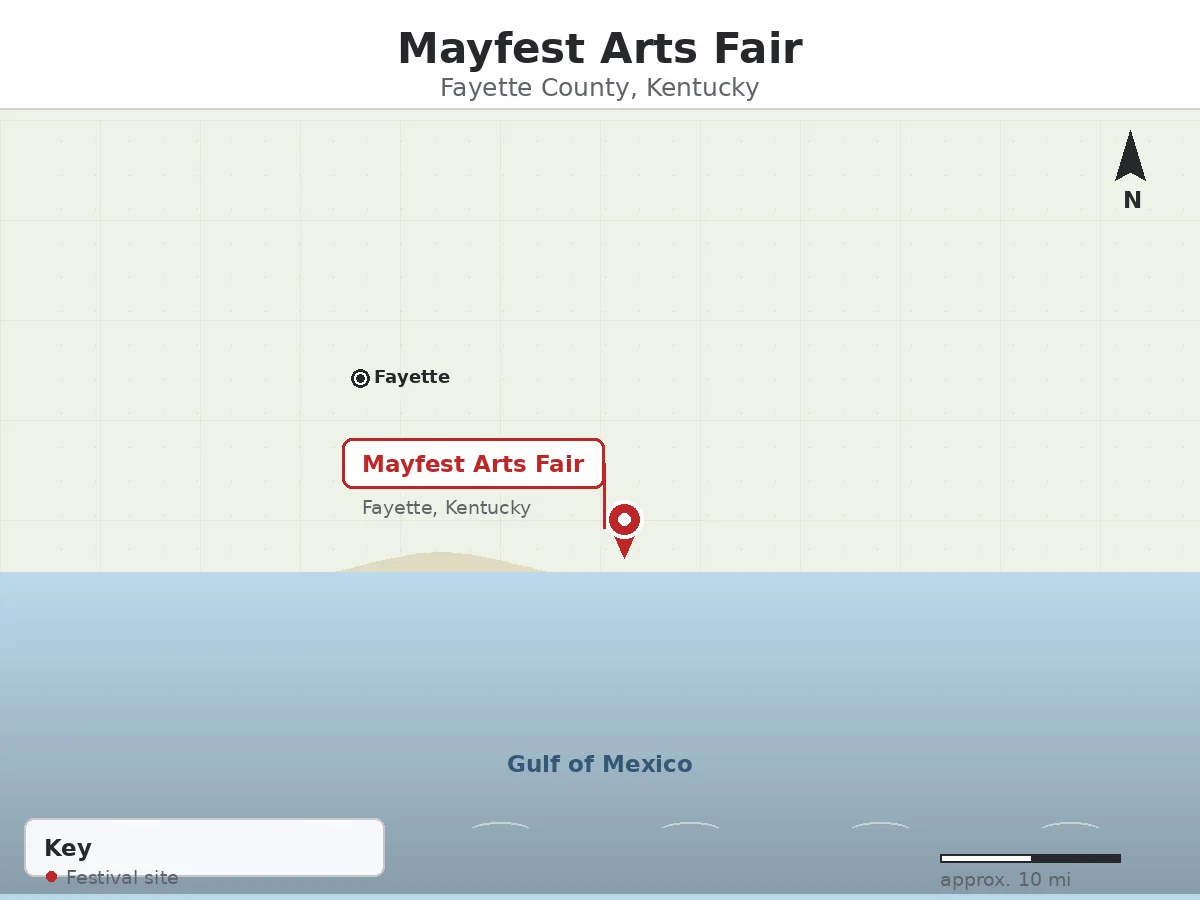
Every May, the lawns of Gratz Park in Lexington trade their quiet for rows of booths, handmade work and families wandering between the trees. The occasion is the event carried on this project’s sheet as the Fayette County Kentucky Mayfest Arts Fair Festival, though nothing in the published record uses that full county-prefixed wording. The name the layers print is Mayfest Arts Fair, and under that name the fair takes over Gratz Park and the surrounding historic district for Mother’s Day weekend.

What backs this article is an unusual sort of evidence. The fair is documented less by previews than by paperwork: the organiser’s own artist agreement and application layers for two thousand twenty and two thousand twenty-six, an events-aggregator listing that fixes the later edition’s dates, hours and venue, a neighbourhood-association layer and a reference layer. Contracts are precise about obligations and vague about atmosphere, so the record here is strongest on dates, names and duties, and openly thinner on the visitor-facing colour a preview would normally supply.
About the Festival
Two printed name forms run through the layers, and they are kept apart here exactly as they appear. The organiser’s artist agreement layers and an events-aggregator layer both use Mayfest Arts Fair. A neighbourhood-association layer and a reference layer shorten the name to Mayfest. No layer read prints the sheet’s full title, with its county prefix and its doubled festival wording, so the long title belongs to the sheet alone while the shorter forms belong to the event’s own paperwork and its neighbours.
Organisation carries a similar split. The artist agreement layers for two thousand twenty and two thousand twenty-six name the Downtown Lexington Partnership, shortened within those documents to the initials DLP, as the body behind the fair. A neighbourhood-association layer instead describes a Downtown Lexington Corporation as the sponsor. The two forms are reported side by side, unmerged, because the layers themselves use both. Separately, the two thousand twenty-six edition carries the billing Presented by Central Bank in the organiser’s application layer and in the events-aggregator listing; that is a presenter billing for one edition, not a third organiser name, and it is treated that way here.
Quick Facts
| Item | Detail |
| Published name | Mayfest Arts Fair |
| Shorter printed form | Mayfest |
| Host city | Lexington, Fayette County, Kentucky |
| County seat status | Lexington serves as the county seat of Fayette County |
| Setting | Gratz Park and the Gratz Park Historic District; booths along Mill and Market Streets |
| Organiser in artist agreements | Downtown Lexington Partnership |
| Sponsor form in neighbourhood layer | Downtown Lexington Corporation |
| Presenter billing for two thousand twenty-six | Presented by Central Bank |
| Documented editions | Ninth to tenth of May, two thousand twenty; ninth to tenth of May, two thousand twenty-six |
| Hours in two thousand twenty-six | Ten in the morning to five in the afternoon |
History
Anyone hoping for a founding story will find the layers unusually quiet. Not one of them gives a first edition or a year in which the fair began, and this article does not manufacture one by counting backwards from the two documented editions. What the paperwork establishes is a pair of fixed points rather than a lineage: an edition on the ninth and tenth of May in two thousand twenty, and another on the same dates in two thousand twenty-six.
For a useful comparison, see the Fayette County Kentucky Kentucky Book Festival for another county festival.
The neighbourhood-association layer contributes the one piece of continuity the record does hold: it treats Mother’s Day weekend as the fair’s standing date, the slot the event returns to rather than a coincidence shared by two editions six years apart. The two thousand twenty-six edition being billed under a presenter, and its artist obligations layer calling the fair a rain-or-shine juried event, show a settled operation by then; how many editions ran between the two documented years, the layers simply do not say.
What to Expect
The fair’s centre of gravity is its art. A reference layer describes a juried arts and crafts fair with more than one hundred artists, which makes selection, rather than open sign-up, the organising principle: the artists who line the park have been chosen. That same reference layer, describing the event in general terms, adds traditional Maypole dances, strolling entertainment and tours of historic Gratz Park to the picture, giving the weekend a folk-festival texture around the booths.
Geography shapes the browsing. The booths stand along Mill and Market Streets as well as within the park and its historic district, per the neighbourhood-association layer and the events-aggregator layer, so the fair spills from lawn to pavement and a circuit of the grounds doubles as a walk through one of Lexington’s historic neighbourhoods. The organiser’s two thousand twenty-six artist obligations layer also commits the event to run rain or shine, which tells visitors the canopies stay up whatever the spring weather decides.
Beyond those documented elements, the layers read grow summary-level: no stage schedule, artist list or programme timetable for a specific edition appears in them, so anything more detailed would be invention rather than reporting.
Planning Your Visit
Build the trip around Mother’s Day weekend. That anchor comes from the neighbourhood-association layer, which treats the weekend as the fair’s standing date, and both documented editions honour it: the ninth and tenth of May in two thousand twenty and again in two thousand twenty-six. For the later edition, the events-aggregator layer gives hours of ten in the morning to five in the afternoon on both days, a compact span that rewards arriving early rather than drifting in at midday.
Money needs one careful distinction. Nothing in the layers read states a public gate price for the fair, and nothing in them is relied on here as a claim that entry is free, so this article takes no position on what a visitor pays at the edge of the park. The only fees the record actually prints belong to artists: a nonrefundable application fee in the two thousand twenty layer, and an invited-artist participation fee per booth space in the two thousand twenty-six layer, higher than the earlier figure. Those are vendor charges inside the organiser’s paperwork, never charges quoted to the visiting public, and their amounts are not given in the layers read.
Weather and paperwork round out the practical picture. The two thousand twenty-six obligations layer frames the fair as rain or shine, so a wet forecast is a reason to pack a jacket rather than cancel. The organiser’s application layers also print a mailing address, an email address and a state revenue telephone number; those contacts are noted here by existence only and never reproduced, and they exist chiefly for artists dealing with the organiser rather than for visitors planning a day out.
A Sample Festival Day
A workable day follows the documented hours. Arrive near ten in the morning, when the two thousand twenty-six listing opens the fair, and begin with a slow circuit of the booths along Mill and Market Streets while the crowds are still thin. The juried field of more than one hundred artists rewards a full first pass; pieces that catch the eye early can be revisited before the five o’clock close.
Midday belongs to the park itself. The reference layer’s general description promises Maypole dances and strolling entertainment, the sort of programme that rewards lingering on the lawn rather than marching booth to booth, and its mention of tours of historic Gratz Park suggests building one into the afternoon. Finish with a second, shorter pass along the streets for purchases, and the day closes at five in the afternoon having used every documented element the record offers.
Mayfest Among Its Namesakes
The name Mayfest travels, and the searches behind this article turned up two other events wearing it. In Fort Worth, Texas, Mayfest is a four-day festival in Trinity Park, large enough that its vendor forms surfaced alongside the Lexington paperwork. In Lincoln, Nebraska, a Mayfest fundraiser appeared as well. Neither has anything to do with Gratz Park: the Texas event runs twice as long in a different state’s river park, and the Nebraska one is a fundraiser rather than a juried fair.
A third namesake of a different kind also surfaced: a generic, AI-style page purporting to give a Mayfest two thousand twenty-six schedule. It was read and is disowned in full here; none of its claims supports any statement in this article, and readers who meet it elsewhere should treat its confident detail as decoration rather than documentation. Against those mirages, the Lexington fair’s identity is plain: a two-day, juried arts fair on Mother’s Day weekend in a historic Lexington park.
A Visitor’s Checklist
- Confirm the current year’s dates against the Mother’s Day weekend pattern before making travel plans.
- Work to the documented hours, ten in the morning until five in the afternoon, and arrive near opening.
- Bring a bag roomy enough for purchases from a juried field of more than one hundred artists.
- Dress for a rain-or-shine event, since the organiser’s two thousand twenty-six layer commits the fair to run in wet weather.
- Leave time between booths for the Maypole dances, strolling entertainment and a tour of historic Gratz Park.
- Artists should read the organiser’s application layers early, noting the nonrefundable application fee and the per-booth participation fee.
- Do not mistake the artist fees in the paperwork for a visitor ticket price; the layers read state no gate price.
Beyond the Booths
The fair’s setting does quiet work of its own. Gratz Park sits inside a historic district, and the reference layer’s tours of the park point to a neighbourhood that rewards attention in its own right: a visitor who only shops the booths misses half of what the location offers. The booths strung along Mill and Market Streets blur the line between fairground and neighbourhood, so stepping away from the art for an hour still leaves a visitor inside the event’s wider setting.
Lexington’s role as county seat gives the weekend a second frame. Reference layers confirm the city as the seat of Fayette County, so the fair unfolds in the county’s civic centre as well as its historic core, one more reason a Mother’s Day trip to Gratz Park can anchor a wider look at the city without leaving the documented ground of the fair itself.
Why Mayfest Matters
Mayfest matters, on this record, as an example of how a community fair is held together by unglamorous documents. Artist agreements, obligations layers and application forms are what survive in the layers read, and they preserve the fair’s skeleton precisely: who organises it, when it runs, where it stands, what its artists owe and are owed. The colour of the day, its crowds, weather and favourite booths, is exactly what paperwork cannot keep, and the gap between skeleton and colour is itself a small lesson in how local events are remembered.
Within Lexington’s calendar, the documented pattern gives the fair a clear niche: a juried arts weekend, on Mother’s Day, in a historic park, drawing more than one hundred selected artists into the open air. That combination of selection, setting and timing is the fair’s significance as the record presents it, and it needs no invented founding myth to stand.
Frequently Asked Questions
Which name should a visitor search for when looking up the fair?
Search for Mayfest Arts Fair, the form used by the organiser’s artist agreement layers and the events-aggregator layer. The shorter Mayfest appears in a neighbourhood-association layer and a reference layer. The sheet title’s county prefix and doubled festival wording appear in no layer read, so listings will not use them.
Who organises Mayfest, and who presented the two thousand twenty-six edition?
The organiser’s artist agreement layers for two thousand twenty and two thousand twenty-six name the Downtown Lexington Partnership, shortened there to the initials DLP. A neighbourhood-association layer instead describes a Downtown Lexington Corporation as the sponsor, and the two forms are left unmerged just as the layers leave them. The two thousand twenty-six edition was billed Presented by Central Bank, a presenter credit rather than an organiser name.
Do the fees printed in the organiser’s forms mean visitors pay to get in?
They do not. Those fees are charged to artists: a nonrefundable application fee in the two thousand twenty layer and an invited-artist participation fee per booth space in the two thousand twenty-six layer. No layer read states a public gate price, and none is relied on here for a claim that entry is free, so what a visitor pays, if anything, is a question the record leaves open.
How long has the fair been running?
Age is the one thing this paperwork never mentions. None of them states a founding year or a first edition, and this article derives none from the two documented editions, which fall on the ninth and tenth of May in two thousand twenty and in two thousand twenty-six. The neighbourhood-association layer does establish Mother’s Day weekend as the event’s standing date, which speaks to rhythm rather than age.
What to Expect From the Next Fayette County Kentucky Mayfest Arts Fair Festival
How often is Fayette County Kentucky Mayfest Arts Fair Festival held?
The documented editions both sit on Mother’s Day weekend, in two thousand twenty and in two thousand twenty-six, and the neighbourhood-association layer treats that weekend as the fair’s standing date. Whether an edition ran in every year between those two points is not something the layers read establish, so the honest answer is a recurring Mother’s Day weekend fixture whose unbroken run the record does not prove.
When is the next Fayette County Kentucky Mayfest Arts Fair Festival?
The layers gathered here print dates only through the two thousand twenty-six edition, so no later date can be quoted from them. If the standing pattern holds, the next edition would fall on Mother’s Day weekend in the following year, but that is an expectation drawn from the pattern, not a date published in any layer read, and it should be checked against the organiser’s current paperwork before travel is planned.
Will the dates change?
The weekend anchor looks stable and the exact dates do not. Both documented editions used the ninth and tenth of May, but that pairing was a gift of those years’ calendars; because Mother’s Day moves, the fair’s dates will land on different May days in other years even while the weekend itself stays fixed. Hours are documented only for two thousand twenty-six, so those could shift as well.
Closing Thoughts
Mayfest’s record is paperwork first and colour second, and this article has kept that order. What can be stated plainly is considerable: a juried fair of more than one hundred artists, in a historic Lexington park, on Mother’s Day weekend, organised under names the layers print in two forms and presented in two thousand twenty-six by Central Bank. The rest a visitor discovers by going.