Linn County Kansas Dancefestopia Music and Camping Festival
A week of electronic music echoing through the trees at a rural education center is not the first picture that comes to mind for a small Kansas county, yet that is exactly what the published record describes at La Cygne. Dancefestopia runs for seven days each September, filling five stages with bass-heavy performers while its audience sleeps in forest camping a short walk from the music. The gathering is commercially produced, fully ticketed and far larger than the one-day community celebrations that fill most of the surrounding calendar. What follows gathers everything the organiser’s own site, a ticketing layer and several music-press layers agree on, keeping each claim tied to the layer that printed it.
About
The organiser’s own site presents the event under the single name Dancefestopia. A ticketing layer prints a fuller form, Dancefestopia Music & Camping Festival, and that longer styling is the closest any source comes to the title at the top of this page. The county prefix itself appears in no layer at all; it is a filing convention of this catalogue rather than part of the festival’s published name, and readers searching for the event should search the short name first.
The host community is La Cygne, a small town in Linn County. La Cygne does not hold the county seat; that role belongs to Mound City, a distinction worth keeping straight because the festival’s scale can make it sound like a county-run production. It is not. The ticketing layer describes the organiser, Borda Productions, as a local production company based in Kansas City that fully operates and funds the event independently, without a city or county fair board behind it.
Every recent edition has taken place at the Wildwood Outdoor Education Center in La Cygne, a wooded site that gives the festival its defining combination of open-air stages and camping under trees. A music-press layer notes that the event has been held at the Wildwood site since two thousand eighteen, so the grounds and the gathering have had years to grow into each other.
The ampersand in the longer published form is worth a moment of attention, because it signals how the organiser packages the week. Music and camping are not presented as a concert with an optional field attached; the printed name welds the two together, and the ticketing arrangements follow the same logic by selling admission and admission-plus-camping side by side.
For a useful comparison, see the Linn County Kansas General Pleasanton Days Festival for another county festival.
Quick Facts
| Fact | Detail |
| Published name | Dancefestopia |
| Longer published form | Dancefestopia Music & Camping Festival |
| Host town | La Cygne |
| County seat | Mound City |
| Venue | Wildwood Outdoor Education Center |
| Organiser | Borda Productions |
| Documented recent edition | Seventh to thirteenth of September, two thousand twenty-six |
| Lineup scale | Two hundred twenty-five artists across five stages |
| Admission | Ticketed passes, never free entry |
| Announced next edition | Sixth to twelfth of September, two thousand twenty-seven |
History
The ticketing layer and organiser-aligned press coverage print a founding year of two thousand eleven, and this article records that year exactly as those layers give it. An EDM-press layer adds texture to the early story, explaining that the gathering began as a two-day festival platforming hip-hop and dance music before its sound settled into the electronic and bass programme it is now known for. Those earliest editions belonged to the Kansas City area, and press layers treat those years as the same event’s history rather than a separate predecessor.
The move east reshaped the festival. Since two thousand eighteen, according to a music-press layer, Dancefestopia has taken place at the Wildwood Outdoor Education Center outside La Cygne, trading its original urban footprint for forest ground where the audience can camp on site. That single change explains much of what the modern festival is: a destination gathering that imports its crowd for a full week instead of drawing a local audience for an afternoon. The growth in duration tells the same story from another angle, since a two-day beginning has stretched into a seven-day run, the longest format documented anywhere in this county’s catalogue.
One billing deserves care. The same EDM-press layer that describes the two-day beginnings also bills the two thousand twenty-six gathering as the festival’s fourteenth edition. The founding year printed elsewhere and that edition number sit side by side in the record without reconciling neatly, and this article leaves them exactly as their own layers printed them rather than forcing the arithmetic into agreement.
What to Expect
Five stages carry the programme from the first afternoon to the final night, and press layers name three of them: the Emerald Stage, the Lollipop Stage and the Emerald Forest Stage. Across those stages the two thousand twenty-six edition presented two hundred twenty-five artists, a lineup counted by a festival-guide layer and echoed through multiple music-press accounts. The headliners at the top of that bill were GRiZ, Excision and Zeds Dead, three of the biggest draws in bass music, anchoring a roster that runs deep into the genre’s touring circuit.
The sound is electronic and bass music throughout, so visitors should arrive expecting heavy low end, long sets and stages that keep moving well past dark. Production is part of the draw in its own right: organiser and press layers describe fireworks and laser shows built into the presentation, turning the wooded site into part of the spectacle once the sun drops.
Between sets, the grounds hold art installations and vendor rows, giving the week a texture beyond the stage schedule. Forest camping sits at the center of the experience rather than at its edge, since the published name itself pairs the music with camping. Most attendees live on site for the run of the festival, which lends the place the feel of a temporary village that assembles in the trees each September and dissolves again a week later. With two hundred twenty-five artists spread across the bill, no attendee hears more than a fraction of the programme, and choosing between overlapping stages becomes the week’s pleasant problem. The three named stages give that choosing a geography, since regulars learn which corners of the woods favour which corners of the lineup.
Planning Your Visit
Tickets come first, because nothing about this gathering is walk-up and free. The ticketing layer sells passes covering three to seven days, so visitors choose how much of the week they want rather than buying a single daily admission. Three tiers structure the offer: general admission, VIP and Super VIP, each printed in the ticketing layer exactly in those terms. For the two thousand twenty-seven edition, that layer prints both admission-only prices and admission-plus-camping prices, and the amounts themselves live only in that layer; anyone budgeting should read the current figures there instead of trusting numbers repeated secondhand.
Camping deserves its own decision. The on-site forest camping is the festival’s signature arrangement, and the admission-plus-camping passes exist precisely because most of the audience stays in the trees. A seven-day stay in September woods calls for gear that handles warm afternoons, cool nights and the possibility of rain, plus food and water planning suited to a rural site outside a small town. La Cygne offers the basics of a small community, but a crowd of this size arriving at once is reason enough to lay in supplies before settling at the grounds.
Length of stay shapes everything else. A three-day pass holder can treat the trip as a long weekend built around favourite acts, while a full-week attendee should pace the days, rotate stages and leave room for the art installations and vendor rows that reward slower wandering. Either way, the announced September dates give planners a fixed frame well in advance.
A Sample Itinerary
A full-week visit might open with arrival and camp setup on the first day, followed by an exploratory circuit of the grounds to learn where the Emerald Stage, the Lollipop Stage and the Emerald Forest Stage sit in relation to the trees. The second day can lean into the undercard, sampling lesser-known performers across all five stages while the site is still fresh. Midweek suits a slower rhythm: mornings among the art installations, afternoons browsing vendors, and evenings reserved for the largest sets and the laser shows that follow dark. Headliner nights deserve planning around GRiZ, Excision and Zeds Dead, whose sets anchor the week’s peak hours. The final day works best as a farewell pass through favourite corners of the grounds, a last walk through the vendor rows and an unhurried pack-up before the drive home.
How It Compares
Set beside the county fairs and single-day town festivals that fill most of this catalogue, Dancefestopia is an outlier in nearly every dimension. It runs seven days rather than one or two. It charges for every level of admission rather than opening its gates freely. Its programme commits to one musical family instead of spreading across parades, contests and livestock traditions, and its audience travels in from well beyond the county instead of walking over from the next street. The independent production model sets it apart as well: a single company operates and funds the whole undertaking, where most gatherings in these pages rest on volunteer committees, civic clubs or fair boards. The comparison is not a ranking; it simply explains why this entry reads differently from its neighbours.
A Planning Checklist
- Confirm which published name to search, since the organiser’s own site uses Dancefestopia alone
- Choose a pass length between three and seven days before buying
- Decide between the general admission, VIP and Super VIP tiers
- Pick admission only or admission plus camping from the ticketing layer
- Read current pass prices in the ticketing layer itself
- Pack camping gear suited to a week in September woodland
- Bring supplies for a rural site beyond a small town
- Mark the headliner sets by GRiZ, Excision and Zeds Dead in advance
- Leave unscheduled hours for art installations and vendor rows
- Note that La Cygne hosts the event while Mound City holds the county seat
Beyond the Festival Grounds
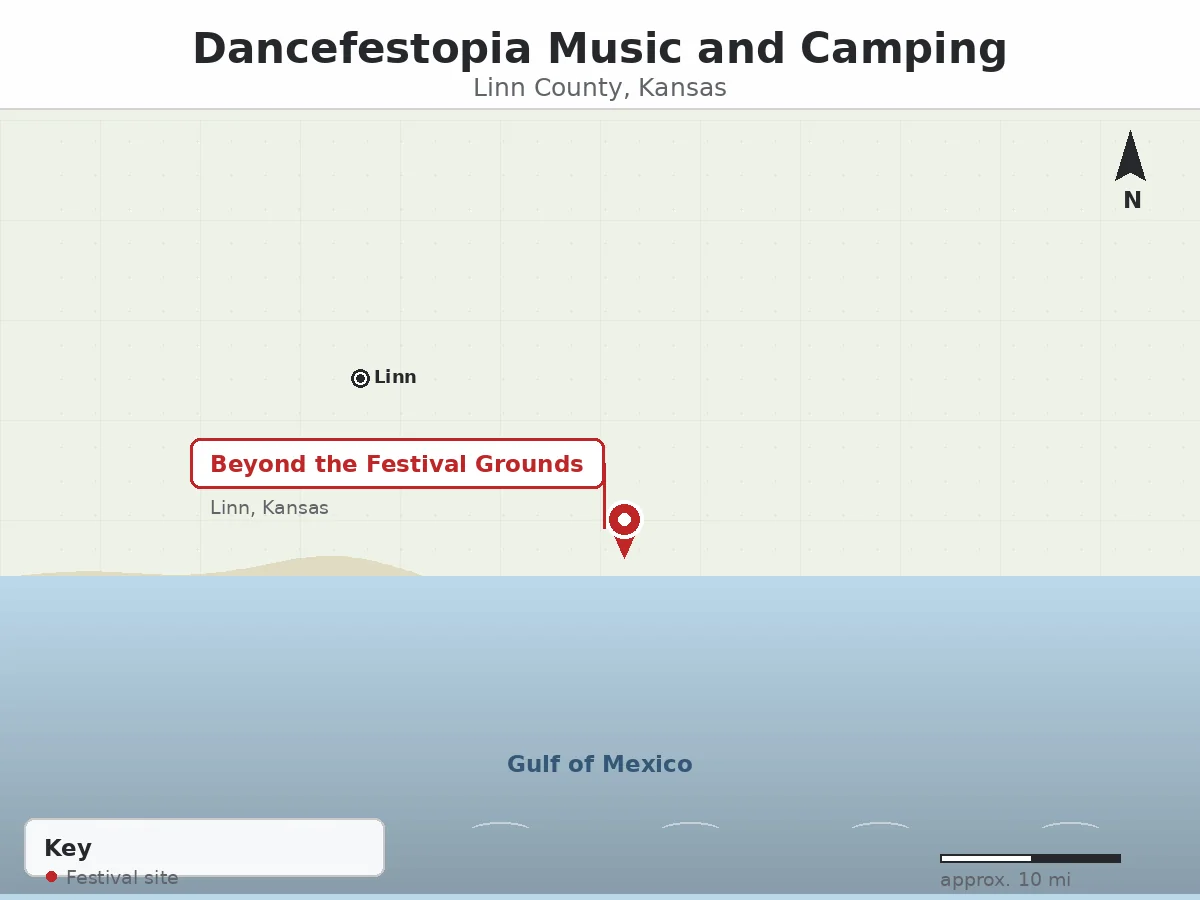
The festival’s setting does much of its quiet work. Wildwood Outdoor Education Center gives the event a wooded home that most electronic festivals, staged in fields or fairgrounds, cannot match, and the forest shapes everything from the camping to the way sound carries after dark. La Cygne itself remains a small town living its ordinary year on either side of festival week, and the contrast between that everyday calm and the September influx is part of the gathering’s character. Elsewhere in Linn County, Mound City carries the county’s administrative life as its seat, a reminder that this corner of Kansas keeps its own rhythms while one week each year belongs to the music in the trees.
Why the Festival Matters
Dancefestopia shows what an independent production can build in a rural county when it is given time. A gathering printed as founded in two thousand eleven survived a change of home, settled into a wooded site in two thousand eighteen and grew into a seven-day event presenting two hundred twenty-five artists, all without a fair board or a municipality underwriting it. For La Cygne, the festival brings a national touring circuit to a town that would otherwise never appear on those routing maps, along with a week of trade for the surrounding area each September. For the wider region, it stands as proof that a destination music festival can root itself in small-town Kansas and keep returning. There is also a quieter point about independence: because one company operates and funds the event itself, the festival’s survival has never depended on a levy, a fair board’s vote or a sponsor committee’s enthusiasm, and its long run at one site since two thousand eighteen suggests that model has given it room to plan in years rather than in seasons.
Frequently Asked Questions
Which name should visitors search for when looking the festival up?
Search the short name. The organiser’s own site calls the event simply Dancefestopia, while a ticketing layer prints Dancefestopia Music & Camping Festival. The county wording in this page’s title is a catalogue convention that no source attaches to the event itself.
Is entry free for any part of the week?
No. The ticketing layer sells passes for every attendee, covering three to seven days across general admission, VIP and Super VIP tiers, with admission-only and admission-plus-camping versions printed for the two thousand twenty-seven edition. Current prices appear only in that layer.
How large is the lineup, and who headlined the documented edition?
A festival-guide layer counts two hundred twenty-five artists across five stages for the two thousand twenty-six edition, which ran from the seventh to the thirteenth of September. GRiZ, Excision and Zeds Dead headlined that bill, with press layers naming the Emerald Stage, the Lollipop Stage and the Emerald Forest Stage among the five.
Where does the county seat sit, if the festival is at La Cygne?
Mound City is the county seat of Linn County. La Cygne hosts the festival at the Wildwood Outdoor Education Center, but the seat and its courthouse functions belong to Mound City, and the event itself is run independently by Borda Productions rather than by the county.
What to Expect From the Next Linn County Kansas Dancefestopia Music and Camping Festival
How often is Linn County Kansas Dancefestopia Music and Camping Festival held?
The documented pattern is a yearly September gathering. The two thousand twenty-six edition occupied the seventh to the thirteenth of that month, and the following edition was announced for September of two thousand twenty-seven, continuing the annual rhythm the recent record shows.
When is the next Linn County Kansas Dancefestopia Music and Camping Festival?
The organiser’s own site and the ticketing layer announce the next edition for the sixth to the twelfth of September, two thousand twenty-seven, again at La Cygne. Passes for that edition are described in the ticketing layer, which prints the three- to seven-day options and the admission-plus-camping figures for that year.
Will the dates change?
Announced dates have a way of being provisional until the organiser confirms them, and this festival’s own history shows movement of a different kind, since it changed its home entirely in two thousand eighteen. The September placement has held steady across the documented recent editions, but anyone travelling should confirm the two thousand twenty-seven dates against the organiser’s own site before booking around them.
Closing
Dancefestopia earns its place in this catalogue on the strength of a plain, well-layered record: an organiser’s own site, a ticketing layer printing passes and dates, and music-press coverage counting artists, stages and headliners across multiple editions. Kept to what those layers actually say, the picture is of an independently produced electronic festival that found a permanent wooded home at La Cygne and grew, September by September, into one of the largest gatherings its county hosts.