Warrick County Indiana Antique Steam and Gas Engine Show Festival
Despite the word at the end of the title above, nothing in the published record calls this event a festival. What the layers describe is a pair of club shows, held twice a year at a park north of Boonville, Indiana, by a group of machinery enthusiasts who have been gathering since the early nineteen sixties. The printed names are plain show names: a Summer Show, a Fall Show, and, in older layers, an Annual Reunion and Show. One AI-flavoured festival directory prints yet another form, “Antique Steam & Gas Engine Tractor Show,” but no organiser or listing layer uses that wording, and it is set aside here as a directory invention. The honest description is simpler: two weekends a year when antique tractors, steam engines, and gas engines come out of barns and sheds across the region and are put back to work for anyone who cares to watch.

About the Shows
The organising club’s name is printed in more than one word order across the layers, and those forms are kept separate here rather than blended. Event-listing layers print “Antique Steam & Gas Engine Club.” The park’s own page reverses the order and prints “Antique Gas and Steam Engine Club.” A nonprofit registry layer prints “Antique Steam and Gas Engine Club Inc.” All three forms point to the same Boonville-area club, but each is recorded as its own layer gives it.
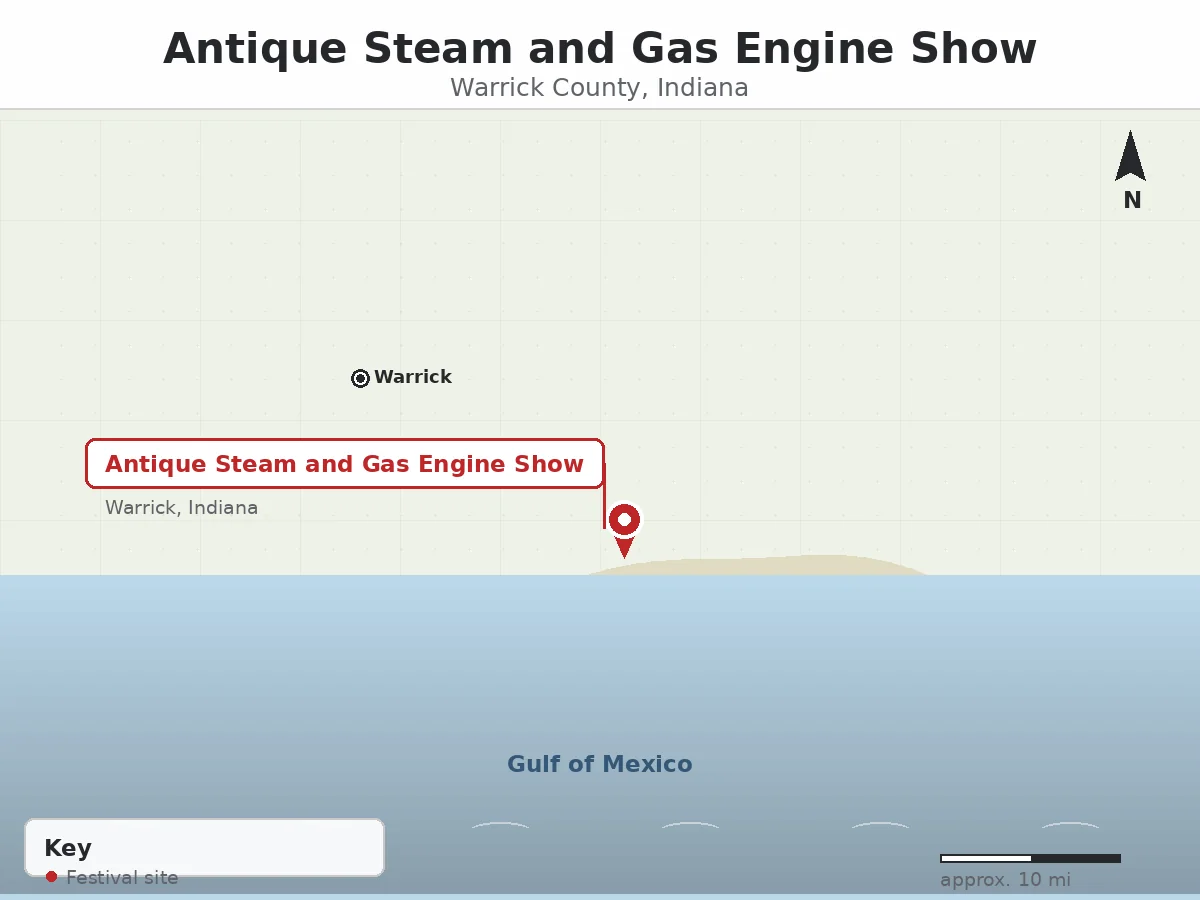
The shows take place at Thresherman Park, also printed as Thresherman’s Park, about two and a half miles north of Boonville off Highway sixty-one. Boonville is the county seat of Warrick County, and the park sits outside town in countryside its members farm. Its own park page states the pattern plainly: the steam show is always the last full weekend in July, running Friday through Sunday, and the fall show is always the second full weekend in October.
Quick Facts
| Item | Detail |
| Published names | Antique Steam & Gas Engine Club Summer Show; Antique Steam & Gas Engine Fall Show; Antique Steam and Gas Engine Club Annual Reunion and Show |
| Host town | Boonville, Indiana |
| County | Warrick County, for which Boonville is the county seat |
| Venue | Thresherman Park, also printed Thresherman’s Park, about two and a half miles north of Boonville off Highway sixty-one |
| Organiser name forms | Antique Steam & Gas Engine Club; Antique Gas and Steam Engine Club; Antique Steam and Gas Engine Club Inc |
| Show pattern | Two shows a year: the last full weekend in July and the second full weekend in October |
| Recent dated editions | Summer show, July twenty-six to twenty-eight, twenty twenty-four; fall show, October eleven, twenty twenty-four; fall show, October ten, twenty twenty-five |
| Admission in dated layers | Five dollars in the twenty twenty-four summer calendar layer; five dollars Friday and Saturday and three dollars Sunday in the twenty twenty-five fall listing; children under thirteen free in both |
| First show | Nineteen sixty-four in Boonville, as the park’s own page states it |
History
The club’s early story survives in one place: its own park page. That page states that the club was formed in nineteen sixty-two by several area men who wanted to preserve their steam engines, machines already passing out of farm use by then. Two years later, in nineteen sixty-four, the club held its first show in Boonville. The gathering outgrew its original setting, and the park has stood at its present location since nineteen seventy-eight.
Layered over that account are the annual billings printed on later listings, and the two do not line up neatly. Show-directory layers bill the July twenty ten gathering, held July twenty-three to twenty-five, as the forty-seventh annual reunion and show. Event-listing layers bill the fall show of October eleven, twenty twenty-four as the sixty-first annual, and the fall show of October ten, twenty twenty-five as the sixty-second annual. Those numbers are recorded here as billings only. They are not reconciled with the park page’s statement that the first show took place in nineteen sixty-four, and no founding year for the shows themselves is worked out from them. The club’s own page remains the only layer that tells the founding story directly.
For a useful comparison, see the Warrick County Indiana Boonville Square Flair Festival for another county festival.
What the dated layers do establish is continuity. A July twenty fifteen gathering, held July twenty-four to twenty-six, appears in show-directory layers under the reunion and show name. The summer show of July twenty-six to twenty-eight, twenty twenty-four appears in an event-calendar layer with featured machinery named. The fall shows of twenty twenty-four and twenty twenty-five appear in event-listing layers. Across six decades, the same club has kept the same two weekends filled with old iron.
What to Expect
A show weekend at Thresherman Park is organised around machinery in motion rather than machinery behind ropes. Event-listing layers describe displays of antique tractors, steam engines, gas engines, and garden tractors, so the grounds read as a working survey of how farms were powered before modern equipment took over. The twenty twenty-four summer calendar layer names the featured machinery for that edition: Ford tractors, Huber steam engines, and Hercules hit and miss engines.
The park’s own page names the headline demonstrations. Wheat threshing and saw milling are main attractions at both the summer and fall shows, and stationary engines that once ran mills, pumps, and other factories are run daily. That last detail gives the shows their character. A stationary engine on a stand is an artefact; the same engine belted to a pump or a mill, chuffing through its work cycle, is a demonstration of how a whole economy used to function. Visitors can expect noise, steam, sawdust, and the smell of hot oil, with club members tending machines they own. The fall show covers the same ground in October, when the harvest season the equipment was built for is under way around the park.
Planning Your Visit
Two weekends anchor the club’s year, and choosing between them is the main decision. The summer show falls on the last full weekend in July, Friday through Sunday, per the park page’s stated rule; the fall show falls on the second full weekend in October. July brings the longer-established steam show and, in the twenty twenty-four calendar layer, named feature machinery. October brings cooler weather and the fall gathering.
Admission figures exist only inside dated layers, and they are kept inside those layers here. The twenty twenty-four summer event-calendar layer lists five dollars, with children under thirteen free; it also mentions a Friday senior rate, though the layer as read was cut off before that figure, so no senior price is given in this article. The twenty twenty-five fall listing gives five dollars on Friday and Saturday and three dollars on Sunday, again with children under the age of thirteen free. Anyone budgeting from older listings should treat those numbers as belonging to their years.
One warning belongs in this section. An AI-flavoured festival directory circulates a twenty twenty-six summer show dated July twenty-six to twenty-eight with admission at around ten to fifteen dollars per day. Both details fail against the documented record: those July dates repeat the twenty twenty-four pattern instead of the club’s stated last-full-weekend rule, and the price conflicts with both dated listing layers. No organiser page with a current-year dated listing was among the layers read, so the club’s own weekend rules, not the directory, are the reliable guide to when the next shows fall.
A Sample Weekend at the Park
Friday suits a first arrival. The gates open on the show’s opening day, the displays are being set throughout the park, and the stationary engines begin their daily running. A Friday visit, at the five-dollar figure the twenty twenty-five fall listing assigns to that day, lets a newcomer learn the grounds before the weekend crowd builds.
Saturday is the fullest day for demonstrations. Wheat threshing and saw milling, the main attractions the park page names for both shows, anchor the middle of the day, and the tractor and engine displays throughout the park reward slow walking. In the twenty twenty-four summer edition, Saturday was the day to study the featured Ford tractors, Huber steam engines, and Hercules engines.
Sunday closes the weekend at a gentler pace. The twenty twenty-five fall listing drops Sunday admission to three dollars, the lowest figure in any dated layer, and the park page’s pattern runs the shows Friday through Sunday, so Sunday is a genuine third day rather than a teardown. It is the day for a second look at favourite machines and for conversations with the owners who keep them running.
How the Shows Compare
Southern Indiana has more than one old-iron gathering, and the layers are careful to keep them apart. The Southern Indiana Antique & Machinery Club’s Classic Iron Show, held in the Evansville area, belongs to a different club entirely; none of its dates, prices, or programme details belong in this article. The large Tri-State show at Portland, Indiana, is likewise a separate organisation’s event, on a far bigger scale. The Pioneer Engineers reunion at Rushville is a third club’s gathering, again distinct.
What sets the Boonville shows apart is their grounding. The Portland and Rushville gatherings draw exhibitors from across the Midwest to fairground settings, while the Thresherman Park shows happen on land the club has occupied since nineteen seventy-eight, organised by the same local membership that formed in nineteen sixty-two to save its own engines. The comparison is one of character rather than rank: a home park, two fixed weekends, and machines with local owners, set against larger regional meets run by other clubs.
Checklist
- Pick your weekend: last full weekend in July for the summer show, second full weekend in October for the fall show
- Carry small bills for gate admission, using the dated-layer figures as a guide rather than a promise
- Bring children under thirteen knowing the dated layers admit them free
- Wear shoes suited to grass, dirt, and sawdust rather than pavement
- Allow a full day if you want both the threshing and the saw milling demonstrations
- Ask engine owners about their machines; the daily running of stationary engines is the heart of the shows
- Ignore directory listings that give the twenty twenty-six show July dates copied from twenty twenty-four or prices far above the dated layers
- Keep the Classic Iron Show, the Portland Tri-State show, and the Rushville reunion on their own calendars, not this one
Beyond the Park
Boonville itself is the natural companion to a show weekend. The town is the county seat of Warrick County, and the club’s story begins there: the first show was held in Boonville in nineteen sixty-four, fourteen years before the park settled at its present location north of town. A visitor driving out Highway sixty-one to Thresherman Park passes through the same town where several area men first pooled their steam engines in nineteen sixty-two. Beyond that documented thread, the layers read stay focused on the club and its grounds, and this article does the same.
Why the Shows Matter
In nineteen sixty-two, steam engines were scrap waiting to happen. The men who formed this club looked at machines that had powered threshing rigs, sawmills, and pumps across Warrick County and decided the machines deserved saving while they could still be run. Six decades later, the club they founded still opens its park twice a year and still runs stationary engines daily at its shows, demonstrating work cycles that no photograph can reproduce. That continuity, carried by a local membership on its own ground since nineteen seventy-eight, is the real subject of the Summer Show and the Fall Show alike. The annual billings on the listings will keep climbing; the significance sits underneath them, in a park full of old iron that still earns its keep.
Frequently Asked Questions
How many shows does the club hold each year?
Two. The park’s own page states that the club holds two annual shows: a steam show on the last full weekend in July and a fall show on the second full weekend in October, each running Friday through Sunday.
Which name forms do the listings actually print for these events?
Listings and directories print show names rather than any festival title: the Antique Steam & Gas Engine Club Summer Show, the Antique Steam & Gas Engine Fall Show, and, in older show-directory layers, the Antique Steam and Gas Engine Club Annual Reunion and Show.
What machinery was featured at the twenty twenty-four summer show?
The event-calendar layer for that edition names Ford tractors, Huber steam engines, and Hercules hit and miss engines as the featured machinery, alongside the wider displays of antique tractors, steam engines, gas engines, and garden tractors described across the park.
Are the sixty-first and sixty-second annual billings a founding date for the shows?
No. Those billings appear on the twenty twenty-four and twenty twenty-five fall listings and are recorded as billings only. The club’s own park page gives a different account, a first show in nineteen sixty-four, and this article does not merge the two into a derived founding year.
What to Expect From the Next Warrick County Indiana Antique Steam and Gas Engine Show Festival
How often is Warrick County Indiana Antique Steam and Gas Engine Show Festival held?
Twice a year, under the show names the club actually publishes. The park page fixes the rhythm: a steam show on the last full weekend in July and a fall show on the second full weekend in October, each spanning Friday through Sunday.
When is the next Warrick County Indiana Antique Steam and Gas Engine Show Festival?
By the club’s own stated rules, the next summer show falls on the last full weekend of July and the next fall show on the second full weekend of October. No organiser page carrying a current-year dated listing was among the layers read for this article, and the AI-flavoured directory’s twenty twenty-six dates, which repeat the twenty twenty-four pattern, are not adopted here.
Will the dates change?
The weekend rules are the stable element in the record, stated by the club itself on its park page, while the specific calendar dates move each year as the weekends shift. What would change the picture is a dated listing from the club itself, which the layers read did not include for the current year.
Closing
Twice a year, on two weekends fixed by the club’s own rule, Thresherman Park fills with tractors, steam engines, and stationary engines doing the work they were built for. The published record never calls it a festival, and after the threshing starts and the sawmill bites, the distinction hardly matters. What Boonville has, under its several printed name forms, is a pair of shows run by the descendants in spirit of the men who refused to let the old machines go silent in nineteen sixty-two.