LaGrange County Indiana Shipshewana Antique Festival
Twice each summer, the Shipshewana Trading Place grounds turn one of their barns over to a two-day indoor gathering of antique dealers. The organiser publishes the event as the Shipshewana Antique Market, and a 2024 event listing prints the longer form Shipshewana Antique & Vintage Market. One festival-guide listing takes a different tack and calls the early-August weekend the Shipshewana Antique Festival. Because the people who run the event use the Market name, this article follows that naming in the body, while recording the guide’s Festival form openly rather than tidying it away.
The market belongs to Shipshewana, a town in LaGrange County, Indiana. The county seat is the town of LaGrange, not Shipshewana, and the distinction matters when reading county records. Behind the event stands the Shipshewana Trading Place, a name the organiser’s own site pairs with the Shipshewana Auction & Flea Market, and a local radio news layer uses the same pairing. The rhythm is fixed and brief: the third Friday and Saturday in June, then the first Friday and Saturday in August, eight in the morning until four in the afternoon on each day.
About
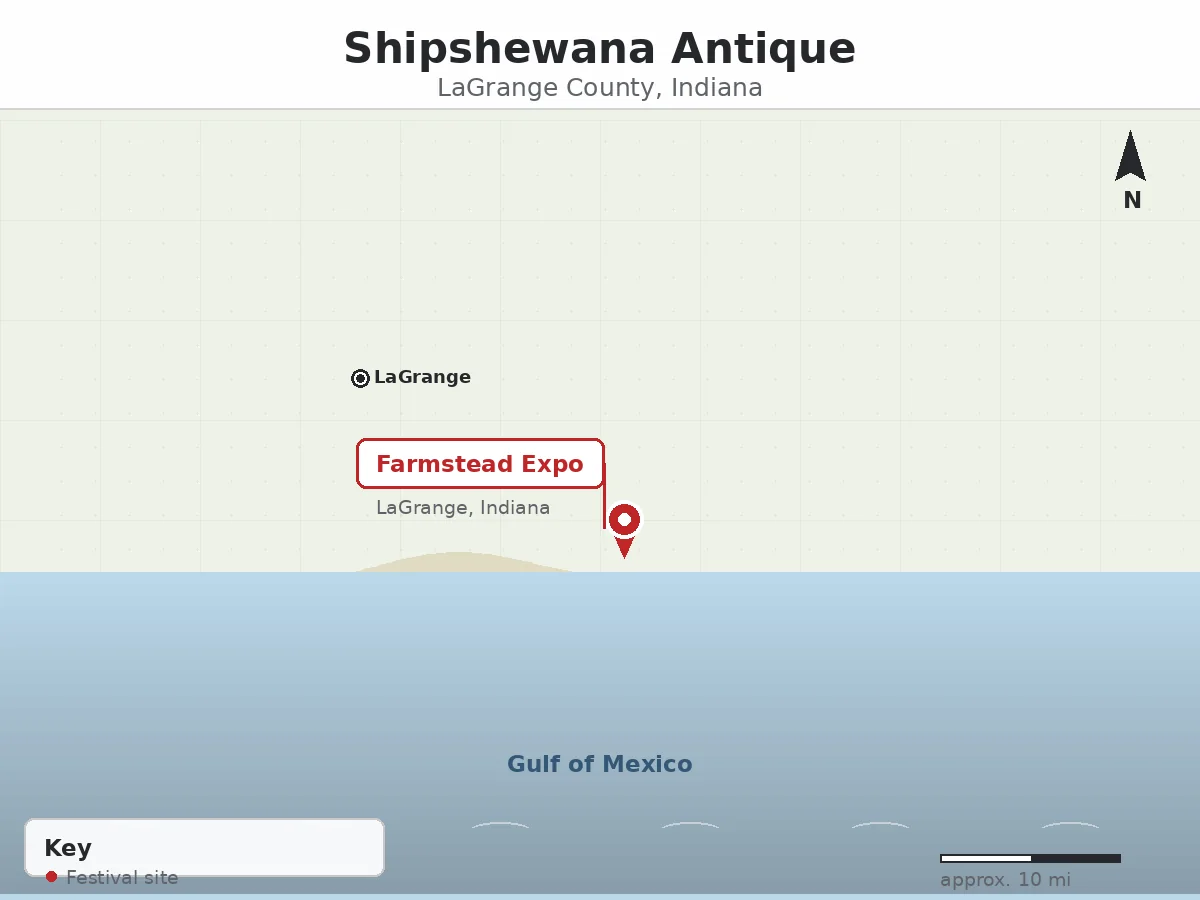
The market is an indoor event held on the Trading Place grounds. Organiser and listing layers print the room as the Antique & Miscellaneous Auction Barn / Event Pavilion, a working auction barn that takes on a different role for these two weekends. One documented edition moved across the grounds: a 2024 listing layer places the August 2024 market at the Farmstead Expo Barn and Event Pavilion instead. Both venue forms are recorded here with the layers that print them, because the grounds clearly give the organiser more than one large room to choose from.
A listing layer puts the scale at more than fifty vendors, selling antiques and vintage goods, with food available and door prizes worked into the day. That vendor figure belongs to the listing layer and is carried here as its count, not as a turnstile tally. No layer read offers a crowd figure for the market, so none is offered here either.
The June 19–20, 2026 edition shows how the market sits inside the grounds’ bigger weekends. The organiser’s release, carried by a local radio news layer, describes that weekend as a “trifecta”: the Antique Market running alongside the weekend flea market and the Saturday swap meet. Three separate attractions, one set of grounds, one pair of days.
For a useful comparison, see the LaGrange County Indiana Shipshewana Quilt Festival for another county festival.
The name deserves one more note, because the layers do not speak with a single voice. The organiser’s own site settles on Shipshewana Antique Market, a 2024 event listing lengthens that to Shipshewana Antique & Vintage Market, and a further listing layer repeats the shorter Market form. Only the festival-guide layer reaches for the word Festival, and only for the August weekend. Readers searching under any of those forms are looking at the same twice-yearly event.
Quick Facts
| Item | Detail |
| Published name | Shipshewana Antique Market, per the organiser’s own site |
| Also printed as | Shipshewana Antique & Vintage Market in a 2024 event listing; Shipshewana Antique Festival in one festival-guide listing, for the August weekend |
| Host town | Shipshewana, Indiana |
| County seat | The town of LaGrange; Shipshewana does not hold that role |
| Organiser | Shipshewana Trading Place, also styled Shipshewana Auction & Flea Market |
| When it runs | The third Friday and Saturday in June and the first Friday and Saturday in August |
| Hours | Eight in the morning to four in the afternoon |
| Setting | Indoors at the Trading Place grounds, in the Antique & Miscellaneous Auction Barn / Event Pavilion |
| Documented editions | August 2024, at the Farmstead Expo Barn and Event Pavilion; 19–20 June 2026, per the organiser’s release |
| Scale | More than fifty vendors, per a listing layer |
History
The grounds carry a long dealing history, but it belongs to a different event, and keeping the two apart is the honest way to tell it. A Trading Place layer states that the Wednesday antique auction has run since nineteen twenty-two. That is the story of a weekly auction that has operated year-round for over a century. It is not a founding year for the Antique Market, and no layer read supplies a founding year for the market itself, so this article does not borrow the auction’s date and pin it to the market.
What the record does show for the market is a settled, recurring pattern rather than an origin story. Organiser and listing layers agree on the twice-yearly shape: a June weekend and an August weekend, indoors, eight hours a day. The August 2024 edition is documented by its own listing layer, complete with the Farmstead Expo Barn and Event Pavilion as its room. The June 2026 edition is documented by the organiser’s own release, picked up by a local radio news layer, which frames the weekend as a trifecta shared with the flea market and the swap meet. Between those fixed points, the market reads as an established fixture of the grounds’ calendar whose early years simply are not described in the layers read.
What to Expect
The draw is the dealing floor itself. More than fifty vendors, on the listing layer’s count, set out antiques and vintage goods under one roof, and the eight-to-four day is built for unhurried browsing rather than a quick pass. Food is part of the documented picture, and door prizes add a small element of chance to a shopping day. Because the market is indoors, the whole event sits inside a single barn or pavilion, which keeps the vendors, the food and the crowd within a short walk of one another.
On a trifecta weekend the day widens beyond the barn. The organiser’s 2026 release places the weekend flea market and the Saturday swap meet on the same grounds at the same time, so a visitor can move between the curated antique stalls indoors and the looser sprawl of the flea market outside, then catch the swap meet on Saturday. Each of the three keeps its own identity; the market’s share of the weekend is the indoor, vendor-led antique and vintage selling.
Two full days matter here. A market of this size rewards a second pass, and the Friday-to-Saturday span means a piece spotted on the first day can be weighed overnight and revisited the next morning, still inside the same eight-to-four frame.
Planning Your Visit
Two short windows carry the whole year, so the first decision is which one suits: the third Friday and Saturday in June, or the first Friday and Saturday in August. Both days of either weekend run from eight in the morning to four in the afternoon, and arriving near the opening bell gives the fullest pick of the stalls before the day’s browsing thins them out.
The room itself is worth a moment’s care. Documented editions have used different spaces on the grounds, so the current edition’s listing is the place to confirm where the doors actually open rather than assuming the barn from a previous year.
Money needs careful reading, because the layers each say something narrow. A listing layer states free admission for the August 2024 edition, and that statement belongs to that edition alone; it is not printed here as a standing policy for every year. Parking carries the opposite fencing: the organiser’s 2026 release sets parking at five dollars a day, with that single daily charge covering all three trifecta events on the grounds. Neither figure is stretched beyond the layer and the year that printed it.
If the trip can be timed, the trifecta weekends offer the most on one parking charge, since the flea market and the Saturday swap meet share the grounds with the market. Buyers who prefer a quieter floor may find the non-trifecta hours simpler, though the layers read do not compare the crowds, and this article will not guess at them.
A Sample Itinerary
A trifecta weekend in June shows the shape at its fullest. Friday can begin at the eight o’clock opening inside the Antique & Miscellaneous Auction Barn / Event Pavilion, working the vendor rows while the day is young and pausing for food on the grounds. Door prizes punctuate the browsing, and the four o’clock close leaves the evening free.
Saturday starts the same way, back inside the market for a second pass at the stalls, then widens: the swap meet runs on Saturday, and the weekend flea market spreads across the grounds alongside it. A visitor can split the day between the indoor antique vendors and the outdoor attractions without leaving the site, which is precisely the appeal the organiser’s release builds its trifecta wording on. The August weekend follows the same two-day pattern, in whichever barn or pavilion the edition is assigned.
How It Compares
Three different attractions share the Trading Place grounds, and confusing them flattens all three. The Wednesday Antique & Miscellaneous Auction is a year-round weekly sale, the one the Trading Place layer traces back to nineteen twenty-two; it happens every week, not twice a year. The regular flea market is a standing Tuesday–Wednesday attraction on the same grounds, a fixture of the week rather than an event on the calendar.
The Antique Market differs from both in kind. It is a gathered body of vendors selling from stalls across two fixed weekends a year, indoors, with set opening and closing hours and a beginning and an end to each edition. The auction sells through a rostrum; the flea market rolls on weekly; the market assembles, trades for two days, and disperses until its next weekend comes around.
A Festival Checklist
- Choose between the June weekend and the August weekend before anything else
- Note the hours: eight in the morning to four in the afternoon, both days
- Bring cash-friendly patience for stall-by-stall browsing across two days
- Check which barn or pavilion the edition uses, since documented editions differ
- On a trifecta weekend, leave time for the flea market and the Saturday swap meet
- Budget for parking using the organiser’s most recent release rather than old listings
- Treat the August 2024 free-admission note as that edition’s detail, not a promise
- Measure larger pieces before the trip so a find can actually travel home
Beyond the Festival
The grounds do not go quiet when the market weekends end. The Wednesday antique auction keeps its weekly rhythm through the year, and the regular Tuesday–Wednesday flea market gives the same site a standing midweek draw. A visitor who misses both market weekends still has those fixtures, though neither is a substitute for the market itself.
Within the county, the town of LaGrange holds the county seat, a reminder that Shipshewana’s fame as a trading destination grew from its grounds and its dealers rather than from any civic role. The market is one expression of that trading character: periodic, dealer-led, and housed in the barns of an auction business.
Why It Matters
A twice-yearly market could easily be a footnote on the grounds’ calendar, but the documented record gives it a larger place. The organiser builds whole weekends around it, pairing it with the flea market and the swap meet under the trifecta banner, and a listing layer counts more than fifty vendors trading under its roof. For the Trading Place, the market converts the grounds’ everyday antique trade into an occasion twice a year, drawing the dealing indoors and giving it dates people can plan around. For Shipshewana, it adds two summer weekends when the town’s trading reputation takes a specific, visitable form.
Frequently Asked Questions
Does the Shipshewana Antique Market charge admission?
The only admission statement in the layers read comes from a listing layer, which records free admission for the August 2024 edition. That note is tied to that edition, and the organiser’s layers read do not print a general admission policy covering every year, so the careful answer is to check the current edition’s listing before travelling rather than assuming the 2024 arrangement still holds.
Why do some listings call this event a festival?
One festival-guide listing layer prints the name Shipshewana Antique Festival for the early-August weekend. The organiser’s own site, which outranks a guide on the event’s own name, publishes it as the Shipshewana Antique Market, with a 2024 listing adding the form Shipshewana Antique & Vintage Market. The Festival wording exists in print, but it is a single listing layer’s choice, not the organiser’s.
Is the market the same event as the Wednesday antique auction?
No. The Wednesday Antique & Miscellaneous Auction is a weekly, year-round sale that a Trading Place layer traces to nineteen twenty-two. The Antique Market is a separate, twice-yearly gathering of vendors that runs on two Friday-and-Saturday weekends, in June and in August. The two share grounds and a trade, and nothing else in the record merges them.
What else is happening on the grounds during a market weekend?
On the documented June 2026 weekend, the organiser’s release describes a trifecta: the Antique Market indoors, the weekend flea market, and the Saturday swap meet, all running on the same grounds. That same release prices parking at five dollars a day covering all three, so one charge opens the whole weekend’s worth of attractions.
What to Expect From the Next LaGrange County Indiana Shipshewana Antique Festival
How often is LaGrange County Indiana Shipshewana Antique Festival held?
Twice a year, on the organiser’s published pattern: the third Friday and Saturday of June and the first Friday and Saturday of August. Each edition runs for two days, from eight in the morning until four in the afternoon.
When is the next LaGrange County Indiana Shipshewana Antique Festival?
Following the documented June 2026 edition, the organiser’s printed pattern points to the first Friday and Saturday of August as the market’s next weekend. The August 2024 edition is the most recent August running described in a listing layer, held that year at the Farmstead Expo Barn and Event Pavilion.
Will the dates change?
The June and August anchors have held steady across every layer read, from the organiser’s own site to the listing layers covering 2024 and 2026. Nothing in those layers floats an alternative slot, though the room within the grounds has varied between editions, so the building is worth confirming even when the weekend is not in doubt.
Closing Thoughts
The Shipshewana Antique Market is a modest event with an unusually honest paper trail. Its organiser names it plainly, its dates repeat without drama, and its record keeps a clear line between the market, the century-old weekly auction and the standing flea market around it. Two weekends a year, the barn fills with dealers, the doors open at eight, and Shipshewana’s trading tradition takes its most concentrated form.