Bond County Illinois Heritage Days Festival
For three days at the end of July, the grounds of the American Farm Heritage Museum in Greenville become a working display of older farm power: antique tractors, farm engines, steam engines, and threshing and baling carried out the slow way in front of visitors. The event is published as Heritage Days, and one weekly farm newspaper has called it Farm Heritage Days. One honest note belongs at the top: the word Festival at the end of the heading above appears in no published layer found for this show, and anyone looking the event up should search under the two shorter names instead.
About Heritage Days at the American Farm Heritage Museum
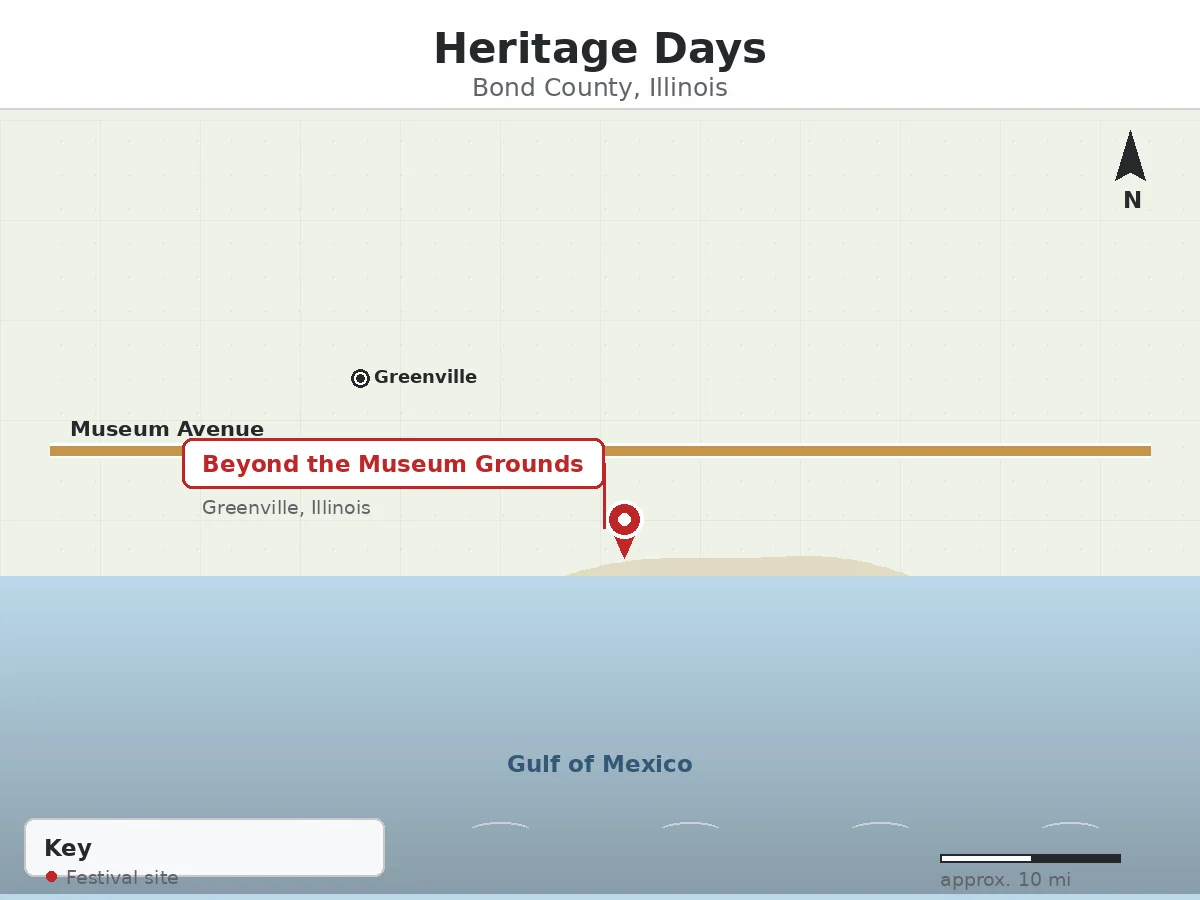
Heritage Days belongs to the American Farm Heritage Museum, which organises the show on its own grounds in Greenville, the county seat of Bond County. The chamber layer for the area describes the museum as the sponsor of a large three-day festival every year, and the museum’s own tourism-grant applications to the City of Greenville, dated 20 March 2024 and 16 February 2026, are the documents that describe the event in the most detail. Those applications name the working roles behind the show, including a show superintendent and a publicity chair. The museum stands on Museum Avenue on the southeast side of Greenville; the chamber places it on the Interstate 70 access road at Exit 45, and museum and city layers print a street number alongside the avenue name, which this article does not reproduce.
Quick Facts
| Field | Detail |
| Published name | Heritage Days; Farm Heritage Days in one farm-newspaper layer |
| Organiser | American Farm Heritage Museum |
| Setting | The museum’s own grounds on Museum Avenue, Greenville |
| County position | Greenville is the county seat of Bond County |
| Timing | The last weekend of July |
| Documented editions | 26 to 28 July 2019; 26 to 28 July 2024; 24 to 26 July 2026 |
| Year count | The museum’s 2024 application calls 2024 the twentieth year; its 2026 application calls 2026 the twenty-second year |
| Admission | Gate fees exist, but no organiser or city layer states an amount |
| Attendance | No reliably labelled figure appears in the layers read |
| Grounds size | Forty acres in chamber and blog layers; sixty acres in one blog layer, unresolved |
A History Told in the Museum’s Own Year Counts
Anyone hunting for the year Heritage Days began will not find it stated: no museum, chamber or city layer gives a founding year, and this article does not manufacture one. What the record offers instead is a pair of counts in the museum’s own words. In its application dated 20 March 2024, the museum confirms the event is annual and states that 2024 will be the twentieth year. In its application dated 16 February 2026, the museum states that 2026 will be the twenty-second year. Those two statements are recorded here exactly as the museum made them: as the organiser’s own reckoning of its show’s age, not as a founding date worked backwards, because the applications never say which edition counted as the first.
The earliest edition described in detail is the one held from 26 to 28 July 2019. A museum flyer layer for that year places Heritage Days in conjunction with International Harvester Collectors, Southern Illinois Chapter 32, and makes clear that all makes of tractors and equipment were welcome rather than one brand alone. The same flyer puts live music inside an air-conditioned building and points visitors toward the Lil’ Red Barn Museum on the grounds. Five years later, the museum’s 2024 application describes the edition of 26 to 28 July 2024 as a living-history event: Lil’ Red Barn displays, antique tractors, farm engines, steam engines, a working sawmill, threshing and baling demonstrations, tractor pulls, a flea market, Hills Fort interpretive displays and train rides. That application’s featuring line is partly garbled in the copy read, so no featured brand is taken from it here. The 2026 application, by contrast, is legible on the point: the edition of 24 to 26 July 2026 features the National Rumely Collectors Show for tractors and equipment, alongside Illinois-built engines and displays, with exhibitors anticipated from across the Midwest. A farm-newspaper layer describes a late-July three-day show whose featured brands were Sheppard and JI Case, but that article’s year was not pinned in the copy read, so those two brands are recorded as an undated account, attached to no edition in this article.
What to Expect at Heritage Days
Machinery at work is the centre of the weekend. The museum’s application layers list living-history displays, antique tractors, farm engines and steam engines, a working sawmill, threshing and baling demonstrations, tractor pulls, antique truck and engine displays, a flea market, Hills Fort interpretive displays, train rides, live music, food and vendors. A museum-visit blog layer, which uses the hyphenated timing form “last week-end of July”, describes hundreds of antique tractors on the grounds together with tractorcades, tractor parades, field demonstrations and car cruises; those hundreds count displayed machines, not visitors. In 2026 the collectors’ show gives the grounds a second focus: the National Rumely Collectors Show brings Rumely tractors and equipment into the same weekend as the Illinois-built engines and displays the museum’s application promises. The site itself is described inconsistently: chamber and blog layers call the grounds a forty-acre site, while one blog layer says sixty acres, and nothing read settles the difference. Visitors should picture a museum campus rather than a fairground midway: the Lil’ Red Barn, the Hills Fort interpretive displays and the demonstration areas are permanent parts of the grounds that the show animates for three days.
For a useful comparison, see the Bond County Illinois Art Walk and Apple Day Festival for another county festival.
Planning Your Visit to Heritage Days
Timing is the firmest planning fact available. The chamber layer gives the show’s placement as the last weekend in July, the museum-visit blog layer phrases the same placement as the last week-end of July, and the three documented editions all sit inside that slot: 26 to 28 July 2019, 26 to 28 July 2024 and 24 to 26 July 2026. The museum is reached on Museum Avenue on the southeast side of Greenville, along the Interstate 70 access road at Exit 45; the street number printed with the avenue in museum and city layers is deliberately not reproduced here.
Admission needs an honest paragraph, because the record is uneven. The museum’s 2026 application says that tourism funds help it keep gate fees reasonable, which establishes that a gate fee exists. No organiser or city layer read states what that fee is. One weak travel-blog layer claims that special events such as Heritage Days charge around ten dollars for a three-day armband, with children under twelve admitted free and train rides at three dollars; that claim stands here only as an unverified blog assertion, not as a published price, and the train rides would be a separately charged component in any case. Blog layers that describe entry as often free or by donation are describing ordinary museum entry, not Heritage Days, and they are not used as admission evidence for this event. Attendance is similarly unsettled: no reliably labelled figure appears in the layers read, and the numeric fields of the 2026 application are not cleanly legible in the copy available, their labels having been lost, so no number is taken from them and none is guessed.
A Sample Three Days Built on the July 2026 Edition
The itinerary below follows the shape of the documented 2026 edition, held from 24 to 26 July, and invents no schedule beyond it. On the Friday, arrive at the museum grounds on Museum Avenue and begin with the collectors’ show, since the 2026 application names the National Rumely Collectors Show as the edition’s feature; pair it with the Illinois-built engines and displays while the grounds are at their quietest. On the Saturday, give the day to the working programme the museum’s applications describe: the working sawmill, threshing and baling demonstrations, tractor pulls and the field demonstrations, with the flea market and the Hills Fort interpretive displays between runs of machinery. On the Sunday, return for whatever demonstrations were missed, ride the train, look in at the Lil’ Red Barn displays, and hear the live music before the weekend closes. Exhibitors were anticipated from across the Midwest for that edition, so wander the mix of machines rather than waiting on a single headline act.
How Heritage Days Compares With the Museum’s Other Events
The American Farm Heritage Museum runs other events across its year, and none of them is Heritage Days. Its calendar, as the layers give it, includes a Spring Fling Festival, a fall festival, a Christmas light display and Halloweenville, together with a TractorCade that a chamber layer places on the second weekend in June. Heritage Days differs from all of them in kind and in season: it is the late-July living-history show, built around antique machinery demonstrated at work, collectors’ exhibits and interpretive displays, rather than a seasonal celebration or a road run. It should also not be confused with the Bond County Fair, which is a separate event altogether and no part of the museum’s programme. A reader choosing between the museum’s own dates is really choosing between subjects: June brings the TractorCade, July brings the machinery show, and the autumn and winter dates belong to the fall festival, Halloweenville and the Christmas lights.
Heritage Days Checklist
- Search for the show under Heritage Days or Farm Heritage Days, since no published layer uses the longer festival title.
- Aim for the last weekend of July, the placement given by both the chamber layer and the museum-visit blog layer.
- Treat the gate price as unpublished: the museum confirms gate fees exist but states no amount in its applications.
- Regard the blog claim of around ten dollars for a three-day armband as unverified rather than a price to budget against.
- Keep train rides in mind as a likely separate component charge, as the one blog figure for them suggests.
- Allow time for demonstrations, not only displays: the sawmill, threshing and baling are working exhibits.
- In a collectors’-show year, start with the featured show before wandering the general grounds.
- Separate the museum’s other dates — the June TractorCade, the fall festival, Halloweenville and the Christmas lights — from this July weekend.
Beyond the Museum Grounds
Heritage Days sits within Greenville’s own summer rather than apart from it. The museum’s applications are filed with the City of Greenville, whose tourism support the museum credits with helping to keep its gate fees reasonable, so the show is part of how the county seat presents itself to visitors each July. The grounds lie on the southeast side of town along the Interstate 70 access road, a short distance from the county seat’s ordinary July life. Nothing in the layers read packages the weekend with other Greenville attractions; the documented relationship is the civic one, between a museum, its home city and a show the museum counts in decades.
Why Heritage Days Matters
The museum’s own numbers give the show its significance. An organiser that can describe its 2024 edition as the twentieth year and its 2026 edition as the twenty-second is describing continuity, and the content of those editions shows what is being continued: farm engines, steam engines, a working sawmill and threshing and baling demonstrations preserve skills and machinery that no longer have a working life outside events like this. The conjunctions matter too. In 2019 the show ran alongside the Southern Illinois chapter of an international collectors’ organisation, and in 2026 it hosts a national collectors’ show for one make while exhibiting engines built in Illinois; that is a small museum in a county seat functioning as a meeting point for a collecting world spread across the Midwest. The absence of a published founding year, a settled grounds size and a stated gate price simply marks where the public record is thin, and this article has left those gaps visible rather than papering over them.
Frequently Asked Questions
Why do published listings drop the word Festival from this event’s name?
Because the name in use is shorter. Museum, chamber and city layers all publish the event as Heritage Days, and one farm-newspaper layer calls it Farm Heritage Days; the trailing word Festival appears in no published layer found, so searches and word of mouth run on the two shorter forms.
Does any source state the year Heritage Days began?
None of the layers read states a founding year. The museum’s own applications give year counts instead: its 2024 application calls 2024 the twentieth year, and its 2026 application calls 2026 the twenty-second year, and those statements are reported here as the organiser’s reckoning rather than converted into a start date.
Will the gate price be known before the next edition?
It is not known from the published record read here. The museum’s 2026 application confirms gate fees exist and says tourism funds help keep them reasonable, but no organiser or city layer states an amount, and the only figure anywhere — a blog claim of around ten dollars for a three-day armband — is unverified.
Are the hundreds of tractors a measure of the crowd?
No. The museum-visit blog layer’s hundreds of antique tractors are display counts, describing machines on the grounds alongside tractorcades, tractor parades, field demonstrations and car cruises. No reliably labelled attendance figure appears in the layers read, and the illegible numeric fields of the 2026 application supply none.
What to Expect From the Next Bond County Illinois Heritage Days Festival
How often is Bond County Illinois Heritage Days Festival held?
The museum’s own applications describe an annual event, and every documented edition — 2019, 2024 and 2026 — occupies the last weekend of July, the placement the chamber layer also gives.
When is the next Bond County Illinois Heritage Days Festival?
The latest edition documented in the layers read is the one running from 24 to 26 July 2026, featuring the National Rumely Collectors Show. No later edition is announced there, so the next running would be expected in the same late-July slot the museum’s applications and the chamber layer describe, without a confirmed date here.
Will the dates change?
The evidence points to stability rather than movement: three documented editions across seven years all sit on the last weekend of July, and no layer read discusses a move. Until the museum publishes otherwise, the last weekend of July is the placement to plan around.
Closing Notes on Heritage Days
Heritage Days is a museum’s show in the fullest sense: organised by the American Farm Heritage Museum on its own Greenville grounds, counted by the museum in its own applications, and filled with the machinery that museum exists to preserve. Read the record as it stands — two name forms, two year counts, two grounds sizes, one unstated gate price — and the event that emerges is still clear: three days each late July when Bond County’s farm past is started up, demonstrated and heard running.