Maui County Hawaii Maui Matsuri Festival
Each May, the Great Lawn of a college campus in Kahului fills with drumbeats, dancers, food stalls and families moving between cultural exhibits, and for one long afternoon and evening the island celebrates its Japanese heritage. That gathering is the Maui Matsuri, published in fuller form in news coverage as the Maui Matsuri Japanese Festival and presented by the Japanese Cultural Society of Maui. The documented record runs from a tenth Annual billing in 2010 through a twenty-fourth Annual on Saturday, May 23, 2026: five dated editions, a named presenter, a stable campus home for the main day, and a companion Children’s Festival a fortnight earlier. Admission costs nothing; the only money a typical visitor hands over is a five-dollar parking charge per vehicle. The record never supplies a founding year, and this article respects that gap.
About the Maui Matsuri
The festival travels under two published name forms, kept separate here because the layers use them differently. Organiser and news layers alike use the short form, Maui Matsuri, while news layers give the main day the fuller Maui Matsuri Japanese Festival. A third published form belongs to the companion event, the Maui Matsuri Children’s Festival, a component of the wider celebration rather than a festival in its own right. The presenter is consistent across every news layer gathered: the Japanese Cultural Society of Maui puts on the festival, working through a volunteer production team. News layers name co-chairs for individual years; those names belong to their own editions and are not merged here into one permanent leader.
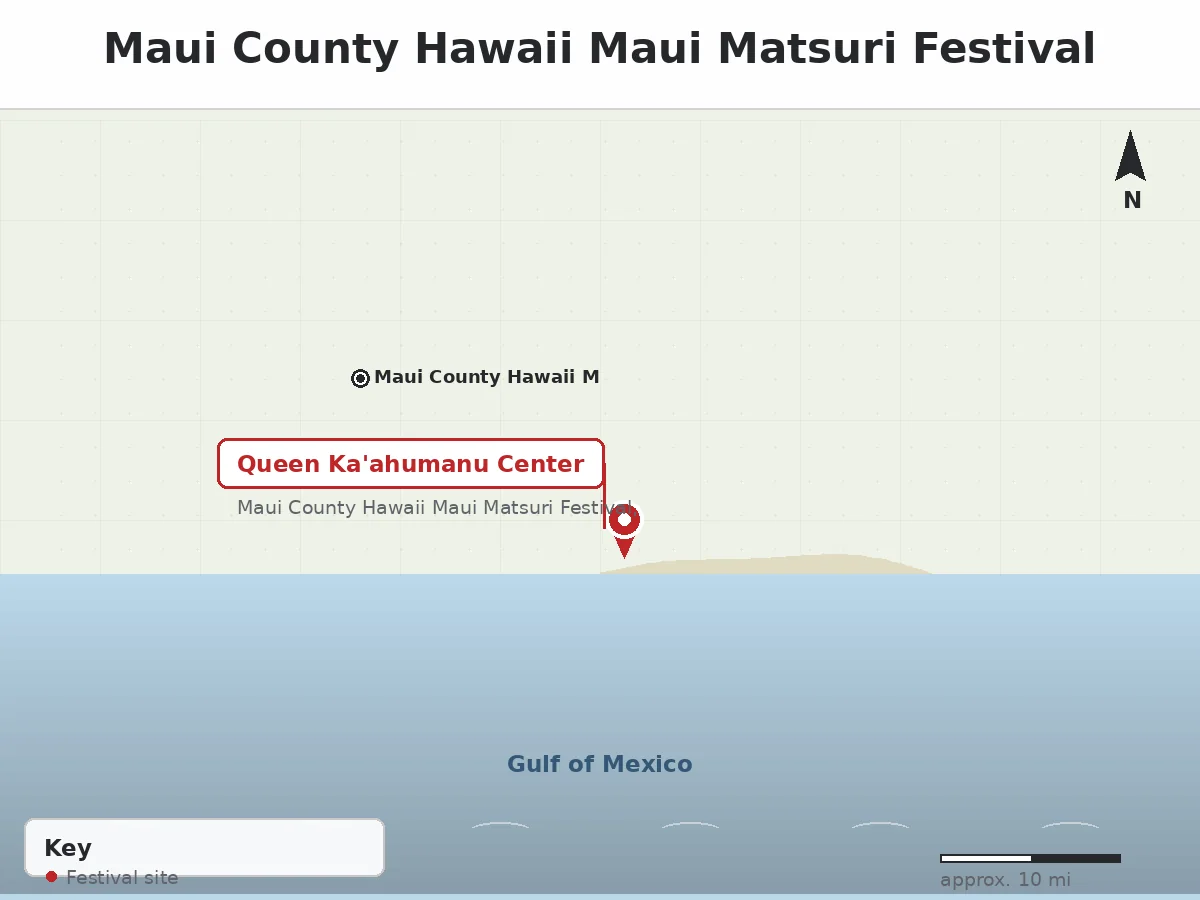
The setting needs one clarification visitors often get wrong. Kahului, where the University of Hawaii Maui College campus stands, is Maui’s commercial hub and airport town, but it is not the county seat. Wailuku holds that role for Maui County; Kahului’s part in this story is simply that the college — and therefore the festival’s main day — sits there. The main festival occupies the campus Great Lawn and its Entertainment Stage. The Children’s Festival, in the 2026 layer, met in the Pilina Building on the same campus, while a news layer for 2024 placed the children’s portion at Queen Ka’ahumanu Center instead, where kickoff events had also been held in a 2016 layer. Those venue forms belong to their components and years.
Quick Facts
| Item | Detail |
| Published names | Maui Matsuri; Maui Matsuri Japanese Festival for the main day |
| Companion event | Maui Matsuri Children’s Festival, a component held on its own date |
| Presenter | Japanese Cultural Society of Maui, working through a volunteer team |
| Host town | Kahului, on Maui’s north shore |
| County seat | Wailuku; Kahului is not the seat of Maui County |
| Main venue | University of Hawaii Maui College campus, Great Lawn and Entertainment Stage |
| Latest documented edition | Twenty-fourth Annual, Saturday, May 23, 2026, 3:00 p.m. to 9:00 p.m. |
| Admission | Free; parking is five dollars per vehicle |
| Founding year | Not stated in any source gathered |
| Attendance | No counted figure is published in the record |
History
The honest starting point for this festival’s history is a gap. No source gathered states the year the Maui Matsuri began, and nothing here works backwards from the billings to manufacture one. The news layers publish a run of ordinal billings, recorded strictly as billings: a tenth Annual across May 14 and 15, 2010; a sixteenth Annual on May 7, 2016; a twenty-second Annual on May 25, 2024; a twenty-third Annual on May 24, 2025; and a twenty-fourth Annual on May 23, 2026. A billing labels an edition; it does not date the first one.
The shape of the event has shifted gently inside that span. The 2010 edition stretched across two days, opening with a Friday movie night and continuing into a Saturday festival running from 2:00 p.m. to 9:00 p.m. By 2016 the main event had settled into a single Saturday, again from 2:00 p.m. to 9:00 p.m., with an April 29 kickoff and kickoff activity at Queen Ka’ahumanu Center. The three most recent documented editions — 2024, 2025 and 2026 — each took a single Saturday in late May, from 3:00 p.m. to 9:00 p.m. on the college campus. The Children’s Festival belongs to this later shape: in 2024 its portion sat at Queen Ka’ahumanu Center, while in 2026 it came home to the campus Pilina Building on May 9, two weeks ahead of the main day. Through every change, the presenter named in the news layers never varied: the Japanese Cultural Society of Maui, with a volunteer team producing.
For a useful comparison, see the Kauai County Hawaii Tahiti Fete Festival for another county festival.
What to Expect
A Maui Matsuri main day is built around the Entertainment Stage and the Great Lawn, and the programme layers describe a mix of performance, food and participation. Taiko drumming anchors the performance side, and the 2026 layer adds a named visiting group, Senshu Miyabi Taiko from Osaka, whose appearance belongs to 2026 alone. Classical and folk Japanese dancing share the stage programme across the layers. Away from the stage, food booths and food trucks feed the crowd, crafters sell their work, and cultural exhibits and hands-on activities fill the grounds. A passport activity threads through the grounds in the programme layers. The most theatrical eating on offer is the saimin and natto eating contest, a recurring element in the record.
Some documented elements belong firmly to single years. Cosplay appears in the 2024 layer, when costumed participants formed part of that edition’s colour. The 2024 layer also records how that edition ended: a closing Obon dance with the lighting of one hundred one candles, a quiet finale after the stage noise. The 2026 layer contributes an art contest for Maui County students, distinct from the visiting taiko group the same year’s coverage names. None of these elements is generalised into a promise about every edition. The frame — drums, dance, food, exhibits, contests and free entry on a campus lawn — is what the evidence supports; each year’s additions arrive with that year’s coverage.
Planning Your Visit
Decide first which piece of the festival you are attending, because the Maui Matsuri arrives in stages. In the documented recent shape, the Children’s Festival comes first — on May 9, 2026 it ran from 10:00 a.m. to 1:00 p.m. in the Pilina Building on campus — and the main day follows a fortnight later. Both are billed free in their layers, as are the kickoff events that in some years precede everything.
Money is simple. Admission to the Japanese Festival is free, stated plainly in the 2024 and 2026 news layers, and the Children’s Festival and kickoff events are likewise billed free. The single charge the record names is parking at five dollars per vehicle, a charge for the car rather than for entry, and this article keeps it in that category. Bring whatever you expect to spend on food and crafts instead. A hotline number and a mailing address for the society appear in news coverage; they are noted here only as existing, never reproduced. Because venue forms vary by component, check the current year’s announcement for the piece you plan to attend rather than assuming every part sits on the Great Lawn.
A Sample Day at the 2026 Edition
The itinerary below follows the documented shape of the twenty-fourth Annual, held on Saturday, May 23, 2026, labelled as that edition’s pattern. A family that had also caught the Children’s Festival on May 9 might treat the main day as the second half of one celebration. Arrive on campus mid-afternoon, ahead of the 3:00 p.m. start, and pay the five-dollar parking charge. Use the first hour to walk the cultural exhibits and let children begin the passport activity, then drift toward the food booths and trucks for an early meal. Settle near the Entertainment Stage for the taiko and the dancing as the light softens, break for the saimin and natto eating contest and the crafters’ rows, and stay to the 9:00 p.m. close.
How the Maui Matsuri Compares
The closest comparison in this queue is also the easiest to confuse. Kaua’i has its own Matsuri, run by a different society on a different island in a different county; the two share a word and a cultural purpose but nothing else. The Maui event’s own companion piece invites a different confusion: the Maui Matsuri Children’s Festival sounds like a separate festival, yet in the layers it is a component of this one, held on its own morning and sometimes in its own venue. A third neighbour needs fencing out rather than comparing. The Lahaina O-Bon Festival at Lahaina Jodo Mission is promoted by the same Japanese Cultural Society of Maui, but it is a separate Japanese Buddhist observance, and none of its facts belong to the Matsuri. Shared promotion is not shared identity.
Visitor Checklist
- Confirm which component you are attending: main day, Children’s Festival or kickoff, since their dates and venues differ.
- Budget five dollars for parking per vehicle, and carry spending money for food and crafts.
- Plan on a 3:00 p.m. to 9:00 p.m. window for a recent-shape main day.
- Bring sun protection for the afternoon hours on the open Great Lawn, and a light layer for the evening.
- If children are coming, look for the passport activity and hands-on stations early in the day.
- Check the current year’s announcement for the Children’s Festival venue, which has sat both on campus and at Queen Ka’ahumanu Center.
Beyond the Festival Lawn
A festival day in Kahului leaves the rest of the town within easy reach. The college campus sits in the middle of Maui’s busiest commercial district, so the practical errands of a festival trip — fuel, groceries, a meal before the grounds open — all happen within a short drive. Wailuku, the county seat, lies just inland with the county’s civic character, a reminder that the festival’s town and the county’s seat are neighbours rather than the same place. Since the documented main-day hours do not begin until 3:00 p.m., the Maui Matsuri asks for your afternoon and evening and leaves your morning alone.
Why the Maui Matsuri Matters
For Maui’s Japanese American community, the festival is the visible crest of a cultural society’s year-round work, kept running on volunteer labour across at least the documented span from 2010 to 2026. Its educational thread is unusually concrete: exhibits and hands-on activities on the day, a passport activity that turns children into participants, and, in the 2026 layer, an art contest aimed at Maui County students. The visiting taiko group from Osaka that same year points the other way, to a living connection with Japan itself rather than a purely local commemoration. A 2026 news layer describes hundreds of attendees, recorded here exactly as that — a reporter’s characterisation of a healthy crowd, not a counted figure, because no counted attendance figure is published anywhere in the record. The festival’s weight rests on what the record supports: longevity in its billings, a stable presenter, free admission, and a college campus opened up as cultural ground.
Frequently Asked Questions
What exactly is the Maui Matsuri Children’s Festival?
It is the festival’s own companion event for young visitors, held separately from the main day. In 2026 it ran on May 9, from 10:00 a.m. to 1:00 p.m., in the Pilina Building on the college campus, a fortnight before the main festival, and it is billed free in its layers. In 2024 the children’s portion instead sat at Queen Ka’ahumanu Center. It is a component of the Maui Matsuri, not a competing festival.
Why does no source give the year the Maui Matsuri began?
Because the record simply does not contain one. News layers publish billings — tenth Annual in 2010, sixteenth in 2016, twenty-second in 2024, twenty-third in 2025 and twenty-fourth in 2026 — and a billing states how an edition was labelled, not when the first edition occurred. Working backwards from those numbers would manufacture a founding year out of arithmetic, and editions can be skipped or renumbered in ways the layers do not describe. The billings are therefore recorded as billings, and the beginning stays unstated.
Is parking really the only charge a visitor should expect?
On the documented record, yes for entry itself. Admission to the Japanese Festival is stated as free in the 2024 and 2026 news layers, and the Children’s Festival and kickoff events are also billed free. The one named charge is parking at five dollars per vehicle, which pays for the car rather than for any person’s entry. Anything beyond that is ordinary spending a visitor chooses, not an admission price wearing another name.
Has the festival always taken place on the college campus?
The main day has, in every documented edition: the Great Lawn and Entertainment Stage at the University of Hawaii Maui College in Kahului form its home across the layers. The wider celebration is more mobile. Kickoff events used Queen Ka’ahumanu Center in a 2016 layer, and the Children’s Festival portion sat there in 2024 before returning to the campus Pilina Building in 2026. The campus answer is therefore firm for the main day and deliberately unfixed for the companion pieces.
What to Expect From the Next Maui County Hawaii Maui Matsuri Festival
How often is Maui County Hawaii Maui Matsuri Festival held?
The documented editions carry annual billings and fall in May in every year the record covers, from the two-day tenth Annual of 2010 through the twenty-fourth Annual of 2026, with the Children’s Festival and occasional kickoff events arranged around the main day. That is a pattern shown by the layers rather than a promise, but a consistent one.
When is the next Maui County Hawaii Maui Matsuri Festival?
No edition beyond the twenty-fourth Annual of May 23, 2026 is announced in the record gathered, so no future date can be stated as confirmed. If the documented pattern holds, the next main day would be expected in May, on a Saturday in the latter part of the month, with a Children’s Festival roughly a fortnight earlier — but that is inference from past editions, and the actual date belongs to the society’s next announcement.
Will the dates change?
They have moved before, within limits the record shows clearly. The main day sat in mid-May in 2010, early May in 2016 and late May across 2024, 2025 and 2026, while the hours shifted from a 2:00 p.m. start to 3:00 p.m. in the recent editions. A future edition could therefore land on a different May Saturday than its predecessor without breaking the festival’s own habits.
Closing
The Maui Matsuri asks very little of its visitors — no ticket, no gate, only a parking charge and an afternoon — and returns a full evening of drums, dance, food and cultural teaching on a college lawn in Kahului. Its record is honest about its own limits: billings without a founding year, crowds described but never counted, companion events that wander between venues. Taken on those terms, it stands as one of Maui County’s steadiest cultural fixtures.

One Comment