Kauai County Hawaii Lights Festival
Each December, the grounds of a county government building in Līhuʻe glow with handmade Christmas decorations built largely from recycled materials, and crowds gather on Friday evenings to walk among them. The celebration is published as the Festival of Lights, and also as the Kauai Festival of Lights; the title above, with its shorter “Lights Festival” wording, is a characterisation of those published forms rather than a name any layer prints. Its ornaments began as one artist’s home display, passed through a garage sale, and ended up as a county tradition. The record is warm but untidy: its founding year is disputed between layers, its opening hours are described two different ways, and one recent guide reports a move no organiser layer has confirmed. This article keeps each loose end visible.
About the Festival
The festival’s published names stand unmerged in the sources. An organiser-adjacent layer and several guide layers call it the Festival of Lights. Guide and news layers use Kauai Festival of Lights, and a blog layer prints Kauaʻi Festival of Lights in a courtesy line toward the festival’s own site. Each form is carried here with the layer that prints it.
The host town is Līhuʻe, and Līhuʻe is the seat of Kauaʻi County — county government layers are issued from the town, and the festival’s home is the county’s own Historic County Building. The display wraps around the building where the county does its everyday business, not a shopping district or a fairground.
Several people and bodies stand behind the festival, and the record gives them distinct roles rather than one tidy organiser credit. Elizabeth Freeman is named as creator and art director in organiser-adjacent and derived layers. The display collection originated with artist Josie Chansky, a point every history layer agrees on. A derived layer names the County of Kauaʻi, the Hawaiʻi Tourism Authority, and the Friends of the Festival of Lights as funders and supporters — support roles, recorded as such, never folded into a single organising body.
Admission, at least, is simple: the festival is free in every layer that states a price at all.
For a useful comparison, see the Honolulu County Hawaii Cherry Blossom Festival for another county festival.
Quick Facts
| Item | Detail |
| Published names | Festival of Lights; Kauai Festival of Lights; Kauaʻi Festival of Lights in a blog layer |
| Title wording | “Lights Festival” is a characterisation of the published forms, not a published name |
| Host town | Līhuʻe |
| County seat | Līhuʻe, seat of Kauaʻi County |
| Long-standing home | Historic County Building, Līhuʻe |
| Address form | 4396 Rice Street, as printed in the organiser-adjacent layer |
| Creator and art director | Elizabeth Freeman |
| Collection origin | Decorations originated with artist Josie Chansky |
| Founding | Layers conflict: 1996 in a derived layer, 1997 in organiser-adjacent and guide layers |
| Season and admission | December evenings; free in every layer that states it |
History
The decorations came first, decades before anything called a festival existed. An encyclopaedia-derived layer dates Josie Chansky’s home-display tradition to 1954: year after year, she filled her home with Christmas decorations she had made herself, many from recycled materials. A second derived layer places her display years first on Oʻahu and then on Kauaʻi. The accounts sit side by side here, unmerged, both flagged as claims resting on derived layers. Either way, Chansky’s tradition is the collection’s origin — not the festival’s founding.
The collection changed hands in 1996. Per the derived layer, Elizabeth Freeman bought the Chansky collection at a garage sale that year, paying about three thousand dollars, and then donated it to the County of Kauaʻi. A purchase and a donation are a transfer, not a founding; the sale explains how the decorations reached public hands and settles nothing about when the festival began.
That question has two answers, and this article crowns neither. An organiser-adjacent layer puts the first public display at the Historic County Building in December 1997, and a December guide layer agrees in so many words, stating the festival was founded in 1997. A derived layer instead states that the festival was founded in 1996, with the first Festival of Lights held that year. The 1996 claim rests on a weaker kind of source and is labelled a derived-layer claim wherever it appears here — but flagging its weakness is not deleting it. The conflict stands open: 1997 on the organiser-adjacent and guide layers, 1996 on the derived layer.
Later billings do not resolve the dispute and are recorded only as billings. A 2016 guide layer bills that year’s edition as the twentieth annual, and a magazine layer describes 2018 as the festival’s twenty-second year. Neither number is converted into a founding year or used to break the tie.
What to Expect
The heart of the festival is the decoration collection itself. Inside the Historic County Building, the organiser-adjacent layer describes a “Christmas House” style theatre display built from the recycled-material ornaments, while the grounds outside are illuminated. The pieces are handmade rather than manufactured, assembled from salvaged and repurposed things worked into ornaments and themed Christmas trees. A blog layer adds that about a third of the decorations are Chansky originals — a proportion recorded as that blog layer’s claim, fenced to it, rather than as an audited count.
Guide layers describe an opening-night ceremony launching the season, and Santa and Mrs. Claus appearances on the County Building porch on December Fridays. Those appearances belong to the County Building form of the festival as the guide layers present it, and are kept with that form. Expect an evening event of a couple of hours, centred on the indoor display, the lit grounds and the porch — not a midway or a market.
Planning Your Visit
Choose your evening with the paperwork, not just the season, in mind, because the sources describe the festival’s hours in ways that do not agree. The organiser-adjacent form — carried by organiser-adjacent and guide layers — opens the festival on Friday, Saturday and Sunday evenings in December, from 6:00 to 8:00 p.m., with Opening Night on the first Friday of December. A 2016 guide layer gives that year’s concrete shape: December 2–3, 8–10, 15–17 and 22–24, at 6:00 to 8:00 p.m. A vacation-rental layer instead describes nightly opening from November 23 to January 1, from 6:00 to 11:00 p.m. That claim conflicts with the weekend pattern, and nothing settles between them; no single set of hours is crowned here as the festival’s settled schedule.
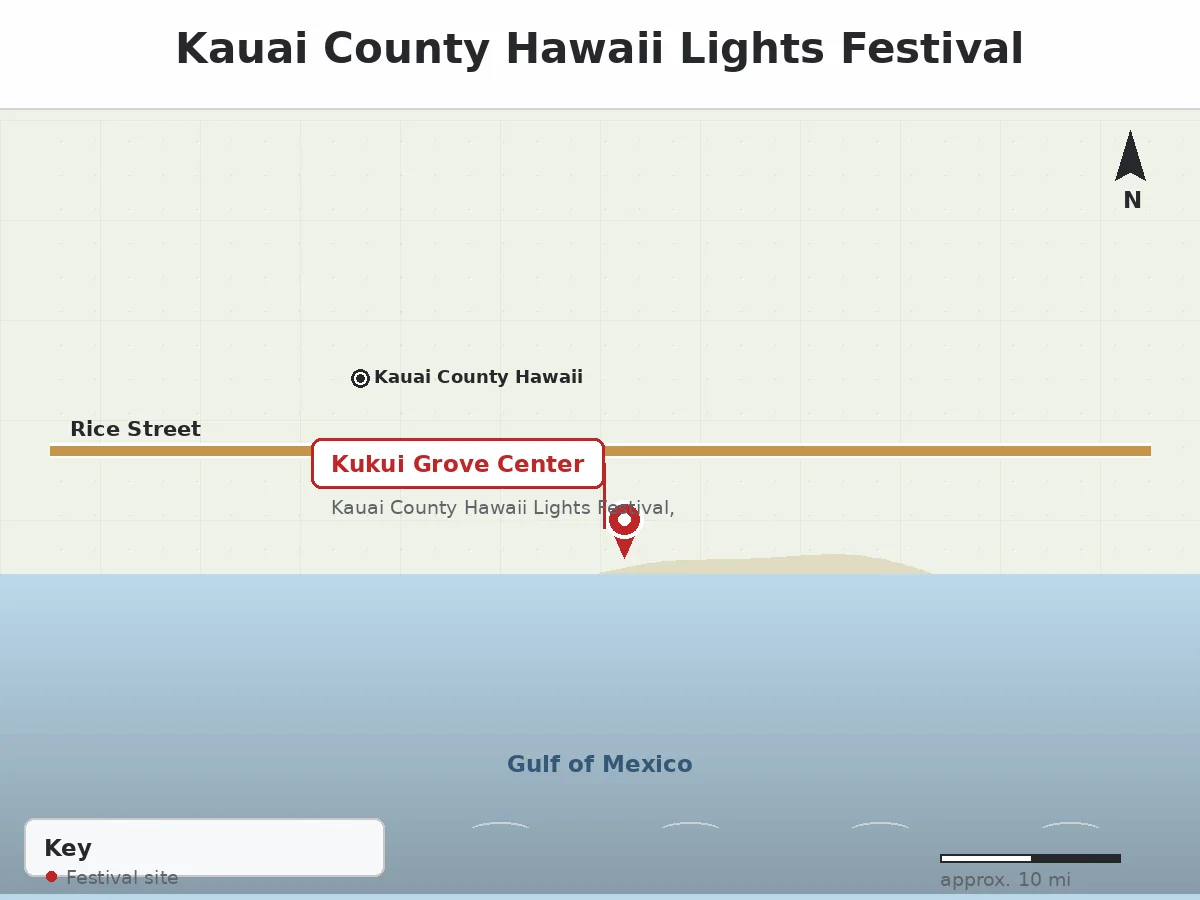
A second uncertainty concerns the venue. A December guide layer reports that the festival “has moved” from the County Building to Kukui Grove Center, giving hours of 5:00 to 8:00 p.m. Thursday through Saturday and 4:00 to 6:00 p.m. Sundays in December, and adding that the County Building exterior is still illuminated through the month. That report rests on one guide layer alone and is not organiser-confirmed in the record captured. So before travelling, check the most current listing you can find, and treat the Historic County Building on Rice Street as the documented long-standing home rather than a guaranteed current venue. Admission is free in every layer that states it, so a wrong assumption costs a wasted trip, not a wasted ticket.
A Sample Itinerary
The plan below is framed on the organiser-adjacent documented shape — a December Opening Night on the first Friday of the month, 6:00 to 8:00 p.m. at the Historic County Building in Līhuʻe, with the illuminated grounds — labelled as that documented shape, not a confirmed schedule for any particular year.
Arrive in Līhuʻe before 6:00 p.m. and reach 4396 Rice Street as the light fades. Spend the first part of the evening outside, walking the grounds while the opening-night ceremony, as the guide layers describe it, sets the season going. Then move indoors for the “Christmas House” style display, taking the recycled-material ornaments slowly — the workmanship repays close looking, and a share of the pieces trace back to Chansky’s own hands. Watch for the Santa and Mrs. Claus appearances the guide layers describe on the porch on December Fridays. Finish with a last circuit of the grounds after full dark, ready for the 8:00 p.m. close.
How It Compares
The closest comparison is also the easiest confusion to make. The Lights on Rice Parade is a separate companion event, run by the Rotary Club of Kauaʻi on the first Friday of December and ending at the Historic County Building; a Kauaʻi Police Department advisory layer documents its December 5, 2025 edition. The parade arrives at the festival’s door, but the two are distinct events with distinct organisers. The Rotary Club organises the parade; it does not organise the festival, and the parade is never merged into the festival here.
Elsewhere on the island, the Waimea Light Parade is a separate event in a different town, and nothing about it is imported into this festival’s record. “Festival of lights” is a name winter events carry in many places; this one’s identity rests on its substance — one artist’s recycled-material collection, a county building, a December run of evenings.
Checklist
- Confirm the current venue before travelling, since one guide layer reports a move to Kukui Grove Center that organiser layers have not confirmed.
- Decide which hours account you are planning around: weekend evenings or the vacation-rental layer’s nightly claim.
- Aim for Opening Night on the first Friday of December if you want the ceremony the guide layers describe.
- Arrive before 6:00 p.m. so you catch the grounds as the lights come up.
- Give the indoor display unhurried time; the ornaments are handmade from recycled materials.
- Remember the opening-night parade is a separate Rotary Club event ending at the County Building.
- Keep the two five-thousand attendance claims in perspective: weak-layer claims, not counts.
- Bring no ticket money — admission is free in every layer stating it — but bring patience for December crowds.
Beyond the Festival
Līhuʻe rewards a little extra time. As the seat of Kauaʻi County, it is the island’s civic centre, and Rice Street puts the county’s working buildings within a short walk of the festival grounds. The Historic County Building is worth a daytime look too: the festival borrows it each December, but its real life is year-round county business, and daylight sharpens what the December transformation changes. December evenings on Kauaʻi are mild, so the festival pairs naturally with an unhurried evening in town.
Why This Festival Matters
The festival’s significance is preservation disguised as celebration. A home display that began, on the derived layers’ account, in 1954 could easily have ended in a skip or an estate dispersal. Instead the collection passed — through a garage sale and a donation — into public keeping, where a creator and art director built a recurring county event around it. About a third of the decorations are said, by a blog layer, to be Chansky originals, making the display part exhibition, part memorial: a named artist’s handiwork, not anonymous seasonal décor.
Its numbers deserve honesty. Two attendance claims circulate. A derived and press layer says more than five thousand attend Opening Night. A real-estate blog layer says up to five thousand people attend each year. These are different claims — one about a single night, one about a whole season — from different weak layers, never merged here into one figure. No counted figure exists in the record. The festival’s draw is real enough in the layers’ descriptions; its size is simply not a measured fact.
Frequently Asked Questions
Has the festival moved away from the Historic County Building?
One December guide layer reports that it has, saying the festival now sits at Kukui Grove Center with its own December hours, while the County Building exterior stays illuminated through the month. That report is single-layer and unconfirmed by any organiser material in the record: a move has been reported, not established, and the County Building remains the documented long-standing home.
Which year did the festival begin, 1996 or 1997?
The layers disagree, and this article does not settle it. Organiser-adjacent and guide layers support 1997, the year of the first public display at the Historic County Building. A derived layer claims a 1996 founding and a first festival that year. The 1996 garage-sale purchase of the collection is documented in the derived layer too, but a purchase is a transfer — not, by itself, a founding under either account.
Where did the festival’s decorations come from?
They originated with artist Josie Chansky, whose home-display tradition an encyclopaedia-derived layer dates to 1954; a second derived layer places her display years first on Oʻahu and then on Kauaʻi. Elizabeth Freeman bought the collection at a 1996 garage sale, for about three thousand dollars per the derived layer, and donated it to the County of Kauaʻi. The ornaments are handmade, many from recycled materials.
Does the festival open every night through the season?
The record conflicts. Organiser-adjacent and guide layers describe Friday, Saturday and Sunday evenings in December, 6:00 to 8:00 p.m. A vacation-rental layer instead claims nightly opening from November 23 to January 1, 6:00 to 11:00 p.m. No source captured reconciles them, so check a current listing before planning around either pattern.
What to Expect From the Next Kauai County Hawaii Lights Festival
How often is Kauai County Hawaii Lights Festival held?
The documented pattern is a December season of evenings each year: an Opening Night on the first Friday, then weekend evenings in the organiser-adjacent account. That pattern describes past practice in the layers; it is not a promise extracted from an organiser announcement, and the record holds no organiser-confirmed schedule for a coming edition.
When is the next Kauai County Hawaii Lights Festival?
No organiser-confirmed date for a next edition appears in the record captured. Expectation, based on the documented shape alone, points to December evenings beginning with the month’s first Friday — but the venue question raised by the Kukui Grove report and the unresolved hours conflict mean any specific date would be a guess dressed as a fact. Treat December as the season to watch, and a current listing as the only confirmation.
Will the dates change?
They could, and the record shows why caution is warranted: the sources already disagree about whether the festival opens on weekend evenings or nightly, and one guide layer reports a different venue with different hours. Until organiser material confirms a coming edition’s dates, hours and home, every forward-looking detail here stays provisional.
Closing
The Kauai County Hawaii Lights Festival — published as the Festival of Lights — is a small event with a traceable soul: a named artist, a rescued collection, a county building, and a town that serves as its county’s seat. Its record resists tidiness, with a founding split between 1996 and 1997, opening hours described two ways, and a reported move awaiting confirmation. Kept honestly, those uncertainties do not diminish it. They describe exactly what it is: a handmade tradition, carried by layers of community memory, glowing on December evenings in Līhuʻe.