DeKalb County Alabama Boom Days Heritage Festival
Fort Payne once bet its future on coal and iron, and for a few dizzying years in the late 1880s the town believed it would become the Pittsburgh of the South. The bubble burst, but the city never forgot the decade that shaped it, and it has spent the last two decades turning that story into one of north Alabama’s most polished heritage events. Boom Days is a two-day celebration of the town’s Gilded Age beginnings, staged on the streets that the boom itself built.
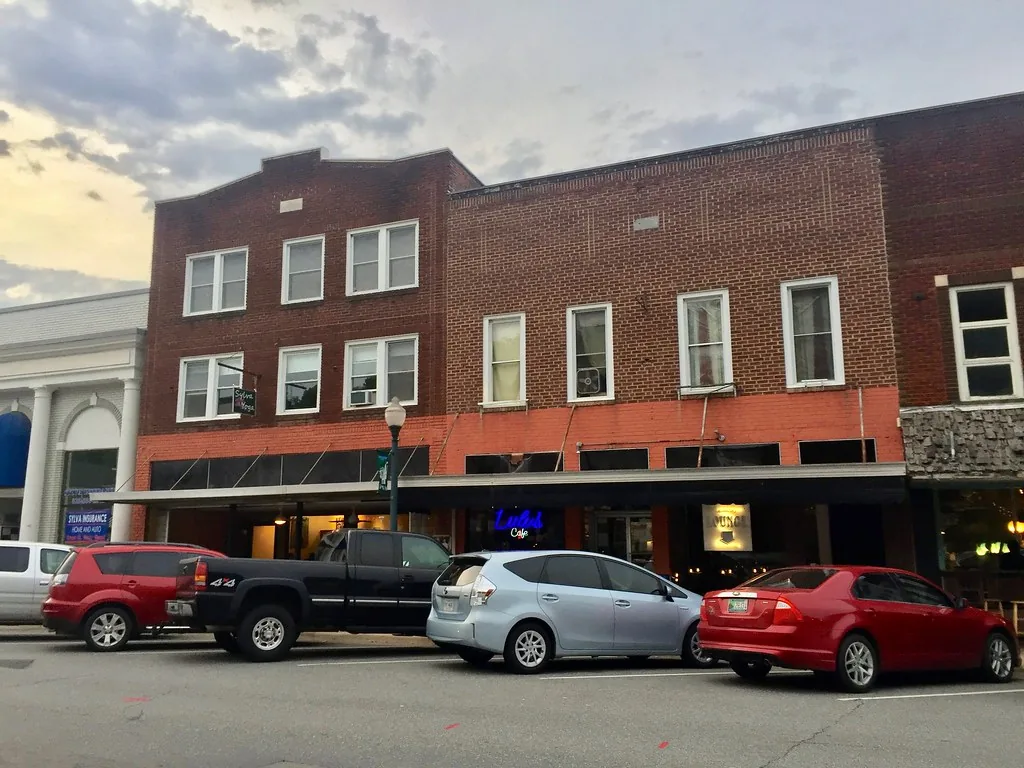
What sets Boom Days apart from a generic street festival is its coherence. The Victorian storefronts of Gault Avenue, the 1889 Opera House, the sandstone depot, and the ginkgo trees that once shaded a grand hotel all still stand, which means the festival does not have to recreate its setting. Visitors walk through the actual boom town while the music plays, and the history and the party reinforce each other in a way few small-town festivals manage.
| Festival name | Boom Days Heritage Celebration |
| Location | Downtown Fort Payne, DeKalb County, Alabama |
| Typical timing | Third Friday and Saturday of September |
| Founded | 2006 |
| Format | Arts, crafts, music, and history festival in a closed downtown |
| Signature features | Four blocks closed, art shows, four stages, period costumes, wine tasting |
| Recognition | Alabama Event of the Year, and North Alabama Event of the Year (2012, 2015) |
| Admission | Free to the public |
About Boom Days
Boom Days is an annual heritage and arts festival held in downtown Fort Payne each September. It began in 2006 and has grown into a two-day event that closes four blocks of the city’s downtown to traffic, filling the streets with visual artists, traditional craftsmen, live music on multiple stages, historical exhibits, sidewalk sales, food vendors, and activities for children. Alabama Park and City Park host art shows, and the Fort Payne Depot Museum and the city’s cultural heritage center mount historical displays.
The event is organized by the City of Fort Payne and a network of community partners, and it has earned real recognition: the North Alabama Mountain Lakes Tourist Association named it Event of the Year in 2012, and in 2015 Boom Days was honored as the state of Alabama’s Event of the Year. That standing reflects both the quality of the programming and the event’s unusual ability to make local history feel alive. To see how a neighboring county treats its own heritage, the Dallas County Alabama Selma Rising Mural Festival builds an entire weekend around the spoken word each October in Selma, honoring a storytelling tradition that stretches back generations.
The Boom That Gave the Festival Its Name
In the late 1880s, Fort Payne was a small farming village of fewer than five hundred people surrounded by cotton fields in Wills Valley. That changed when a group of investors, led by a Vermont financier, organized the Fort Payne Coal and Iron Company in 1888 and began promoting the area’s mineral deposits to New England capital. The town incorporated in February 1889, and the “boom” followed almost immediately.
In the space of a few years the population swelled from a few hundred to several thousand. A 125-room hotel rose on a full city block, the Fort Payne Opera House opened in 1889, the beautiful sandstone depot was completed in 1891, and Victorian homes and commercial blocks went up across the grid. Then the iron and coal deposits proved smaller than the promoters had promised, and a national economic panic arrived in 1893. The boom ended as quickly as it began, leaving behind the architecture that still defines the town.
Fort Payne found its next chapter in 1907, when the W.B. Davis Hosiery Mill opened and turned local cotton into socks. The industry grew until the city called itself the “Sock Capital of the World,” at one point producing a remarkable share of the world’s hosiery and employing thousands of residents. Boom Days takes its name from the 1889 episode, but the festival also honors the later industrial chapter that kept Fort Payne working for most of the twentieth century.
DeKalb County: Mountains, Music, and Makers
DeKalb County sits in the northeastern corner of Alabama, in the Appalachian foothills along Lookout Mountain. Fort Payne is the county seat and largest city, with an unusual location: it was established in the 1830s around a fort built to hold Cherokee people during their forced removal on the Trail of Tears, and it sits just off Interstate 59, roughly an hour south of Chattanooga and two hours northeast of Birmingham. U.S. Highway 11, the old federal road, runs through the city alongside the interstate.
The county is known for three things above all: its scenery, its music, and its manufacturing heritage. Little River Canyon National Preserve, one of the deepest canyon systems east of the Mississippi, lies within the county, and DeSoto State Park draws visitors to its waterfalls and trails. Fort Payne is the hometown of the band Alabama, one of the best-selling country acts in history, and live music is woven into the region’s identity. And the hosiery mills of the twentieth century gave the town its “Sock Capital” nickname, which residents still wear with pride.

What to Expect at Boom Days
Arts, crafts, and artists at work
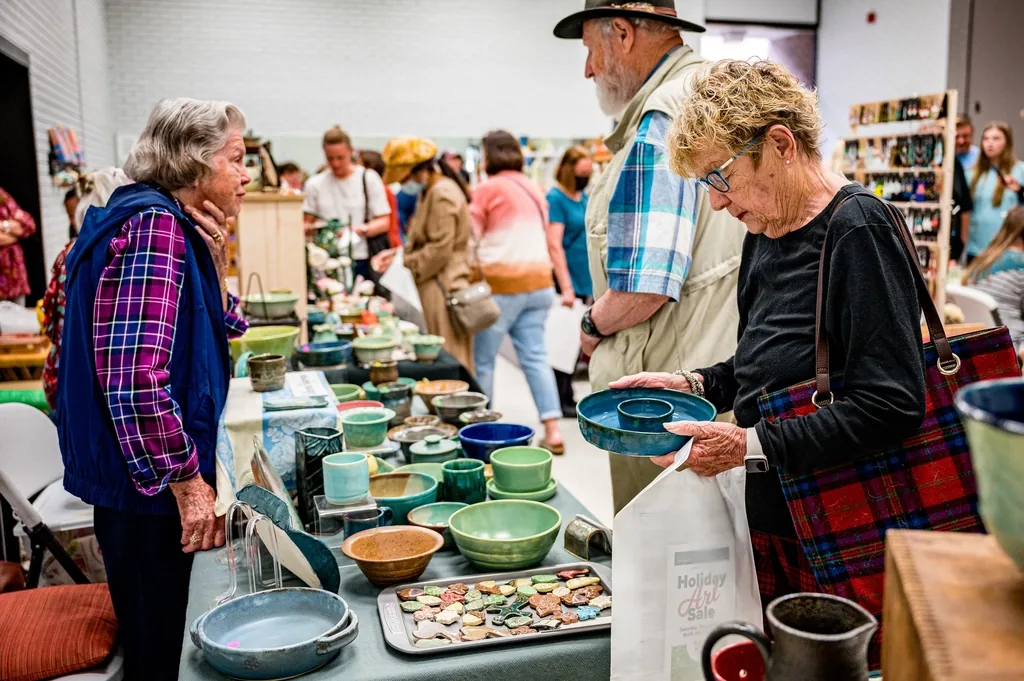
Boom Days fills the closed downtown blocks with some of the finest visual artists and traditional craftsmen in the region. Painters, potters, woodworkers, quilters, and jewelers set up in Alabama Park and City Park, and many demonstrate their craft on site. Artist demonstrations are a point of pride for the festival, and they make it easy to spend an afternoon learning how things are made rather than simply shopping.
Music on four stages
Live music is the festival’s heartbeat. Four outdoor stages host a rotating lineup that spans bluegrass, country, gospel, rock, and Americana, reflecting the mountain region’s deep musical roots. The schedule typically runs through both days and closes with a headline act at the Rotary Pavilion. Bring a folding chair, pick a stage, and settle in, or wander between sets while browsing the vendor rows.
History, heritage, and the mayor
History is never far from the surface at Boom Days. The Fort Payne Depot Museum displays artifacts and clothing from the boom era, and the original Coal and Iron Company office holds a miniature railroad system that delights children and model enthusiasts alike. Historical exhibits are mounted at the Fort Payne Culture and Heritage Center, and the city’s mayor and first lady have been known to appear in period clothing from the Boom Days era, a tradition that gives the weekend its playful sense of occasion.
Children, food, and wine
Families are well looked after, with a dedicated children’s area and plenty of open space in the parks. Food vendors line the streets with festival favorites and regional specialties, and the festival includes a wine tasting for adult visitors. Downtown merchants hold sidewalk sales, so the shopping extends beyond the vendor booths and into the historic storefronts themselves.
Planning Your Visit
Getting to Fort Payne
Fort Payne is reached from Interstate 59, which runs northeast-southwest through DeKalb County, with several exits serving the city. U.S. Highway 11 parallels the interstate through downtown, and Alabama Highway 35 links the city to points east and west. Chattanooga is about an hour to the north, Birmingham roughly two hours southwest, and Huntsville about two hours northwest. The nearest major airports are Chattanooga Metropolitan and Huntsville International.
Where to stay
Fort Payne has a solid selection of hotels and motels near the interstate, and DeSoto State Park, about ten miles away, offers cabins and camping for visitors who want to combine the festival with a mountain weekend. Because Boom Days is a regional draw, rooms fill quickly for the third weekend of September, so booking early is recommended. Mentone, on the mountain above the canyon, has additional inns and cabins.
Parking and logistics
With four blocks of downtown closed to traffic, parking is in surrounding lots and on-street spaces outside the festival footprint. Arriving in the morning, before the crowds build, is the easiest way to find a spot. Because the festival is compact and walkable, once you park you can leave the car for the day and move between the parks, stages, and museum on foot.
Admission, costs, and refreshments
Boom Days is free to the public. You pay only for food, crafts, and any ticketed extras such as wine tasting. Because there is no gate fee, it works well as a low-cost family outing, and the sidewalk sales and vendor booths offer everything from snacks to handmade gifts.
Weather and what to wear
Late September in the Appalachian foothills is mild and often beautiful, with warm days and cool nights that hint at autumn. Layering is the smart approach, and comfortable walking shoes are essential for a festival spread across several blocks. An umbrella or light rain jacket is worth packing in case of showers.
A Boom Days Weekend Plan
- Friday afternoon: arrive in Fort Payne, walk Gault Avenue, and catch the first musical acts.
- Friday evening: browse the vendor rows and stay for the headline performance.
- Saturday morning: visit the Depot Museum and the Culture and Heritage Center.
- Saturday afternoon: work through the art shows, the children’s area, and the food vendors before the closing acts.
Nearby Festivals to Compare
DeKalb County keeps a busy calendar beyond Boom Days. The Little River Canyon Fest, held in early November, celebrates art and nature at the canyon center, while the Lookout Mountain Craft Festival in August draws makers to the mountain. Fort Payne also hosts an Independence Day celebration and an agricultural fair in October. Together these events reflect a county that has turned its mountain setting and its cultural history into a year-round draw for visitors.
What to Bring
- A folding chair for the music stages.
- Layers for warm days and cool evenings.
- Comfortable walking shoes for the closed downtown blocks.
- Cash for vendors and food.
- A camera for the Victorian architecture.
Beyond the Festival — Exploring DeKalb County
Fort Payne’s historic downtown is worth exploring on its own. The Fort Payne Opera House is the oldest standing theatre in Alabama, the 1891 depot now houses a museum, and the surrounding blocks retain the Victorian character of the boom era. The Coal and Iron Company office, with its miniature railroad, is a small gem for families.
Nature is the county’s other great attraction. Little River Canyon National Preserve protects a spectacular gorge with overlooks, trails, and waterfalls, and DeSoto State Park offers camping, cabins, and miles of hiking. Mentone, perched on Lookout Mountain, is a charming arts community with galleries and a famously scenic drive along the canyon rim. For a town that once hoped to be an industrial giant, Fort Payne has become something better: a gateway to the mountains.
The Significance of the Festival
Boom Days does something valuable with a difficult history. The boom of 1889 was, in the end, a bust for many investors, but the buildings it produced gave Fort Payne a downtown worth saving, and the festival turns that legacy into community pride. By pairing the arts with the town’s story, it supports local artists and musicians, fills the historic storefronts, and gives residents a reason to take a second look at their own architecture. The state Event of the Year recognition is a fair reflection of how well the formula works.
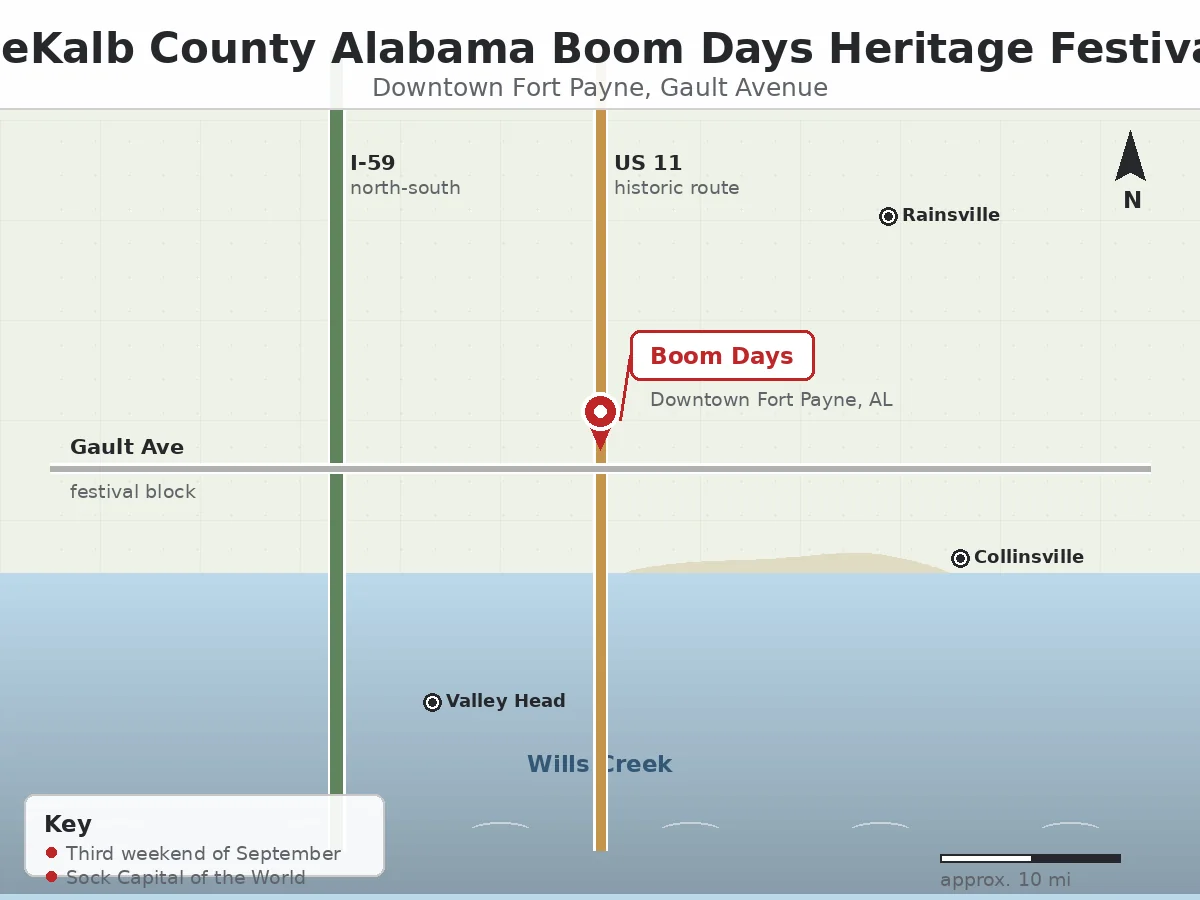
Festival Area Map
Boom Days is held in downtown Fort Payne, DeKalb County, on the blocks around Gault Avenue near the junction of U.S. Highway 11 and Interstate 59.
Frequently Asked Questions
When is Boom Days in Fort Payne?
Boom Days is held on the third Friday and Saturday of September each year, running from Friday evening through Saturday. Confirm the exact dates with the city before you travel.
Is Boom Days free?
Yes, the festival is free to the public. You pay only for food, crafts, and any ticketed extras such as the wine tasting.
Where is Boom Days held?
It is held in downtown Fort Payne, DeKalb County, Alabama, with four blocks closed to traffic around Gault Avenue and activities in City Park and Alabama Park.
What is there to do at Boom Days?
The festival features art shows, traditional crafts, live music on four stages, historical exhibits, a children’s area, food vendors, a wine tasting, and sidewalk sales in the downtown shops.
Why is it called Boom Days?
The name honors Fort Payne’s industrial boom of the late 1880s, when coal and iron discoveries drew investors and the town grew rapidly. Though the boom ended by 1893, it left behind the Victorian downtown that hosts the festival today.
What is Fort Payne, Alabama known for?
Fort Payne is known for its Victorian downtown, its history as the “Sock Capital of the World,” its proximity to Little River Canyon and DeSoto State Park, and as the hometown of the band Alabama.
Is Boom Days good for children?
Yes. The festival includes a dedicated children’s area, the miniature railroad at the Depot Museum, and plenty of open space in the parks. It is a family-friendly event.
What should I bring to Boom Days?
Bring a folding chair for the music, layers for cool evenings, comfortable walking shoes, and cash for vendors and food. A camera is useful for the historic architecture.
What to Expect From the Next Boom Days
Boom Days is an annual event and has run since 2006, so visitors can count on a celebration each September in most years. The timing follows the third Friday and Saturday of the month, and the two-day format with four stages, art shows, and historical exhibits has been consistent for two decades. Its recognition as Alabama’s Event of the Year in 2015 reflects the event’s standing.
Because the dates track the third weekend of September, they shift slightly each year, so confirm with the city before booking lodging. Hotel rooms in Fort Payne and cabins at DeSoto State Park fill for the festival weekend, so planning ahead is wise. Arriving in the morning remains the best way to find parking and to see the art demonstrations before the crowds build.
How often is Boom Days held?
It is an annual event, held every September since 2006.
When is the next Boom Days?
The next edition is expected on the third Friday and Saturday of September, following the festival’s established pattern. Check with the city for the confirmed dates.
Will the dates or lineup change?
The festival is held on the third weekend of September, so the dates move slightly each year. The musical lineup and vendor roster change annually, so check the schedule close to the event.
Last updated: October 2026
Boom Days works because Fort Payne decided to be honest about its history and generous with its streets. The result is a festival that feels less like an attraction and more like a town opening its doors, which is exactly what the best heritage celebrations do.
One Comment