Marengo County Alabama Christmas on the River Festival
Most Christmas festivals end with a parade down a main street. In Demopolis, the parade takes to the water. Christmas on the River fills a full week of December with concerts, candlelight tours, a state barbecue championship and a children’s parade, then closes on the first Saturday of the month with a nighttime procession of decorated, lighted boats moving along the Tombigbee River, followed by fireworks. The event has been part of the town’s calendar since 1972, and its blend of river spectacle and small-town ceremony makes it a distinctive west Alabama holiday tradition. Demopolis is the largest city in Marengo County, although the county seat is Linden, and the festival draws on that setting throughout: a historic town square, antebellum homes opened by candlelight, and a river bluff that gives the finale its grandstand.
About the Festival
Christmas on the River is presented by the Demopolis Area Chamber of Commerce, which publishes the festival’s schedule and provides its official description. The Chamber’s framing is the organising record for the week: community functions spread across several days, building toward the nautical parade rather than a single afternoon. The festival has its own official website, and the Chamber remains the body that assembles the programme each year.
The scale of the week is described in two separate layers of the record, and they are not the same figure. A festival reference account, citing a television source, states that attendance at the Marengo County festival averages about 40,000 people. A utility magazine, quoting a past chairman of the event, recorded the chairman’s own words: “We have 20,000 to 30,000 visitors for Christmas on the River every year.” Neither figure is treated here as a settled count; together they show the festival described, by those closest to it, as drawing crowds far larger than the host town’s population.
On admission, the verified record is silent in a specific way: no general admission price and no blanket free-admission statement appears in the solid sources behind this article, so visitors should not assume either a charge or free entry for any part of the week.
Quick Facts
| Item | Detail |
| Festival name | Christmas on the River |
| Organiser | Demopolis Area Chamber of Commerce |
| Host city | Demopolis, Alabama |
| County | Marengo County |
| Setting | Demopolis Town Square and White Bluff on the Tombigbee River |
| Timing pattern | A week of events culminating on the first Saturday in December |
| First held | 1972 |
| Most recent documented finale | Saturday, December 6, 2025 |
| Signature event | Nautical parade of lighted boats, followed by fireworks |
| Admission | Not published in the verified record |
History
The festival’s own history, as the sources state it, begins in 1972. Christmas on the River began in 1972 as a night parade of decorated and lighted floats on riverboats along the river at White Bluff, and that first river procession was followed by a fireworks show.
For a useful comparison, see the Madison County Alabama Rocket City Pride Festival for another county festival.
From that single evening, the festival grew outward. The sources describe an event that has since expanded to a week of functions leading up to the nautical parade, so that the boat parade became the culmination of a festival rather than the whole of it. Reference listings give the festival’s years active as 1972 to the present, which places the river parade among the region’s longer-running holiday traditions. One further layer deserves recording exactly as it stands: a utility magazine, in its own year of publication, recorded the flotilla celebrating 45 consecutive annual Christmas on the River shows. That count belongs to that magazine layer and its year; it is not restated here as a current total.
A second tradition grew up inside the festival. The Christmas on the River Barbeque Cook-off originated in Demopolis in 1989 as part of the Christmas on the River festivities, giving the week a competitive cooking centrepiece alongside its ceremonies. Two years later, in 1991, the cook-off was designated the Official Alabama State Barbecue Championship, a status recorded in a 2012 proclamation by the Governor of Alabama. The week’s history thus runs on twin tracks: a river parade that began in 1972 and a barbecue contest that joined it a generation later and rose to state-championship standing.
What to Expect
A visitor arriving early in the week meets a festival of gatherings rather than spectacles. The Canebrake Players, a local theatrical group, perform a matinee. The Christmas Story is read in the Demopolis Town Square. A community-wide church service brings residents together, and the Alabama Boychoir gives a concert. One of the week’s most distinctive ceremonies is the crowning of Saint Nicholas, which is not a pageant role but an honour: it acknowledges community members for their work helping children.
Light is the week’s recurring theme, indoors as well as on the river. The “Lighting of the Tree” celebration centres on the tree known in local layers as the Love Lights tree. Candlelight house tours open Demopolis homes after dark, and they reach their fullest expression in “Christmas in the Canebrake”, a party held the night before the finale, with candlelight evening tours at Bluff Hall, Gaineswood and Lyon Hall, three of the town’s antebellum homes. For many visitors, that evening is the festival’s most atmospheric: historic interiors, candlelight, and the sense of a town presenting its own heritage as part of its Christmas.
Daytime brings its own programme. The Children’s Day Christmas Parade gives the town’s youngest residents their place in the week. Fair in the Square shopping, recorded in the 2025 local layer, turns the town square into a marketplace. On the final day, the Jingle Bell Run, a 5K road race, adds a sporting start to the closing Saturday.
Then there is the barbecue. The Alabama Barbecue Championship, the festival’s cook-off, is recorded in two layers that must be kept apart. The Governor’s proclamation layer describes teams from nine different states and 75 judges, with categories of ribs, chicken, brisket and pork, and calls the crowd 15,000 barbeque enthusiasts. The festival reference layer, separately, gives roughly 8,000 participants for the championship. Both figures stand exactly as their layers give them, describing the same contest from different vantage points. What is not in dispute is the championship’s standing: designated the state’s official barbecue championship in 1991, it is the competitive heart of the week.
Everything builds to Saturday night. The nautical parade’s main event site is at White Bluff on the Tombigbee River at Demopolis. In 2025, the finale fell on Saturday, December 6, with the Nautical Parade and Fireworks running from 6 p.m. to 8 p.m.: decorated boats carrying their lights along the river, and fireworks to close the week where it began in 1972, on the water.

Planning Your Visit
The practical shape of a visit follows from the festival’s structure. Because the programme is a week of separate functions rather than one continuous event, the first decision is which days to attend. The finale Saturday carries the nautical parade, the fireworks and the Jingle Bell Run, while the night before offers Christmas in the Canebrake and its candlelight tours of the three antebellum homes. A visitor with only one evening should weigh those two against each other: Friday for the houses, Saturday for the river.
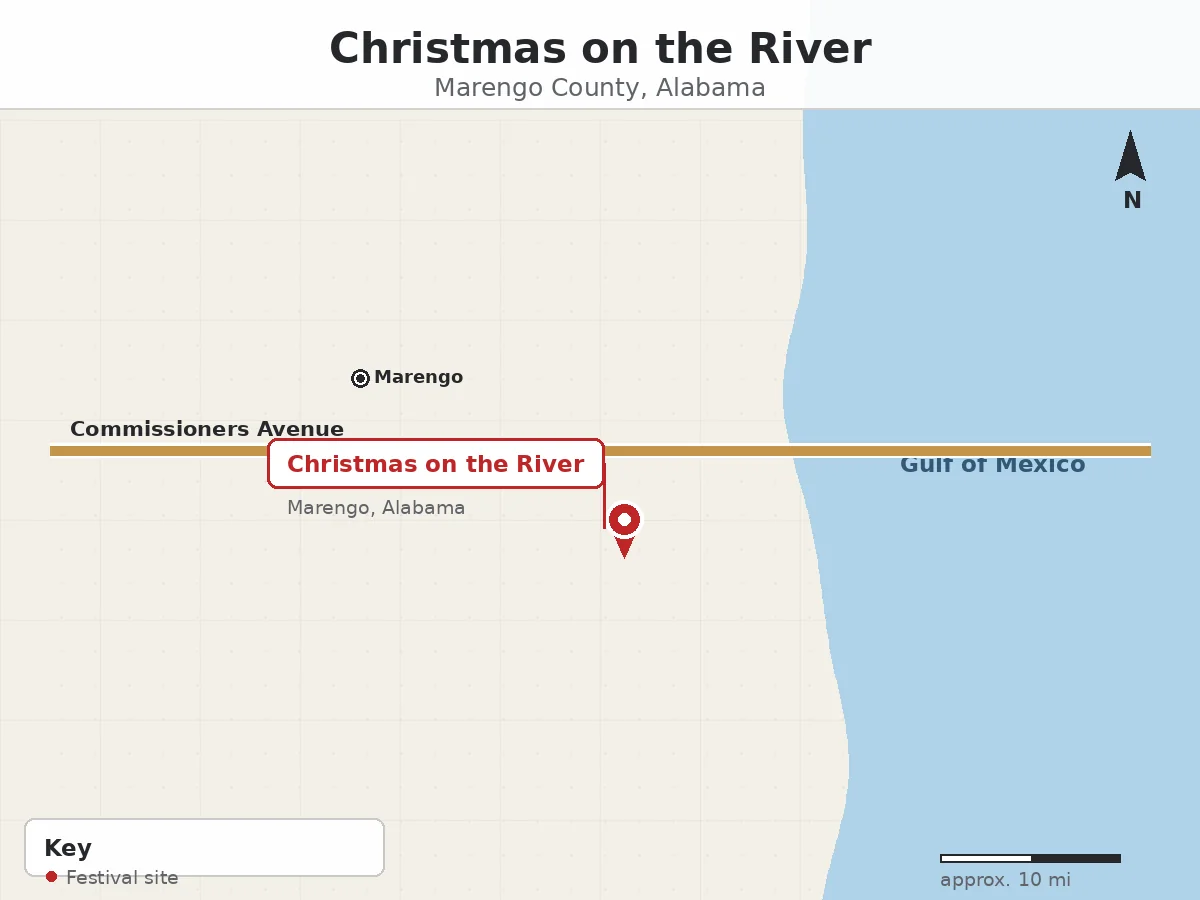
The Chamber publishes the schedule, so its listings are the reference point for confirming the order and timing of individual functions in any given year. One address needs careful handling: a tourism listing for the 2025 nautical parade gives the address form “501 North Commissioners Avenue, Demopolis”, but that address belongs to the Chamber and visitor listing attached to the event. Treat it as the Chamber’s listing address, not a surveyed address for the festival site at White Bluff.
Budgeting requires the same honesty as the record itself. Since no general admission price or blanket free-admission statement appears in the verified sources, a visitor should confirm arrangements for individual functions directly rather than assuming the whole week is free or that any single element carries a particular charge.
A Sample Festival Itinerary
A two-day visit built around the finale might run as follows. Arrive on the Friday and settle into Demopolis during the afternoon, taking in the town square and the Fair in the Square shopping. Spend the evening at Christmas in the Canebrake, moving by candlelight through Bluff Hall, Gaineswood and Lyon Hall as the tours proceed. On Saturday morning, watch or join the Jingle Bell Run, the 5K road race held on the final day. Give the middle of the day to the town itself and the closing events around the square. Then, as darkness falls, take up a position for the nautical parade at White Bluff, where the documented 2025 finale ran from 6 p.m. to 8 p.m., and stay for the fireworks that end the week.
A visitor with the full week can spread the load: the matinee and the reading of The Christmas Story early on, the church service, concert and ceremonies as they fall, the barbecue championship on its day, and the Children’s Day Christmas Parade before the weekend.
How the Week’s Parts Compare
Within the one festival, the experiences divide naturally. The river events — the nautical parade and fireworks at White Bluff — are the public spectacle, depending on darkness for their effect. The candlelight events are the opposite in character: smaller, quieter, and built around historic interiors rather than open sky. The barbecue championship is different again, a contest with judges, categories and state designation, where the audience watches skill being tested rather than a ceremony being performed. And the community functions — the reading in the square, the church service, the crowning of Saint Nicholas — are the parts of the week that belong most plainly to Demopolis itself, honouring residents and gathering the town before the visitors’ finale arrives.
Planning Checklist
- Confirm the year’s schedule with the Demopolis Area Chamber of Commerce before travelling
- Decide between the Friday candlelight tours and the Saturday river finale if only one evening is available
- Check admission arrangements for individual functions, since no general position is published
- Plan to be in place at White Bluff before dark on finale Saturday
- Dress for standing outdoors by the river on a December night
- Treat the Commissioners Avenue address as the Chamber’s listing address, not the parade site
Beyond the Festival
The festival’s settings reward attention in their own right. Bluff Hall, Gaineswood and Lyon Hall, the three antebellum homes opened for Christmas in the Canebrake, place Demopolis’s architectural heritage at the centre of its Christmas week rather than at its edges. White Bluff, where the first lighted floats moved along the river in 1972 and where the nautical parade still gathers, gives the town a natural amphitheatre on the Tombigbee River. A visitor who comes only for the parade sees the spectacle; one who also walks the square and tours the houses sees why the festival took the shape it did.
Why Christmas on the River Matters
For Marengo County, the festival does several kinds of work at once. It sustains a tradition documented from 1972 in the reference record, keeping the lighted-boat parade at the centre of the county’s Christmas. It gives Demopolis a state-designated championship in the barbecue cook-off, a distinction few festivals anywhere can claim. It honours the town’s own people through the crowning of Saint Nicholas, which recognises work done for children. And it brings visitors, in numbers its own record describes in the tens of thousands, into a small city’s square, churches, theatres and historic homes. Few county festivals combine heritage, competition, ceremony and spectacle in a single week as completely as this one does.
Frequently Asked Questions
Why does the festival end on the water instead of in the streets?
Because it began there. The sources state that Christmas on the River started in 1972 as a night parade of decorated and lighted floats on riverboats along the river at White Bluff, followed by fireworks. As the event expanded into a week of functions, the nautical parade remained its culmination, and the modern finale keeps that form: in 2025 the Nautical Parade and Fireworks ran on the Tombigbee River on Saturday, December 6, from 6 p.m. to 8 p.m.
What makes the barbecue contest a state championship?
Its designation. The Christmas on the River Barbeque Cook-off originated in Demopolis in 1989 as part of the festivities, and in 1991 it was designated the Official Alabama State Barbecue Championship, a status recorded in a 2012 gubernatorial proclamation. That proclamation layer describes teams from nine different states and 75 judges across ribs, chicken, brisket and pork categories, while a separate festival reference layer gives roughly 8,000 participants; the two figures belong to their own layers and are not combined.
Who is honoured at the crowning of Saint Nicholas?
Community members recognised for their work helping children. The crowning is one of the week’s ceremonies, and its purpose in the record is acknowledgement of service: Demopolis uses the moment to honour residents whose efforts have benefited the town’s children.
Which single event should a first-time visitor not miss?
The nautical parade, if only one choice is possible. It is the festival’s founding event from 1972, its signature spectacle and the culmination toward which the whole week builds, with fireworks following the lighted boats at White Bluff. A visitor with a second evening should add Christmas in the Canebrake, the candlelight party and tours at Bluff Hall, Gaineswood and Lyon Hall on the night before the finale.
What to Expect From the Next Marengo County Alabama Christmas on the River Festival
How often is Marengo County Alabama Christmas on the River Festival held?
The festival returns each December as a week of events in Demopolis, following the pattern documented in the record: several days of functions — theatre, music, ceremonies, tours, the barbecue championship and the children’s parade — building toward a finale on the first Saturday in December.
When is the next Marengo County Alabama Christmas on the River Festival?
The documented pattern points to the first Saturday in December, when the week of events culminates in the nautical parade and fireworks. The most recent documented finale was Saturday, December 6, 2025. Because individual functions are arranged year by year, the exact dates and order of events for the next edition should be confirmed against the schedule published by the Demopolis Area Chamber of Commerce.
Will the dates change?
The week’s anchor — a culmination on the first Saturday in December — is the festival’s published pattern and has the weight of a tradition running since 1972 behind it. The detailed programme within the week can vary as the Chamber arranges each year’s functions, so the parade Saturday is the stable point and the surrounding days are the part to verify before travelling.
A week of candlelight, music, barbecue smoke and community ceremony, all of it flowing toward one dark river filled with lights: that is the shape Christmas on the River has kept since 1972, and it is why Demopolis’s festival remains the defining Christmas tradition of Marengo County.