Coffee County Alabama Thunder in the Pines Powwow Festival
Every October, the pine woods outside Elba fill with a sound older than the town itself: drums pulsing across tribal grounds while dancers in full regalia circle the arena. The Thunder in the Pines Powwow is the signature gathering of the Ma-Chis Lower Creek Indian Tribe of Alabama, billed in local reporting as the tribe’s forty-eighth annual powwow for its October 23–24 edition in 2026. For two days, dancers, drummers, veterans and visitors honour Native American culture, heritage and traditions.
A powwow is at once a competition, a reunion and a classroom, and this one carries all three roles. Contest dancers chase prize money across nine categories, families reconnect around the drum, and children at the circle’s edge absorb lessons about the old ways no textbook delivers the same way. Stay long enough, and the rhythm of grand entries and contests settles into a shape any newcomer can read.
About the Festival
The Thunder in the Pines Powwow is hosted by the Ma-Chis Lower Creek Indian Tribe of Alabama on the tribe’s grounds at 2950 County Road 377 in Elba. Elba sits in Coffee County, in Alabama’s Wiregrass region, and serves as one of the county’s two seats, a distinction it shares with Enterprise. The name suits the place: tall pines surround the gathering ground, and when several host drums play across a long Saturday, the sound rolls through the trees before it reaches the parking area.
Local news coverage from The 24 Times, filed with an Elba dateline, described the gathering as the tribe’s forty-eighth annual Thunder in the Pines Powwow, and a curated 2026 festival calendar independently listed the same October 23–24 dates in Elba. That billing signals a tradition carried across decades by tribal citizens who plan, drum, dance and cook for it year after year.
The gates are open to everyone. Spectators pay a modest fee, veterans enter free with military identification, and dancers arriving in regalia are admitted without charge. Inside, visitors watch contest dancing through the day, browse handmade craft and Native American artwork at vendor stalls, and — at previous gatherings — watch demonstrators turn flint, hides, clay, baskets and beads into finished pieces.
For a useful comparison, see the Coffee County Alabama Festival in the Park for another county festival.
Quick Facts
| Item | Details |
| Festival name | Thunder in the Pines Powwow |
| Host | Ma-Chis Lower Creek Indian Tribe of Alabama |
| Host town | Elba, Coffee County, Alabama |
| Venue | The tribe’s grounds at 2950 County Road 377, Elba |
| 2026 dates | Friday, October 23 and Saturday, October 24, 2026 |
| Edition billed | Forty-eighth annual powwow |
| Admission | Five dollars per person; veterans with military identification and dancers in regalia enter free |
| Grand entries | Friday at 9:00 a.m. and 2:00 p.m.; Saturday at noon and 6:00 p.m. |
| Dance divisions | Juniors ages 7–12, teens ages 13–17, junior adults ages 18–54, senior adults ages 55 and older |
| Ground rules | Drugs, alcohol and firearms are prohibited on the grounds |
History
The documented record of Thunder in the Pines begins with its billing rather than a founding date. The 24 Times reported the October 2026 gathering as the forty-eighth annual powwow of the Ma-Chis Lower Creek Indian Tribe of Alabama, placing its origins decades back without pinning a single first year to it. Such longevity is no accident: a powwow survives because tribal families keep booking the drums, directing the arena, registering dancers and readying the grounds.
Across those decades, the gathering has become a fixture of the Wiregrass autumn calendar, drawing dancers and drum groups from beyond Coffee County while staying rooted in Elba. Its continuity lives in roles like the head man and head lady, respected dancers who lead by example in the circle, and in the head veteran, a reminder that military service holds an honoured place in Native communities.
Earlier editions show through in reporting on previous gatherings. Demonstrations of flint knapping, hide tanning, pottery making, basket weaving and beadwork gave visitors a close look at traditional skills, while vendors offered handmade crafts and Native American artwork alongside food. In a 2024 interview, Ma-Chis tribal citizen De Williams described the powwow as a chance to connect across generations: grandparents, parents and children sharing one ground and one drumbeat. Tribal Chief James Wright has stated the educational mission plainly: “We want to teach kids and adults about the culture, the old ways, and the history of the area.”
What to Expect
The 2026 edition ran on a full two-day schedule. Friday’s activities ran from 8:30 in the morning until 6:00 in the evening, with grand entries at 9:00 a.m. and 2:00 p.m. and dancer registration open until 7:00 p.m. Saturday started later and ran far longer: activities opened at 10:00 a.m. and continued until 10:00 p.m., or until the final drum fades, with grand entries at noon and 6:00 p.m. and a 9:00 to 11:00 registration window for dancers.
Grand entry is the moment to be in your place. Dancers process into the arena in regalia, and the day unfolds from there under the arena director’s hand. For 2026, Collis Wright served as arena director and Nina Martinez as emcee, guiding spectators through what they were seeing. Billy Hunt served as head man and Heather Hunt as head lady, with Eric Cox as head veteran. Four host drums — Pine Lodge, Young Waters, Medicine Tail and Scuffletown Society — supplied the heartbeat everything in the circle keys off.
Competition is serious business here. Dancers contested nine categories: Northern Traditional, Southern Straight, Grass, Fancy, Chicken, Woodlands Style, Southern Cloth, Buckskin and Jingle. Four age divisions kept the field fair, from juniors ages seven to twelve through senior adults fifty-five and older. Prize money went to the top three finishers in each division, with junior and teen awards ranging from fifty dollars to one hundred dollars and adult awards from one hundred fifty dollars to three hundred dollars. Participating dancers must wear appropriate regalia, and spectators should understand the outfits are not costume: each carries family, tribal and personal meaning.
Between sessions, the grounds offer plenty beyond the arena. Vendors at previous gatherings sold handmade crafts and Native American artwork, food vendors kept crowds fed, and demonstrators showed how flint becomes a blade and how baskets and beadwork take shape. Past programming is no promise for any single year, but it shows the powwow’s texture: part contest ground, part marketplace, part open-air classroom.
Planning Your Visit
Begin with the gate. Admission for the 2026 edition was five dollars per person, and two groups entered free: veterans presenting military identification, and dancers wearing regalia. Carrying some cash is sensible, since food stalls and vendor rows often work faster with it than with cards.
Timing shapes the experience. Friday suits visitors who prefer a shorter, quieter day, running from morning into early evening with two grand entries. Saturday is the marathon, not winding down until 10:00 p.m. or the last drum fades, so plan meals, rest and shade breaks accordingly. If you can catch only one grand entry, Saturday’s 6:00 p.m. session pairs the ceremony with a crowd that has been building all day.
Dress for an autumn day on open ground: layers for a cool morning, sun protection by midday and shoes that handle grass and packed earth. Bring a folding chair or blanket, since arena-side seating goes to those who claim it early, and spectators stay outside the circle while dancing is under way. Listen to the emcee on photography, and never step into the arena for a closer shot.
Respect the ground rules, explicit for 2026: drugs, alcohol and firearms are prohibited on the tribe’s grounds. Families will find the event welcoming for children, especially those old enough to watch the junior divisions, where dancers their own age compete in full regalia. Above all, remember whose ground you are on: a visitor who behaves as a guest — attentive, patient and courteous — will get the most from it.
A Festival Day in Elba
A Saturday at Thunder in the Pines might unfold like this. Arrive before 10:00 a.m., pay the five-dollar admission or show veteran identification at the gate, and claim a spot with a clear view of the arena before the grounds fill. Use the first hour to walk the vendor row while it is quiet.
By noon, be seated for grand entry, when the dancers come into the circle together and the gathering’s scale lands all at once. Spend the afternoon rotating between contest sessions — the colour and footwork of Fancy, the story carried in a Jingle dress, the discipline of Northern Traditional — and breaks for food from the vendor stalls.
Stay for the 6:00 p.m. grand entry if stamina allows; the evening session, with four host drums still playing, is the powwow at full strength. From there the night runs until 10:00 p.m. or until the final drum fades, and leaving to that sound is the right way to end it.
How Thunder in the Pines Compares
Coffee County’s best-known emblem is a monument to a boll weevil in Enterprise, the county’s other seat, and its festival calendar leans heavily on agricultural fairs and small-town heritage days. Thunder in the Pines is a different species of event: organised not by a chamber of commerce or a city department but by a tribal nation on its own ground, with a dance arena governed by protocol far older than the county itself at its centre.
The comparison sharpens what a powwow asks of its audience. A fair invites you to consume; a powwow invites you to witness. The contests carry real prize money and dancers train as athletes do, yet the competition sits inside a framework of honour — for veterans, for elders and for children entering the circle for the first time. And where heritage festivals reconstruct the past, Thunder in the Pines presents a living culture in the present tense: the regalia is new as well as inherited, and some dance styles developed within living memory.
Planning Checklist
- Confirm the year’s dates before travelling, since editions are announced per year.
- Bring five dollars per person for admission, or military identification if you are a veteran entering free.
- Arrive before the grand entry you most want to see, and claim seating early.
- Pack folding chairs or a blanket for arena-side viewing.
- Carry cash for food stalls and craft vendors.
- Dress in layers for a cool morning and a warm afternoon on open ground.
- Plan Saturday as a long day, from 10:00 a.m. until 10:00 p.m. or the final drum.
- Listen to the emcee for photography guidance and arena etiquette.
- Leave drugs, alcohol and firearms behind; all three are prohibited on the grounds.
- Dancers should register inside the published windows and wear appropriate regalia.
- Allow time to browse handmade crafts and Native American artwork between sessions.
Beyond the Festival Grounds
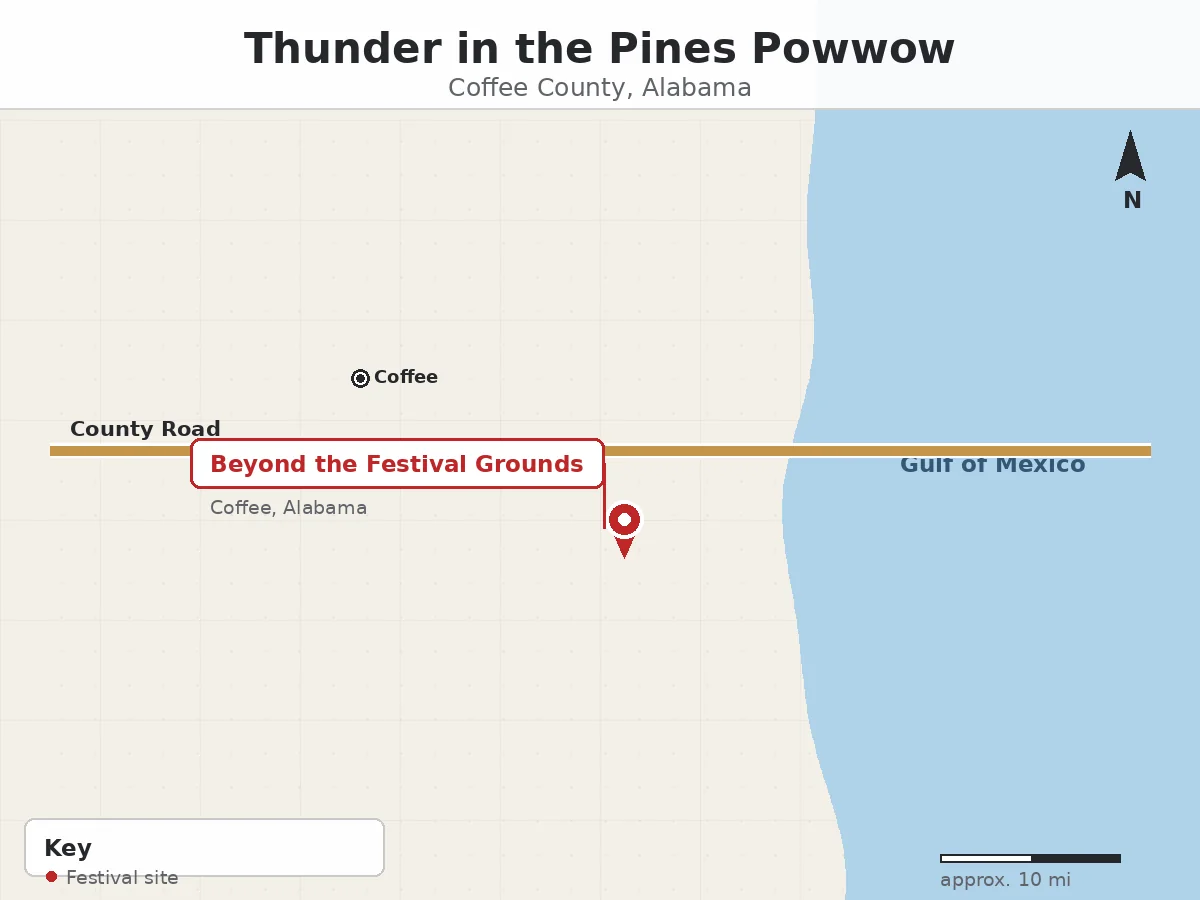
Elba rewards a slower itinerary than a single-purpose dash to the powwow. As one of Coffee County’s two seats, its courthouse square anchors a small Wiregrass downtown where a festival morning can start with breakfast before the gates open. The Pea River runs through Elba’s history as both lifeline and threat — the town’s story includes famous floods — and that river-valley setting explains the farmland and pine forest framing the tribe’s grounds.
Pairing the powwow with a drive across the county adds contrast. Enterprise, the other seat, offers the county’s larger commercial strip and its famous boll weevil monument, a reminder that this corner of Alabama rebuilt its farm economy around a pest and then thanked it in bronze. Still, give the grounds the largest share of your time: the festival is not a stop on the way to somewhere else, it is the destination.
Why the Thunder in the Pines Powwow Matters
A forty-eighth annual billing represents something fragile made durable. Traditions like this persist only because people choose, every year, to do the work: raising prize money, booking host drums, preparing grounds and teaching the youngest dancers their steps. When the Ma-Chis Lower Creek Indian Tribe of Alabama opens its gates, it shares something maintained for its own community first — its dances, its honours for veterans, its way of gathering generations in one circle.
For Coffee County, the powwow also corrects the local story. County history is often told through cotton, peanuts and a celebrated insect, but Native history in the Wiregrass is older than all of it, and Thunder in the Pines keeps it visible, audible and present. Chief James Wright’s stated hope is fulfilled every time a schoolchild from Elba or Enterprise watches a junior division contest and understands this culture is not a chapter in a book but neighbours, dancing twenty minutes from home.
Frequently Asked Questions
Who hosts the powwow, and whose ground is it held on?
The Ma-Chis Lower Creek Indian Tribe of Alabama hosts the gathering on its own grounds at 2950 County Road 377 in Elba. It is a tribally run event, organised by the community whose tradition it celebrates.
What did the 2026 gathering cost, and who could enter without paying?
Admission for the 2026 edition was five dollars per person. Veterans who presented military identification entered free, and so did dancers wearing regalia.
Which dance styles and age groups compete for prizes?
Dancers contested nine categories, including Northern Traditional, Southern Straight, Grass, Fancy, Chicken, Woodlands Style, Southern Cloth, Buckskin and Jingle. Divisions ran from juniors ages seven to twelve up to senior adults fifty-five and older, with prize money for the top three finishers in each division.
What should a first-time spectator know before attending?
Arrive before a grand entry, bring a chair, and follow the emcee’s guidance on etiquette and photography. Saturday runs until 10:00 p.m. or the final drum fades, and drugs, alcohol and firearms are prohibited on the grounds.
What to Expect From the Next Coffee County Alabama Thunder in the Pines Powwow Festival
How often is Coffee County Alabama Thunder in the Pines Powwow Festival held?
The gathering is an annual tradition of the Ma-Chis Lower Creek Indian Tribe of Alabama, billed in 2026 as the tribe’s forty-eighth annual powwow. That yearly rhythm, a fixture of the tribal calendar each autumn, is part of what gives the event its weight.
When is the next Coffee County Alabama Thunder in the Pines Powwow Festival?
The most recent documented edition took place on Friday, October 23 and Saturday, October 24, 2026, on the tribe’s grounds in Elba. A following edition would be expected the next autumn on a similar late-October pattern, but visitors should wait for the tribe’s own announcement rather than treating any projected weekend as confirmed.
Will the dates change?
They can. The 2026 edition fell on October 23–24, and while late October is the documented pattern, the tribe sets each year’s dates itself, and weather or scheduling can shift a weekend. Checking the announced dates for the year you plan to attend is the only reliable approach.
When the drums start up again in the pines outside Elba, they will be keeping a promise now kept across forty-eight annual gatherings: that this culture, these dances and this community endure, and that anyone willing to visit as a respectful guest is welcome to witness it.