Wayne County New York Fair Festival
Every August, Wayne County’s fair belongs to Palmyra. For seven days in the middle of the month, the Wayne County Fair fills the fairgrounds on West Jackson Street in the village of Palmyra, run by a farmers’ society organised on this same ground in 1856. The county seat, Lyons, does not host it — Palmyra does. What visitors find is a traditional agricultural fair at a deliberately small price: one low gate charge for everyone six and older, free parking, and a grandstand programme priced separately for those who want it. At the centre of the grounds stands Floral Hall, a fair building raised in 1856 and still in use during fair week, where the evening band series plays.
About the Fair
The Wayne County Fair is run by The Union Agricultural Society at Palmyra, the name the state fairs directory records as the fair operator and the name on the fair’s own entry forms and fair book. The Town of Palmyra’s history gives the same body in a second published form, the Palmyra Union Agricultural Society; the two forms stand side by side in the record rather than merged. The society became a stock company in its first year and remains one today, carried through fair week by volunteer committees. No county or village government runs this fair. Its ground is the Wayne County Fairgrounds at 300 West Jackson Street, Palmyra, New York 14522 — the address the fair and the state directory publish identically — while the post office box used for exhibitor entries is a mailing address only. Floral Hall, erected in 1856, anchors the site and was included on the National Register of Historic Places in 2009 as part of the Palmyra Village Historic District.
Quick Facts
| Item | Detail |
| Event | Wayne County Fair |
| Where | Wayne County Fairgrounds, 300 West Jackson Street, Palmyra, New York |
| County seat | Lyons — the seat does not host; Palmyra hosts |
| Operator | The Union Agricultural Society at Palmyra |
| When | Seven days in mid-August, Monday to Sunday — August 10 to 16 in 2026 |
| Admission | Six dollars pre-sale online, seven dollars at the gate, for everyone six and older; five and under free |
| Weekly pass | Twenty dollars for adults, ten dollars for youth ages six to sixteen |
| Parking | Free |
| Grandstand | Ticketed events fifteen dollars, charged on top of admission; harness racing and the pulls free |
| Camping | Offered at the fairgrounds in fair and non-fair periods; no current price published |
Groves, Stock Companies and a Hall That Never Left
In the fall of 1849, some citizens of Palmyra decided to hold a fair in Hathaway’s grove, a display of horse racing and agricultural products. The fair’s own history treats that gathering as a precursor, not a founding. The society era began in 1856, although the record hands down two organisation dates that stand unreconciled: one fair-history text has seventeen men organising as The Union Agricultural Society at Palmyra on April 13, 1856, while the town history dates the Palmyra Union Agricultural Society’s formation to June 26, 1856. Every account agrees that Floral Hall was built that same year. The society first leased its Jackson Street acres — eighteen and more in one account — and bought the ground in 1863 for six thousand dollars by that account; a county-press history instead describes about twenty acres purchased from Daniel Gates for three thousand dollars, and the two versions stand as published. In a 1962 reorganisation the Palmyra Fair was renamed the Wayne County Fair, becoming the county’s official fair — in the town history’s words, when the Palmyra Fair became the only fair remaining in the county, it became the Wayne County Fair.
Wayne County once had a second fair society, and keeping it separate matters. A distinct Wayne County Agricultural Society, based at Lyons, boasted its 76th Annual Fair at the county seat on October 3 to 5, 1918. That society is extinct and was never the Palmyra society. The Palmyra fair’s own billing describes it as founded in 1856, and its recent editions are billed, in their own layers, as the 167th in 2024 in local press, the 168th in the fair’s own 2025 release, and with a 169 billing in the 2026 schedule’s opening ceremonies. Those numbers stand as billing only, across a run that is not unbroken: the fair was cancelled in 2020 and 2021.
What to Expect
The Grandstand Week
Monday opens with free grandstand sport: New York State Sire Stakes harness racing at noon and a New York sanctioned horse pull at half past five. The ticketed events, each at fifteen dollars on top of gate admission, run through the week — the Empire State Pullers tractor pull on Tuesday, championship figure 8 racing on Wednesday, the Beat the Beast Bull Riders Tour rodeo on Thursday and a demolition derby on Friday. Saturday pairs the free Central New York garden tractor pull at ten in the morning with the Black Cat Hell Driver stunt show, and a championship demolition derby closes the fair on Sunday.
For a useful comparison, see the Washington County New York Fair Festival for another county festival.
Livestock, Barns and the Fair Book
The barns hold 4-H and open competition across the week: English and Western horse shows alongside miniature, driving and gaming classes, dairy cattle in 4-H and open divisions, beef showmanship, sheep, swine, dairy and meat goats, rabbits and cavies, poultry, a dog show and a draft-horse show. Friday brings the 4-H livestock auction. Indoors, the fair book’s departments fill the halls — Grange booths, domestics and home arts, flower shows in split sections, fruits, vegetables, fairy gardens and eggs.
Signature Contests and Fair Traditions
Some of this fair’s best texture costs nothing extra. The grease pole runs qualifications across the week, with finals on Sunday. A pie contest ends in an auction of its own entries, celebrity goat milking draws a crowd, and the eating contests cover corn for youth and adults, watermelon and an egg drop. Veggie races and a mullet and facial hair competition round out the novelty bill. The ceremonies remain, too: opening ceremonies at one on Monday and the parade itself, royalty court in attendance, at four on Saturday.
Music, Acts and Evening Extras
Floral Hall hosts the Back Porch band series through the week. The 2026 schedule’s named music includes a full-band set by Claudia Hoyser at nine on Wednesday evening, the Zac Brown tribute ZBTB, the Taylor Swift tribute Cruel Summer, the M80’s and State Line. The Flying Wallendas perform from Tuesday through Sunday, horse-drawn wagon rides run on the same span, and sensory-friendly hours are set aside on Tuesday and Wednesday afternoons. A beer garden pours until midnight on Friday and Saturday.
Rides and the Midway
Rides do not operate on Monday, worth knowing before a Monday visit with children. From Tuesday onward, ride tickets cost one dollar and fifty cents each, and each ride takes three, four or five tickets. A daily pay-one-price bracelet costs thirty-five dollars, and a youth day bracelet special runs on Wednesday and Sunday from one to five in the afternoon at twenty-five dollars. The schedule also prints a separate line of two dollars each for adult rides, which stands here exactly as printed — its own line, not merged into the ticket ladder.
Planning Your Visit
Admission, Passes and the Free Windows
The fair’s own admission page and its 2026 schedule agree word for word, and their ladder governs. Pre-sale admission bought online costs six dollars for youth and adults six and older; gate admission costs seven dollars on the same terms; children five and under are free. A weekly pass costs twenty dollars for an adult of seventeen or older and ten dollars for a youth aged six to sixteen, sold online and at the Macedon and Palmyra town offices starting Monday, July 6. Parking is free. The named days carry free windows: admission is free all day on Monday, Salute to America Day; senior citizens enter free until five on Tuesday; youth of sixteen and under enter free until five on Wednesday and free through Sunday, Family Day; first responders with identification, with their immediate family, enter free on Saturday. Two cautions belong with the ladder: the eight-dollar exhibitor pass sold with show entries is an exhibitor credential, not visitor admission; and an older published rules document priced adults and youth at different rates, a split the current pages have replaced with the single price above.
Getting There and Parking
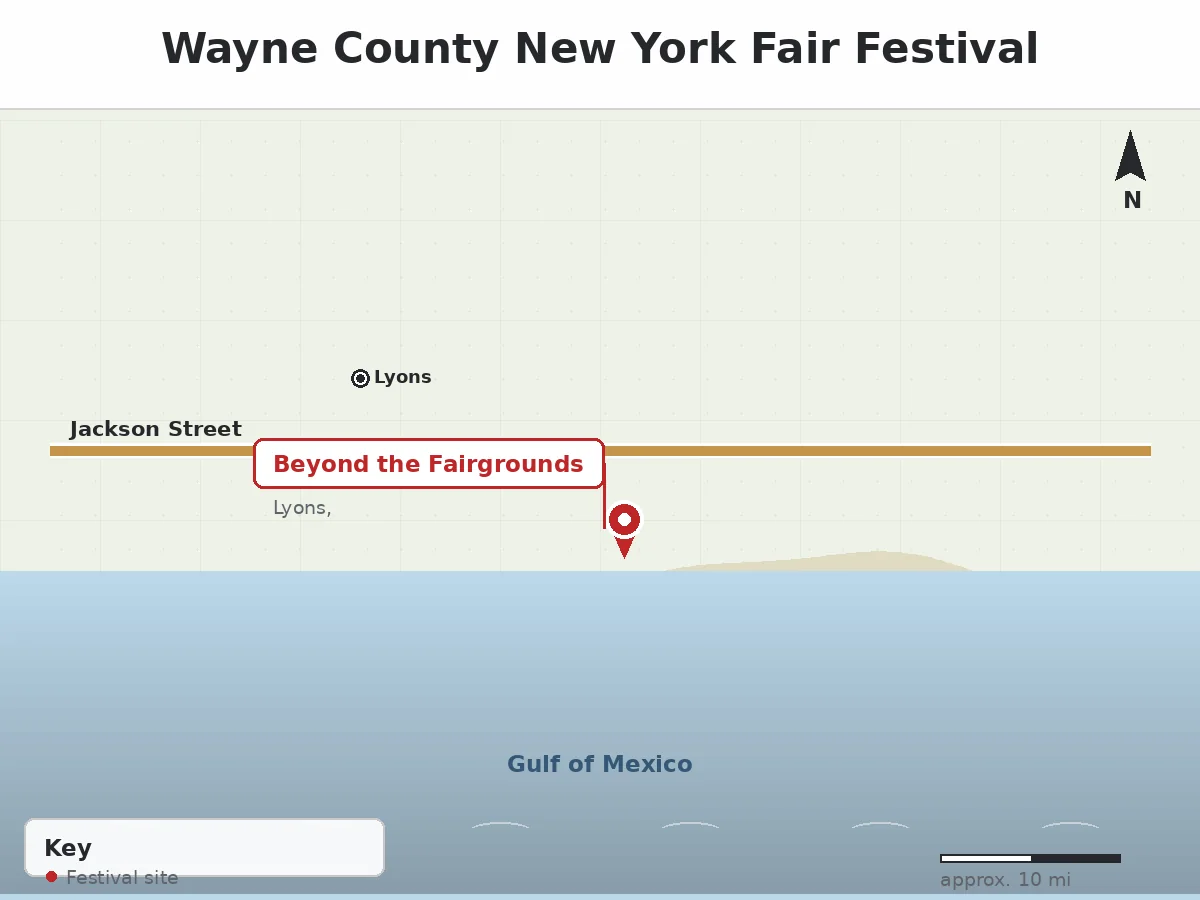
Point yourself at 300 West Jackson Street in Palmyra and you are at the gate, where parking costs nothing, on the fair’s own emphatic statement. Do not navigate by the fair’s post office box — it receives entry paperwork, not visitors.
A Sample Saturday
Saturday is First Responder’s Day, when responders with identification and their immediate families enter free. Start at ten with the garden tractor pull, free beyond admission, and give the late morning to the barns and the halls. The afternoon belongs to the midway, and everything pauses at four for the parade. Stay for the evening stunt show — fifteen dollars a head on top of admission — and, if the day runs long, the beer garden pours until midnight.
Camping, Dogs and Practical Details
Camping is a documented fairgrounds function: the fair’s own contacts page names a camping contact for fair and non-fair stays alike. What the fair does not publish is a price — no camping rate or reservation terms appear in its own pages, so none is quoted here. Figures on an undated form circulating under the fair’s name bear no year and should not be treated as current prices; confirm terms with the fair office, whose published telephone number is (315) 597-5372. The fair’s published rules bar dogs from the grounds during any event, with service animals accommodated on notice to the main office.
How This Fair Compares
Wayne County fairs exist in several states — Pennsylvania’s at Honesdale, Ohio’s at Wooster, Iowa’s at Corydon and Indiana’s at Richmond among them — and each is a separate fair with its own society, prices and past; nothing from any of them belongs to this one. Closer to home, the same Palmyra fairgrounds host a separate September festival, Harvest on the Canal, which is not the fair. Within the county’s own past, the extinct Lyons society’s fairs belonged to a different organisation entirely. The Palmyra fair’s distinction is continuity of place: one society, one street and one hall since the society’s organisation, at a gate price below most of the region’s larger fairs, with grandstand charges kept optional.
A Fair-Day Checklist
- Buy pre-sale admission online at six dollars, or a weekly pass if several days are planned
- Check the day’s free window — Monday, senior, youth and first-responder hours — before paying
- Budget fifteen dollars a person for any ticketed grandstand event, on top of admission
- Arrive before four on Saturday so the parade is not missed
- Remember the midway rests on Monday; plan ride time from Tuesday onward
- Ask the fair office about camping rather than trusting prices found elsewhere
- Leave dogs at home, since the grounds bar them during events
Beyond the Fairgrounds
The fairgrounds sit on West Jackson Street in the village of Palmyra, an Erie Canal community whose canal heritage the fair itself celebrated in its 2025 theme, inviting visitors to follow the Erie Canal to the fair for the waterway’s two-hundredth year. Floral Hall’s place on the National Register of Historic Places, as part of the Palmyra Village Historic District, marks the historic streets around the grounds. Lyons, the county seat, is where county business is done; during fair week the fair is not there.
Why This Fair Matters
The fair bills itself as one of New York State’s premier agricultural fairs and among its longest-running, and those superlatives stand here as the fair’s own billing. The substance underneath is verifiable enough: a stock-company society of local farmers still runs its own fair on ground it bought in the eighteen-sixties, in a hall raised in its first year, with the county’s youth showing animals and handiwork at its centre. The low unified gate, the free windows and the free parking all point the same way — a community fair priced to be attended by the community, with spectacle sold separately.
Frequently Asked Questions
Where exactly is the Wayne County Fair, and who runs it?
The fair is held at the Wayne County Fairgrounds, 300 West Jackson Street, in the village of Palmyra. Lyons is the county seat, but the seat does not host. The operator is The Union Agricultural Society at Palmyra, organised in 1856; a separate society of a similar name once ran fairs at Lyons and is long extinct.
What does a day at the gate cost?
On the fair’s own current pages, daily admission for 2026 is six dollars bought pre-sale online and seven dollars at the gate, for everyone six or older, with children of five and under free. A weekly pass costs twenty dollars for adults and ten dollars for youth six to sixteen. Parking is free, and several named days carry free windows for seniors, youth and first responders.
Are grandstand events and rides included in the gate price?
No. The fair states plainly that grandstand events are an additional price, not included in gate admission: ticketed grandstand events cost fifteen dollars each, while the harness racing, the horse pull and the garden tractor pull are free. Rides are charged separately again, by ticket or daily bracelet, and do not run on Monday.
Can I camp at the fairgrounds, and what does it cost?
Camping exists at the fairgrounds in fair-week and non-fair periods, and the fair names a camping contact for it. No current camping price or reservation terms are published in the fair’s own pages, so this article quotes none; rates on an undated form circulating under the fair’s name should not be relied on, and terms should be confirmed with the fair office.
What to Expect From the Next Wayne County New York Fair Festival
How often is the Wayne County New York Fair Festival held?
The fair is held once a year, over seven days in mid-August.
When is the next Wayne County New York Fair Festival?
The documented current edition runs Monday, August 10 to Sunday, August 16, 2026, at the Palmyra fairgrounds. The edition after that will return in mid-August 2027 by the fair’s annual pattern, but its exact dates had not been published in the record behind this article.
Will the dates change?
They can move within their mid-August home. Recent editions show the drift: the 2024 fair ran six days, August 12 to 17; the 2025 fair ran August 4 to 10; and the 2026 fair runs August 10 to 16. The week stays in August, but the exact Monday and Sunday are set year by year, so check the fair’s published schedule for the year in question.
That is the Wayne County Fair as its own record supports it: Palmyra’s fair, on Palmyra’s ground, under a society that has outlasted every rival in the county — priced gently and still opening its gates each August.