Middlesex County New Jersey Fair Festival
The Fair That Belongs to East Brunswick
Middlesex is a county name found in several states, two of which run fairs of their own, so the first thing to fix is which fair this page describes. The Middlesex County Fair on this page is New Jersey’s: a seven-day fair held each year in East Brunswick, on grounds it has owned outright for more than sixty years. It is not the 4-H fair held in Durham for the Middlesex and New Haven counties of Connecticut, and it is not the 4-H fair held at Westford in Middlesex County, Massachusetts; those are separate events in separate states, and none of their arrangements apply here.
Within New Jersey there is a second easy confusion. New Brunswick is the county seat, where the courthouse and county government sit, but the fair has never been a New Brunswick event; it stands in East Brunswick, a few miles away, and everything in this article belongs to that fair alone.
What the fair offers is a full week shaped around a working county. For five evenings it opens only after the working day ends, then gives the weekend over to two long full days, marking the opening Monday and the closing Sunday with fireworks. At its centre sits a home arts competition of hundreds of classes — baking, sewing, preserving, gardening and craft — displayed for the whole week.
An Association of Trustees, Not a County Department
The fair is run by the Middlesex County Fair Association, a private non-profit organisation founded in 1938 and managed by a board of trustees of local farmers and community volunteers. No county department operates it or sets its programme. The Middlesex County Board of Agriculture stands behind the fair as its sponsor, a supporting role the fair’s own pages state plainly; sponsorship is not management, and the association, not the board, is the organiser of record.
The fair’s home is the Middlesex County Fairgrounds at 655 Cranbury Road in East Brunswick, a property the trustees bought rather than rented. The association publishes an attendance figure of more than eighty-five thousand visitors a year; that number is the fair’s own billing, carried here as its claim rather than as an independently counted crowd.
For a useful comparison, see the Mercer County New Jersey 4-H Fair Festival for another county festival.
One piece of the fair’s own publicity deserves an honest note. Its current layers disagree about how many fairs there have been: fair-side press coverage of the 2026 edition billed that week as the eighty-eighth, while the association’s own welcome letter spoke of celebrating eighty-nine years. Both phrases are billing, they cannot both be a settled count, and this article asserts neither.
Quick Facts
| Item | Detail |
| Fair | Middlesex County Fair |
| Fair town | East Brunswick |
| County seat | New Brunswick, which does not host the fair |
| Grounds | Middlesex County Fairgrounds, 655 Cranbury Road, East Brunswick |
| Organiser | Middlesex County Fair Association |
| Sponsor | Middlesex County Board of Agriculture |
| Season | The first full week of August, Monday to Sunday (in 2026, August 3–9) |
| Admission (2026) | Adults ten dollars; seniors over sixty-five and children aged three to ten, four dollars; children under two, active-duty military and veterans free |
| Parking | Free |
A Grange Idea That Bought Its Own Farm
The fair began as a Grange project. The Milltown Grange had staged a Flower and Crop Show in 1937, and the following year the Grange founded the Middlesex County Fair as that show’s successor; the show itself was the forerunner, not the first fair. The new fair took a charter in 1938 setting out its agricultural purposes, and by the fair’s own recorded figures its first edition took receipts of one thousand seventy-nine dollars and twenty-three cents, charged ten cents for admission, and drew about two thousand people — a small township exhibition, a long way from the week-long event of today.
The young fair then met the Second World War, during which it was not held at all. That silence breaks any straight line from 1938 to a present-day edition number — one more reason this article prints none. In its early decades the fair moved between borrowed homes, sitting at the East Brunswick Grange property and at Dunhams Corner, while its sponsorship drew closer to the Middlesex County Board of Agriculture; only in 1960 was the certificate of incorporation formally changed to reflect that sponsorship.
The decisive step came in 1961, when the trustees bought the Scott Farm on Cranbury Road, the purchase closing on September 15 of that year. After several seasons of preparation the fair opened on its own land for the fair of 1965, and it has stood on that farm ever since.
What to Expect Across the Week
Fireworks at Both Ends
The fair’s own schedule bookends its week with fireworks. In 2026 the displays were set for the opening Monday at a quarter to ten in the evening and for the closing Sunday at half past nine; those times belong to that edition, but an opening-night and a farewell display form the fair’s signature frame. Opening ceremonies on the Monday evening, held between six and seven in the 2026 programme, start the week before the first display.
Sixteen Divisions of Home Arts
The competitive heart of the fair is its home arts programme. The fair’s own rules publish hundreds of classes in sixteen divisions, covering baking, canning, needlework, gardening and handcraft, and entries stay on display in the Home Arts building all week rather than being judged and sent home. Two terms are worth knowing: there is no entry fee, and the classes are open to non-residents, so the competition is not fenced to Middlesex County addresses. Around the home arts sit the week’s agricultural displays, including the 4-H and Master Gardener exhibits recorded in the 2026 coverage.
Dogs, Magic and a Circus That Is a Show
The fair publishes free entertainment with admission, and its 2026 stage list leaned toward spectacle. K9’s in Flight brought a rescue-dog show; Scott’s Magic USA presented its Future of Magic; Agricadabra turned farm subjects into a magic act; comedy hypnotists and a stilt walker filled out the bill, alongside a Thursday line-dance lesson and a daily disc jockey. The Cowboy Circus and its strolling counterpart, the Cowgirl Circus, worked the grounds with roping and rodeo-clown material as an interactive show — a performance visited between exhibits, not a standalone rodeo; no rodeo is part of this fair. In the large red Antique Storage Building, antique farm equipment from the New Jersey Museum of Agriculture anchors the machinery side of the week.
The Midway, Priced Separately
Rides come from Skelley’s Amusements, in the spelling the 2026 fair coverage used. Ride money is a separate purchase from admission: the 2026 layers priced single-day wristbands at thirty dollars on weekdays and thirty-five dollars at weekends, with Mega Wristbands at fifty-five dollars bought online before opening and sixty dollars from opening day. Every one of those figures is midway pricing fenced to 2026 — none of it is a gate price.
Planning Your Visit
Hours Built Around the Working Day
In 2026 the fair opened Monday to Friday from five in the afternoon until eleven at night, then ran Saturday from eleven in the morning until eleven at night and Sunday from eleven in the morning until ten at night. Those hours are that edition’s published pattern, and they explain the fair’s character: the weekday fair is an evening event layered onto the end of a working day, the weekend fair a full-day outing. Anyone travelling a distance for one visit gets the most fair from a weekend day.
The Gate and the Seven-Day Passes
The 2026 admission ladder charged adults ten dollars, seniors over sixty-five four dollars, and children aged three to ten four dollars, while children under two entered free, as did active-duty military members and veterans with military identification. Stage entertainment was included rather than separately ticketed. For anyone attending repeatedly, the fair sold seven-day passes online: fifty dollars for an adult pass against a seventy-dollar full value, and twenty dollars for children’s and senior passes against twenty-eight dollars at full value. Those are that season’s online offers, so check the current terms before relying on them in a future year.
Parking Without a Charge
Parking is free, stated plainly on the fair’s own pages and confirmed in its 2026 coverage; no parking charge should be expected or invented. The fair’s directions name parking areas on Fern Road, on Cranbury Road and on Dunhams Corner Road, with attendants directing cars as they arrive. On staying overnight, the record is equally clear by its silence: the fair publishes no camping, public or exhibitor, so plan a visit as a day or evening trip with lodging in the surrounding towns.
A Sample Sunday, the Last Day of the Fair
Arrive when the gates open at eleven and walk the Home Arts building first, while the rooms are at their quietest. Spend the late morning among the 4-H and Master Gardener exhibits, take lunch from the food stands, and give the early afternoon to the antique barn. Watch the rescue dogs and one stage act in mid-afternoon, leave the midway for the cooler hours toward evening, and end the day as the closing fireworks go up, in 2026 timed for half past nine. Sunday closes an hour earlier than Saturday, so the display doubles as the week’s farewell.
Two Fairs in One Week
The fairest way to understand this event is as two fairs sharing one set of grounds. The weekday fair runs five evenings, five o’clock to eleven, pitched at neighbours coming after work and supper; it rewards short, repeated visits and suits the seven-day pass, whose online price equalled five single adult admissions at the gate. The weekend fair runs two eleven- and twelve-hour days pitched at families travelling in for the whole day, when midway, stages and exhibits all run at full stretch. Judged as the pair together, it is a county fair arranged so that people who work can still attend most of it.
A Short Checklist
- Decide which fair you are attending: a weekday evening or a weekend day.
- Carry gate money for your party: ten dollars per adult, four dollars for seniors and children aged three to ten.
- Remember that children under two enter free, as do military members and veterans with identification.
- Budget rides separately from admission; wristbands are midway purchases, never part of the gate.
- Follow the attendants into the Fern Road, Cranbury Road or Dunhams Corner Road parking areas — all free.
- Enter something: home arts classes carry no fee and are open to non-residents.
- Time an evening visit to end with the fireworks on the Monday or the closing Sunday.
- Plan lodging off the grounds, since the fair publishes no camping of any kind.
Beyond the Fairgrounds
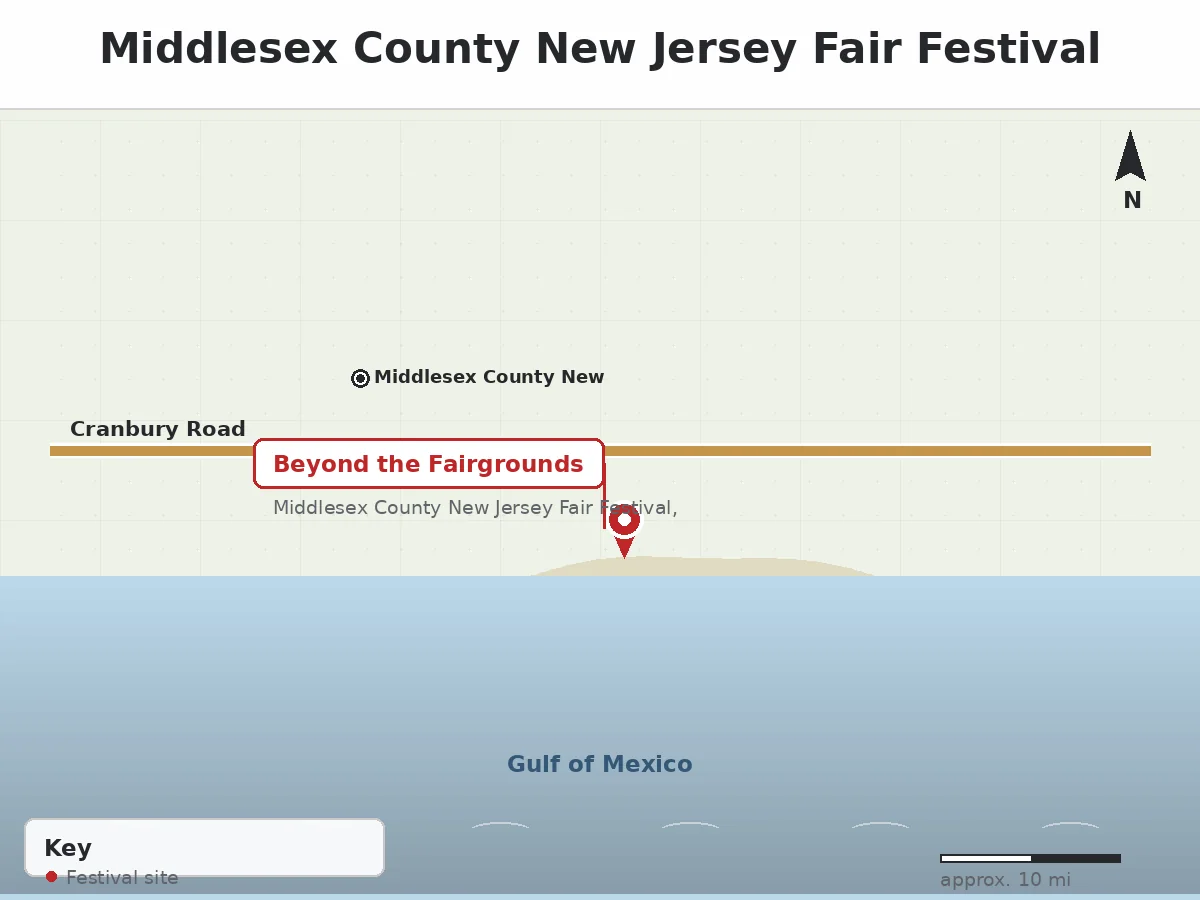
The fairgrounds sit on Cranbury Road in East Brunswick, the township the fair has called home since its earliest editions, in the suburban heart of Middlesex County. New Brunswick, the county seat, lies a short drive away with a life of its own quite separate from the fair; its events are its own and form no part of this fair’s programme. Across the rest of the year the fairgrounds host other occasions under other organisers — tenants’ events, not fair programme, worth checking on their own terms. Visitors staying locally between fair days will find the county’s towns, parks and diners fill the hours comfortably.
Why a Volunteer Fair Still Anchors Its County
Plenty of county fairs are run by county governments or professional promoters; Middlesex’s is run by the institutional descendants of a Grange that wanted a better flower show, and that origin still shows. The trustees are farmers and community volunteers, the fair owns the farm it stands on, and the home arts doors are open to anyone willing to enter rather than only to county residents. In a county better known for its highways and logistics sheds, the fair is the week when Middlesex County describes itself as a farming place — with the exhibits, entries and antique machinery on its own ground to back the description up.
Frequently Asked Questions
Where is the Middlesex County Fair actually held?
At the Middlesex County Fairgrounds, 655 Cranbury Road, East Brunswick. New Brunswick is the county seat and holds the county’s government, but it does not host this fair and no part of the fair takes place there.
How much does admission cost, and is parking really free?
For 2026 the fair charged adults ten dollars, seniors over sixty-five and children aged three to ten four dollars each, and nothing for children under two or for active-duty military members and veterans showing military identification. Parking was free in the fair’s own published terms, in its named parking areas.
Are the rides included in the admission price?
No. Admission covers entry and the fair’s stage entertainment, while rides are bought separately from the midway operator. In 2026 that meant single-day wristbands at thirty dollars on weekdays and thirty-five dollars at weekends, with a Mega Wristband above that; those are ride prices for that edition, not admission prices for any year.
Is this the same fair as the Middlesex fairs in Connecticut or Massachusetts?
It is not. Connecticut’s Middlesex and New Haven counties share a 4-H fair at Durham, and Massachusetts has a Middlesex County 4-H fair at Westford; both are different events in different states. This article covers only the Middlesex County Fair at East Brunswick, New Jersey.
What to Expect From the Next Middlesex County New Jersey Fair Festival
How often is the Middlesex County New Jersey Fair Festival held?
Once a year, across a single seven-day week; it has no second edition in any other season.
When is the next Middlesex County New Jersey Fair Festival?
The fair’s own published tradition fixes it to the first full week of August, Monday through Sunday, and the association announces each year’s exact dates in advance. Expect the next edition in that same early-August week, on the established pattern of weekday evenings and full weekend days, and confirm the specific dates with the fair before travelling.
Will the dates change?
The numbered days are not fixed. The week is anchored to the first full week of August rather than to fixed calendar dates, so the dates shift a little from year to year, even though the season and the Monday-to-Sunday shape stay steady.
A Week That Ends the Way It Began
The Middlesex County Fair opens with fireworks on a Monday night and closes with fireworks the following Sunday, and in between it runs on the labour of volunteer trustees standing on ground their predecessors bought in 1961. Eighty-five thousand visitors a year, by the fair’s own count, come for the home arts, the midway and the antique machinery; what they are really attending is a Grange idea from 1938 that was never handed over to anyone else. For a county that could easily have lost its fair to a landlord or a ledger, keeping it is the achievement the week celebrates.

One Comment