Buffalo County Nebraska Fair Festival
For six days in late July, the Buffalo County Fair fills the fairgrounds on the north side of Kearney with two fairs running at once. By day the barns take in market lambs, dairy goats and bucket calves while judges work through rows of decorated cakes. By night the same crowd moves to the Outdoor Grandstand for concerts that would headline a far larger town. Both registers sit on ground the fair has occupied since 1884, and its published record reaches from a single agriculture exhibit staged in a furniture store in 1875 to two national-act concert nights in the summer of 2026.
About the Fair on Avenue N
The Buffalo County Fair is staged at the Buffalo County Fairgrounds, 3807 Avenue N, Kearney, Nebraska, on a plant of more than fifty acres in the county seat. The grounds work through the year as a rental venue for weddings, trade shows and livestock events, yet the late-July fair is plainly the reason the place exists.
Who runs the fair is a question the record answers in more than one voice, and this account will not force it into a single name. Buffalo County’s own modern records, board agreements from 2022 and 2023 covering fairgrounds upgrades, contract with a body styled the Buffalo County Agricultural Society, whose manager has addressed the county board about the grounds. The fairgrounds’ own history page tells it differently: an organisation formed in 1913 as the Buffalo County Agriculture Association still oversees the fairgrounds’ operations today. A county history printed in 1916 gives that same 1913 body a third name, the Buffalo County Mid West Fair Association. Each form stands here in its own source, unmerged. Alongside whichever body holds the grounds, Nebraska Extension in Buffalo County runs the 4-H side of the fair from an office at 1400 East 34th Street, on the fairgrounds themselves.
Quick Facts
| Item | Detail |
| Event | Buffalo County Fair |
| Town | Kearney, the Buffalo County seat |
| Grounds | Buffalo County Fairgrounds |
| Address | 3807 Avenue N, Kearney, Nebraska |
| Grounds size | More than 50 acres |
| Season | Late July, running six days from Wednesday to Monday |
| Organiser | Carried in the record as both the Buffalo County Agricultural Society and the Buffalo County Agriculture Association |
| 4-H programme | Nebraska Extension in Buffalo County |
| Admission | No gate price appears in the fair’s own published record |
| Camping | Grounds camping with electrical hookups; fair-week terms unpublished |
A History That Begins in a Furniture Store
The fairgrounds keep their own history, and the telling below is theirs. The first agriculture exhibit in Buffalo County, they record, was held in 1875 in a furniture store in downtown Kearney, a display of what the county could grow arranged among a shopkeeper’s stock. In 1880 the county’s farmers formed an Agriculture Society — the fair’s own pages vary the name between Agriculture Society and Agricultural Society — and staged the first annual fair at Shelton, in the county’s east. A county history from 1916 records a reorganisation of that society the following year.
In 1884 the society moved the fair to Kearney and bought the ground the fairgrounds still occupy. The fourth annual fair at Kearney drew a crowd counted at more than three thousand. Money troubles ended the first run in 1893, when the society discontinued and the fair lapsed altogether. In 1913 a new organisation took over the fairgrounds and brought the fair back to its former location, where it has remained. No edition number is claimed here: a record that begins in 1880 and then falls silent for two decades cannot honestly be counted forward into the present day, and the fair’s own telling never attempts it.
For a useful comparison, see the Brown County Nebraska Fair & Rodeo Festival for another county festival.
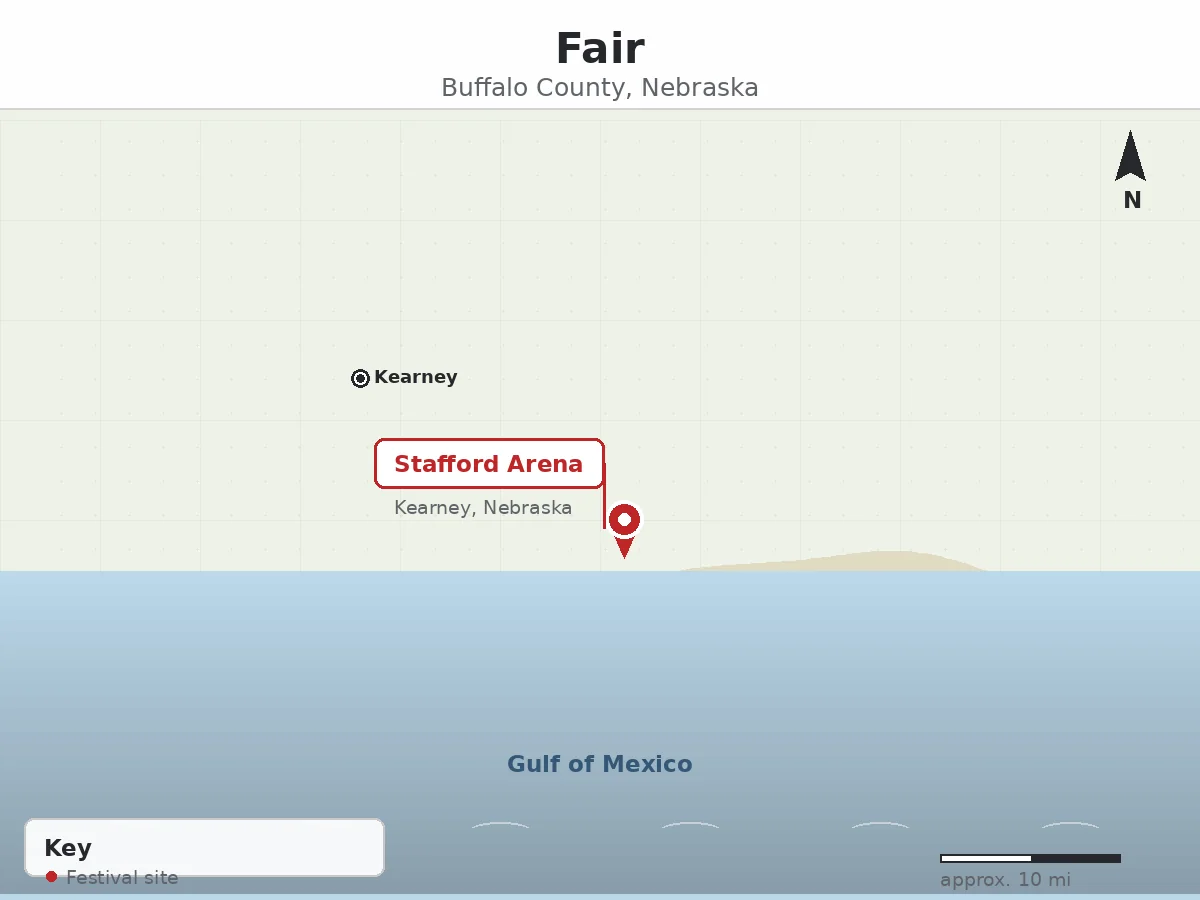
The buildings carry the later chapters. The Pole Barn, the Stafford Arena and the Small Animal Barns rank among the oldest fabric on the site. The Exhibit Building went up in 1983 and holds the fair offices; the Exposition Building followed in 1990; the Ag Pavilion was added in 2000. The LandMark Implement Arena and the Outdoor Grandstand complete the plant.
What to Expect
The 4-H Week That Runs Underneath Everything
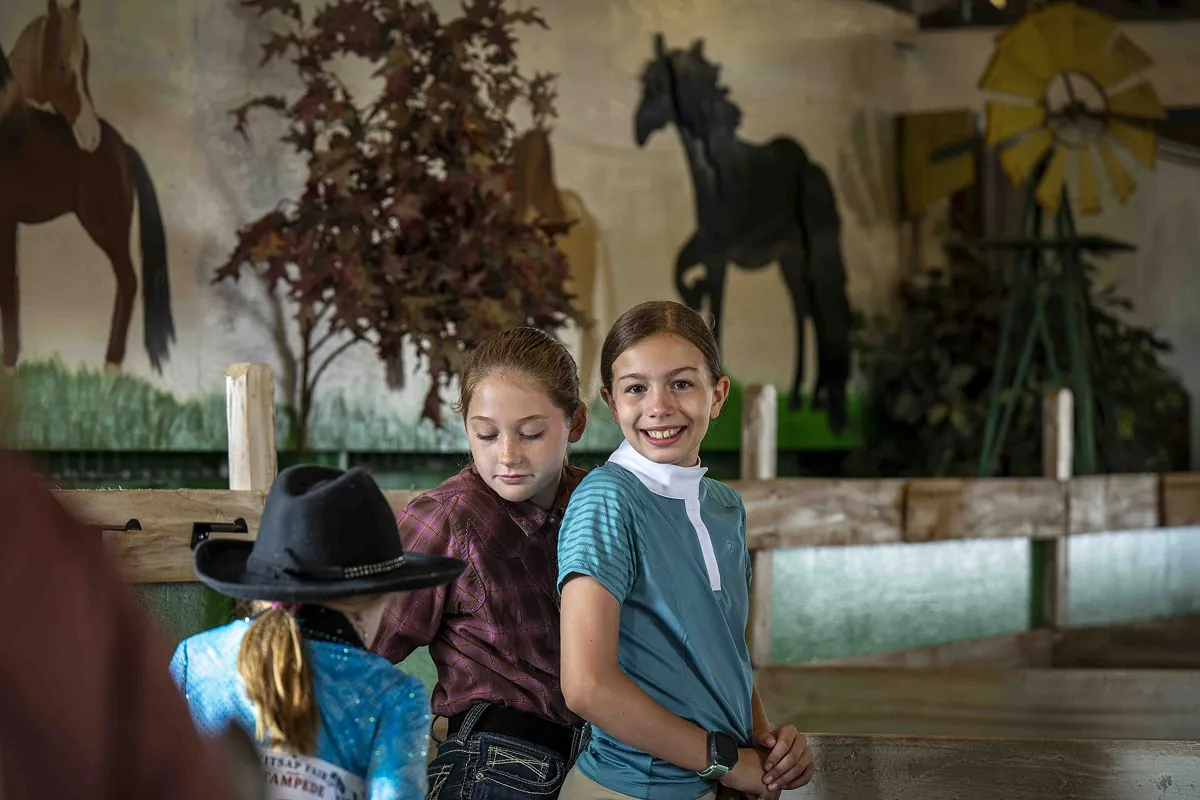
Extension’s published schedule gives fair week its weekday skeleton. On the Thursday morning the grounds open early to livestock entries and weigh-ins, with market lambs, goats, sheep, dairy animals, bucket calves, feeder calves and junior bulls all passing across the scales. The Exhibit Building opens at one o’clock that afternoon, and dairy and bucket calf judging fill the day. Friday belongs to the sheep and goat shows and to rabbit and poultry judging, with Clover Kid bucket calf classes and lottery sheep and goat showmanship woven through the programme. Anyone who arrives only for the evening concerts misses the fair’s working half, where a year of feeding, fitting and record books is judged in days.
Cakes, Pies and Young Sewers
Thursday also carries the fair’s most home-grown ceremonies. The Cake Walk circulates decorated cakes as prizes, the Decorated Cake and Pie Auction sells the week’s finest baking to the room, and the 4-H Fashion Show sends young sewers along a runway in garments they made themselves. None of it is imported entertainment: the cakes come out of Buffalo County kitchens, and every garment began as cloth on a county sewing table.
Grandstand Nights
Concerts belong to the fair’s published shape, and the 2026 edition filled its two largest nights with national names: Tracy Lawrence played the Friday night of that fair, and Dylan Scott, joined by Corey Kent, played the Saturday. Those names belong to the 2026 edition alone, because the fairgrounds stage concerts across the whole year and only those inside fair week are the fair’s own. Concert tickets are event tickets, priced for the show itself rather than as entry to the grounds. Note, too, what the record does not contain: no rodeo and no demolition derby is documented for the 2026 fair, whatever the grounds may host in other months.
The Standing Card
Around the scheduled machinery runs the ordinary traffic of a large county fair: livestock shows through the week, a carnival, bingo, fair food stalls, auctions and a cornhole tournament, a beer garden for the adults, and the Pioneer Farm Family Awards, honouring families whose farming in the county reaches back across generations. That card is the fair’s standing shape in its listing record, not a day-by-day promise for any single edition.
Planning Your Visit
Finding the Grounds
The fairgrounds stand at 3807 Avenue N on the north side of Kearney, with the Exhibit Building, home of the fair offices, as a natural first landmark. Kearney is a full-service seat, so fuel, meals and a bed are ordinary errands rather than expeditions. Drivers should keep one trap in mind: Kearney County, whose seat is Minden, is a separate county with a fair of its own, and the near-identical names misdirect somebody every summer.
What Entry Costs, and What Is Not Published
No gate, pass or parking price for the fair appears on the fairgrounds’ site or in Extension’s pages, so none is printed here. Silence of that kind should never be read as a promise, because an unpublished price is a different thing from a free fair; anyone budgeting for the week would do well to confirm the current position with the fairgrounds before setting out. The only documented tickets are concert tickets, and a concert ticket buys a seat at a show. Resale marketplaces attach figures of their own to this venue, but those numbers belong to the resale trade and play no part here.
Reading the Week’s Rhythm
Fair week runs six days, Wednesday to Monday, and its weight shifts as it goes. Entries and weigh-ins open the livestock side on Thursday morning, the Exhibit Building unlocks that afternoon, shows stack up through Friday and the weekend, and the grandstand peaks on the Friday and Saturday nights. A family with a single day to spare will find the fullest cross-section on Friday or Saturday, when the barns, the midway and the concert crowd occupy the grounds together. Exhibitors work to a different clock, governed by the entry deadlines Extension publishes ahead of the week.
One Saturday From Barns to Grandstand
A Saturday visit can hold the whole fair in a single arc. Start in the livestock barns while the morning is cool, where the weekend shows draw the barns’ busiest crowd of the week. Move on to the Exhibit Building before lunch to walk the judged exhibits and static entries. Give the early afternoon to fair food, a round of bingo and the carnival rides, then drift back through the barns as the day cools. Finish where the grounds finish: in front of the Outdoor Grandstand, when the concert crowd gathers and the fair’s second register takes over until dark.
The County Fair and the State Fair
A month after this fair closes, the Nebraska State Fair opens at Grand Island in neighbouring Hall County, and the two are confused often enough that the distinction is worth making plainly. The state fair is the statewide showcase, running from late August into early September at a scale no single county attempts. The Buffalo County Fair is one county’s own week, held a month earlier on ground its organisation bought in 1884, where the exhibitors are neighbours and the cake auction money stays local. Hall County stages a county fair of its own at Grand Island as well, making three separate events where a careless search suggests one. Choosing between them is a choice of scale, and plenty of local families attend both.
Before You Leave Home
- Confirm the current admission position with the fairgrounds, since no gate price is published in the fair’s own record.
- Treat a concert ticket as a ticket to that show only, never as documented entry to the grounds.
- Aim for Friday or Saturday if only one day is available, when shows, midway and grandstand coincide.
- Spend a morning in the livestock barns rather than saving the whole visit for the evening concert.
- Allow time for the Exhibit Building, which opens on the Thursday afternoon of fair week.
- Check Extension’s fair page for entry deadlines if anyone in the party plans to exhibit.
- Leave room in the budget for the cake and pie auction, a fair-week institution in its own right.
- Ask the fairgrounds directly about camping terms before counting on a hookup for fair week.
Beyond the Fairgrounds
Kearney keeps a crowded summer calendar around its fair. Cruise Nite takes over the town in mid-July, in the days just ahead of fair week, while Art in the Park and the Nebraska Shrine Bowl belong to the same season; each is a separate event with its own organisers, and none forms part of the fair. Downtown repays a short walk for the fair’s strangest footnote, since its streets hold the ground where the county’s first agriculture exhibit was arranged inside a furniture store in 1875. The fairgrounds stay busy long after the fair packs up, hosting rentals across the year, including a Festival of Lights in the winter season, all separate from the July event. A traveller still hungry for a fair can plan a second trip east to Grand Island, where the state fair opens a month later.
Why This Fair Holds Its County
The Buffalo County Fair matters to its county because it is the one week when the county’s work goes on public display in a single place. Its continuity is unusual: the fair began as exhibits in a shop, moved onto ground bought in 1884, died with its first society in 1893, was revived on the same acres twenty years later, and still runs its July week as a genuine county fair rather than a concert series with livestock attached. The Pioneer Farm Family Awards tie the week to the generations who built the county’s farms, the cake and pie auction turns home baking into support for young exhibitors, and the 4-H barns give county children a deadline that organises their whole summer. Two national-act nights may draw the casual visitor, but the weigh-in scales, the fashion show runway and the auctioneer’s chant are what the week is for.
Frequently Asked Questions
Where exactly does the Buffalo County Fair take place?
The fair is held at the Buffalo County Fairgrounds, 3807 Avenue N, in Kearney, the county seat, on grounds of more than fifty acres occupied by the fair since 1884. Everything from the livestock barns to the Outdoor Grandstand sits inside that single plant.
What will it cost me to get into this fair?
The fair’s own record publishes no gate, pass or parking price, so this article quotes none, and the fair should not be assumed free merely because its price is unpublished. The only documented tickets are concert tickets, which buy entry to a particular show rather than to the grounds. Checking with the fairgrounds before travelling is the reliable way to budget.
Is the Buffalo County Fair the same thing as the Nebraska State Fair?
No; the two are separated by both a county line and a month. The Buffalo County Fair is the county’s own event, held in Kearney in late July, while the Nebraska State Fair is the statewide event held at Grand Island in Hall County from late August into early September. Hall County also has a county fair of its own at Grand Island, distinct from both.
Does the fairgrounds offer camping while the fair is on?
The fairgrounds operate camping with electrical hookups as one of their standing facilities, so camping clearly exists at the site. Fair-week rates, rules and booking arrangements, however, are not published in the fair’s record, and no visitor should count on a pitch without asking the fairgrounds directly first.
What to Expect From the Next Buffalo County Nebraska Fair Festival
How often is the Buffalo County Nebraska Fair Festival held?
The fair is an annual event, held once every year in the second half of the summer. Its modern shape is a six-day run, Wednesday to Monday, anchored in late July.
When is the next Buffalo County Nebraska Fair Festival?
The next edition falls due in late July, following the same Wednesday-to-Monday frame used in the fair’s recent documented editions. The most recent ran through the last week of July 2026, and the fairgrounds publish each new edition’s confirmed dates as its season approaches.
Will the dates change?
The season itself is settled: late July is this fair’s fixed place in the Nebraska calendar, ahead of the state fair’s late-August opening. The precise days are set edition by edition, so the Wednesday-to-Monday span can slide by a few days from one year to the next while the season stays put.
A Fair Still on Its First Ground
Plenty of county fairs have moved, merged or faded into a concert weekend, but this one still unfolds on the acres its society bought in 1884, under an organisation whose very name the record leaves honestly unsettled. Come for the grandstand if that is the draw; stay for the weigh-ins, the cake auction and the fashion show, because those smaller ceremonies are where Buffalo County actually keeps its fair.