Dougherty County Georgia Water, Wings & Wildlife Festival
How far is Albany from other southwest Georgia towns?
Albany is the regional hub of southwestern Georgia, which makes it a practical base for exploring the surrounding area by car. Bainbridge, Thomasville, Americus, and Plains are all reachable within a comfortable drive, making a two-town weekend genuinely feasible. Because rural distances can be deceptive on a map, plan your route in advance and allow more time than the mileage suggests.
The Future of Albany’s Wildlife Weekend
The trajectory for Water, Wings & Wildlife looks steady rather than explosive, and that is probably the right outcome. The ingredients that make it work — a river, a bird-rich corridor, a walkable downtown, and a community that treats its natural assets as public property — are not going anywhere. The likely evolution is in programming depth: more guided experiences, stronger educational partnerships, better interpretation along the water, and continued emphasis on keeping entry free so that the weekend remains something anyone in Dougherty County can decide to do on a Saturday morning.
For visitors, that means the planning fundamentals will keep mattering more than any single headline attraction. Arrive early. Park with a backup plan. Budget for food and a couple of optional activities. Watch the weather. And leave room in your schedule for the moment when a heron lifts off twenty feet from the bank and the whole point of the festival explains itself.
Last updated: October 2026
Albany does not need to compete with Georgia’s larger tourism destinations to put on a weekend worth driving for. It only needs the river, the birds, and a few thousand people willing to look up at the right time — and Water, Wings & Wildlife delivers all three with an ease that makes the planning feel like the least interesting part of the trip, which is exactly how it should be.
Water, Wings & Wildlife is a name that doubles as a set of directions: follow the water, look up at the wings, and pay attention to the wildlife that southwest Georgia has been sheltering for generations. Held in Albany, the Dougherty County seat, the festival takes the three things this corner of the state does best — a wide, slow river, a sky busy with birds, and a downtown close enough to walk to both — and folds them into a weekend that rewards anyone willing to think an hour ahead.
This is a logistics-first guide, and that framing matters. Festivals built around living creatures behave differently from festivals built around a stage and a ticket gate. The best sightings usually happen early, the shade runs out by midday, and the parking that looked generous at eight in the morning looks considerably less generous by eleven. What follows covers how to reach Albany, where to sleep, what to budget, how a spring thunderstorm can rewrite your schedule, and how to build a weekend that leaves room for the unplanned — because with birds and rivers, the unplanned is often the best part.
The Albany and Dougherty County Basics, in One Table
| Town | Albany, Georgia |
| County | Dougherty County, Georgia |
| County seat | Albany |
| Population | 85,790 (2020 census) |
| Region | Southwestern Georgia |
| Typical timing | Spring, when regional bird activity is high |
| Admission | Typically free to attend; some activities may carry a small fee |
| Setting | Albany’s riverfront and green space along the Flint River corridor |
| Signature features | Birding, water-based recreation, native wildlife exhibits, family programming |
| Organizer | Albany-area conservation, city, and community partners |
What Water, Wings & Wildlife Actually Is
Strip away the branding and you have a nature festival with three fixations, all of them spelled out in the title. Water means the Flint River and the creeks, springs, and sloughs that feed it — the reason Albany exists where it does and the reason the county’s 335 square miles of land are stitched together by bottomland forest. Wings means birds, and plenty of them: herons and egrets working the shallows, hawks and vultures riding thermals, songbirds moving through the canopy, and waterfowl loafing on open water. Wildlife means everything else that shares the corridor, from turtles and fish to pollinators and the occasional white-tailed deer at the edge of a treeline.
Practically speaking, this is a walkable, outdoor-heavy event rather than a gated carnival. Programming tends to spread across riverfront and green space, mixing guided observation with hands-on exhibits, and the atmosphere leans educational and unhurried. That has real consequences for how you should plan. There is no single “must-see” hour that justifies arriving at noon and fighting for a spot; instead there are rhythms — a cool, loud, productive morning, a hot and social middle, and a softer evening that belongs to music, food, and conversation. Build your day around those rhythms and the festival feels easy. Ignore them and you will spend the good light in a parking line.

How a River Town Built a Wildlife Weekend
Albany’s festival did not appear out of nowhere, and it does not belong to a single building or a single weekend. It grew out of a longer habit in Dougherty County of treating the Flint River as a shared front yard — a place where people fish, paddle, photograph, and simply sit. In a county of 85,790 residents in southwestern Georgia, that relationship is not a niche interest; it is part of the local identity, and it is why a wildlife-focused gathering could take root here rather than in a town that turns its back on its water.
The event’s evolution follows a pattern familiar to river towns. It began as something small and focused — a morning of birding, a guided walk, an exhibit table or two — and expanded as partners realized that the audience was broader than they had assumed. Families came for the hands-on activities. Photographers came for the light. Paddlers came because the water was already there. Schools came because the curriculum wrote itself. Over time, the pieces knit together into a multi-day spring tradition with food, music, and programming running alongside the wildlife observation that started it all.
What has stayed constant is the emphasis on access. Albany’s version of a nature festival is not designed as an exclusive, expert-only affair. It is designed so that a first-time birder and a lifelong naturalist can stand twenty feet apart and both get something out of the same hour, which is a harder thing to engineer than it sounds. That instinct — keep it open, keep it outside, keep it cheap — is the thread running from the festival’s earliest iterations to the present one.
What a Water, Wings & Wildlife Day Looks Like in Albany
Expect a festival that changes character as the sun moves. Arrive early and you get mist on the water, quiet trails, and the best odds of seeing something worth telling someone about. Arrive at midday and you get vendors, demonstrations, shade-seeking crowds, and kids running between activity stations. Arrive in the evening and you get a gentler version of the whole thing, with music carrying across the river and far fewer people competing for a view.
Food and Drink Along Albany’s Riverfront
Festival food here leans Southern and portable: smoked meats, fried favorites, boiled peanuts, funnel cakes, snow cones, and the kind of lemonade that exists specifically to be consumed in 85-degree humidity. Vendors typically cluster near the busiest programming, which means you can eat without abandoning your group. Two practical notes. First, lines are shortest immediately after the morning programming breaks up and longest right at the lunch peak, so eating at 11:15 rather than 12:30 is a genuine upgrade. Second, if you have dietary restrictions, do not assume the riverfront will accommodate them; downtown Albany restaurants within easy reach of the water give you more control, and they are a pleasant walk when the heat backs off.
Music, Demonstrations, and Live Entertainment
Live entertainment at a wildlife festival serves a specific purpose: it gives people a reason to stay once the birds have gone quiet. Expect regional acts, acoustic sets, and family-friendly performers rather than a headline concert experience, along with demonstrations that sit somewhere between education and spectacle — animal presentations, river-focused talks, and hands-on stations where you can look through a scope or examine a specimen. The sound carries across open ground, so if you want the music as a backdrop rather than the main event, set up a folding chair a hundred yards back and you will get the best of both.
Family Activities Built Around Birds and Water
This is where Water, Wings & Wildlife earns its reputation as an easy sell for families. Programming is designed to be touched, not just observed: craft stations, scavenger hunts, identification games, casting and paddling demos, and short guided walks sized for short legs. Strollers handle the paved and graveled sections fine; the rougher riverbank paths are better with a carrier. Bring a change of clothes for anyone under eight, because water plus children plus a warm spring day is a predictable equation. And keep one adult free of gear duty during the busy middle hours — the crowd is friendly, but a festival spread across open ground makes it easy to lose sight of a fast-moving kid for thirty seconds at a time.
Planning the Trip: Albany Logistics From the Ground Up
Getting to Albany and Dougherty County
Albany sits in southwestern Georgia and functions as the regional hub for a wide rural area, which makes it easier to reach than its size suggests. Most visitors arrive by car, typically via the highways that funnel traffic into the city from the north, east, and south. If you are flying, plan on connecting through a larger Georgia airport and renting a vehicle; a car is not optional here, because the festival grounds, your lodging, and the surrounding natural areas are spread out enough that walking everywhere will not work. Build in buffer time on the day you arrive. Rural highway driving is fast, but the last few miles into a festival weekend can slow to a crawl.
Where to Stay for a Water, Wings & Wildlife Weekend
Albany has the standard national hotel chains plus independent and extended-stay options, and because this is a regional hub rather than a resort town, room rates are generally reasonable — with the caveat that a spring festival weekend plus any concurrent local event can tighten availability quickly. Book as early as you can commit. If you are choosing between properties, prioritize two things: proximity to the riverfront or downtown, and a parking situation you understand before you arrive. A hotel ten minutes farther out with free, obvious parking often beats a closer property with a cramped lot. Campers and RV travelers should research regional campground options in advance rather than assuming a spot will be available on arrival.
Parking Around the Albany Festival Grounds
Parking is the single most common source of festival frustration, and it is almost entirely avoidable. Arrive before the morning programming begins and you will park close, walk less, and start your day in a good mood. Arrive mid-morning and you will join a slow parade. Arrive at lunch and you should expect to walk. Have a mental backup plan: a lot or garage a few blocks from the water, a downtown side street where you have checked signage, and a willingness to treat the walk as part of the outing. Keep your vehicle clear of anything that looks like a trailhead or a resident’s driveway — the goodwill of the neighborhood is part of what makes a free riverfront festival possible.
Admission, Costs, and What to Budget
Admission to Water, Wings & Wildlife is typically free, which is central to the event’s character — it is meant to be something a family can decide to do on a Saturday morning without checking the bank account first. Where money does enter the picture is in the optional layer: food and drinks, vendor merchandise, craft or activity fees, and any paid add-ons such as a guided paddle or a specialty program. Set a simple cash-and-card budget before you go, decide in advance whether you are buying souvenirs, and treat paid activities as a la carte rather than mandatory. Because prices and offerings can change from year to year, confirm the specifics with the festival’s current materials rather than relying on last season’s numbers.
Southwest Georgia Weather and What to Wear
Spring in Dougherty County is warm, green, and unpredictable. Mornings can start cool enough for a light jacket and end hot enough that you are looking for shade by noon, and a fast-moving afternoon shower is always a possibility. Dress in layers, choose breathable fabrics, and wear shoes you do not mind getting dusty or damp — riverbank ground stays soft after rain. Sun protection is non-negotiable: hat, sunscreen, and sunglasses. Insect repellent matters too, especially near water at dusk. If storms are forecast, check the festival’s channels before you drive in; outdoor programming can pause or shift, and knowing that early saves you a wasted trip.
A Sample Water, Wings & Wildlife Weekend Itinerary
Friday evening. Arrive in Albany, check in, and take a low-effort drive or walk along the riverfront to get your bearings. Eat dinner downtown rather than at the festival site, and use the evening to confirm parking options for the morning. Set out your gear — binoculars, water bottles, hats, sunscreen — so you are not hunting for them at dawn.
Saturday, early. This is the block that justifies the whole trip. Get to the grounds before the crowds, walk the quieter water’s-edge paths, and let the morning do the work. Birds are active, light is soft, and the temperature is still on your side. If a guided walk is offered, this is when to take it.
Saturday, midday. Shift to the social side: exhibits, demonstrations, family activity stations, and food. Eat slightly before the rush, then find shade and slow down during the hottest stretch. This is a good window for the kids’ programming and for anything indoors or covered.
Saturday, late afternoon into evening. Revisit the water as the light turns golden, then settle in for music and dinner. Stay later than you think you should — the evening version of the festival is calmer, cooler, and often the most memorable part of the day.
Sunday. Use the morning for the parts of the region the festival does not cover: a slower riverfront walk, a visit to one of Albany’s local attractions, or a drive through the surrounding countryside. Leave before the afternoon departure crunch if you have a long drive home.
How Albany Compares With Other Southwest Georgia Weekends
Albany’s advantage in the regional festival calendar is scale plus water. With 85,790 residents in Dougherty County, it has the population base to support a genuinely multi-day event with vendors, entertainment, and programming depth — something smaller towns cannot always sustain. It also has the Flint River running directly past its downtown, which gives the wildlife theme a physical anchor rather than a decorative one.
Bainbridge, another Flint River town downstream, offers a comparable river-town feel with a smaller footprint and a more intimate scale; if you love the water element of Water, Wings & Wildlife, it is a natural second stop. Thomasville, to the east, trades the river for historic streets, live oaks, and a strong garden-and-architecture identity — a different kind of spring weekend entirely. Americus and nearby Plains lean into small-town heritage and a slower pace, better suited to travelers who want a quiet afternoon than a full festival program. None of these is a substitute for Albany’s event; they are complements, and stringing two of them into one long weekend is one of the better ways to see this part of Georgia.
The Dougherty County Festival Checklist
| Binoculars | The single biggest upgrade to your experience; even a basic pair changes what you can see |
| Water bottles | Refill stations are not guaranteed; heat and walking add up fast |
| Sun protection | Hat, sunscreen, sunglasses — riverfront exposure is relentless by midday |
| Insect repellent | Especially for dawn and dusk near water |
| Layers | Cool mornings, hot afternoons, possible showers |
| Comfortable shoes | Gravel, grass, and soft riverbank ground |
| Cash and a card | Vendors vary; small bills speed up lines |
| Folding chairs or a blanket | Makes the music and midday break far more pleasant |
| Change of clothes for kids | Water plus children is a predictable equation |
| Confirmed parking plan | Know your primary and backup option before you leave the hotel |
Beyond the Festival: What Else Albany Offers
Water, Wings & Wildlife is a good excuse to spend more than a few hours in Dougherty County. The Flint River itself is the obvious starting point — paddling, fishing, and riverside walking are all part of the local rhythm, and the corridor’s bottomland forest is exactly the habitat the festival is celebrating. Albany’s historic downtown rewards a slow walk, with architecture, local restaurants, and a compact, walkable core that makes an evening out easy.
Families and nature-minded travelers should look into the area’s park and garden attractions, which pair well with a festival weekend and often fill the gaps in the programming schedule. History-minded visitors will find that Albany’s story is inseparable from the broader story of southwest Georgia — agriculture, river commerce, and the civil rights movement all left marks on the city. Radium Springs, one of Georgia’s natural wonders, sits close enough to the city to make an easy add-on. Build one unstructured half-day into your trip and use it for whichever of these fits your mood; the region rewards curiosity more than checklists.
What This Weekend Means to Albany and Dougherty County
In a county of 335 square miles where agriculture, healthcare, and regional services anchor the economy, a free public festival centered on the natural world does something quiet but important. It turns the Flint River from a background feature into a shared asset. It gives residents a reason to bring out-of-town family into the city. It puts schoolchildren face to face with the ecosystem in their own backyards, which is a different kind of learning than a classroom can provide.
It also reinforces a civic identity that Albany has been building for years: a river city that knows what it has. Conservation partners, city departments, volunteers, and local businesses all have a hand in making the weekend work, and the payoff is not measured only in visitors. It is measured in residents who notice the heron on their morning commute because a festival taught them what to look for. That is a modest legacy, but it is a durable one, and it is the reason the event keeps returning.
Where the Festival Happens in Albany
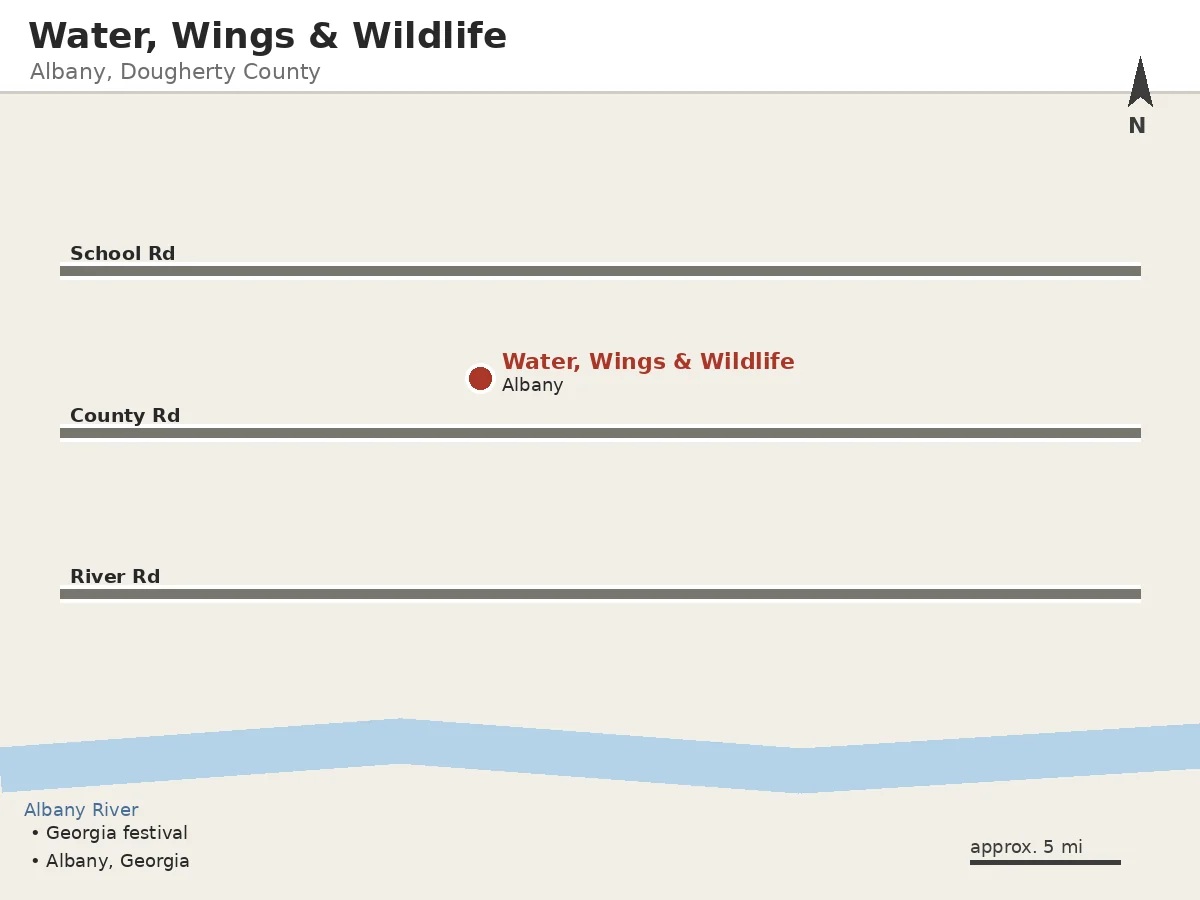
Water, Wings & Wildlife takes place in Albany, the Dougherty County seat in southwestern Georgia, along the city’s Flint River riverfront and adjoining green space.
Water, Wings & Wildlife: Visitor Questions, Answered
Is Water, Wings & Wildlife free to attend?
Admission is typically free, which is part of the event’s design as an accessible community weekend. Individual activities, guided programs, food, and merchandise may carry their own costs, so plan for an optional spending layer on top of a free entry. Check current festival materials before you travel, since offerings and any associated fees can change from year to year.
What time of day is best for seeing birds and wildlife in Albany?
Early morning is consistently the most productive window. Birds are active, the light is soft, temperatures are comfortable, and crowds are thin. Late afternoon into early evening is the strong second choice. The midday hours are better spent on exhibits, food, and family programming than on serious wildlife observation.
Do I need to bring my own binoculars or kayak?
Bring binoculars if you own them — even an inexpensive pair transforms the experience. If you do not, some programming may offer shared viewing equipment, but availability is not guaranteed, so ask ahead. For paddling, do not assume a boat is provided; confirm whether rentals or guided paddles are part of the current schedule before you plan your day around being on the water.
Is the Albany festival suitable for young children and older visitors?
Yes, with sensible adjustments. The event is family-oriented, with hands-on activities aimed at kids and mostly flat, walkable ground. Older visitors will do best arriving early, parking close, and planning a shaded midday break. Anyone with mobility concerns should look at the site layout in advance and identify the shortest route between the programming they most want to see.
What happens if it rains during the Dougherty County weekend?
Spring showers in southwestern Georgia are common and often brief, so a passing storm does not necessarily end the day. Outdoor programming may pause or shift when conditions are unsafe, and some activities may move under cover or indoors. Check the festival’s current channels on the morning of your visit and build flexibility into your itinerary rather than a rigid schedule.
Can I bring my dog to the riverfront festival grounds?
Policies vary by activity and venue, and wildlife-focused programming often restricts pets for the safety of both animals and visitors. Leashed dogs are common at general outdoor events, but exhibit areas, guided walks, and water activities may be off limits. Confirm the current rules before you pack the leash and the water bowl.
How far is Albany from other southwest Georgia towns?
Albany is the regional hub of southwestern Georgia, which makes it a practical base for exploring the surrounding area by car. Bainbridge, Thomasville, Americus, and Plains are all reachable within a comfortable drive, making a two-town weekend genuinely feasible. Because rural distances can be deceptive on a map, plan your route in advance and allow more time than the mileage suggests.
The Future of Albany’s Wildlife Weekend
The trajectory for Water, Wings & Wildlife looks steady rather than explosive, and that is probably the right outcome. The ingredients that make it work — a river, a bird-rich corridor, a walkable downtown, and a community that treats its natural assets as public property — are not going anywhere. The likely evolution is in programming depth: more guided experiences, stronger educational partnerships, better interpretation along the water, and continued emphasis on keeping entry free so that the weekend remains something anyone in Dougherty County can decide to do on a Saturday morning.
For visitors, that means the planning fundamentals will keep mattering more than any single headline attraction. Arrive early. Park with a backup plan. Budget for food and a couple of optional activities. Watch the weather. And leave room in your schedule for the moment when a heron lifts off twenty feet from the bank and the whole point of the festival explains itself.
Last updated: October 2026
Albany does not need to compete with Georgia’s larger tourism destinations to put on a weekend worth driving for. It only needs the river, the birds, and a few thousand people willing to look up at the right time — and Water, Wings & Wildlife delivers all three with an ease that makes the planning feel like the least interesting part of the trip, which is exactly how it should be.