Monterey County California Monterey Jazz Festival
The Monterey Jazz Festival is the oldest continuously running jazz festival in the world, and it has been held on the same oak-studded fairgrounds since 1958. Every September, five hundred musicians perform across nine stages for a weekend that has become a cornerstone of American music.
Its first edition, in October 1958, featured Louis Armstrong, Dizzy Gillespie, Billie Holiday and Dave Brubeck. Nearly seven decades and almost 3,000 performances later, the festival still draws the leading names in jazz alongside the artists who will define the next generation.
This guide covers what the Monterey Jazz Festival is, how the weekend works, and how to plan a visit to the Monterey Peninsula for it.
What the Festival Is
The Monterey Jazz Festival is a three-day event held on the third full weekend of September, beginning on Friday. It takes place on the twenty-acre Monterey County Fairgrounds, where multiple stages host roughly fifty concert performances across the weekend. Beyond the main stages, the festival includes jazz conversations, panel discussions, workshops, exhibitions and clinics.
Food and shopping spread across the grounds, and the atmosphere is relaxed and outdoors. The festival is a nonprofit, and its work extends beyond the weekend into education programs, artist support and community engagement that run through the year.
For a nearby comparison, see the Mono County California OkTUBERfest Festival.
A History That Shaped American Music
The festival was the idea of Jimmy Lyons, a San Francisco jazz disc jockey, and Ralph J. Gleason, the jazz critic of the San Francisco Chronicle. Inspired by the Newport Jazz Festival, they raised money through hundred-dollar donations and staged the first Monterey Jazz Festival on October 3 to 5, 1958, as a nonprofit from the start.
That first lineup is now legendary: Louis Armstrong, Dizzy Gillespie, Max Roach, the Modern Jazz Quartet, Sonny Rollins, Dave Brubeck, Cal Tjader, Harry James, and Billie Holiday in her only Monterey performance. The event was well received and became annual.
The fairgrounds went on to host the Monterey Pop Festival in 1967, which made the site internationally famous, and the jazz festival rode that wave of attention. In 1970, Clint Eastwood filmed part of his directorial debut, Play Misty for Me, at the festival. Lyons managed the event until his retirement in 1992.
Where and When
The festival is held at the Monterey County Fairgrounds on the Monterey Peninsula, on the third full weekend of September. The setting, a short drive from the coast and the town of Monterey, gives the weekend its distinctive mix of music and sea air.
| Location | Monterey County Fairgrounds, Monterey, California |
| Typical timing | Third full weekend of September, Friday through Sunday |
| Founded | 1958, by Jimmy Lyons and Ralph J. Gleason |
| Scale | About 500 artists, nine stages, roughly 50 performances |
| Extras | Panel discussions, workshops, clinics, exhibitions, food and shopping |
| Status | Longest continuously running jazz festival in the world |
| Organizer | A nonprofit with year-round education and artist programs |
The Music
The programming is broad by design. Main-stage concerts anchor each day, but the festival’s reputation rests as much on its smaller venues and its willingness to program across the range of jazz and its relatives, from traditional and big band to bebop, fusion, Latin jazz and contemporary improvisation.
The Next Generation Jazz Orchestra, the festival’s flagship youth ensemble, has been a fixture for decades and gives young musicians a stage alongside established artists. Education is central to the festival’s identity, and many of the workshops and clinics are free or open to students.
Planning Your Visit
Monterey is a popular coastal destination, and festival weekend is one of its busiest. Lodging in Monterey, Pacific Grove and Carmel fills early, so booking well in advance is the single most important step. The fairgrounds are reachable from the surrounding towns by car, and shuttles and transit help on the busiest days.
- Book lodging months ahead; September is peak season on the peninsula.
- Buy tickets early, and consider a full-weekend pass for the best value.
- Bring layers, since coastal evenings in September are cool and foggy.
- Arrive early on Friday to settle in before the evening sets begin.
- Check the schedule in advance to plan around the artists you most want to see.
Beyond the Festival
The Monterey Peninsula rewards a longer stay. The Monterey Bay Aquarium and Cannery Row are minutes from the fairgrounds, the coastal recreation trail runs along the bay, and the seventeen-mile drive through Pebble Beach and Pacific Grove is one of the most scenic routes in California.
Inland, Carmel Valley’s wineries and the artichoke fields around Castroville offer a different side of the county. For visitors who come for the music, adding a day or two of coast and country is an easy choice.
The Fairgrounds and the Stages
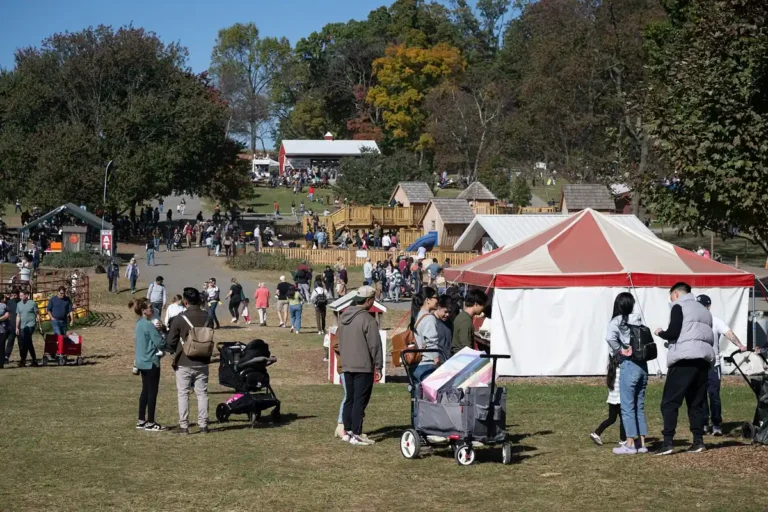
The festival is staged on the twenty-acre Monterey County Fairgrounds, an oak-studded site a short drive from the waterfront. The grounds hold several distinct venues, from the main arena to smaller indoor rooms and outdoor stages, and the layout encourages wandering between sets rather than sitting in one place all day.
The arena is the largest space, hosting the headline concerts that anchor each evening. Smaller stages and tents present more intimate performances, and the indoor rooms host clinics, panel discussions and late-night jams. Food and drink stalls, merchandise booths and art vendors fill the spaces between.
The setting gives the festival a relaxed, outdoor character. Trees provide shade, the California weather is usually mild in September, and the site is compact enough to walk comfortably. Many attendees bring low chairs or blankets and settle in for the day.
Education and the Next Generation
Education has been part of the Monterey Jazz Festival almost since the beginning, and it is now one of the organization’s central missions. The festival runs year-round programs that support young musicians, and its flagship youth ensemble, the Next Generation Jazz Orchestra, has performed at the festival for decades.
The student programming gives emerging artists a stage alongside established names, which is unusual even among major festivals. Clinics and master classes let young players learn directly from professionals, and the festival’s commitment to jazz education helps sustain the music’s future audience and performers alike.
For visitors, the educational programming adds depth to the weekend. Panels and talks put the music in context, and the presence of students and mentors gives the festival a sense of continuity that a pure concert series would lack.
The Festival’s Place in Monterey
The Monterey Peninsula has a remarkable musical history, and the jazz festival is a large part of it. The fairgrounds hosted the Monterey Pop Festival in 1967, one of the defining events of the era, and the jazz festival has run alongside that legacy for nearly seven decades.
That history draws visitors who come as much for the sense of place as for the lineup. The festival has been filmed and written about for generations, and attending it feels like stepping into a piece of American cultural history. The 2027 edition will mark seventy years of continuous programming.
The town embraces the festival. Restaurants, hotels and shops fill with musicians and listeners for the weekend, and the event is woven into the peninsula’s identity in a way that few festivals achieve.
Where the Music Comes From
Monterey’s place in jazz history is not accidental. In the 1950s, California’s Central Coast was home to a thriving scene of musicians, clubs and festivals, and the success of Newport gave Lyons and Gleason a model to build on. The peninsula’s mild climate and coastal setting made it an appealing place to gather a large audience outdoors.
The festival’s early years helped establish jazz as a serious American art form at a time when that was still contested. Recordings from the fairgrounds became landmarks, and the festival’s stage became a place where careers were launched and reputations confirmed. The list of artists who have performed here reads like a history of the music.
That legacy shapes the festival today. Booking decisions are made with an eye on both continuity and discovery, and the programming connects the music’s roots to its present. For listeners, the result is a weekend that feels connected to a living tradition rather than a nostalgia exercise.
Practical Notes for Attendees
Tickets are sold as day passes and full-weekend packages, and the most popular performances can sell out. Because the fairgrounds host multiple stages, the schedule rewards a little planning: attendees who map out the sets they most want to see will see more of the music and spend less time crossing the grounds.
The site is outdoors, so weather matters. September on the Monterey Peninsula usually brings mild days and cool evenings, with the chance of fog in the mornings. Comfortable shoes, a layer for the evening, and sun protection for the afternoon are the essentials.
Parking near the fairgrounds is limited and fills early, and the surrounding neighborhoods are residential. Shuttles, rideshare and local transit are the easier options, and they leave visitors free to enjoy the full day without worrying about the drive home.
The Sound of the Fairgrounds
One of the festival’s enduring pleasures is the way music carries across the grounds. With stages set among the oaks, the sound of a horn or a piano drifts between venues, and the boundaries between performances blur. It is a quality that recordings of the festival have captured for decades and that live attendees notice immediately.
The intimate scale of some venues is another hallmark. The smaller rooms and tents put audiences close to the musicians, which is unusual at a festival of this size. That proximity is why so many jazz fans treat Monterey as a pilgrimage rather than just a concert weekend.
Between sets, the grounds function as a gathering place. Food stalls, merchandise tables and conversations among musicians and listeners fill the hours, and the atmosphere stays warm and unhurried throughout the weekend.
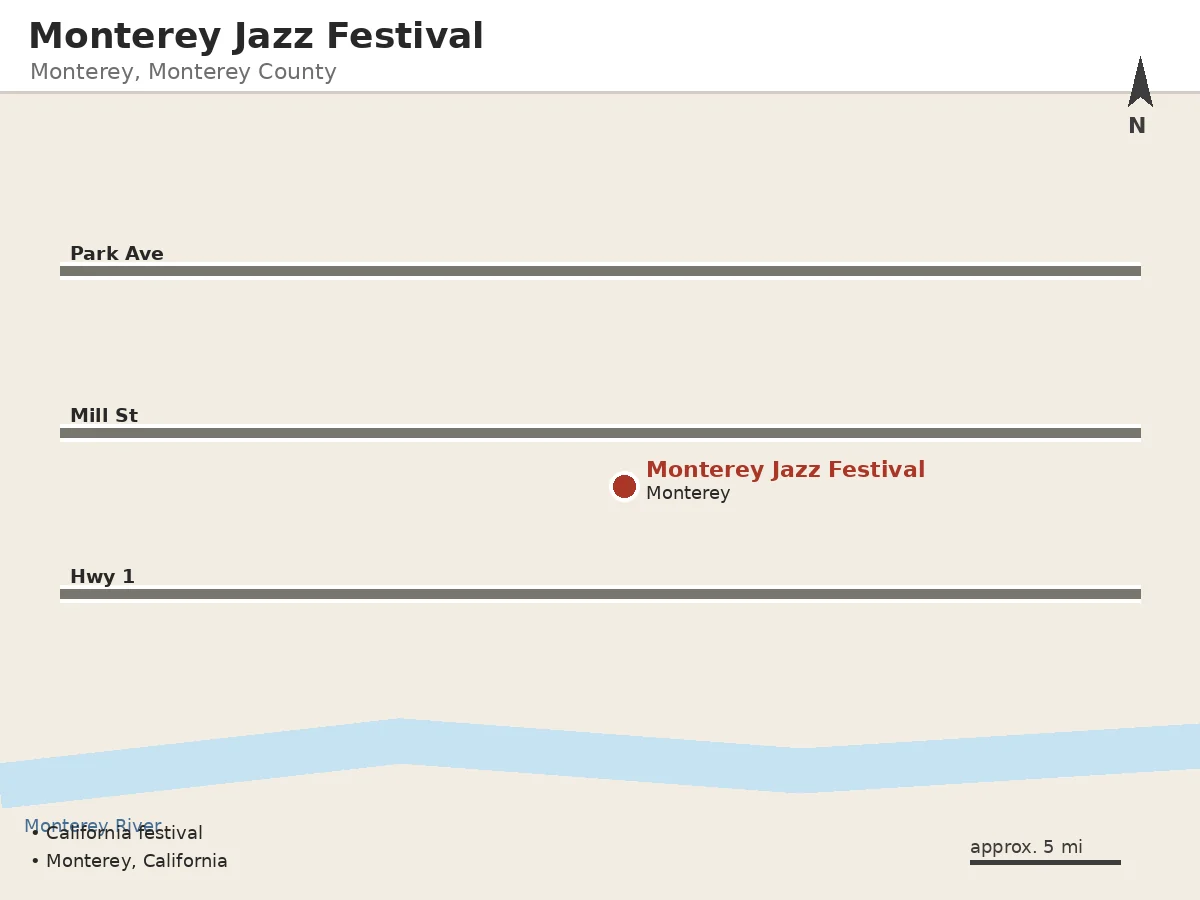
Festival Area Map
The map below marks the Monterey County Fairgrounds, with the approach from Highway 1 for planning your visit to the jazz festival.
Frequently Asked Questions
When is the Monterey Jazz Festival?
It is held on the third full weekend of September, Friday through Sunday.
Where is it held?
At the Monterey County Fairgrounds in Monterey, California.
How long has it been running?
Since 1958, making it the longest continuously running jazz festival in the world.
How many artists perform?
About 500 artists perform across nine stages, with roughly 50 concert performances.
Is there programming beyond concerts?
Yes. The festival includes panel discussions, workshops, clinics, exhibitions and jazz conversations.
Is the festival a nonprofit?
Yes. It is a nonprofit with year-round education and artist-support programs.
What to Expect From the Next Festival
How often is it held?
It is an annual event, held each September.
When is the next festival?
The next edition is expected on the third full weekend of September. Confirm dates, lineup and ticket details with the organizers.
Will the format change?
The three-day, multi-stage format has been consistent for decades, though the lineup and programming change each year.
Last updated: October 2026
Few festivals in the world can claim the Monterey Jazz Festival’s combination of history, setting and programming. It began with Billie Holiday and Louis Armstrong on a fairgrounds stage and has never stopped, drawing generation after generation of listeners to the same oak-shaded grounds on the California coast.
One Comment