Merced County California Merced County Fair Festival
For five days each June, the Merced County Fairgrounds become the busiest place in the Central Valley. The fair draws more than 70,000 visitors for livestock shows, carnival rides, free concerts and the kind of fair food that only tastes right under a summer sky. It is the county’s oldest recurring public event and, by most measures, its largest.
The fair has been held in some form since 1891, when Merced and neighboring Mariposa County put on a joint exhibition. Over more than a century it has survived two world wars, a bankruptcy and a pandemic, and it remains the anchor of the county’s summer calendar.
This guide covers what the fair is, where and when it happens, what to see, and how to plan a visit without fighting the crowds.
What the Fair Is
The Merced County Fair is a traditional agricultural fair at heart. Its centerpiece is the livestock program, where 4-H and FFA students from across the county show animals they have raised for months. Around that core sit carnival rides, competitive exhibits of everything from baked goods to photography, live entertainment, and rows of food vendors.
In recent years the fair has stretched across two weekends in June, with free stage shows, a junior livestock auction, and a fireworks finale. The mix is deliberate: it is meant to be a fair that a farm family, a college student and a young parent can all enjoy on the same evening.
For a nearby comparison, see the Mendocino County California Noyo Harbor Festival.
Where and When
The fair runs at the Merced County Fairgrounds, 900 Martin Luther King Jr. Way, at the corner of 11th and G streets in Merced. The site has been the fair’s home since 1931, and it is used year-round for other community events when the fair is not in session.
| Location | Merced County Fairgrounds, 900 Martin Luther King Jr. Way, Merced, CA |
| Typical timing | Five days in mid-June (recent editions run across two weekends) |
| Gate hours | Weekday evenings from 5 p.m.; weekends from 3 p.m. |
| Parking | Paid lot on 11th and G streets; free shuttle service to the main gate |
| Highlights | Livestock show and auction, carnival, concerts, competitive exhibits |
| Operator | 35th District Agricultural Association (California Dept. of Food & Agriculture) |
Gates typically open in the late afternoon on weekdays and earlier on weekends, with the grounds staying busy until midnight. A free shuttle drops visitors at the main entrance on Martin Luther King Jr. Way, which spares a long walk in the valley heat.
A Fair With Deep Roots
The county’s fair tradition reaches back to September 2, 1891, when the first Merced County Fair opened in a pavilion on 18th Street as a joint effort with Mariposa County. The modern fair’s organizers date the event in its current form to a two-day run in 1929 at the old Municipal Baseball Park, now Applegate Park, sponsored by the Merchants’ Association.
The fair moved to its present site at 11th and G in 1931. It struggled through the Depression, going dark in 1936 before local businesses pooled funds to bring it back in 1937, a year that added a parade and a three-day horse racing program. After World War II the fair was turned over to the 35th District Agricultural Association, and its 1946 edition drew a record 30,000 people.
The fair has been interrupted only by world wars, a financial collapse and, in 2020 and 2021, the COVID-19 pandemic. That endurance is part of why locals treat it as a fixed point in the year rather than just another weekend event.
The Livestock Program
If there is a heart to the Merced County Fair, it is the barns. The Junior Livestock Show runs across several days, and the auction that follows is a serious affair: buyers from across the region bid on animals raised by students, and the proceeds often go straight into college funds and future projects.
The Hilmar Cheese Barn hosts the junior auction, and the list of participating chapters reads like a map of the county, from Atwater, Buhach Colony and Golden Valley to Los Banos, Livingston, Gustine, Le Grand and Hilmar. For many families, the fair is less a carnival than the culmination of a year of work.
Dairy cattle, beef, swine, sheep, goats and poultry all have their own shows. Visitors who have never spent time in a barn will find the livestock areas the most distinctly local part of the fairgrounds, and the students are usually happy to talk about their animals.
Rides, Food and Entertainment
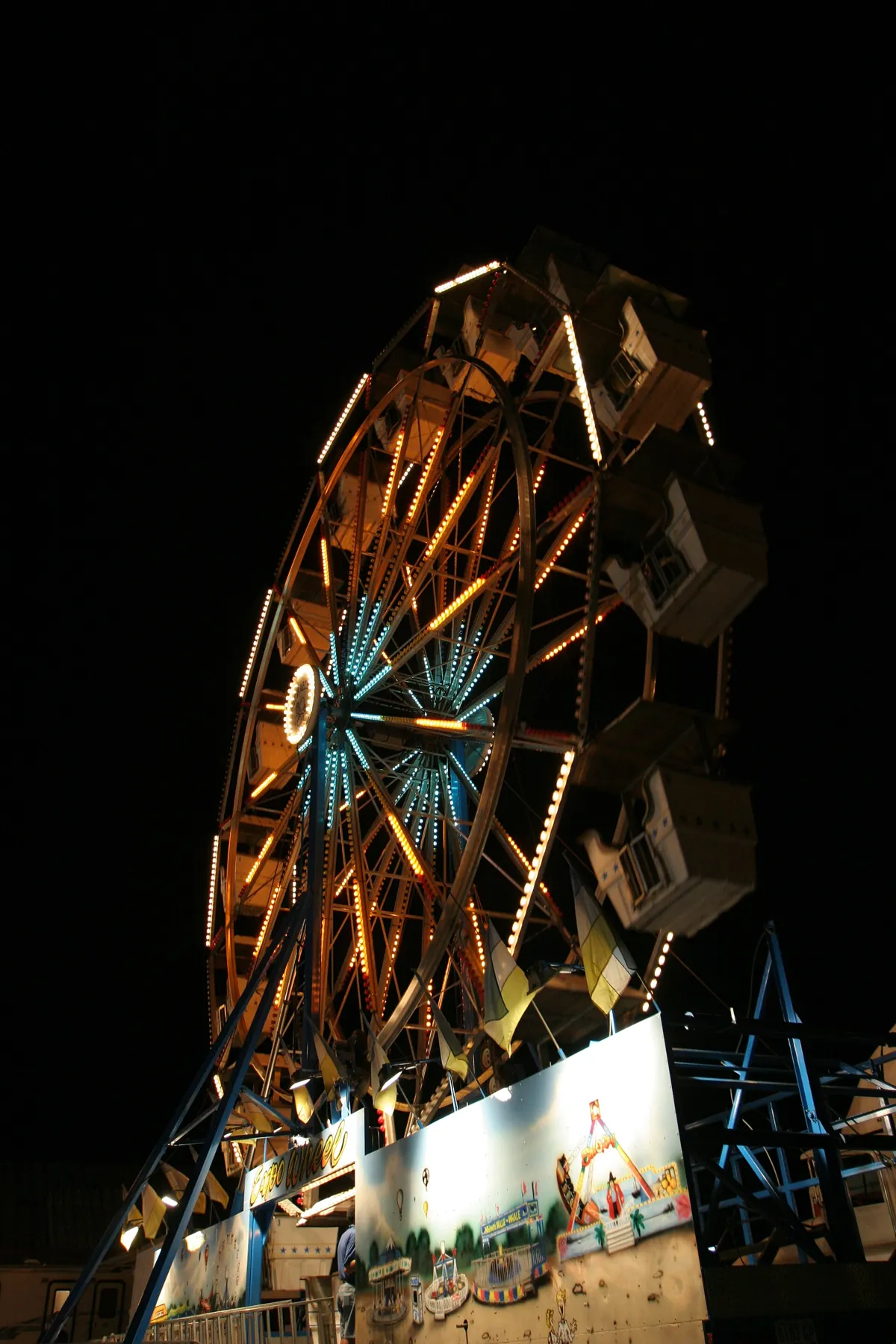
The carnival midway supplies the fair’s visual signature, with a Ferris wheel and a full spread of rides for every age. The food is the other draw: corn dogs, funnel cake, barbecue, and the deep-fried experiments that appear at fairs everywhere.
Free stage entertainment runs through the evening, and recent fairs have leaned into the region’s musical mix, booking Latin, country and tribute acts. The fair closes with a fireworks show that has become a local tradition in its own right.
The Spring Fair
Merced County also holds a separate Spring Fair, based at the fairgrounds in Los Banos on the county’s west side. It is a smaller, earlier event with its own character, including a Friday flea market and demolition derby. Together the two fairs bookend the county’s fairgoing season, one in spring and one in summer.
Planning Your Visit
Merced gets hot in June, and the fair is an outdoor event. Visitors do best to arrive in the late afternoon or evening, when the temperature drops and the lights come on. Weekday nights are generally less crowded than weekends.
Parking is available in a paid lot on 11th and G streets, and the free shuttle is the easiest option for anyone who would rather not hunt for a space. G Street between Childs Avenue and West 11th Street is closed to through traffic during the fair to keep pedestrians safe.
- Buy tickets and ride wristbands in advance when discounts are offered.
- Use the free shuttle to avoid parking and the walk to the gate.
- Visit the barns in the early evening, when the livestock shows are active.
- Bring a light layer; valley evenings cool off quickly after sunset.
- Check the concert schedule, since headliners play on specific nights.
Getting There and Around
Merced sits on Highway 99 in the heart of the San Joaquin Valley, roughly two hours from the Bay Area and about an hour from Fresno. The fairgrounds are a short drive from downtown and from UC Merced.
Because the city bills itself as the Gateway to Yosemite, many out-of-town visitors pair the fair with a trip to the park. Lake Yosemite, Applegate Park and its zoo, and the Castle Air Museum are all close by and make easy additions to a fair weekend.
Where to Stay and Eat
Merced has a range of chain hotels and motels along Highway 99, plus a growing number of downtown options near the historic Mainzer theater and the city’s cultural district. Downtown restaurants and the Saturday farmers market are worth seeking out between fair sessions.
For a longer stay, Merced works well as a base for Yosemite day trips, and the fair can be the centerpiece of a summer visit rather than the whole trip.
The Competitive Exhibits
Beyond the barns and the midway, the fair is a large exhibition of county talent. The competitive program covers baked goods, preserved foods, quilts and textiles, photography, fine art, flowers and garden produce. Entries come from every corner of the county, and the display halls are where the fair’s agricultural roots show most clearly.
For many families, entering the fair is a tradition passed down through generations. A grandparent’s jam recipe, a teenager’s photograph and a child’s decorated pumpkin can all end up behind glass with a ribbon attached. The judging standards are real, and a blue ribbon still carries bragging rights.
The exhibit halls are also a good place to escape the heat and the noise of the midway. They tend to be quieter, and they reward a slow walk rather than a quick pass.
Fair Food and the Midway
The carnival midway is the fair’s loudest, brightest quarter, and the food that goes with it is part of the experience. Corn dogs, funnel cake, kettle corn and barbecue are the staples, and each year brings another round of deep-fried novelties. Vendors accept cash and cards, and the lines move fastest in the early evening.
Ride wristbands and individual tickets are both available, and families often find that a wristband is the better value if children plan to ride for hours. The carnival is operated by an outside company and is inspected before the fair opens.
A Fair for the Whole County
What makes the Merced County Fair distinct is its range. On any given night you can watch a student groom a prize steer, hear a mariachi band on the free stage, and ride a Ferris wheel above the valley, all within a few hundred yards. The fair does not force a choice between its agricultural and its entertainment sides; it puts them side by side.
That blend reflects the county itself, where farming, a growing university and a diverse population share the same small cities. The fair is one of the few places where all of those Merceds appear at once, and it is the reason the event has outlasted so much else.
Festival Area Map
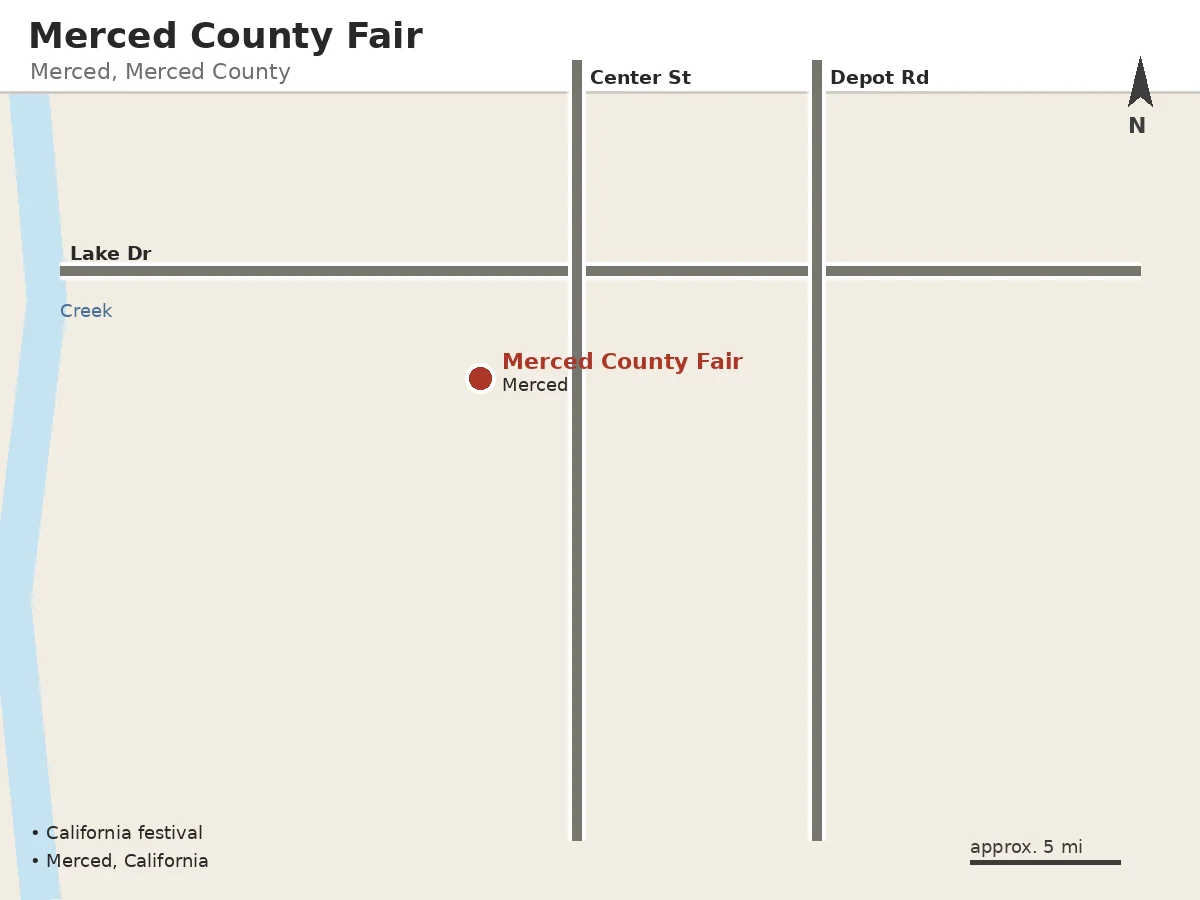
The map below marks the Merced County Fairgrounds at 11th and G streets, with the downtown and Highway 99 approach for planning your visit.
Frequently Asked Questions
When is the Merced County Fair?
It is held over five days in mid-June, with recent editions spread across two weekends.
Where is it held?
At the Merced County Fairgrounds, 900 Martin Luther King Jr. Way in Merced, at 11th and G streets.
How much is parking?
There is a paid lot on 11th and G streets, and free shuttle service drops visitors at the main entrance.
Is the fair good for families?
Yes. The carnival, the livestock barns and the free stage shows are all family-oriented, and weekend hours start earlier in the afternoon.
Can I see the livestock auction?
Yes, the Junior Livestock Sale is open to the public and is held on the final Saturday morning in the Hilmar Cheese Barn.
What is the Spring Fair?
It is a separate, smaller county fair held earlier in the year at the Los Banos fairgrounds.
What to Expect From the Next Merced County Fair
How often is the fair held?
It is an annual event, held each June.
When is the next fair?
The next edition is expected in mid-June. Confirm the exact dates and concert lineup with the fair office or its website.
Will the format change?
The livestock program and carnival have been constants for decades, though the number of days, the entertainment and the pricing shift from year to year.
Last updated: October 2026
The Merced County Fair is the kind of event that explains a place. Its barns and auction show a working agricultural county, and its midway and concerts show a community that likes to gather. For a visitor passing through the Central Valley in June, it is the easiest way to see Merced at its most itself.

One Comment