Branch Michigan Meteor Festival
Most festivals celebrate something a community grows, makes or remembers; the Meteor Festival in Union City celebrates something that fell out of the sky. Reference layers describe an annual early-July gathering in this Branch County village built around a real meteor that landed on a local farm, a story retold for young readers in a well-known picture book. Honesty matters more than usual here, because the surviving documentation is slender: exactly one edition, held on Saturday 9 July 2011, is pinned down with a date, hours and ticket prices, while everything else the layers offer is general description without a year attached.
About the Festival
The published name is simply “Meteor Festival.” A reference layer for Union City uses that wording, a county reference layer repeats it, and a parenting-blog layer preserves it in a ticket announcement from 2011. Those layers often wrap the name in a descriptive phrase, calling it the village’s annual Meteor Festival, but no longer title appears anywhere. The sheet title used for this article, “Branch Michigan Meteor Festival,” is a catalogue construction rather than a printed name; the festival is documented under the shorter form, used throughout what follows.
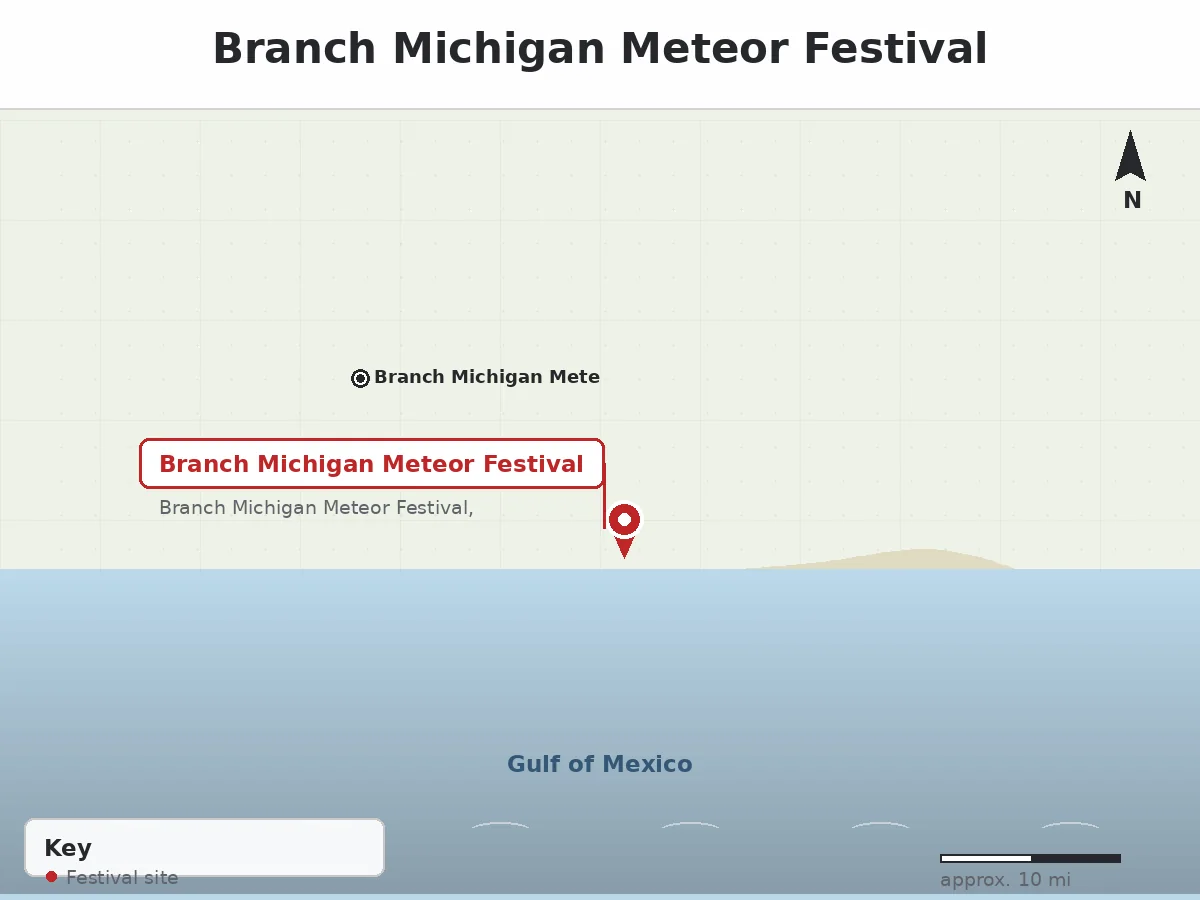
Union City is a village in southern Michigan, placed by a reference layer mainly within Branch County, with a small northern portion reaching into Calhoun County. The county seat of Branch County is Coldwater, according to a county reference layer, so Union City hosts this festival without holding the county’s administrative role.
No formal organising body is attached to the event in the material reviewed. The parenting-blog layer names the children’s author Patricia Polacco as the person who held a meteor festival in July of the year it covered, presenting her as the gathering’s host and the creator figure behind it. Beyond that connection, the reference layers hand the festival to the community at large: one remarks that Union City now has an annual Meteor Festival, and another phrases it as the village holding one each year. Those are town-level descriptions of a local custom, not the name of a committee or company.
Where the festival physically happens is another gap: the layers name no grounds, park, hall or street as its venue. The 2011 ticket announcement carried a Union City postal contact so tickets could be ordered, noted here by existence only. Readers will think of Meteor Ridge Farm, the name a reference layer gives to Polacco’s Union City home and to the farm in the tale, but the farm functions as the story’s setting; nothing establishes it as a festival venue.
For a useful comparison, see the Branch Michigan Apple Festival for another county festival.
Quick Facts
| Item | Detail |
| Sheet title | Branch Michigan Meteor Festival |
| Published name | Meteor Festival, described in reference layers as an annual event |
| Host town | Union City, Branch County, Michigan |
| County seat status | Union City is not the county seat; Coldwater holds that role for Branch County |
| County geography | The village lies mainly in Branch County, with a small northern portion in Calhoun County |
| Only fully documented edition | Saturday 9 July 2011, ten in the morning to five in the afternoon |
| Documented admission, 2011 only | Ten dollars for adults; children twelve and under free |
| Documented programme | Activities for children, per reference layers |
| Origin of the story | A real meteor that fell on a Union City farm, retold in the 1987 picture book “Meteor!” |
History
The history of this festival begins with the history of a rock. Reference layers recount that a genuine meteor fell on a farm in Union City, becoming the family’s defining story. Patricia Polacco, who grew up connected to that farm, turned the episode into her first published book, “Meteor!”, which a reference layer dates to 1987. In her telling, the fallen meteor brings the whole community together in celebration, and the real village eventually followed its fictional counterpart by holding a festival.
The meteor itself still exists. A reference layer states that the original stone now sits in Riverside Cemetery, serving as a marker for the family, and that Polacco’s Union City home carries the name Meteor Ridge Farm, tying author, farm and book into a single small geography.
When the festival itself began is a question the sources decline to answer. The layers supply no year for a first edition, no anniversary billing and no account of an inaugural organising effort. The 2011 ticket announcement proves the event existed by then, and the reference layers’ present-tense descriptions show the idea persisted in print, but a founding date cannot be built from those fragments.
What the record does support is a modest, locally rooted celebration rather than a large regional production: one dated edition running a single Saturday, admission priced for families, and described content centred on children’s activities. Its wider fame travels through the book.
What to Expect
A truthful answer has to start with the limits of the evidence. Reference layers characterise the Meteor Festival as an annual early-July event with many activities for children, and that sentence is nearly the whole of the documented programme. No layer lists rides, contests, food stands, musical acts, vendors or ceremonies for any edition, so none of those things can be promised here. Picture a small village celebration aimed at youngsters.
The one edition that can be described concretely is the gathering of Saturday 9 July 2011. The ticket announcement reproduced in the parenting-blog layer gives a full day, running from ten in the morning until five in the afternoon, suggesting a festival paced for families rather than an evening spectacle. Admission that year cost ten dollars for an adult ticket, while children aged twelve and under went free.
One confusion deserves clearing up. In Polacco’s book, the meteor’s arrival prompts festivities that include a band, a circus and hot-air balloon rides. Those are joyful inventions inside a children’s story, and no layer documents them as part of the actual Union City festival. Anyone who attends hoping to recreate the book should expect the real event to be quieter than its literary version.
The present-day status of the festival is unverified in this record. The reference layers speak of it as an annual fixture without dating their descriptions, and no recent edition with a confirmed day, time or place was found, so any upcoming date encountered elsewhere needs local confirmation.
Planning Your Visit
Because no current edition is documented in the layers reviewed, planning begins with verification rather than with bookings. The reference layers point to early July as the festival’s season, and the single dated edition fell on a Saturday, so a visitor’s first step is to look for a fresh local announcement close to that time of year, in the village’s own channels and regional event calendars, where the festival’s paper trail has always run.
The 2011 announcement shows how tickets were handled for that edition: sold in advance through a postal contact in Union City, priced at ten dollars for adults with children twelve and under going free. That arrangement belongs to 2011 alone. Prices, sellers and even the need for tickets in any later year are undocumented, so a visitor should ask locally rather than assuming the old figures hold.
Practical expectations should stay modest. Union City is a village, not a resort town, and the festival is documented as a one-day, daytime gathering, so a trip built around it works best as part of a wider day out in southern Michigan. Coldwater, the county seat, offers the larger community’s services. Nothing in the record describes parking, shuttles or accommodation packages tied to the festival, and families should expect the small-town kind of pleasure rather than the midway kind.
A Visitor’s Day Shaped by the Documented Edition
Any itinerary here is necessarily a reconstruction built from the one edition with published hours, Saturday 9 July 2011, and should be read as an illustration of that day’s rhythm rather than as a promise about a future festival. A family might arrive by mid-morning, matching the ten o’clock start given in the ticket announcement. The morning hours suit the festival’s documented focus, activities for children, and a relaxed pace fits a single-day village event with no competing stages in the record. Lunch would be whatever the village offers on an ordinary summer Saturday, since no food element is documented for the festival itself.
The afternoon can carry the visit into the story behind the festival. Riverside Cemetery, where the reference layer places the original meteor as a family marker, is the one site firmly tied to the tale that a visitor can seek out respectfully, before the day winds down at the documented edition’s five o’clock close.
How It Differs From Other Meteor Events
The clearest fence to draw runs around a similarly named programme. “Meteors & S’mores” is a Perseid meteor-shower programme operated by the state natural-resources department through the state parks system, with sessions at parks across the state including one on Saginaw Bay. It is a night-sky watching event built around an annual shower, sharing nothing with Union City’s festival beyond a related word. Confusing the two would send a visitor to the wrong county, at the wrong hour, for the wrong reason.
Meteor-shower watch parties held in other states are likewise separate affairs, dependent on the calendar of the night sky. Union City’s festival celebrates one particular stone that struck one particular farm, and its early-July timing follows local custom rather than any celestial schedule. Its meaning is historical and literary, not astronomical.
It also differs from the festivals around it in this part of Michigan. Branch County’s other documented celebrations are built around harvests, holidays and downtown commerce, with organiser names, vendor counts and dated editions researchers can verify. The Meteor Festival’s record is thinner and stranger: one priced, dated edition, a famous children’s book, and a meteor resting in a cemetery.
Visitor Checklist
- Look for a current local announcement before travelling, because no upcoming edition is confirmed in the layers reviewed
- Read or reread “Meteor!” with younger travellers so the story behind the celebration is familiar on arrival
- Plan around a daytime, single-Saturday shape, following the pattern of the one documented edition
- Keep expectations modest: children’s activities are the only programme element the sources describe
- Include Riverside Cemetery in the trip if you want to see where the original meteor now rests
- Avoid confusing the festival with the state-parks “Meteors & S’mores” programme, a separate night-sky event
- Remember that Meteor Ridge Farm is a private home named in the story, not a documented festival venue
Beyond the Festival
The meteor story gives Union City an identity reaching well past one July Saturday. Polacco’s books are shelved in school libraries across the country, and “Meteor!” holds a special place among them as her first book, rooted in her own family’s farm. For readers who grew up with it, the village is the real setting of a story they can picture page by page.
Riverside Cemetery offers the story’s most tangible landmark: a meteor serving as a family marker is an extraordinary piece of local heritage. The surrounding county provides lakes, farmland and quiet roads for anyone extending the trip.
Why the Meteor Festival Matters
A festival founded on a falling stone sounds like a novelty, yet the significance here is genuine. Union City took the most dramatic thing that ever happened on one of its farms and converted it into a shared celebration, then watched one of its own turn that event into a children’s book read far beyond Michigan. The festival is where those two achievements meet, keeping a local memory active in the village where the meteor landed.
It also shows how a very small community sustains a tradition without a large apparatus. The layers name no corporation, no fair board and no permanent grounds; they show instead an author who hosted, a village that describes the festival as its own, and families who came for a day of children’s activities. Even the thinness of the documentation carries a lesson: small celebrations slip easily out of the written record.
Frequently Asked Questions
Which year of the festival can be described in full detail?
Only the edition of Saturday 9 July 2011 carries particulars in the sources reviewed. Its announcement gives the day, the hours of ten in the morning to five in the afternoon, and ticket prices, while every other mention describes the festival in general terms without attaching a year.
Where does the original meteor rest today?
A reference layer places the stone in Riverside Cemetery in Union City, where it serves as a marker for the author’s family. The farm where it fell is known in the same layer as Meteor Ridge Farm, the story’s setting and the author’s home, although the farm is not documented as the festival’s venue.
Who is connected with creating the festival?
The parenting-blog layer presents the children’s author Patricia Polacco as the person who held the July meteor festival it covered, making her the documented host and creative figure behind the gathering. Reference layers otherwise credit the village generally.
Are the band and circus from the book part of the real festival?
No layer documents them as programme. The band, the circus and the hot-air balloon rides appear inside the story told in “Meteor!”, as part of the fictional celebration following the meteor’s landing. The documented festival programme consists of activities for children, and the book’s festivities belong to literature rather than to the event.
What to Expect From the Next Branch Michigan Meteor Festival
How often is Branch Michigan Meteor Festival held?
Reference layers describe the Meteor Festival as an annual event in Union City, tied to early July. That characterisation comes from general descriptions rather than from a run of dated editions, since only the 2011 gathering carries a specific day in the material reviewed.
When is the next Branch Michigan Meteor Festival?
A confirmed date for the coming edition has not surfaced in the sources read for this article. The pattern those sources support is a Saturday in early July, matching the 2011 edition’s placement, so early July is the window to watch. Any exact day should be verified locally before travel plans are built on it.
Will the dates change?
The documented pattern leaves room for movement. With a single dated edition on record, there is no long series of fixed dates to compare, and an event of this size could shift its Saturday within the early-July season. Checking the current year’s announcement remains the only reliable way to fix the day.
The Meteor Festival asks to be taken on its own terms: a village celebration wrapped around a true story, a famous book and a stone in a cemetery. Its record is thin, and this article has kept it that way on purpose, because a festival this distinctive deserves accuracy more than embellishment. What survives in print still shows why Union City celebrates, and invites anyone who loved the book to check each early July whether the village is gathering again.