Alger Michigan Michigan Ice Festival
Every February, the frozen shoreline east of Munising fills with climbers carrying ropes, tools and thermoses toward walls of ice that exist only for the coldest weeks of the year. The gathering that brings them to Alger County is an ice-climbing festival built around instruction, demonstrations and evenings in town. Its record also carries two honest complications that this article keeps visible throughout: the name printed by the people who run it is not quite the name on the county sheet, and the story of its first edition is told two different ways.
About the Festival
The organiser-linked layers, a visitors-bureau layer and news layers all print the event’s name as Michigan Ice Fest. The fuller form, Michigan Ice Festival, shows up only in secondary material — a university outing layer and a winter-festivals guide layer — and never in the organiser’s own presentation of the event. Because of that split, the two forms are carried separately here rather than blended into one; the shorter form is the one attached to the host, the classes and the official descriptions.
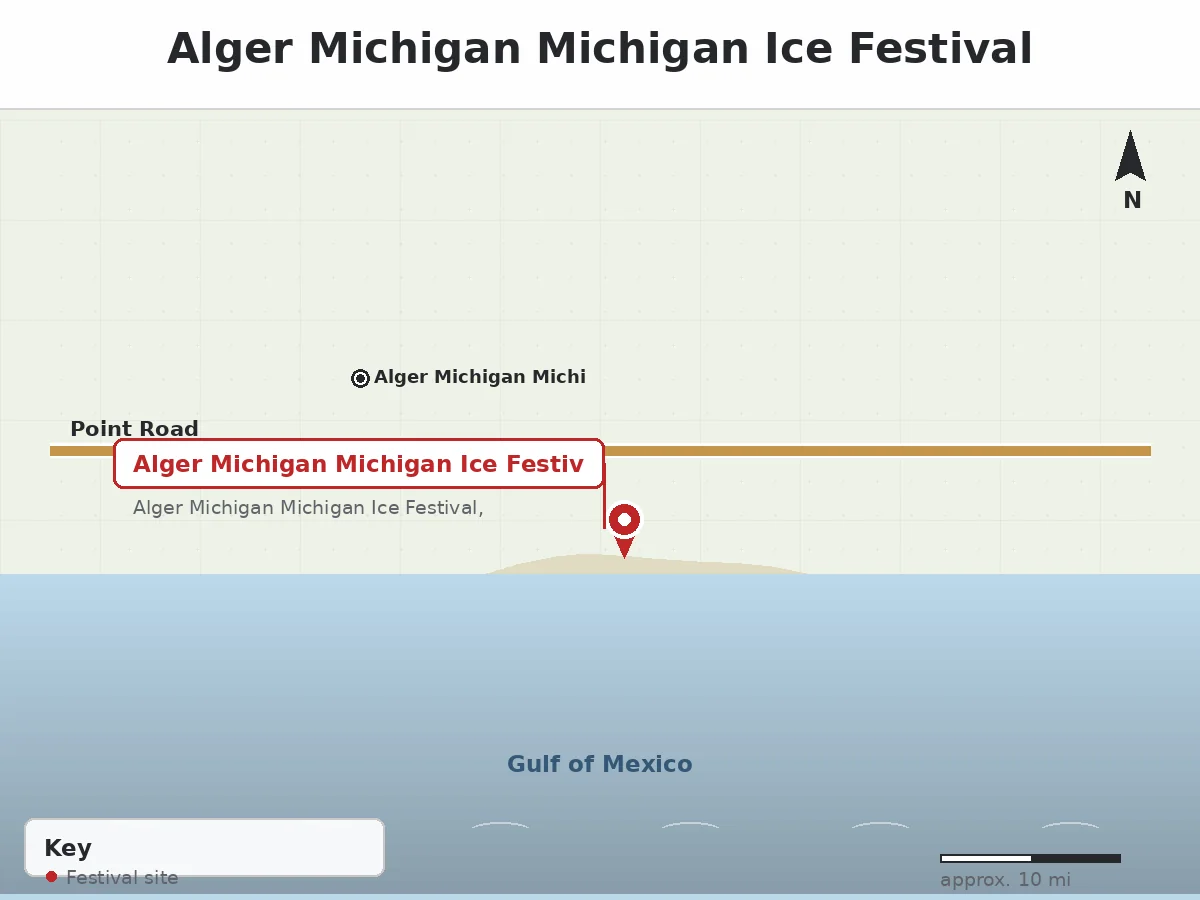
Munising hosts the festival, and a reference layer confirms that Munising is the county seat of Alger County, so the event sits in the county’s administrative centre as well as its best-known shoreline town. The climbing itself spreads across the ice of Pictured Rocks National Lakeshore and the frozen waterfalls around the town, while the classes, talks and social hours gather in Munising itself. That division shapes the whole character of the event: days are spent out on natural ice formations, and evenings return to warm rooms, slide shows and conversation.
A visitors-bureau layer credits a local gear shop, printed there as Down Wind Sports, with hosting the annual festival and offering its guided classes. A university layer spells the same shop’s name as Downwind Sports, and that variant spelling is preserved here exactly as printed rather than corrected. A news layer identifies the event’s organiser through his role as the shop’s co-owner, which is how he is described in these pages as well. The organiser’s own layers carry the registration and contact material for the event, and joining runs through those channels.
Quick Facts
| Item | Detail |
| Organiser’s printed name | Michigan Ice Fest |
| Fuller name in secondary layers | Michigan Ice Festival |
| Host town | Munising, Alger County, Michigan |
| County seat status | Munising is the seat of Alger County |
| Climbing ground | Pictured Rocks National Lakeshore ice and frozen waterfalls near Munising |
| Named ice areas | The Curtains on Sand Point Road and Miners Falls |
| Host as printed by a visitors-bureau layer | Down Wind Sports |
| Host as printed by a university layer | Downwind Sports |
| Most recent documented dates | Wednesday 11 to Sunday 15 February 2026 |
| Documented cost model | Registration, priced at seventy dollars per person for the 2025 edition in a winter-festivals guide layer |
History
Two different news layers tell the beginning two different ways, and neither version is smoothed over here. One account holds that the first festival took place in 1991, spread mostly by word of mouth, and drew just ten climbers. That same account traces the idea back a year earlier, to a 1990 visit by four ice climbers from Kalamazoo who came to explore the Munising ice. The second account compresses the story and states simply that the festival began in 1990 with four climbers. Read together, the pair agree on a tiny founding party and a Kalamazoo connection, but they place the first festival itself a year apart, and the layers read do not reconcile that gap.
For a useful comparison, see the Alcona Michigan Arts and Crafts Festival for another county festival.
Growth from that small start is measurable in the coverage. A news layer reporting the February 2024 edition noted that the previous year’s gathering had drawn about one thousand four hundred climbers and spectators, a striking distance from ten people and word-of-mouth invitations. Reputation claims travel with the event as well, each attached to its source: some layers describe the festival as believed to be the oldest ice climbing festival in the country, while other coverage calls it the country’s second-largest gathering of ice climbers. Both are reputations reported by layers rather than audited rankings, and they are presented that way here.
The documented recent run is steady and February-bound. A student news layer places the festival on 8 to 12 February 2023. A news layer gives Wednesday 7 to Sunday 11 February 2024. A winter-festivals guide layer lists 12 to 16 February 2025, and a visitors-bureau layer states the 2026 dates as Wednesday 11 to Sunday 15 February. Four consecutive documented winters give the event a firmer footing than its disputed birth year might suggest.
What to Expect
Instruction sits at the centre of the programme. Classes and clinics run for all levels, and beginner classes are a documented part of the offering, which means a newcomer can arrive without prior time on ice and still take part under guidance. A dealer-blog layer describes the skills teaching as three tracks: an Ice Climbing Track, an Adventure Track and a Mountaineering Track. That track structure belongs to that layer’s description, but it matches the picture of structured teaching sorted by ambition and experience found elsewhere.
Demonstrations take place on frozen waterfalls and on the lakeshore ice curtains, the tall sheets of ice that form where water seeps over the sandstone edges along the lake. The Curtains area on Sand Point Road and Miners Falls are among the climbing places named in the visitors-bureau and news layers, alongside other frozen falls scattered around Munising. Watching experienced climbers move up those formations is part of the daytime programme even for people who never tie into a rope.
Evenings belong to town. Presentations by leading climbers headline the after-dark schedule, joined by guest speakers, social events and afterparties, per the programme descriptions in the layers read. The rhythm that emerges is consistent across editions: climb or learn during daylight, then gather indoors at night to watch slides, hear talks and compare notes on the day’s ice. For a February gathering on Lake Superior’s shore, that alternation between cold exposure and warm company is not incidental — it is the design.
Planning Your Visit
Registration is the documented way in. The cost model in the credible layers is a registration fee rather than a gate ticket, and the one firm price attached to a specific edition is the seventy dollars per person that a winter-festivals guide layer gives for 2025. A university layer describing a student trip mentions a seventy-five dollar element covering festival registration and insurance, but that figure belongs to that trip’s own package and is not a general admission price, so it should not be quoted as one. Differing registration figures for 2026 appear in a low-quality travel layer and are not relied on here. No layer read documents free general admission, so visitors should budget for registration and confirm the current year’s terms through the organiser’s registration material before travelling.
Timing follows the ice. Every documented edition falls in February, running Wednesday to Sunday in the 2023, 2024 and 2026 accounts, which gives working visitors a long weekend wrapped around two travel-friendly shoulders. Because the climbing depends on formed ice at Pictured Rocks and the area falls, the February placement reflects when those curtains and falls are reliably in.
Lodging and daily logistics centre on Munising itself, since classes and evening programming are based in town even though the climbing spreads along the lakeshore. A sensible pattern is to sleep in town, ride out to the ice with the day’s class or demonstration group, and return for the evening sessions. Packing should assume full winter on Lake Superior — insulated layers, serious boots, and protection for hands and face — and spectators should dress as warmly as the climbers, because the viewing is stationary.
A Sample Itinerary
A five-day visit shaped around the documented programme could run as follows. Wednesday serves as arrival day: reach Munising, complete registration, and attend the opening evening gathering. Thursday suits a beginner or skills class, when the teaching schedule is underway and the ice areas are less crowded than they will be at the weekend.
Friday can pair a second clinic — perhaps stepping from the introductory teaching toward one of the more ambitious tracks — with time at Miners Falls or another named waterfall to watch demonstrations. Saturday is the fullest day: climbing or spectating at the Curtains on Sand Point Road during daylight, then the headline evening presentation and its social hours. Sunday winds down with a final morning session on the ice before the drive home, matching the Sunday close that every documented edition shares. This ordering is a suggestion built from documented elements, not an official schedule, and the actual day-by-day programme is set by the organiser each year.
How It Compares
Two nearby winter names deserve clear separation from this one. A dealer-blog layer mentions Winter Games in Marquette in passing, but that is a separate event in a different city and shares nothing with the Munising programme beyond a season. The Eben Ice Caves, likewise, are a standalone winter attraction that people visit independently; festival climbing happens in the wider Munising ice country, but the caves are not a festival venue and the festival is not a caves tour. February in the central Upper Peninsula stacks several ice attractions into the same weeks, so the distinction matters.
The festival also differs from a typical town winter carnival in kind rather than degree. Its centre of gravity is participation — registered climbers learning on real formations — with spectating built around demonstrations instead of parades or midway entertainment. Compared with the country’s other ice-climbing gatherings, its layers make two standing claims, oldest in the nation in one telling and second-largest in another, and those claims are part of its identity even though the sources behind them are journalistic rather than official. Few county-level winter events anywhere rest on a natural asset as specific as a national lakeshore’s frozen waterfalls.
Before You Go: A Checklist
- Register through the organiser’s own channels and confirm the current edition’s dates before booking travel.
- Choose a class level honestly; beginner instruction is documented, and advanced tracks assume prior skills.
- Reserve Munising lodging early, since evening programming keeps most visitors based in town.
- Pack insulated layers, sturdy winter boots, gloves and face protection for long periods standing on ice.
- Plan one session at the Curtains on Sand Point Road and one at Miners Falls or another named frozen fall.
- Set aside evenings for the presentations, speakers and social events.
- Budget for the registration fee; the documented benchmark is seventy dollars per person for the 2025 edition.
- Leave room in the schedule for weather, since February ice conditions on the lakeshore can shift plans.
Beyond the Festival
Alger County rewards anyone who extends the trip. Munising’s shoreline position on Lake Superior gives the town a winter landscape of frozen bays, snow-covered forest roads and the same waterfall country the festival uses, much of it viewable without climbing gear. The Eben Ice Caves, visited independently of the festival, draw their own winter crowds to walk behind curtains of ice in the forest. Pictured Rocks National Lakeshore in February is a quieter place than its summer postcard version, and visitors who come for the climbing often stay an extra day to see the lakeshore formations at walking pace.
Why This Festival Matters
For a county seat of Munising’s size, anchoring what layers describe as one of the country’s significant ice-climbing gatherings is no small thing. The event converts the hardest weeks of the local winter — a season many lakeshore towns simply endure — into the main attraction, filling rooms and restaurants in February. It also performs a teaching function that outlasts any single edition: decades of beginner classes on the Curtains and the falls have turned spectators into climbers, which is how a ten-person word-of-mouth weekend becomes a gathering counted in the thousands. The disputed founding year, 1990 or 1991, matters less than the continuity the dated editions prove.
Frequently Asked Questions
Why do some sources call it Michigan Ice Fest and others Michigan Ice Festival?
The organiser-linked, visitors-bureau and news layers print the shorter Michigan Ice Fest, while the fuller Michigan Ice Festival appears in a university outing layer and a winter-festivals guide layer. The two forms are both documented, and this article keeps them unmerged rather than declaring one an error.
Which Munising ice formations host the climbing?
Programme descriptions centre on the Pictured Rocks National Lakeshore ice, naming the Curtains area on Sand Point Road and Miners Falls, with demonstrations and classes also spread across other frozen waterfalls around Munising. Evenings and class organisation are based in Munising itself.
Can someone with no climbing background take part?
Yes, according to the documented programme. Classes and clinics are described for all levels, and beginner classes are specifically part of the offering, so a first-time participant can learn under instruction rather than needing prior experience on ice.
What did the previous year’s crowd look like?
A news layer covering the February 2024 edition reported that the preceding year’s festival drew about one thousand four hundred climbers and spectators. That figure belongs to that layer’s reporting of the 2023 gathering and is the clearest attendance picture the layers provide.
What to Expect From the Next Alger Michigan Michigan Ice Festival
How often is Alger Michigan Michigan Ice Festival held?
The documented editions form an unbroken February sequence from 2023 through 2026, each running several days in the middle of the month. That run of dated winters, rather than any formal statement of frequency, is the evidence that the gathering returns every winter season.
When is the next Alger Michigan Michigan Ice Festival?
The most recent documented edition ran from Wednesday 11 to Sunday 15 February 2026, per a visitors-bureau layer. A following edition would fit the established mid-February pattern, but no specific dates for a later edition are documented in the layers read, so none are printed here as fact.
Will the dates change?
The four documented editions all sit inside February, though their exact days shift from year to year — the eighth to the twelfth in 2023, the eleventh to the fifteenth in 2026. A future edition could move within the month according to ice and scheduling, so checking the organiser’s announced dates for the specific year remains essential.
Closing
Michigan’s ice festival in Alger County asks to be read carefully: a name that shortens in the organiser’s hands, a founding story told two ways, and a price record that must be fenced to the edition it belongs to. What survives that careful reading is substantial — a February gathering on national lakeshore ice, built on teaching, that grew from a handful of Kalamazoo climbers into one of the country’s noted winter climbing events. For anyone willing to dress for it, the Curtains alone are worth the drive.