Norfolk Massachusetts Asian American Festival
Quincy, on the southern edge of Boston’s harbour shore, hosted a short but well-documented run of celebration in the early twenty-tens, when an association of Asian American residents staged a festival of music, dance and gymnastics first in a restaurant, then in a school auditorium. The event carried the plain name Asian American Festival, and for three editions, from 2011 through 2013, it belonged to Norfolk County. After that opening chapter the same organisers carried their festival into Boston and renamed it along the way, which means the Quincy years have to be read on their own terms: a distinct beginning before the move across the county line.
About
The Asian American Festival was the creation of an association whose name appears in the layers in three forms that are kept separate here: Asian American Association of Boston (AAAB), Asian-American Association of Boston, and Asian American Association. However the name is styled, the body’s own yearbook presents the festival as its flagship gathering, launched in Quincy in 2011 as a stage for performers drawn from China, from American university ensembles and from the association’s own art troupe.
What makes this title unusual is its geography. The association’s name points to Boston, yet its festival began in Quincy, a Norfolk County city, and only later followed the name home. The Quincy editions are the subject of this article. The later Boston life, carried on under the forms Asian American Day Festival and Asian American Day, belongs to the story’s continuation and is treated below as history rather than as part of the Norfolk record.
Quincy itself is a city within Norfolk County, though county honours sit elsewhere: a state reference layer marks Dedham as the Norfolk County seat, so Quincy hosted the festival without being the seat. That distinction matters for this page, because the festival’s county identity rests on where its early editions happened, not on where its organiser was based or where it later travelled.
Quick Facts
| Item | Detail |
| Published name, Quincy editions | Asian American Festival |
| Host town | Quincy, Massachusetts |
| County | Norfolk County |
| County seat | Dedham, not Quincy |
| First edition venue | A restaurant in Quincy |
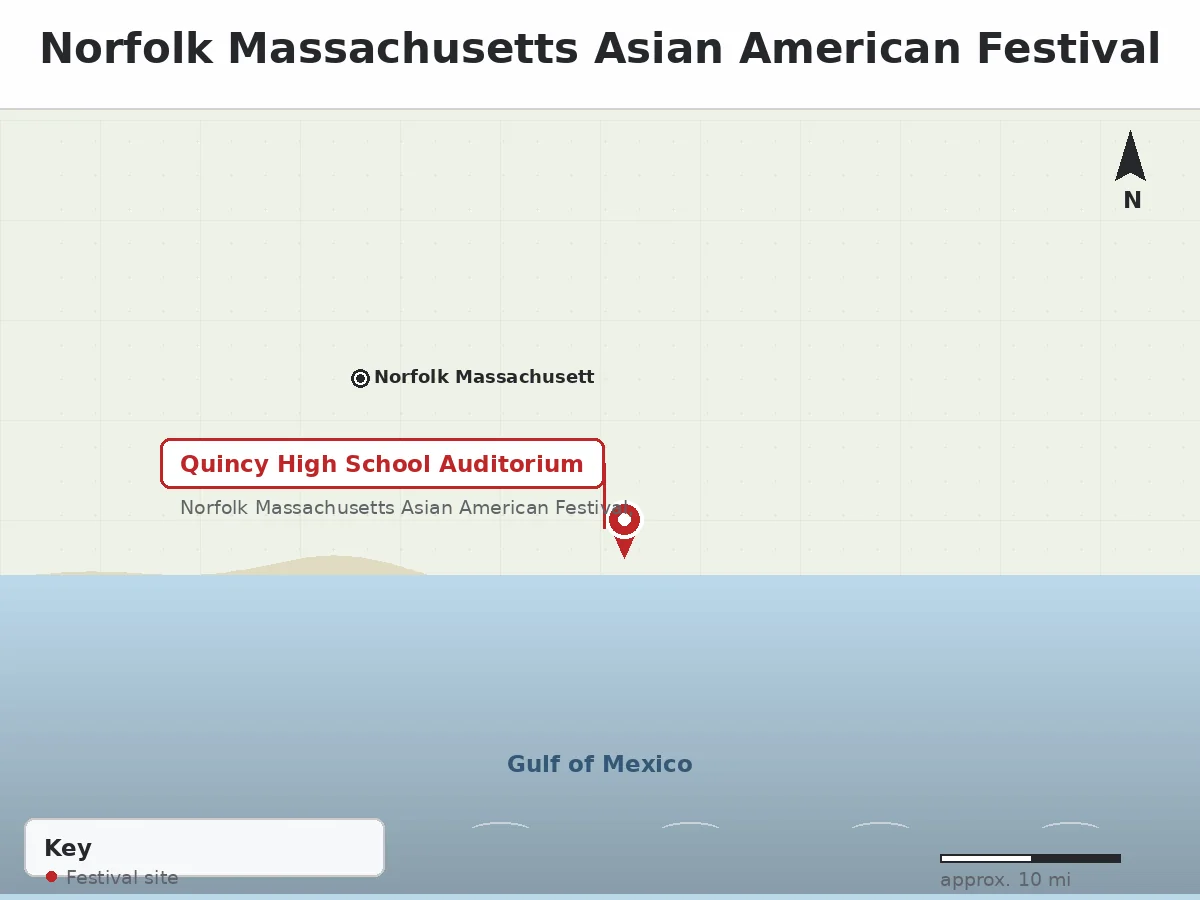
| Later Quincy venue | Quincy High School Auditorium |
| Organiser forms | Asian American Association of Boston (AAAB); Asian-American Association of Boston; Asian American Association |
| Documented Quincy editions | 2011, 2012 and 7 September 2013 |
| Programme | Singing, dancing, instrumental performance and gymnastics |
| Later continuation | Boston editions under the names Asian American Day Festival and Asian American Day |
History
The association behind the festival took shape around 2010 and 2011, according to its own yearbook, and the festival arrived with that founding energy. A community news layer likewise credits the association with initiating the festival in 2011, and the yearbook places the first edition in Quincy in June of that year, gathered inside a Quincy restaurant. A restaurant room is a modest setting for a festival, but the choice fits an organisation testing its reach: a meal-centred venue, a single day of performance, and an audience drawn from the Asian American community and its neighbours.
For a useful comparison, see the Nantucket Massachusetts Comedy Festival for another county festival.
One thread of the record refuses to settle neatly, and it is left open here on purpose. A separate college news layer describes a first festival in July 2011 rather than June, and names a different Quincy restaurant as its setting. Rather than stitching the two accounts into one opening night, this article keeps them side by side: the association’s yearbook says June and one restaurant, the college layer says July and another, and each version stands as its source printed it.
Growth came quickly. For the second edition, in August 2012, the festival moved into the Quincy High School Auditorium, trading the restaurant room for raked seating and a proper stage. The yearbook remembers that edition for a youth symphony orchestra from Guangzhou, an appearance that lifted the programme from community showcase toward international exchange. The school auditorium then hosted the third edition as well, on 7 September 2013, when artists from China joined a Harvard symphony orchestra and the association’s own art troupe on the bill. The community news layer confirms that third edition from the governance side, reporting the association’s board reviewing the September festival at a meeting the following month, in October 2013.
After 2013 the trail leads out of the county. The same organiser’s festival resurfaced in Boston, in Suffolk County, under the adjusted name Asian American Day Festival, with Asian American Day as its shorter form, and one layer also prints Boston Asian American Festival along the way. Later Boston editions acquired vendor and cultural booths and food stalls, features that belong to the city chapter and are not projected backwards onto the Quincy school stage. Some layers number later Boston editions as the twelfth or fourteenth in the line; those counts describe the Boston continuation’s arithmetic, and this article does not turn them into a founding claim for the Quincy years. The documented Norfolk chapter remains the three editions of 2011 to 2013.
What to Expect
Accounts of the Quincy editions describe a performance-led occasion rather than a street fair. Guests arriving at the school auditorium in 2013 would have settled into their seats for a staged programme: invited artists from China, a university symphony orchestra from Harvard, and the association’s resident art troupe moving between gymnastics displays, instrumental numbers, singing and dance. The emphasis, in every layer, sits on the stage. Nobody describes midway rides, craft rows or a carnival field, because the Quincy festival did not work that way.
The 2012 edition set the template for that concert character a year earlier, when the visiting youth orchestra from Guangzhou performed in the same auditorium. Taken together, the yearbook’s descriptions suggest evenings built like recitals with variety woven through them: orchestral passages giving way to acrobatic gymnastics, vocal pieces following instrumental ones. For a reader of this record, the safest expectation is a seated programme of a few hours, mounted by a community association with international guests, in the borrowed hall of a city high school.
Just as important is what not to expect. The food vendors and cultural booths mentioned in connection with this festival belong to its later Boston editions, after the rename, and reading them back into Quincy would invent a festival the layers never describe. Likewise, Quincy stages other Asian cultural celebrations of its own, and those are separate events entirely, a distinction the comparison section below takes up directly.
Planning Your Visit
Anyone hoping to attend a future edition in Quincy should first understand what the record supports: no Quincy edition after 2013 appears in any layer read for this article, and the festival’s continuation is in Boston under the Asian American Day Festival name. A trip planned around this title therefore begins with checking which city, and which name, a current announcement actually carries, since an invitation phrased one way in Boston says nothing about a return to Norfolk County.
For the documented editions, practical detail is thin because the layers are an organiser’s yearbook and a community news report rather than visitor guides. The 2013 edition fell on a Saturday, 7 September, at Quincy High School, and the 2012 edition occupied an August date in the same auditorium. The first edition’s restaurant setting is recorded without visitor particulars, and its month is disputed between the two earliest layers. Nothing in the layers read addresses parking, seating reservations or door arrangements for any Quincy edition, so none of that is guessed at here.
Admission deserves the same honesty. Whether guests paid to enter the Quincy editions goes unrecorded in every layer relied on for this article; the yearbook celebrates the performances without mentioning a door price, and the community layer reports the board’s review without touching the question. No fee has been borrowed from any other festival to fill that gap, and readers should treat the admission position for 2011 to 2013 as simply undocumented.
A Sample Itinerary From the Documented Editions
A visitor reconstructing the 2013 edition from the record could shape a day around its single Saturday performance. The morning belongs to Quincy itself, a city of harbour views and deep presidential history, before the short journey to the high school as the afternoon crowd gathers. Inside the auditorium, the programme unfolds in sequence: the Harvard symphony orchestra’s instrumental passages, the visiting Chinese artists, and the association’s art troupe closing passages with gymnastics, song and dance. The evening ends with the audience dispersing into a September night in Quincy, the whole festival contained within one hall and one day, as its organisers designed it.
Comparing Quincy’s Asian Festivals
Quincy supports more than one Asian cultural celebration, and confusing them would corrupt this record, so the boundaries are worth drawing plainly. The city’s August Moon Festival is organised by a different body, Quincy Asian Resources, Inc., shortened to QARI, and its own layers trace that tradition back to 1987, long before the association’s festival existed. The same QARI organisation also runs the city’s Lunar New Year Festival. Neither event is this title, neither shares its organiser, and neither’s history, programme or attendance can be lent to the Asian American Festival.
The contrast in character is just as clear. The August Moon Festival is an outdoor city celebration with a decades-long run, while the Asian American Festival of 2011 to 2013 was an indoor, stage-centred programme mounted by a young association in a restaurant and then a school auditorium. A third near-namesake, the Boston Asian American Film Festival, belongs to Boston cinema and shares nothing with this title beyond overlapping words.
Checklist Drawn From the Record
- Confirm which city any announced edition is actually in before making travel plans.
- Check whether the announcement uses the name Asian American Day Festival, the Boston continuation form.
- Separate this festival from Quincy’s August Moon Festival and Lunar New Year Festival, which have a different organiser.
- Treat the 2011 restaurant venue and month as disputed between two layers, not settled.
- Do not assume an admission price for the Quincy editions, since no layer states one.
- Look for the organiser under all three of its printed name forms when searching for announcements.
- Remember that Dedham, not Quincy, is the Norfolk County seat when placing the festival geographically.
Beyond the Festival
The Quincy editions gain depth when set against the city that hosted them. Quincy is one of Massachusetts’ older harbour cities, home to a substantial Asian American community whose presence along its main streets made it a natural first home for the association’s festival, even though the association carried Boston in its name. The move from a Quincy restaurant in 2011 to a high school auditorium in 2012 and 2013 charts an organisation growing into its ambitions, and the later relocation to Boston reads as the next step of that growth rather than a failure of the Quincy chapter.
For readers exploring Norfolk County more widely, the festival’s Quincy years offer a reminder that the county’s cultural life is not confined to its seat at Dedham. Quincy’s own calendar, anchored by long-running celebrations from other organisers, continued independently of this festival’s departure, and the county’s stages, school halls and community rooms have hosted many associations writing first chapters much like this one.
Why This Festival Matters
A three-edition run in one city might look like a footnote, yet the Quincy years carry real documentary weight. They capture the moment a young immigrant-community association moved from founding meetings to performance, from a restaurant room to a school stage, and from home performers to an international bill that included a youth orchestra from Guangzhou and artists from China. The board review reported in October 2013 shows an organisation mature enough to evaluate itself in public record. When the festival later continued in Boston under a new name, it carried that Quincy apprenticeship with it. Preserving the boundary between the two chapters, rather than blending them into one undated event, is what keeps this small history accurate.
Frequently Asked Questions
Which years did the festival take place in Quincy?
The documented Quincy editions fall in 2011, 2012 and 2013. The first was held at a restaurant in the city, with its month given as June in the organiser’s yearbook and July in a college news layer. The second and third editions moved to the Quincy High School Auditorium, the third falling on 7 September 2013.
Who organised the Quincy editions?
The organiser was an association printed in three forms across the layers: Asian American Association of Boston (AAAB), Asian-American Association of Boston, and Asian American Association. Its own yearbook documents the editions, and a community news layer confirms its role in launching the festival in 2011 and its board’s review of the 2013 edition.
How is this different from Quincy’s August Moon Festival?
They are separate events with separate organisers. The August Moon Festival is run by Quincy Asian Resources, Inc., dates its tradition to 1987, and is an outdoor city celebration. The Asian American Festival was an indoor, performance-led event staged by the association in 2011, 2012 and 2013, and its record should never be merged with the older festival’s.
What happened to the festival after 2013?
The same organiser continued the festival in Boston, in Suffolk County, under the name Asian American Day Festival, also shortened to Asian American Day. The Boston editions grew to include vendor and cultural booths and food vendors. That continuation sits outside Norfolk County, so this article treats it as later history rather than as part of the Quincy record.
What to Expect From the Next Norfolk Massachusetts Asian American Festival
How often is Norfolk Massachusetts Asian American Festival held?
During its Quincy chapter, an edition appeared in each of three consecutive years, 2011, 2012 and 2013. The organiser’s continuation in Boston has carried its own later numbering, and no layer read for this article documents a Quincy edition after 2013, so the Norfolk County pattern rests on those three annual appearances.
When is the next Norfolk Massachusetts Asian American Festival?
No Quincy edition beyond the documented 2013 gathering appears in the layers read. Readers looking for the organiser’s current activity should watch for announcements under the Asian American Day Festival name in Boston, while understanding that such an edition would belong to the Boston continuation, not to a revived Norfolk County run, unless an announcement expressly places it in Quincy.
Will the dates change?
They already have, repeatedly: the Quincy editions moved from a disputed early-summer dating in 2011, to August in 2012, to 7 September in 2013, and the festival later changed its city and its name. Any future date would be set by the organiser’s announcement, and the layers give no fixed traditional date that a new edition could be expected to follow.
The Asian American Festival’s Quincy chapter is brief, bounded and honestly documented: three editions, two venues, one young association finding its stage. That small, verifiable record is worth more than a grander story stitched together from other festivals’ histories, and it is the record this page has tried to keep intact.