Hampden Massachusetts Big E Festival
Every September, the fairgrounds in West Springfield fill with livestock barns, midway lights, parade music and the smell of fair food for the largest exposition of its kind in the eastern United States. The event on the sheet for this title is the one New Englanders call The Big E, staged formally as the Eastern States Exposition. One point of naming honesty belongs at the front: no layer read for this article prints the words “Big E Festival” as the event’s name. The published names are The Big E and Eastern States Exposition, with Eastern States Agricultural and Industrial Exposition kept as the original form, and those are the names used below.
About
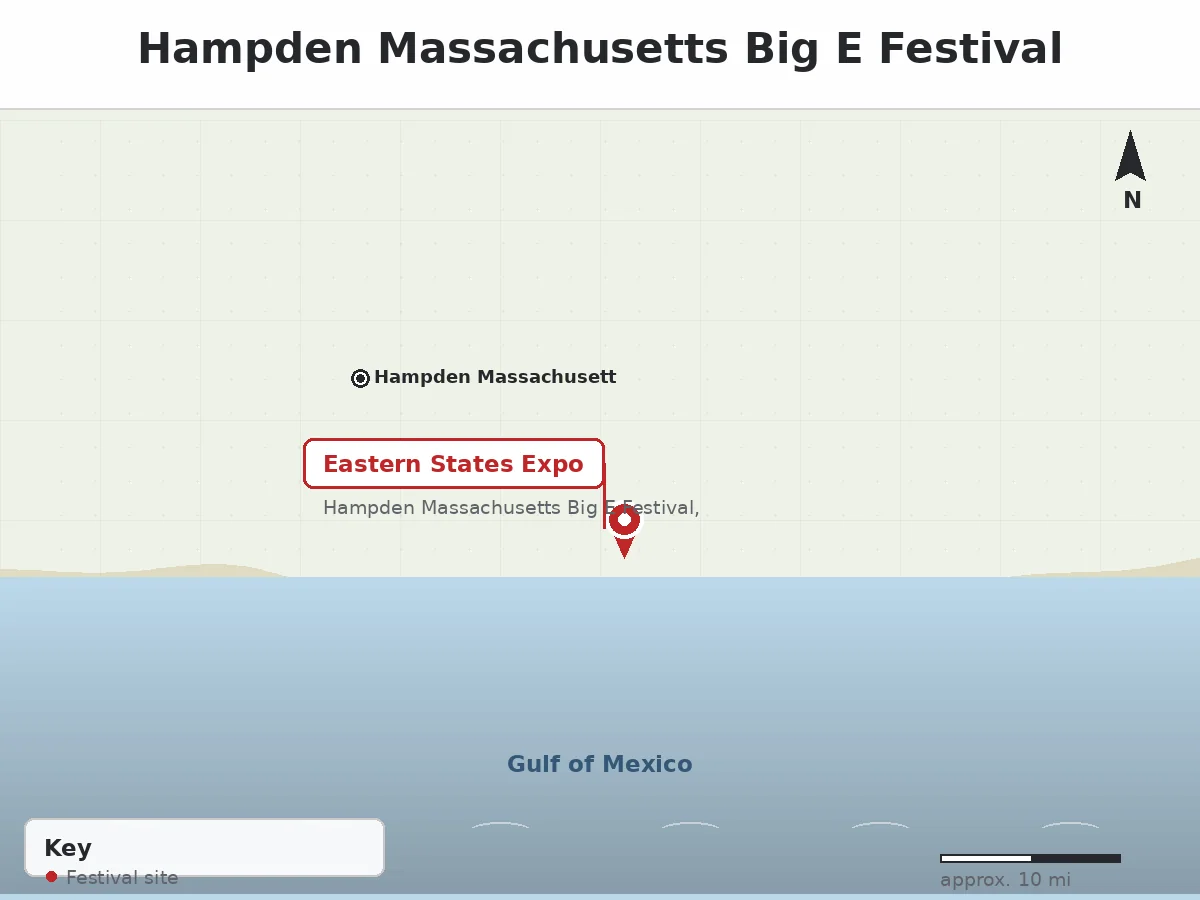
The Big E is a regional exposition rather than a single-county fair, drawing its exhibitors, competitors and visitors from across New England while sitting in one Hampden County town. Its home is West Springfield, on the Eastern States Exposition fairgrounds, a permanent ground that spends most of the year hosting other events and then gives over more than two weeks each autumn to the fair itself. West Springfield is not the county seat; Springfield, across the river, holds that position for Hampden County, a distinction a reference layer confirms and one worth keeping straight because the two names are so easily confused.
Who runs the fair depends on which layer is speaking. A fair-listing layer names the ESE Fair Board, while reference layers treat the exposition itself as the presenting body, and neither form is folded into the other here. The fair’s shape is consistent across the record: it opens on the second Friday after Labor Day and runs for seventeen days, a pattern the reference layers state as the standing arrangement. Two recent editions anchor the detail in this article. A travel-guide layer documents the 2025 edition, which ran from Friday 12 September to Sunday 28 September 2025. A fair-listing layer documents the 2026 edition, running from Friday 18 September to Sunday 4 October 2026.
Quick Facts
| Item | Detail |
| Published names | The Big E; Eastern States Exposition |
| Original name form | Eastern States Agricultural and Industrial Exposition |
| Sheet title note | The form “Big E Festival” is not printed as the event’s name in any layer read |
| Host town | West Springfield, Hampden County |
| County seat | Springfield (West Springfield is not the seat) |
| Venue | Eastern States Exposition fairgrounds, West Springfield |
| Organiser forms | ESE Fair Board (fair-listing layer); the exposition itself as presenting body (reference layers) |
| 2025 edition | Friday 12 September to Sunday 28 September 2025 |
| 2026 edition | Friday 18 September to Sunday 4 October 2026 |
| Usual run | Opens the second Friday after Labor Day; seventeen days |
History
The founding record carries a disagreement, and this article leaves it exactly where the layers put it. Most layers, including the main text of a reference layer, state that the first exposition took place in October 1916 in West Springfield. The same reference layer’s summary panel gives the wording “Inaugurated 1917”. Both versions are carried here side by side, unmerged, because choosing between them would mean inventing a certainty the sources do not offer.
What the layers agree on is the purpose. The exposition was conceived by its founder to promote agriculture and to educate young people, a mission visible to this day in the livestock halls and the youth programmes described below. The facts file behind this article describes that founder as a named figure in the exposition’s own story, but it does not print the name itself, so the founding is credited here by role rather than by a name this article cannot verify from its own record. The original name, Eastern States Agricultural and Industrial Exposition, spells out that agricultural and industrial purpose in full.
For a useful comparison, see the Franklin Massachusetts Welcome Yule Festival for another county festival.
The shorter name arrived decades later, though the layers argue about the year. Different accounts date the “Big E” marketing name to 1966, to 1967 and to 1968, and all three dates are left standing in this article rather than reconciled. Anniversary language needs the same care: a listing for a recent edition speaks of a 109th anniversary, which is billing as printed and is not converted here into a founding year, since arithmetic of that kind is exactly how the 1916 and 1917 conflict would get papered over.
A recreated historic village on the grounds gives the fair a physical link back to the New England past it grew out of, and one food item carries its own pedigree: a layer notes a cream puff sold at the fair dating to the 1920s, which makes the pastry older than the Big E nickname by roughly four decades.
What to Expect
The signature sight is the Avenue of States, where six New England state buildings line up in a row, each presenting its own state’s products, foods and displays under one roof. Visitors walk from one state’s hall to the next in a few steps, and the row functions as a compressed tour of the whole region without leaving the fairgrounds.
Agriculture fills much of the rest of the ground. Livestock shows and farm exhibits run through the seventeen days, and young exhibitors are a visible part of the programme: 4-H and FFA members show animals and compete as part of the exposition’s long-standing educational purpose. Beyond the barns, the programme layers describe rides on the midway, concerts, daily parades and the recreated historic village, where interpreters and period buildings present an earlier New England.
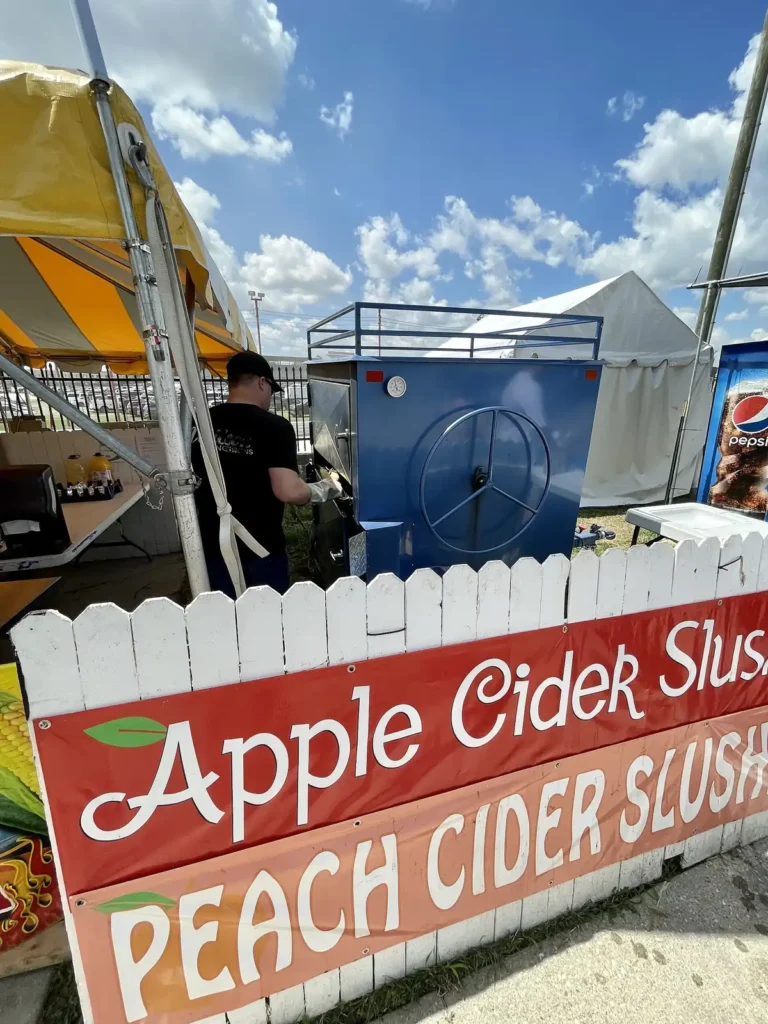
Food is a programme element in its own right. The cream puff noted in the History section is the famous example, with a lineage one layer traces to the 1920s, but it sits alongside the ordinary abundance of fairground cooking spread across the ground. State buildings add a second layer of eating, since each hall promotes the foods its own state is known for, and a visitor can graze from one state’s specialities to another’s within a short walk. Because the fair runs seventeen days rather than a single weekend, the programme repeats and rotates: a parade route or a stage schedule seen on one day may be matched by a different lineup later in the run.
The agricultural programme also deserves a slower look than fairgoers sometimes give it. Judging in the livestock rings follows its own timetable, with breeds and classes brought forward across the run, so the animal on display in a barn on the first weekend may have been replaced by another class entirely by the second. Young exhibitors prepare for months for these classes, and the polish on the animals and the orderliness of the barns reflect that work. Anyone who treats the fair as rides and food alone will miss the half of it that the exposition was founded to present.
Planning Your Visit
Seventeen days of fair offer a genuine choice of when to come. The fair opens on the second Friday after Labor Day and runs seventeen days, so a visit can be aimed at the opening weekend, the middle stretch or the closing days, with the 2026 edition documented from Friday 18 September to Sunday 4 October. Opening days carry the freshness of a ground just swung into action, while the final weekend tends to gather the largest crowds of neighbours determined not to miss the year. Visitors with flexibility will usually find the middle weekdays the calmest window of the whole run. Weekdays within the run are the natural choice for anyone hoping to walk the state buildings and livestock halls at an easier pace than a Saturday crowd allows.
On admission, the record is deliberately plain: none of the layers read for this article states a gate price, so this article states none, and it does not describe the fair as free either. Ticketing questions belong with the fair’s own current information at the time of a visit. The fairgrounds do have a published street address in the layers, which is noted here only as an existing detail; its value is not reproduced, in line with the no-address rule this series follows.
Grounds beyond the fair dates need care. Concerts and other events take place on the exposition grounds at other times of year, and those are separate happenings, not part of the seventeen-day fair. Checking that a chosen date falls inside the fair’s run, rather than on a standalone grounds event, is the surest way to arrive at the event this article describes.
A Sample Day at the Fair
Arrive in the morning and begin with the Avenue of States, moving along the six state buildings while the halls are still filling. Late morning belongs to the livestock barns, where the showing schedule rewards those who come before the midway crowds build. Take lunch inside the fair, with the cream puff as the documented heritage item to seek out.
In the afternoon, split the time between the recreated historic village and the agricultural exhibits, then find a place along the parade route for the day’s parade. Evening can carry the midway rides and a concert, closing out a day that has touched the fair’s three characters: regional showcase, working agricultural show and amusement ground.
How the Big E Compares
The closest confusion is with the Three County Fair in Northampton, which is a different fair in a different county and plays no part in this article. The Big E is also frequently mistaken for a county fair because it sits in one town in Hampden County, yet its six-state structure, its seventeen-day run and its permanent exposition grounds all place it in a larger class of event. Against the typical weekend fair, its scale works differently: there is no single day on which everything happens, and no visitor is expected to see the whole of it.
Its relationship to its own grounds is another point of difference. Most fairs borrow a ground for a week; the exposition owns its calendar slot on a ground that bears its name, and the other concerts and events staged there through the year are guests on the fair’s home turf, fenced off from the fair itself in this article just as they are in the layers.
A Visitor Checklist
- Confirm the visit date falls inside the seventeen-day run, which opens on the second Friday after Labor Day.
- Allow a full day if the state buildings, the livestock halls and the village are all on the list.
- Plan an order for the grounds: state buildings first, barns second, midway last.
- Seek out the cream puff as the fair’s documented heritage food.
- Check the day’s parade and concert times on arrival rather than assuming a fixed hour.
- Keep the Three County Fair in Northampton separate when comparing September fairs.
- Treat any concert on the grounds outside the fair dates as a different event.
Beyond the Fairgrounds
West Springfield itself carries the practical side of a visit, with the fairgrounds embedded in the town rather than isolated from it. During the run the whole town adjusts to fair season, and the roads and businesses around the ground take on the rhythm of the seventeen days. A visitor who leaves the gates for an evening will still feel the fair’s presence in the town that hosts it. Springfield, the Hampden County seat, sits across the Connecticut River and holds the area’s densest cluster of museums and city sights, making it the natural extension of a fair trip for anyone staying more than a day. The Connecticut River valley around both communities offers the early-autumn scenery that matches the fair’s late-September timing, and Northampton, home of the separate Three County Fair, lies up the valley for travellers comparing the region’s September calendar.
Why the Big E Matters
The exposition holds together two ideas that often drift apart: a working agricultural show and a regional showcase. The state buildings give six states a shared stage, while the livestock rings and the 4-H and FFA programmes keep the fair tied to the farming purpose its founder set out in the 1910s. That the record cannot agree on whether the first exposition belongs to 1916 or 1917, or on the exact year the Big E name arrived, does not weaken the event’s standing; it simply means the honest article reports the disagreement instead of hiding it. A fair still running seventeen days each autumn, more than a century after either candidate founding year, has continuity enough without borrowed precision.
Frequently Asked Questions
Which names does the fair actually go by?
The published names are The Big E and Eastern States Exposition, with Eastern States Agricultural and Industrial Exposition preserved as the original form. The sheet title’s wording, “Big E Festival”, does not appear as the event’s name in any layer read, so the article uses the printed names throughout.
How long does the fair run in West Springfield?
Seventeen days. Reference layers describe the standing pattern as opening on the second Friday after Labor Day, and the dated editions match it: Friday 12 to Sunday 28 September in 2025, and Friday 18 September to Sunday 4 October in 2026.
What stands along the Avenue of States?
Six buildings, one for each New England state, each filled with that state’s products, foods and displays. The avenue is the fair’s signature feature and the clearest expression of its regional, rather than county, character.
Is West Springfield the county seat of Hampden County?
No. Springfield is the Hampden County seat, as a reference layer confirms. West Springfield hosts the fairgrounds and the fair, which is a different honour from holding the seat.
What to Expect From the Next Hampden Massachusetts Big E Festival
How often is Hampden Massachusetts Big E Festival held?
The exposition returns every autumn on its standing pattern, opening on the second Friday after Labor Day and running seventeen days, as the reference layers describe the arrangement and as both the 2025 and 2026 editions followed it.
When is the next Hampden Massachusetts Big E Festival?
Following the 2026 edition, which the fair-listing layer dates from Friday 18 September to Sunday 4 October 2026, the next edition would be expected in September of the following year on the same second-Friday pattern, though no layer read prints its exact dates.
Will the dates change?
The pattern has a built-in drift: because the opening is tied to the second Friday after Labor Day, the calendar dates shift slightly from year to year while the rule stays fixed. The 2025 and 2026 editions differ by several days for exactly that reason.
The Big E endures because it was never only one thing: it is a livestock show, a six-state showcase, a midway and a village of older New England, held together on one ground for seventeen days each autumn. Whether its first October belonged to 1916 or 1917, the exposition that grew from it remains the autumn fixture of West Springfield and the largest event of its kind in the region, and the record’s small disagreements are part of its story rather than a flaw in it.