Talbot County Maryland Waterfowl Festival
Each November, downtown Easton fills with carved decoys, wildlife paintings, calling contests and crowds drawn by the birds that define the Chesapeake autumn. The Talbot County Maryland Waterfowl Festival, published simply as the Waterfowl Festival, spreads across several venues in the county seat and brings close to twenty thousand visitors into town over three days. Its fifty-fifth annual edition runs from 13 to 15 November 2026, with preview events beginning on 12 November, following a fifty-fourth annual edition held from 14 to 16 November 2025. Art sits at the centre of the weekend, yet conservation, education and community engagement run through every hall, stage and shoreline conversation.
About the Festival
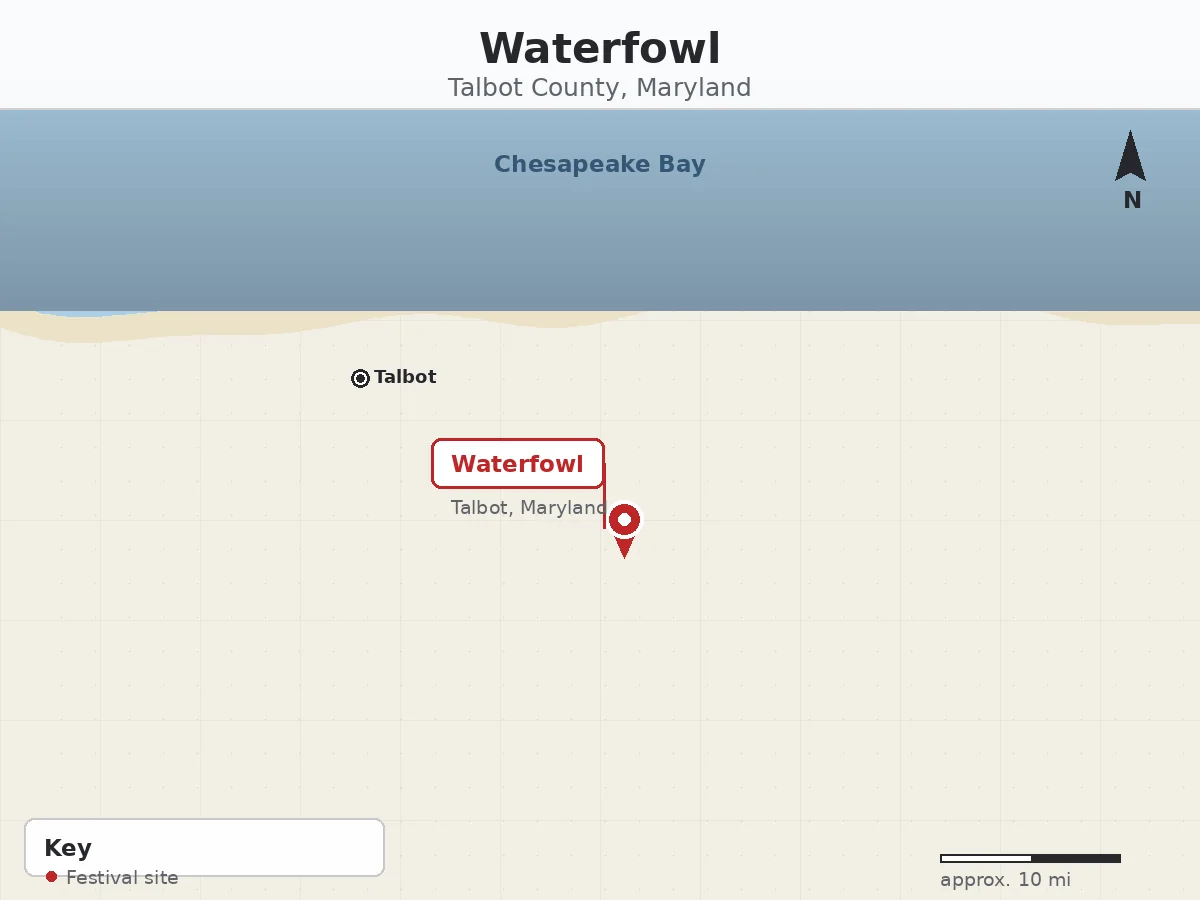
The festival is organised by Waterfowl Festival, Inc., and headquartered at the old Easton Armory in downtown Easton. From that base, activity reaches outward to venues that include the Tidewater Inn, the Elks Lodge and the Talbot County Free Library, so a visit becomes a walk through the town as much as a tour of exhibition rooms. Easton is the seat of Talbot County, and the festival uses that compact civic centre to hold a large programme within easy reach of its headquarters.
Painters, sculptors, carvers and photographers present wildlife art that the organiser describes as world-class in standard. Alongside the galleries, the World Waterfowl Championship Calling Contests test a very different kind of craft, while Delmarva DockDogs and the Ducks Unlimited Landing add outdoor energy to a weekend otherwise shaped by quiet looking and close study. Opening ceremonies and Hall of Fame inductions give the programme its formal moments, honouring people whose work forms part of the festival story without turning the whole event into a ceremony.
The organiser states its mission plainly: inspiring appreciation for wildlife and promoting environmental stewardship through art, education and community engagement. That wording matters because it explains why pictures, carvings and calls share billing with conservation themes. A visitor can admire a finished painting in one room, watch a dog launch into water at another site, and hear a champion caller reproduce the voice of a bird with startling precision, all within a single afternoon.
Quick Facts
| Item | Detail |
| Published name | Waterfowl Festival |
| Host town | Easton, the Talbot County seat |
| Headquarters | The old Easton Armory, downtown Easton |
| Other venues | Tidewater Inn, Elks Lodge and Talbot County Free Library |
| Organiser | Waterfowl Festival, Inc. |
| Edition in 2026 | Fifty-fifth annual, 13 to 15 November, previews from 12 November |
| Previous dated edition | Fifty-fourth annual, 14 to 16 November 2025 |
| Attendance drawn | Close to twenty thousand visitors over three days |
| Three-day pass in 2026 | Twenty-five dollars, with free parking, entry to all venues and bus transport |
| Programme pillars | Wildlife art, calling contests, DockDogs, conservation and education |
History of the Festival
Layers describing the festival agree that it has run for more than fifty years, and the organiser’s own wording says it has served the Eastern Shore community for more than fifty-five years. The annual billings support that long view in their own way: the 2025 gathering carried the fifty-fourth annual billing, and the 2026 gathering carries the fifty-fifth. Those numbers describe a sequence of editions, and this article treats them as billings only, because the layers give no separate founding year to attach to the first gathering.
For a useful comparison, see the St. Mary’s County Maryland FamilyFest on the Potomac Festival for another county festival.
A festival that repeats across five decades in the same town builds habits that newer events cannot copy quickly. Artists return to rooms they know, visitors learn which venues reward an early start, and the town itself becomes part of the memory people carry home. Easton’s armory headquarters anchors that continuity, while the spread of venues shows how the event grew into the civic fabric rather than remaining inside one hall.
The Hall of Fame inductions belong to that longer story. Each induction marks a contribution the festival chooses to remember publicly, linking present activity to earlier effort. What survives in the documented record is therefore a shape rather than a single origin scene: a town on Maryland’s Eastern Shore hosts an annual November gathering devoted to waterfowl, art gives it a lasting visual identity, calling and working-dog elements keep the sporting culture audible and visible, and conservation gives the celebration a purpose beyond display.
What to Expect
Wildlife art provides the broadest thread through the weekend, with painters showing finished canvases, sculptors presenting three-dimensional work, carvers displaying the decoy tradition in modern and classic forms, and photographers offering images made in marshes and open water. Looking slowly is rewarded here, because carving and painting both hide much of their skill in small decisions about feather, light, posture and habitat. A gallery conversation can start with a single bird and widen into questions about the places that bird needs in order to thrive.
Sound arrives through the World Waterfowl Championship Calling Contests, where competitors reproduce waterfowl calls under contest conditions. For a newcomer, the surprise often lies in how musical and disciplined calling becomes when judged at championship level. Rhythm, control and accuracy matter, and the gap between a casual imitation and a winning routine becomes clear within a few performances.
Movement arrives through Delmarva DockDogs, whose jumping dogs bring splashes, cheers and a looser festival mood to the programme. The Ducks Unlimited Landing adds another gathering point shaped around waterfowl culture and conservation interest. Opening ceremonies set the tone at the start of the weekend, and Hall of Fame inductions pause the bustle to recognise honourees whose contributions the festival records as part of its own history.
Between those set pieces, the venues themselves shape the experience. One room may feel like a hushed gallery, another like a reunion of carvers comparing techniques, and an outdoor site may carry the noise of a crowd watching dogs compete. Moving among the venues keeps the day varied, and the bus transport included with a pass helps visitors reach satellite sites without worrying over parking at each stop.
Planning Your Visit
November dates reward warm layers and a realistic sense of how much ground Easton asks a visitor to cover on foot. The 2026 festival runs across Friday, Saturday and Sunday, 13 to 15 November, with preview events from Thursday 12 November for those who can arrive early. Building the weekend around the headquarters at the old Easton Armory gives a natural starting point, because orientation is easier once the central venue and its programme rhythm are clear.
For the 2026 edition, a county tourism layer records a three-day pass costing twenty-five dollars. That pass provides free parking, entry to all venues and bus transportation to satellite sites, which makes it the simplest basis for planning a full weekend rather than a single afternoon. Visitors considering only one day should still check what the pass covers before assuming a shorter option suits them better, since the multi-venue layout is a defining feature of this festival.
Comfortable shoes matter more than formal dress at most venues, although indoor exhibition spaces may feel warmer than the walks between them. A small bag for purchases helps anyone tempted by carvings or prints, and protecting bought artwork from damp November weather is worth planning before leaving home. Photography inside galleries can vary by exhibitor, so asking at each venue keeps the visit courteous.
Families often pace the day by alternating quiet galleries with the livelier outdoor elements, letting younger visitors burn off energy at the DockDogs before returning to detailed carving displays. Anyone especially interested in the calling contests should arrive with time to spare, because championship rounds reward listening from the beginning rather than drifting in midway.

A Sample Weekend Itinerary
A Thursday arrival for the 2026 preview events suits visitors who enjoy a gentler introduction before the main crowds build. Use that early window to learn the layout around the Armory, note where the Tidewater Inn and library venues sit, and decide which artists or contests deserve priority once the full programme opens on Friday.
Friday can begin at headquarters with a first pass through the art, taking time over sculpture and carving while the rooms remain comparatively calm. After lunch in town, move toward the calling contest sessions and listen long enough to understand the judging rhythm. Close the day by revisiting one favourite gallery, because returning to a piece after seeing the wider field often changes what a buyer notices in it.
Saturday suits the fullest version of the festival, mixing the Ducks Unlimited Landing, a DockDogs session and the library or Elks Lodge venues in a single circuit using the included bus transport. Saturday evening is a good moment to settle art purchases rather than leaving decisions to the final hours.
Sunday works well as a slower farewell, with a final walk through downtown Easton and one last look at photography that caught the eye earlier. Visitors leaving on Sunday afternoon should allow room for the walk back to parking and for careful packing of any artwork bought during the trip.
How This Festival Compares
Within Talbot County’s own calendar, the Waterfowl Festival occupies the November, wildlife-centred ground that no neighbouring event quite duplicates. Plein Air Easton fills July with outdoor painting competition across the county, sharing an art theme but replacing waterfowl, calling and carving with painters working live in summer landscapes. Both events celebrate visual art in Easton, yet their seasons, subjects and moods separate them cleanly.
The Chesapeake Bay Maritime Museum’s OysterFest, held in Saint Michaels, offers another useful contrast. That gathering centres on oysters and maritime heritage in a different Talbot County town, while the Waterfowl Festival stays in Easton and builds its identity around birds, wildlife art and calling. A visitor who enjoys both weekends will find county pride in each, expressed through different harvests, crafts and traditions.
Against Maryland’s many autumn fairs, this festival stands out for depth in a single subject. Rather than spreading attention across livestock, midway rides and general entertainment, it concentrates on waterfowl from several directions at once: the painted bird, the carved bird, the called bird, the working dog, and the habitat that sustains real birds. That concentration gives collectors, artists and conservation-minded visitors a shared vocabulary.
Beyond the Festival Venues
Easton rewards extra time beyond the official programme. Its downtown streets hold the ordinary pleasures of a county seat in festival week, with places to eat, warm up and talk over the day’s discoveries between venue visits. Arriving early turns a busy trip into a calmer Eastern Shore break.
The wider county offers marshes, rivers and small towns that explain why waterfowl culture runs so deeply here. A quiet drive after the galleries close can connect the carved and painted birds of the exhibition rooms with the real landscapes those artists study. Tilghman Island, Oxford and Saint Michaels each give a different shoreline angle on the same county, although their own events belong to separate dates and should not be confused with the November gathering in Easton.
Visitors who build that wider view into the trip often leave with a stronger sense of place. The stewardship message lands differently after a morning spent looking across open water, because habitat stops being an abstract word and becomes a visible, fragile part of the county itself.
Why the Festival Matters
On the Eastern Shore, waterfowl are not a decorative theme chosen for a poster. They belong to the region’s hunting traditions, its art market, its conservation debates and its seasonal sense of time, and the festival draws those strands into one public weekend. By placing championship calling and working dogs beside fine painting and carving, it refuses to separate sporting practice from artistic interpretation.
The event also matters as a bridge between appreciation and responsibility. A visitor may arrive for a famous carver or a particular painter, then leave thinking about wetlands, migration and the care of wild places, because the mission threads stewardship through art and education rather than bolting it on as an afterthought. Close to twenty thousand visitors over three days gives that message real reach.
For Easton, the festival brings a dependable November gathering that fills venues across town and gives local institutions a role in a regional story. For artists, it offers an audience that understands the subject deeply. For the wider Chesapeake community, it keeps a shared culture visible and open to newcomers who may know the birds first through a painting and only later through a marsh at dawn.
Frequently Asked Questions
Which venues host the festival in Easton?
The festival is headquartered at the old Easton Armory in downtown Easton, with further venues across town that include the Tidewater Inn, the Elks Lodge and the Talbot County Free Library. Bus transportation to satellite sites is included with the three-day pass recorded for the 2026 edition.
What kind of art fills the exhibition rooms?
Painters, sculptors, carvers and photographers present wildlife art described as world-class in standard. Carved decoys and sculptural work sit alongside paintings and photographs, so visitors can compare how different media handle feathers, water, light and habitat across a single weekend.
Which contests and outdoor features run during the weekend?
The World Waterfowl Championship Calling Contests headline the competitive programme, while Delmarva DockDogs brings jumping-dog action and the Ducks Unlimited Landing adds a further gathering point. Opening ceremonies and Hall of Fame inductions provide the formal moments within the three days.
What does the three-day pass cover in 2026?
For the 2026 edition, the recorded three-day pass costs twenty-five dollars and provides free parking, entry to all venues and bus transportation to satellite sites. That coverage suits the festival’s multi-venue layout, which spreads activity across downtown Easton rather than gathering everything under one roof.
What to Expect From the Next Talbot County Maryland Waterfowl Festival
How often is Talbot County Maryland Waterfowl Festival held?
The festival follows an annual pattern, shown by the fifty-fourth annual billing carried by the November 2025 edition and the fifty-fifth annual billing carried by the November 2026 edition. Each year’s gathering occupies a November weekend in Easton, with preview activity ahead of the main days in 2026.
When is the next Talbot County Maryland Waterfowl Festival?
Beyond the edition running from 13 to 15 November 2026, with previews from 12 November, the layers consulted for this article give no separate date for a later gathering. Visitors planning further ahead should watch for the organiser’s own announcements as the following November approaches.
Will the dates change?
The two dated editions on record sit in mid-November, one running 14 to 16 November 2025 and the next running 13 to 15 November 2026. Exact weekend placement can shift slightly from year to year around that mid-November position, so checking the confirmed dates for any future edition remains sensible.
A November weekend in Easton built around birds may sound narrow until the first gallery and contest widen it. The Talbot County Maryland Waterfowl Festival endures because it understands its subject from many sides at once, honouring the artistry waterfowl inspire, the skills they call forth, and the wild places they still need.