Queen Anne’s County Maryland Chesapeake Storytelling Festival
On a spring weekend in 2016, a college campus in Wye Mills filled with voices telling stories. The Chesapeake Storytelling Festival, also printed as the Queen Anne’s County Storytelling Festival, brought nationally touring professional storytellers to Chesapeake College for three days. It was billed as the first storytelling festival on the Eastern Shore: not a fair, not a concert, but a weekend built entirely around the spoken word. It returned for a second annual edition in September 2017, and the county visitor guide lists it among the county’s annual September events, even though no edition after 2017 is documented in the layers read.
A storyteller takes a stage in the Todd Performing Arts Center or the Cadby Studio Theatre, the lights dim, and a room of listeners settles into a tale. Children gather for their own activities, musicians play between sessions, and local storytellers share the heritage of the Chesapeake. The record is thin — two dated editions plus a preview — but it is specific: dates, venues, named performers, and a preview priced at forty-five dollars.
About
The Chesapeake Storytelling Festival is a storytelling gathering held on the campus of Chesapeake College in Wye Mills, Maryland. Its published names are the Chesapeake Storytelling Festival and the Queen Anne’s County Storytelling Festival, and the sheet title is printed exactly in the layers read. The organiser is the Queen Anne’s County Arts Council, also printed as the Queen Anne’s County Centre for the Arts, in partnership with Chesapeake College. Wye Mills is not the county seat; Centreville holds that role, according to a state archives reference layer.
The programme centres on nationally touring professional storytellers on stage, with children’s activities, music, local storytelling panels and a heritage storytelling series alongside. The Watermen’s Story Swap, a panel in which people connected to the Chesapeake’s working waterfront trade stories, appears in the 2017 edition, along with living-history reenactors.
The first festival ran Friday 29 April to Sunday 1 May 2016, three days on the college campus, according to a college layer and a regional news layer. A preview event took place in spring 2015 with two featured storytellers. The second annual festival was held Saturday 16 September 2017, according to a regional blog layer. Admission was ticketed: the 2015 preview cost forty-five dollars, while ticket prices for the 2016 and 2017 editions are not stated in the layers read.
For a useful comparison, see the Prince George’s County Maryland Wine & Food Festival for another county festival.
Quick Facts
| Detail | Information |
| Sheet title | Queen Anne’s County Maryland Chesapeake Storytelling Festival |
| Published names | Chesapeake Storytelling Festival and Queen Anne’s County Storytelling Festival |
| Host town | Wye Mills, Maryland |
| County seat | Centreville, not Wye Mills |
| Venue | Chesapeake College, Todd Performing Arts Center and Cadby Studio Theatre |
| Organiser | Queen Anne’s County Arts Council, in partnership with Chesapeake College |
| Preview event | Spring 2015, two featured storytellers |
| First festival | Friday 29 April to Sunday 1 May 2016 |
| Second annual festival | Saturday 16 September 2017 |
| Admission | Ticketed; preview forty-five dollars, later prices not stated |
History
The festival began with a preview in spring 2015. A regional news layer records the preview with two featured storytellers and a ticket price of forty-five dollars.
The first full festival followed a year later, Friday 29 April to Sunday 1 May 2016, running three days on the Chesapeake College campus. A college layer and a regional news layer agree on the dates. The college layer presents the gathering as the first storytelling festival on the Eastern Shore. Five featured storytellers performed: Andy Irwin, Dolores Hydock, Michael Reno Harrell, Ed Stivender and Kim Weitkamp, each a nationally touring professional, with children’s activities, music, local storytelling panels and a heritage storytelling series around them.
The second annual edition came on Saturday 16 September 2017, recorded in a regional blog layer. The first festival had taken place in late April and early May, so the move to September is part of the record. The 2017 edition added three more featured storytellers — Bil Lepp, Megan Hicks and Tim Lowry — alongside living-history reenactors and a Watermen’s Story Swap. The county visitor guide lists the festival among the county’s annual September events, which fits the 2017 dating.
No edition after 2017 is documented in the layers read. The record shows a preview in 2015, a first festival in 2016 and a second annual festival in 2017, and then silence in the layers consulted. The festival may have continued beyond 2017 without leaving a trace in those layers, or it may have ended; the layers read do not say.
The Queen Anne’s County Arts Council, also printed as the Queen Anne’s County Centre for the Arts, organised the event together with Chesapeake College, which provided the stages — the Todd Performing Arts Center and the Cadby Studio Theatre. That pairing of a county arts body with a community college campus shaped the festival’s character: a cultural event with professional touring performers, held in proper theatres rather than on a fairground or a town green.
What to Expect
A visitor could expect a weekend, or in 2017 a single day, organised around listening. The core of the programme was the featured storytellers: nationally touring professionals who perform stories on stage. The first festival in 2016 featured five such performers across three days, while the 2017 edition added three more.
Children’s activities ran alongside the main performances, giving younger visitors their own way into the weekend. Music filled the gaps between sessions, and local storytelling panels brought the Chesapeake’s own voices into the programme. The Watermen’s Story Swap, part of the 2017 edition, gathered people connected to the working waterfront.
The Todd Performing Arts Center and the Cadby Studio Theatre are indoor theatre spaces on the Chesapeake College campus, so the festival was an indoor listening experience rather than an outdoor fair. A visitor would move between the two theatres, settle into a seat, and listen. Living-history reenactors in 2017 added a visual element, performing the past in costume and character.
Admission was ticketed, though the record is uneven on price. The 2015 preview cost forty-five dollars, according to a regional news layer. Ticket prices for the 2016 and 2017 editions are not stated in the layers read, so a reader should not assume the preview price applied to the later editions.
Planning Your Visit
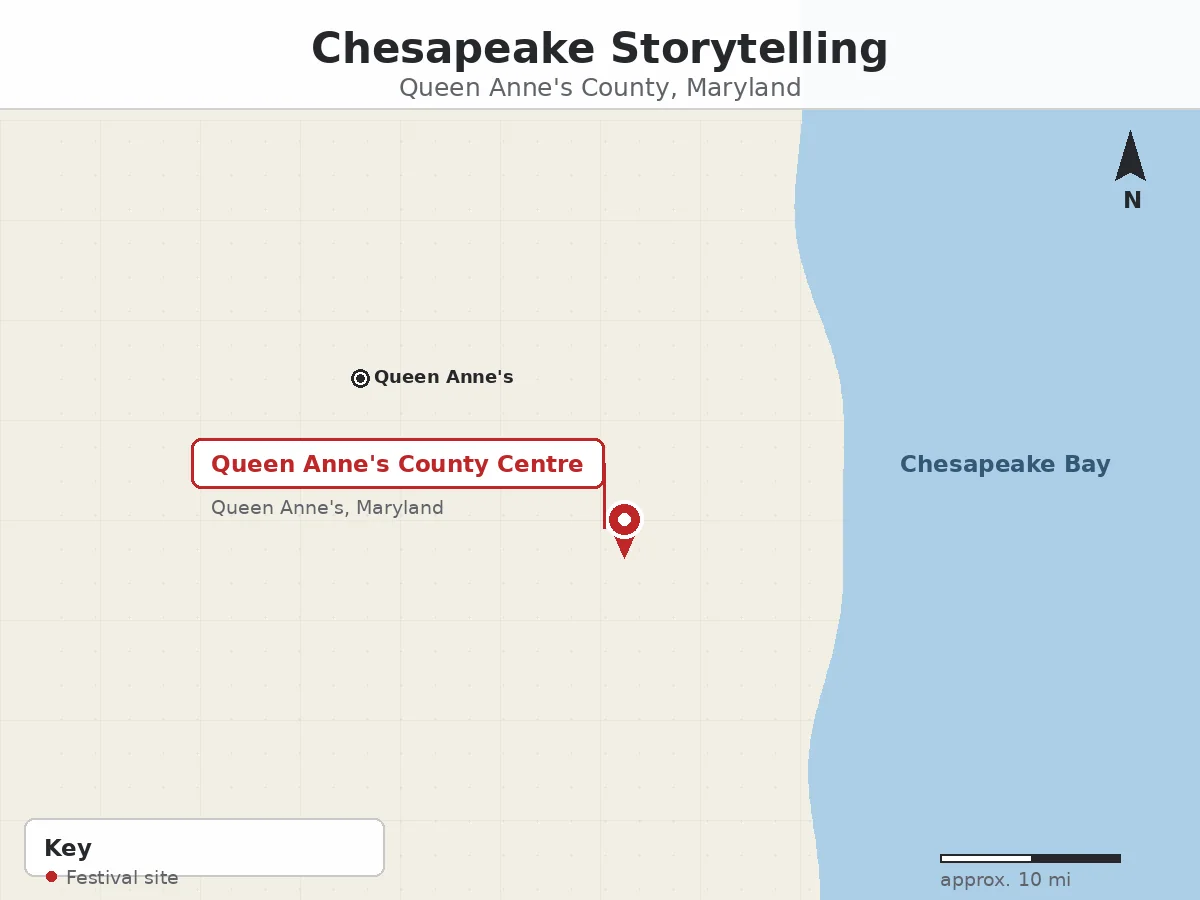
Wye Mills sits in Queen Anne’s County on Maryland’s Eastern Shore, and Chesapeake College is the landmark that anchors the festival. A visitor would head for the college campus and look for the Todd Performing Arts Center and the Cadby Studio Theatre, the two venues named in the record. Centreville, the county seat, lies nearby, though the layers read do not name specific lodgings or restaurants for festival visitors.
Because the festival was ticketed, a visitor would need to arrange admission in advance or at the door, but the record gives no ticket price for the 2016 or 2017 editions, and no edition after 2017 is documented. Anyone hoping to attend a future edition should confirm first that the festival is still running. The 2017 edition fell on a Saturday in mid-September, and the county visitor guide lists the festival among the county’s annual September events.
A day at the festival would be built around the performance schedule, moving between the two theatres. Children’s activities were part of the programme, so families could bring younger listeners. The audience sits for long stretches, so a visitor would do well to arrive early enough to choose a good seat.
Sample Itinerary
A Saturday at the second annual festival in 2017 might have unfolded like this. Arrive at Chesapeake College in the morning and find the Todd Performing Arts Center, where the day’s storytelling sessions begin. Settle in for a morning performance by one of the featured storytellers — Bil Lepp, Megan Hicks or Tim Lowry.
Around midday, step out for a break and take in the music or visit the children’s activities with younger members of the party. The living-history reenactors would be worth a look during this part of the day. In the afternoon, return to the theatre for another featured storyteller, then join the Watermen’s Story Swap, the panel where people connected to the Chesapeake’s working waterfront trade stories of life on the Bay.
As the day winds down, catch a final session in the Cadby Studio Theatre, where the smaller space suits an intimate telling. The day is a listening day above all, so the best plan is a loose one: follow the schedule, sit where the sound is good, and let the stories carry the hours.
Comparison
The Chesapeake Storytelling Festival differs from most Eastern Shore festivals in a simple way: it is built around listening rather than eating, shopping or watching a parade. A food festival fills its hours with vendors and tastings; a music festival fills them with bands. Here the main event is a person on a stage telling a story, and the audience’s job is to sit still and pay attention.
The festival also differs from its nearest neighbours in the record. The Chesapeake Folk Festival at the Chesapeake Bay Maritime Museum in Saint Michaels, Talbot County, is a different event, centred on folk music and craft rather than storytelling. The Waterman’s Story Swap at the museum is likewise a different event from the Watermen’s Story Swap panel that formed part of the 2017 storytelling festival, even though the two share a name and a theme.
Within Queen Anne’s County, the storytelling festival stands apart from the county’s other gatherings by its venue and its organiser. Held on a college campus in proper theatres and organised by the county arts council in partnership with the college, it has a cultural-institution character that a farm or fairground festival does not.
Checklist
- Confirm the festival is still running and find its next date, since no edition after 2017 is documented
- Plan to reach Chesapeake College in Wye Mills, and identify the Todd Performing Arts Center and the Cadby Studio Theatre on arrival
- Expect ticketed admission, and check the price before travelling, since only the 2015 preview price is documented
- Arrive early enough to choose a good seat for the storytelling sessions
- Bring younger listeners to the children’s activities, which were part of the programme
- Set aside time for the Watermen’s Story Swap and the living-history reenactors
- Do not confuse this festival with the Chesapeake Folk Festival in Saint Michaels, a different event
- Allow for a full day of listening, with breaks between sessions for music and conversation
Beyond the Festival
Wye Mills and the surrounding part of Queen Anne’s County reward a longer stay. Centreville, the county seat, is the nearest town of any size, and the Eastern Shore’s villages, waterways and farmland lie in every direction. A visitor who came for the festival could spend another day exploring the county’s shoreline, small towns and historic sites.
Storytelling is an old Eastern Shore practice, carried in families and communities long before anyone built a festival around it. The college layer’s claim that the 2016 gathering was the first storytelling festival on the Eastern Shore suggests the organisers saw themselves as giving a formal stage to something the region already did informally.
Significance
The Chesapeake Storytelling Festival matters for what it tried to do. In 2016, a county arts council and a community college set out to create the Eastern Shore’s first storytelling festival, bringing nationally touring professional storytellers to a campus in Wye Mills. That ambition gave Queen Anne’s County a cultural event unlike its fairs and food festivals.
The festival also matters as a record of partnership. The Queen Anne’s County Arts Council and Chesapeake College worked together to stage it, and the college provided the venues that made the weekend possible. A community college campus is an unusual home for a festival, and it shaped the event’s identity: indoor theatres, scheduled sessions, an audience seated and listening.
The record’s silence after 2017 is part of the story too. Two dated editions and a preview are documented, and then the layers read carry nothing further. Whether the festival ended or simply stopped appearing in the layers consulted, its documented life is short.
Frequently Asked Questions
What makes this festival different from other Eastern Shore gatherings?
The festival is built around listening. Nationally touring professional storytellers perform on stage in the college theatres, with children’s activities, music and local panels alongside. There is no fairground, no parade and no food competition at its centre — the stories themselves are the main event.
Do I need a ticket for every session at Chesapeake College?
Admission was ticketed, but the record is incomplete on price. The 2015 preview cost forty-five dollars, while ticket prices for the 2016 and 2017 editions are not stated in the layers read. A visitor should check the current price before travelling, and should confirm that the festival is still running.
Can children take part in the storytelling weekend?
Yes, children’s activities were part of the programme in the layers read. The festival was designed as a listening weekend for audiences of different ages, with younger visitors given their own activities alongside the main stage performances.
Why did the festival move from spring to September?
The first festival ran Friday 29 April to Sunday 1 May 2016, while the second annual edition was held Saturday 16 September 2017. The layers read record the change of season without explaining it.
What to Expect From the Next Queen Anne’s County Maryland Chesapeake Storytelling Festival
How often is Queen Anne’s County Maryland Chesapeake Storytelling Festival held?
The festival was billed as an annual event: a preview in spring 2015, a first festival in 2016 and a second annual festival in September 2017. The county visitor guide lists it among the county’s annual September events. No edition after 2017 is documented, so the record does not show whether the annual pattern continued.
When is the next Queen Anne’s County Maryland Chesapeake Storytelling Festival?
A date for a coming edition appears nowhere in the material consulted. The most recent dated edition is Saturday 16 September 2017, and no later edition appears in those layers. A reader hoping to attend should check with the Queen Anne’s County Arts Council or Chesapeake College for current information, since the record consulted here ends in 2017.
Will the dates change?
The dates have already changed once in the record: the first festival took place in late April and early May 2016, while the second annual edition moved to mid-September 2017. Any future edition could fall in either season, or in a new one altogether.
The Chesapeake Storytelling Festival brought the art of the spoken story to a college campus in Wye Mills for two documented editions and a preview, and its record — the dates, the venues, the named storytellers, the ticketed preview — is specific enough to picture the weekend clearly. Until a new date appears in a credible layer, the 2016 and 2017 editions stand as the festival’s story.