Somerset County Maine Skowhegan Moose Festival
Skowhegan spent one June weekend in two thousand eighteen doing something it had never done before and has not done since. From Friday the eighth of June through Sunday the tenth of June, the Skowhegan Moose Festival — billed in shorter form as Moosefest — filled the state fairgrounds with calling contests, hunting and fly-fishing demonstrations, vendors, food trucks and a Saturday night concert, all built around that year’s Maine Moose Permit Lottery. About six thousand people came from thirteen states, and more than a thousand of them stood together on Saturday to try for a world record in simultaneous moose calling. The festival was a one-off, staged to mark Skowhegan’s turn as host of the lottery drawing, and the material reviewed carries no word of a second edition.
About
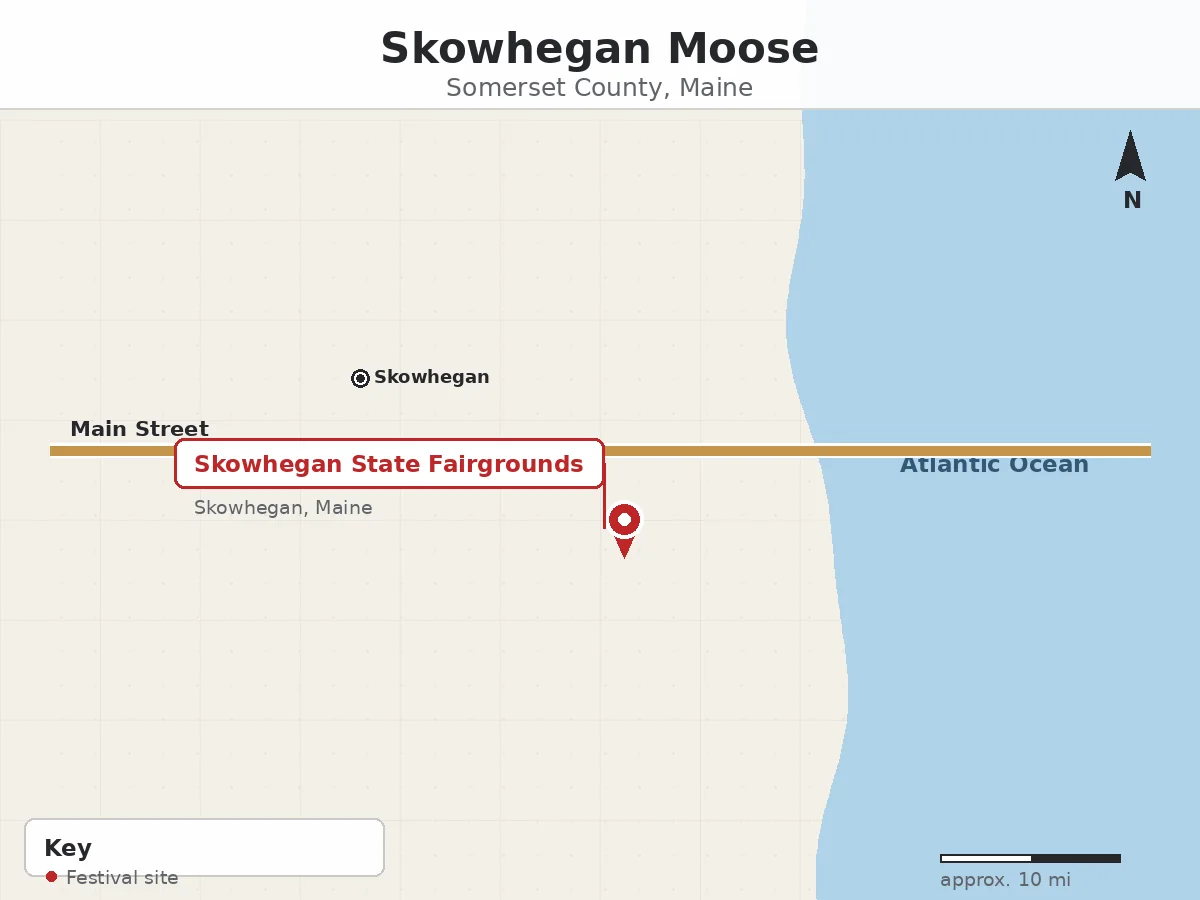
The Skowhegan Moose Festival was a single weekend celebration of Maine’s moose country, held at the Skowhegan State Fairgrounds in Skowhegan, the town where Somerset County’s government sits. Its published name appears in two forms, “Skowhegan Moose Festival” and the shorter “Moosefest”. The organiser is recorded in two forms that are carried unmerged: Main Street Skowhegan and the Skowhegan Moose Festival Committee. Main Street Skowhegan is the nonprofit organisation behind the town’s downtown revitalisation work, and the festival was one of its most visible undertakings.
The lottery was the reason the weekend existed. Each year the state Department of Inland Fisheries and Wildlife draws the names of hunters who receive moose permits, and for two thousand eighteen Skowhegan had won the right to host that drawing. The festival grew up around it. The permit results were announced on Saturday at two in the afternoon under the fairgrounds grandstand, and the rest of the weekend — the calling contests, the demonstrations, the vendors, the concert and the banquet — gave the thousands of people who came for the drawing a reason to stay for the whole weekend. About six thousand people attended from thirteen states, a crowd far larger than a first-time local event usually draws.
The weekend was free and open to the public, with two ticketed elements inside it: the Saturday night concert and the Friday wild game and craft brew banquet. Everything else — the contests, the demonstrations, the vendors and the record attempt — sat inside the free fairgrounds weekend, a shape that made the festival easy to attend without planning far ahead.
Quick Facts
| Detail | Information |
| Published name | Skowhegan Moose Festival |
| Short form | Moosefest |
| Town | Skowhegan, Maine |
| County | Somerset County |
| County seat | Skowhegan |
| Venue | Skowhegan State Fairgrounds |
| Dates | Friday the eighth of June through Sunday the tenth of June two thousand eighteen |
| Organiser | Main Street Skowhegan / Skowhegan Moose Festival Committee |
| Admission | Free and open to the public; Saturday concert and Friday banquet ticketed separately |
| Status | One-off event; no later edition documented |
History
The festival’s story starts with the moose permit lottery, not with the festival itself. For many years the drawing was held in Augusta, the state capital. That arrangement ended in nineteen ninety-nine, and after that communities around Maine began bidding to host the drawing, turning a bureaucratic announcement into a travelling celebration. Skowhegan won the hosting for two thousand eighteen, and the town’s answer was to build a whole festival around the drawing rather than simply handing over a hall for an afternoon.
For a useful comparison, see the Somerset County Maine Skowhegan Craft Brew Festival for another county festival.
The timing carried a second layer of meaning. The festival proposal noted that two thousand eighteen was the two hundredth anniversary of the Skowhegan State Fair, the long-running fair that uses the same fairgrounds. The moose festival was therefore not only a welcome for the lottery but also a nod to the fairgrounds’ own long history. The fair itself remained a separate event, and the two should not be confused: the moose festival borrowed the fairgrounds and the anniversary as a theme, but it was its own weekend with its own committee and its own programme.
Nothing in the layers read suggests the festival was meant to become a regular fixture. It was designed for a single purpose — to host the two thousand eighteen lottery — and when the weekend ended, the purpose was served. A travel-guide layer describes an annual Skowhegan moose gathering every October, but that reading contradicts the documented single June weekend and is not used here. The June two thousand eighteen weekend stands alone, a one-off built for a single drawing, and no later edition is documented.
What to Expect
The weekend opened on Friday with the wild game and craft brew banquet, a ticketed evening meal that set a sporting tone for everything that followed. Friday was the quieter day, a chance for early arrivals to settle in and meet the vendors and outdoor retailers. The fairgrounds were the centre of gravity, with food trucks and vendor stalls spread around the grounds and the grandstand waiting for Saturday’s main event.
Saturday was the heart of the weekend. The permit results were announced at two in the afternoon under the fairgrounds grandstand, the moment the whole festival had been built around. Around that announcement the programme ran in both directions: adult and child moose-calling competitions gave the weekend its signature sound, hunting and fly-fishing demonstrations and seminars with sporting experts filled the daytime hours, and the Guinness World Records attempt for the most people moose calling simultaneously brought one thousand fifty-four people together on the ninth of June, led by a registered Maine guide. The evening closed with a concert by Phil Vassar and Bryan White, with tickets at ten dollars for adults and five dollars for children twelve and under.
Sunday closed the weekend without a second headline event. The final day gave visitors a last chance to walk the vendor rows, watch the demonstrations and take in the fairgrounds before the crowds dispersed. The weekend’s shape was therefore a build: a banquet on Friday, the lottery and the record attempt and the concert on Saturday, and a gentler close on Sunday.
Planning Your Visit
Planning was simple, because the event itself was free and open to the public and the fairgrounds sat in Skowhegan, the county seat town, with the downtown close by. The two things worth settling in advance were the ticketed elements: the Friday banquet and the Saturday night concert, each sold separately from the free weekend. The concert tickets were ten dollars for adults and five dollars for children twelve and under. Everything else — the calling contests, the demonstrations, the vendors, the record attempt and the lottery announcement — needed no ticket at all.
Timing mattered most on Saturday. The permit results were announced at two in the afternoon under the grandstand, and the record attempt for simultaneous moose calling took place on the ninth of June as well, so a visitor who wanted the weekend’s two defining moments needed to be on the fairgrounds by early afternoon. Arriving on Friday made the weekend fuller, with the banquet opening the event and the vendor stalls at their freshest.
Skowhegan’s fairgrounds are built for crowds, and about six thousand people attended from thirteen states, so the grounds handled a large gathering without the cramped feel of a downtown street festival. Comfortable shoes, a layer for a June evening and an appetite for food truck fare were the practical needs. The downtown scavenger hunt rewarded anyone willing to leave the fairgrounds for an hour.
Sample Itinerary
Friday began with arrival and a walk through the fairgrounds, where the vendor stalls and outdoor retailers were set up and the food trucks were serving. The downtown scavenger hunt offered a reason to leave the grounds and see Skowhegan’s streets before the evening, and the wild game and craft brew banquet closed the day for those who held tickets.
Saturday was the full day. The morning belonged to the demonstrations and seminars and to the moose-calling competitions for adults and children. By early afternoon the crowd gathered under the grandstand for the two o’clock announcement of the permit results, the moment the festival existed to stage. The record attempt for simultaneous moose calling followed on the same day, with one thousand fifty-four people calling together under the guidance of a registered Maine guide. The evening belonged to the concert, with Phil Vassar and Bryan White on the Saturday night stage.
Sunday was for a last slow walk. The vendor rows, the food trucks and the demonstration areas were still there, and the fairgrounds had a quieter feel as the weekend wound down. A visitor could revisit a favourite stall and leave with a sense of the whole weekend rather than a single moment.
How It Compares
The closest comparison is the Skowhegan State Fair, which uses the same fairgrounds and which marked its two hundredth anniversary in two thousand eighteen, the same year as the moose festival. The two are easy to confuse because they share a venue and a year, but they are different events with different purposes: the fair is a long-running county fair, while the moose festival was a one-off built around a single lottery drawing.
The lottery itself offers a second comparison. Before nineteen ninety-nine the drawing was held in Augusta, and after that it travelled from community to community as towns bid to host it. Skowhegan’s festival was therefore part of a travelling tradition rather than a fixed one. Skowhegan’s version was distinguished by its record attempt and its concert.
Against other Maine festivals, the moose weekend stands out for its narrow focus. Most Maine festivals celebrate a harvest, a catch or a season, and they return year after year. This one celebrated a single animal and a single administrative moment, and it ran once. That narrowness is its distinction: it was not trying to become a tradition, and its value lies in the weekend it actually staged.
A Visitor Checklist
- Settle the two ticketed elements first: the Friday banquet and the Saturday night concert were sold separately from the free weekend.
- Be on the fairgrounds by early Saturday afternoon for the two o’clock permit announcement under the grandstand.
- Plan around the Saturday record attempt, which brought one thousand fifty-four people together for simultaneous moose calling.
- Leave an hour for the downtown scavenger hunt, which took visitors off the fairgrounds and into Skowhegan’s streets.
Beyond the Festival
Skowhegan itself is worth more than a single weekend’s attention. The town holds the seat of Somerset County, and its downtown carries the shape of a mill town that has spent years rebuilding itself around its river and its streets. Main Street Skowhegan, one of the festival’s organisers, exists to carry that rebuilding work forward.
The fairgrounds are the town’s gathering ground, home to the state fair that marked its two hundredth anniversary in two thousand eighteen. The moose festival’s use of the grounds for a single weekend shows how flexible that space is: it can hold a county fair, a lottery celebration and a world record attempt in the same season.
Moose loom large in Maine’s identity, and the festival leaned into that. The calling contests, the record attempt and the lottery itself all turn on the animal’s place in the state’s outdoor life. The lottery, with its travelling host towns and its crowds of hopeful hunters, is a Maine institution, and the festival gave that institution a weekend of celebration rather than a bare announcement.
Why It Matters
The festival matters because it shows what a small town can do with a single opportunity. Skowhegan bid for the lottery hosting, won it, and answered with a full weekend rather than a brief ceremony. The record attempt — one thousand fifty-four people calling together — gave the weekend a moment that travelled beyond Maine. The attendance figure, about six thousand people from thirteen states, shows that the gamble worked.
It also matters as a record of a travelling tradition. The lottery’s move from Augusta to bidding communities turned a state function into a local celebration, and Skowhegan’s version is one of the fullest examples of that pattern. The festival did not need to repeat to prove its point. It ran once and left behind a documented weekend — a banquet, a drawing, a record attempt, a concert — that says something about how Maine towns welcome the outdoors into their public life.
Frequently Asked Questions
What did the moose permit lottery have to do with the weekend?
The lottery was the reason the weekend existed. The state Department of Inland Fisheries and Wildlife draws the names of hunters who receive moose permits, and Skowhegan had won the hosting for two thousand eighteen after communities began bidding for the drawing following its long run in Augusta. The festival was built around that drawing, with the permit results announced on Saturday at two in the afternoon under the fairgrounds grandstand.
Did the Saturday night concert cost extra?
Yes. The festival weekend itself was free and open to the public, but the Saturday night concert was a separate ticketed element, with tickets at ten dollars for adults and five dollars for children twelve and under. The Friday wild game and craft brew banquet was also ticketed separately.
How did the record attempt for moose calling work?
The attempt aimed for the most people moose calling simultaneously, a Guinness World Records category, and it took place on Saturday the ninth of June two thousand eighteen. One thousand fifty-four people called together, led by a registered Maine guide. The attempt sat inside the Saturday programme alongside the calling competitions for adults and children.
Was the festival meant to return every year?
No. The festival was a one-off built around Skowhegan’s turn as host of the two thousand eighteen lottery drawing. The layers read carry no word of a second edition, and no later edition is documented. A travel-guide layer describes an annual October gathering, but that reading contradicts the documented single June weekend and is not used here.
What to Expect From the Next Somerset County Maine Skowhegan Moose Festival
How often is Somerset County Maine Skowhegan Moose Festival held?
Once. The festival ran a single time, from Friday the eighth of June through Sunday the tenth of June two thousand eighteen, and the layers read document no other edition. It was built to host that year’s moose permit lottery drawing, and it did not become a repeating event.
When is the next Somerset County Maine Skowhegan Moose Festival?
No next edition has been announced in the material reviewed, and no later date is documented. The festival was a one-off tied to Skowhegan’s two thousand eighteen lottery hosting, so there is no scheduled return to plan around.
Will the dates change?
No later dates exist that could move. The only documented dates are Friday the eighth of June through Sunday the tenth of June two thousand eighteen, and those dates are fixed in the past.
The Skowhegan Moose Festival lasted three days, drew about six thousand people from thirteen states, set a record with one thousand fifty-four voices calling at once, and then ended. It was a town’s answer to a single invitation, and it remains a finished weekend rather than an ongoing event.