Lincoln County Maine Pemaquid Oyster Festival
The Damariscotta River runs cold and brackish between two small Maine villages, and at the end of September the water gives the region its best-known reason to gather. The Pemaquid Oyster Festival takes over Schooner Landing, where the river narrows and the tide turns back on itself in a set of reversing falls, and fills the day with oysters served four ways, music over the water, poetry read aloud, and a crowd learning how the river grows the shellfish it celebrates.
A university layer describing the edition held on Sunday the twenty-ninth of September, twenty nineteen, calls the gathering free and lists educational exhibits, vendors, music and plenty of oysters, and a state tourism layer confirms the same shape. The harbour-guide layer that first described the festival, originally posted on the seventeenth of October, twenty twelve, says the event returns every year on the last Sunday in September, and in that layer’s year the Pemaquid Oyster Company pulled nearly seventeen thousand oysters for the occasion.
About
The Pemaquid Oyster Festival is an annual one-day celebration of oysters and river life held at Schooner Landing on the Damariscotta River in Lincoln County. The published name is printed exactly as the sheet title, with no variant forms seen in the layers read. The hosts, named by a university layer, are The Pemaquid Oyster Company and Schooner Landing Restaurant, two neighbours on the same stretch of waterfront whose daily work is the river’s harvest and the kitchen that serves it.
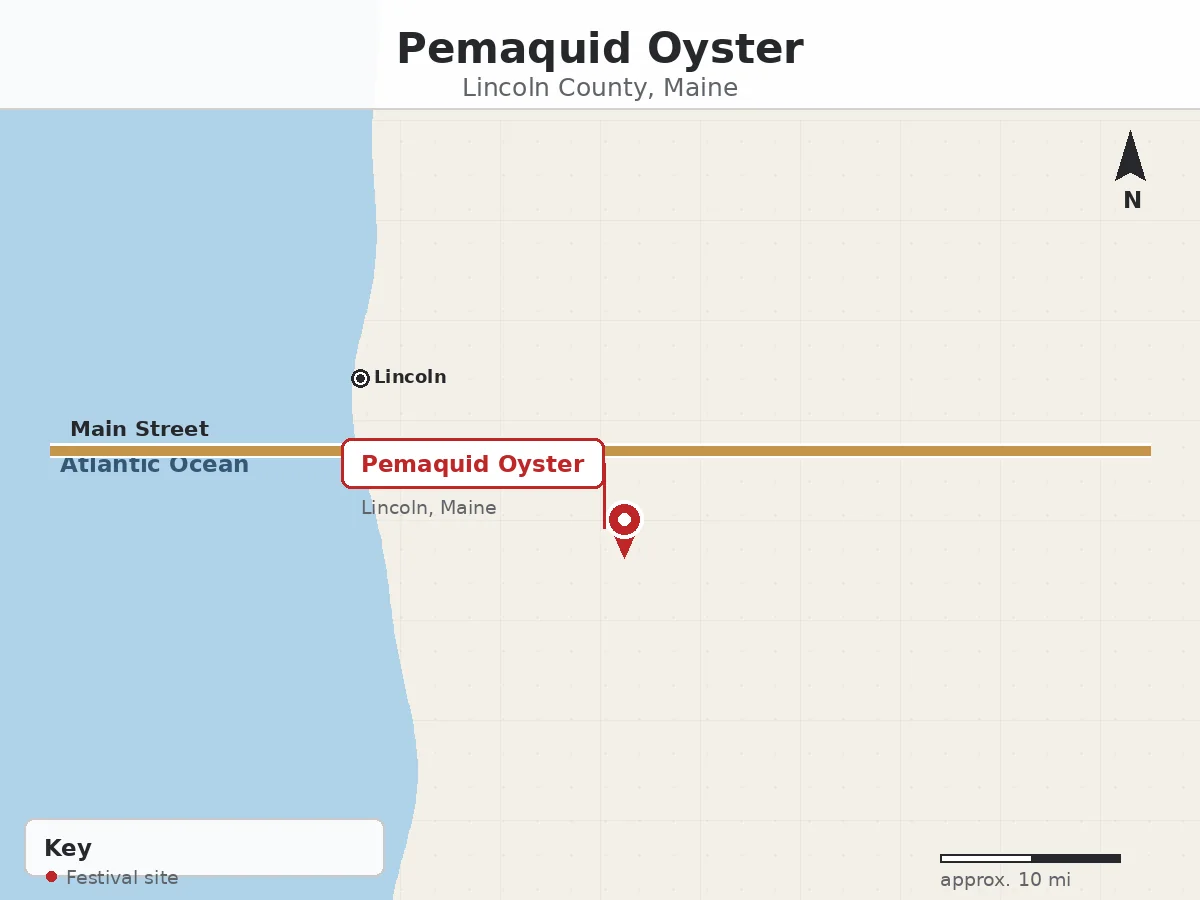
Schooner Landing overlooks the reversing tidal falls of the Damariscotta River, where the incoming tide meets the river’s flow and the water appears to change direction. The venue is given as the Schooner Landing Restaurant and Marina on Main Street by a university layer, and the harbour-guide layer places the same spot on the river between the twin villages of Damariscotta and Newcastle. The two location forms are not merged in the record: the harbour-guide layer describes the site as Newcastle, while the university layer describes it as Damariscotta. Neither village is the county seat; Wiscasset holds that place in Lincoln County.
Oysters arrive on the half-shell, roasted, barbecued and stewed. Music plays through the afternoon, poetry is read aloud, and educational exhibits explain shellfish aquaculture and the ecology of the river. A touch tank lets visitors handle marine life under the guidance of students, and an oyster-shucking competition tests who can open the most oysters in the time allowed.
For a useful comparison, see the Lincoln County Maine Fall Foliage Festival for another county festival.
Quick Facts
| Item | Detail |
| Festival name | Pemaquid Oyster Festival |
| Host villages | Damariscotta and Newcastle, twin villages on the Damariscotta River |
| County | Lincoln County, Maine |
| County seat | Wiscasset |
| Venue | Schooner Landing, overlooking the reversing tidal falls |
| Hosts | The Pemaquid Oyster Company and Schooner Landing Restaurant |
| Usual timing | The last Sunday in September each year |
| Best documented edition | Sunday the twenty-ninth of September, twenty nineteen |
| Admission | Free for the twenty nineteen edition, per a university layer |
| Signature contest | An oyster-shucking competition |
History
The festival’s beginning is not dated in the credible material. No founding year appears in the layers read, and the record offers no origin story, no named founder and no account of a first gathering. What the record does give is a pattern: a harbour-guide layer originally posted in twenty twelve describes the festival as an annual event held every year on the last Sunday in September, and a state tourism layer confirms the annual festival and its programme.
The strongest dated particular is the edition held on Sunday the twenty-ninth of September, twenty nineteen. A university layer published on the second of October, twenty nineteen, describes that day in detail, and a second university news layer carries the same account. Students from the University of Maine Semester by the Sea programme ran the touch tank, and the festival that day included educational exhibits, vendors, music and oysters, with no admission charged. That edition anchors everything this article says about the programme.
One scraped aggregator page prints fragments suggesting a longer numbered history: a fourteenth annual billing, a Sunday the twenty-seventh of September, a thirtieth of September, and a Memorial Weekend claim. The page conflates multiple years and is disowned in the research, so none of those fragments is used here, and no founding year is derived from it. The hosts give the event its continuity: the oyster company works the river’s beds, and the restaurant serves what the river yields, so the festival is the two neighbours opening their working waterfront to the public for a day.
What to Expect
A day at the festival begins at the water. Schooner Landing sits where the river narrows, and the reversing falls give the site a restless, moving backdrop. Visitors arrive to find oyster stations working through the harvest, music playing, and the touch tank drawing the day’s youngest visitors into close contact with the river’s smaller life. The pace is unhurried: a one-day village festival, not a sprawling fair, where the pleasure is in lingering.
The oysters are the centre of the day, arriving in four preparations that reward comparison. Half-shell oysters give the cleanest taste of the river, served raw with nothing between the visitor and the shellfish. Roasted oysters soften that briny edge with heat, barbecued oysters add smoke and char, and stewed oysters turn the harvest into something warm and spoonable for a cool late-September afternoon. Tasting all four is the natural way to spend the first part of the day.
The shucking competition is the day’s liveliest spectacle. Shuckers work against the clock to open the most oysters, and the contest draws a crowd because the skill is visible: a fast hand, a sure knife, a clean shell. The competition is confirmed by a state tourism layer as part of the annual programme. Exhibits explain shellfish aquaculture and the ecology of the Damariscotta River, and the touch tank, run in twenty nineteen by Semester by the Sea students, lets visitors handle marine creatures and ask questions. Poetry readings add a reflective note, and music keeps the landing lively.
Planning Your Visit
Late September in Midcoast Maine brings cool, changeable weather, and the festival takes place entirely on an exposed waterfront, so dressing in layers is the first practical step. A warm morning layer, a windproof outer layer, and comfortable shoes will cover most conditions. The event is a single day, the last Sunday in September by its established pattern, and arriving before midday gives the fullest experience, including the shucking competition and the touch tank at their busiest.
The twenty nineteen edition charged no admission, according to the university layer that described it, so visitors to that edition could walk onto the landing and take in the exhibits, music and poetry without paying at a gate. Oysters and food from vendors were the day’s purchases. Later editions carry no admission figure in the layers read, so the free entry of twenty nineteen is fenced to that edition and not presented as a standing promise.

Getting to Schooner Landing means reaching the Damariscotta River between Damariscotta and Newcastle, two villages joined by the river and by Main Street. Parking in a small river village on a festival day fills early, so arriving ahead of the midday crowd is worth the effort.
Sample Itinerary
Arrive in the late morning, when the oyster stations are fully working and the landing is busy but not yet crowded, and begin with oysters on the half-shell, the preparation that shows the river’s flavour most directly. Take a plate to a spot overlooking the falls and eat slowly, watching the tide move against the river’s flow.
From the oyster stations, move to the touch tank, where the Semester by the Sea students in twenty nineteen guided visitors through the marine life on display. The tank is the day’s best stop for families. After the tank, walk through the educational exhibits on shellfish aquaculture and river ecology, which explain how the oysters on the plate were grown in the water just beyond the landing.
Spend the early afternoon at the shucking competition, then try the roasted and barbecued oysters, comparing the smoke and heat against the clean taste of the half-shell, and finish with a bowl of oyster stew as the afternoon cools. Poetry readings and music fill the gaps between these stops. Close the visit at the water’s edge, watching the falls as the light changes.
Comparison
The comparison that matters most is with the Maine Oyster Festival in Freeport, held in June. The two events share a subject and a state, but they are different gatherings in different towns at different times of year, and nothing in the record merges them. Freeport’s festival comes at the start of summer, in a larger town with a different waterfront; Pemaquid’s comes at the end of September, on a small river landing between two villages, with the reversing falls as its backdrop.
A second comparison runs across the Atlantic. The North East Oyster Festival takes place in Newcastle, England, and the shared place-name is a coincidence of geography rather than a connection between events. The Maine festival’s Newcastle is a village on the Damariscotta River; the English festival’s Newcastle is a city in the north of England. Within Lincoln County, the Damariscotta Pumpkinfest and Regatta, held in the same twin villages in October, celebrates a different harvest: the autumn pumpkin.
Checklist
- Dress in layers for a cool late-September day on an exposed waterfront, with a windproof outer layer and comfortable shoes
- Arrive before midday to catch the shucking competition and the touch tank at their busiest
- Taste oysters in all four preparations: half-shell, roasted, barbecued and stewed
- Visit the touch tank and talk with the students staffing it about the river’s marine life
- Walk through the exhibits on shellfish aquaculture and Damariscotta River ecology
- Watch the shucking competition and note how much practice a clean, fast shuck takes
- Listen for the poetry readings between the music sets
- Stand at the water’s edge and watch the reversing tidal falls change direction
- Bring a small bag for purchases from the festival’s vendors
- Allow time to walk between Damariscotta and Newcastle along the riverfront
Beyond the Festival
The Damariscotta River region rewards a longer stay, and the festival’s late-September date places it in one of the best weeks of the Maine year, when the air is cool and the foliage is beginning to turn. The twin villages are worth walking on their own, with shops, galleries and restaurants along Main Street and the riverfront, and the working waterfront gives visitors a view of the boats and gear that keep the oyster beds productive. Wiscasset, the Lincoln County seat, lies a short drive away and offers its own historic streetscape.
The river itself is the region’s main attraction beyond the festival. The reversing falls at Schooner Landing are worth returning to at different stages of the tide, since the water behaves differently as the tide rises and falls, and the surrounding shoreline offers quiet places to watch birds and boats. Visitors with more time can explore the wider Midcoast, where working harbours, lighthouses and small museums tell the same story the festival tells in a single day.
Why It Matters
The Pemaquid Oyster Festival matters because it keeps a working river visible. Oyster farming on the Damariscotta River is a livelihood before it is a festival theme, and the event puts that livelihood on display in the place where it happens, with the growers and the restaurant that serves their harvest hosting the day together. The educational exhibits and the student-run touch tank extend that visibility to the next generation, giving young visitors a direct encounter with aquaculture and river ecology rather than a textbook account. Damariscotta and Newcastle are small places, and a one-day gathering on the river between them gives both villages a shared moment at summer’s end, when the community turns to its own harvest.
Frequently Asked Questions
What preparations of oyster does the festival serve?
Oysters are served on the half-shell, roasted, barbecued and stewed, according to the harbour-guide layer and the university layer that describe the programme. The four preparations give visitors different ways to taste the same harvest.
How does the touch tank work for visitors?
The touch tank lets visitors handle marine life with guidance from the people staffing it. In the twenty nineteen edition, students from the University of Maine Semester by the Sea programme ran the tank, answering questions and explaining the creatures on display. The tank is one of the festival’s most family-friendly features.
What is the oyster-shucking competition?
The shucking competition is a timed contest to see who can open the most oysters, confirmed by a state tourism layer as part of the annual programme. Shuckers work against the clock in front of a crowd, and the contest shows how much skill the simple act of opening an oyster takes.
Where exactly do Damariscotta and Newcastle meet at the festival?
The festival takes place at Schooner Landing, on the Damariscotta River between the two villages. The harbour-guide layer describes the site as Newcastle and the university layer describes it as Damariscotta, and the two forms are recorded unmerged in the research. The landing sits in the seam between the villages, on Main Street by the Schooner Landing Restaurant and Marina, overlooking the reversing tidal falls.
What to Expect From the Next Lincoln County Maine Pemaquid Oyster Festival
How often is Lincoln County Maine Pemaquid Oyster Festival held?
The festival is an annual event, returning each year on the last Sunday in September, according to the harbour-guide layer that first described its pattern. The state tourism layer confirms the same annual rhythm, and the twenty nineteen edition fell on that pattern, on Sunday the twenty-ninth of September.
When is the next Lincoln County Maine Pemaquid Oyster Festival?
A later edition has no printed date in the material consulted. The established pattern points to the last Sunday of September, and any visitor planning around that weekend should confirm the date with the hosts before travelling.
Will the dates change?
The festival’s timing has held steady on the last Sunday in September across the layers read, from the harbour-guide layer originally posted in twenty twelve through the twenty nineteen edition. A move away from that Sunday would break a long-standing pattern, and nothing in the material consulted suggests such a change is planned. Visitors should still confirm the date before travelling.
The Pemaquid Oyster Festival is a small, sure-footed celebration of a river and the shellfish it grows. It asks little of its visitors beyond attention: attention to the oyster in its four preparations, to the students and growers who explain the river, to the shuckers whose skill fills the afternoon, and to the falls that turn the tide back on itself beneath the landing.