Kennebec County Maine Atlantic Music Festival
Each summer, the Colby College campus in Waterville becomes a working school for classical music, and the Atlantic Music Festival opens its doors so the public can hear what that school produces. The festival is not a street fair with a stage tucked between food stalls. It is a residential institute where young musicians study, rehearse and perform, and where the concerts that grow out of that study are free and open to anyone who walks in. A visitor expecting crowds and vendors will find quiet rooms, focused listeners, and students playing beside the faculty who teach them. The published name is the Atlantic Music Festival, and it has run from the same campus since its first summer in two thousand nine.
About
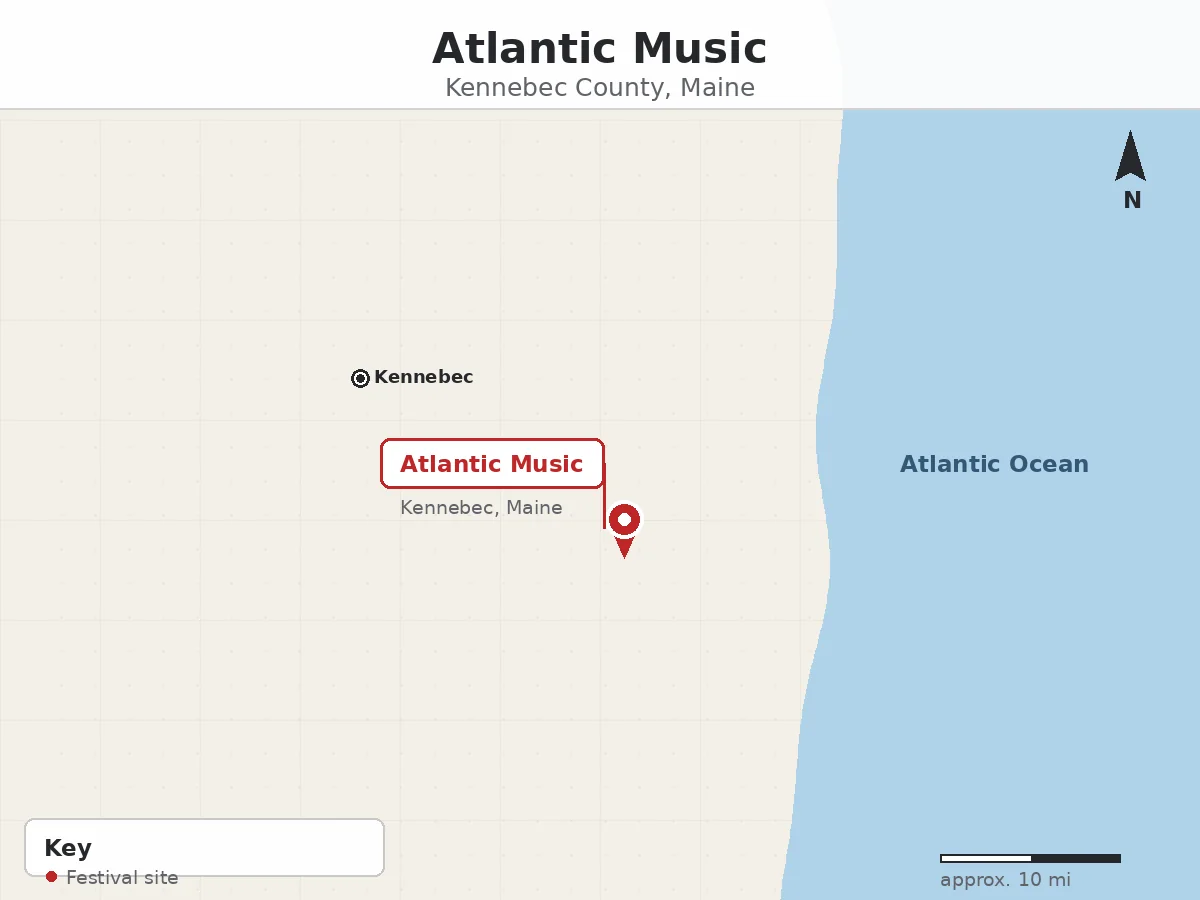
The Atlantic Music Festival is a summer classical-music institute and concert series based at Colby College in Waterville, Maine. Its published name is the Atlantic Music Festival, shortened in layers to the initials AMF. The festival began at Colby College in two thousand nine, and every documented edition took place on that campus, with concerts on campus and in the community. Waterville is the host town, and it is not the county seat of Kennebec County. Augusta holds that role, designated county seat in seventeen ninety-nine.
The organiser is the Atlantic Music Festival itself, described in the layers as a non-profit organisation dedicated to the empowerment of classical musicians. A horn-society layer from two thousand nine also records support from Little Feather Works. The programme is built around five divisions: chamber music, full orchestra, composition, conducting and opera. The public side is a concert series of dozens of free orchestral and chamber concerts by resident artists and faculty. About one hundred fifty students took part in the two thousand twenty-three edition, the latest dated edition in the layers read. No dated edition from two thousand twenty-four, two thousand twenty-five or two thousand twenty-six appears in the layers read.
Quick Facts
| Detail | Information |
| Published name | Atlantic Music Festival |
| Host town | Waterville, Maine |
| County seat | Augusta, designated in seventeen ninety-nine |
| Venue | Colby College, Waterville |
| Chapel named in two thousand nineteen | Lorimer Chapel |
| Organiser | Atlantic Music Festival, a non-profit organisation |
| First held | Two thousand nine at Colby College |
| Latest documented edition | Twenty-six June to eight August, two thousand twenty-three |
| Programme divisions | Chamber music, full orchestra, composition, conducting, opera |
| Concert admission | Free and open to the public |
History
The Atlantic Music Festival began at Colby College in two thousand nine. The inaugural event ran six weeks, from twenty-two June to thirty-one July, and it set the pattern ever since: a residential institute on a college campus, with study and performance folded together across the summer. A university layer records the beginning.
The next dated edition is the two thousand twelve fellowship, which ran from nine July to five August. An opera workshop ran from two to twenty July, two thousand seventeen. The two thousand nineteen season ran from thirty June to twenty-eight July, and a programme layer from that year names Lorimer Chapel among the concert venues on campus. The two thousand twenty-two edition ran from twenty-six June to seven August. The two thousand twenty-three edition, the latest dated edition in the layers read, ran from twenty-six June to eight August. About one hundred fifty students took part that summer.
For a useful comparison, see the Kennebec County Maine Maine International Film Festival for another county festival.
That run of dates leaves a clear gap after two thousand twenty-three. The layers read document no edition from two thousand twenty-four, two thousand twenty-five or two thousand twenty-six. Nothing in them says the festival ended, and nothing in them announces a later edition either. The record stops at two thousand twenty-three, and any later season would need a fresh layer to confirm it. The festival’s home has never moved: every dated edition sits at Colby College in Waterville, and the five divisions have stayed constant across the dated record.
What to Expect
A visit to the Atlantic Music Festival is a visit to a working institute, and the rhythm of the place follows the rehearsal schedule. Mornings and afternoons belong to study and rehearsal. Students practise in studios, coaches work through chamber pieces bar by bar, and the orchestra builds a programme across days of rehearsal before it plays it in public. Evenings belong to the concerts, which any visitor can walk into.
The concert series is the public face of the festival. Dozens of free orchestral and chamber concerts are given across each season by resident artists and faculty, and a state arts layer describes them as free and open to the public. The music is classical, played in concert halls and chapels rather than outdoors, for listeners who have come for the music itself. A visitor should expect quiet rooms and programmes that change from night to night.
The five divisions shape what a listener hears. Chamber music puts small groups close together, and the sound is intimate enough to follow a single line as it passes between instruments. The full orchestra brings the largest forces together and fills the biggest rooms on campus. Composition means new student work is heard in performance. Conducting puts young conductors in front of real players, and opera brings singers and staging into a programme that is otherwise instrumental. Lorimer Chapel, named in a two thousand nineteen programme layer, is one campus venue. There are no rides, no midway and no vendor rows.
Planning Your Visit
Waterville is the host town, and Colby College is the venue, so a visit begins with the campus. The concerts are free and open to the public, according to a state arts layer, so a visitor needs no pass or ticket. The institute itself is a different matter: it is a tuitioned residency, and fellowships cover tuition, housing and meals for the participating musicians. The tuition is a participant fee, not a charge at the door.
Because the latest dated edition in the layers read is two thousand twenty-three, a visitor should confirm the current season before travelling. The layers read carry no dated edition from two thousand twenty-four, two thousand twenty-five or two thousand twenty-six, so the article cannot give a current date. A reader who wants to attend should look for a fresh announcement from the festival itself.
When a season is running, the shape of a visit is simple. Concerts take place on campus and in the community, so a visitor can walk between venues, and an evening concert is the natural centre of a day. Arriving early gives time to find a seat, and the programmes are worth reading before the music starts. The planning that matters is the planning of time: which evenings to attend and which divisions to hear. The documented seasons all fall in late June, July and early August, so warm-weather clothing and an evening layer are the sensible choices.
Sample Itinerary
A three-evening visit gives a fair taste of the festival.

On the first evening, arrive in Waterville in the late afternoon and walk the Colby College campus before the concert. Find the hall or chapel, read the programme, and settle in early. A chamber concert is a good opening night, because the small forces let a listener hear individual players clearly.
On the second evening, attend a full orchestra concert. These are the largest performances of the season, and they show what weeks of rehearsal can build.
On the third evening, choose a programme from one of the other divisions, such as composition or opera. A composition concert offers new work heard in performance for the first time, and an opera workshop brings singers into a season that is otherwise instrumental.
Comparison
The Atlantic Music Festival is easy to confuse with a public street festival, and the two kinds of event ask different things of a visitor. A street festival fills a town centre with stalls, rides and food, and its pleasures are broad and immediate. The Atlantic Music Festival fills a college campus with rehearsals and concerts, and its pleasures are narrower and slower. The audience is a room of listeners sitting still, following a piece of music from its first notes to its last.
The difference shows in the admission as well. A street festival often charges at a gate or sells wristbands for rides. At the Atlantic Music Festival the public concerts are free and open to the public, and the money sits on the other side of the event: the institute is a tuitioned residency, and fellowships cover tuition, housing and meals for the musicians who study there. A visitor pays nothing to listen. A student pays tuition, or holds a fellowship that covers it.
The length of the event is another point of contrast. A street festival usually lasts a weekend. The Atlantic Music Festival lasts weeks. The inaugural event ran six weeks, from twenty-two June to thirty-one July, two thousand nine, and the later documented seasons run four to six weeks each. That length is the time a student needs to learn a programme, rehearse it, and perform it.
Checklist
- Confirm the current season before travelling, since the latest dated edition is two thousand twenty-three
- Remember that Waterville hosts the festival and Augusta is the county seat
- Plan around evening concerts on the Colby College campus and in the community
- Read each night’s programme before the music starts
- Arrive early for orchestra concerts, which draw the largest audiences
- Expect quiet concert rooms rather than a midway or vendor rows
- Bring an evening layer for air-conditioned halls
- Keep the institute’s tuition separate from the free concerts
- Allow time to walk the campus between venues
- Treat the five divisions as a guide to what you might hear
Beyond the Festival
Waterville is a small Maine city, and the festival sits inside a college campus rather than inside a fairground, so the time around the concerts belongs to the town and the county. A visitor can walk the campus in the daytime, when the students are rehearsing, and then walk into Waterville itself before an evening concert. The town is compact, and the college is close to its centre. Augusta, the county seat since seventeen ninety-nine, lies nearby.
The festival also belongs to a wider Maine summer, in which colleges and towns host music across the state. What sets this one apart is its form: a residential institute where the performers are students in the middle of their training, and where the audience hears music that is still being learned.
Why It Matters
The Atlantic Music Festival matters because it treats classical music as something to be studied and lived with, not only performed. A summer institute gives young musicians weeks of uninterrupted work with teachers and with one another, and the concerts that come out of that work are free for the public to hear. The festival’s own description calls it a non-profit organisation dedicated to the empowerment of classical musicians, and the students are the centre of the event.
The five divisions give the institute its breadth. Chamber music teaches players to listen to one another in small groups. The full orchestra teaches them to play as one large body. Composition teaches them to write the music they will one day perform. Conducting teaches them to lead. Opera teaches singers and players to work together across disciplines.
Frequently Asked Questions
Can I attend the concerts without being a student at the institute?
Yes. The public concerts are free and open to the public, according to a state arts layer, and a visitor needs no connection to the institute to hear them. The institute itself is a tuitioned residency, with fellowships covering tuition, housing and meals, and that residency is separate from the concert series.
What should a first-time listener expect at a chamber concert in Waterville?
A chamber concert is a small-group performance, usually in a chapel or hall on the Colby College campus, and the sound is close enough to follow a single instrument’s line as it passes between players. The audience sits quietly, the programme changes from night to night, and the musicians are students and faculty in the middle of a summer of study.
How does the fellowship residency work for participating musicians?
The institute is a tuitioned residency, and fellowships cover tuition, housing and meals for the musicians who take part. About one hundred fifty students took part in the two thousand twenty-three edition, working across the five divisions. The residency lasts weeks. The tuition and the fellowships belong to the participants, not to the public audience, whose concerts are free.
What happened to the festival after the two thousand twenty-three edition?
The layers read document no edition from two thousand twenty-four, two thousand twenty-five or two thousand twenty-six, and the latest dated edition is two thousand twenty-three, which ran from twenty-six June to eight August. Nothing in the layers read says the festival ended, and nothing in them announces a later edition either.
What to Expect From the Next Kennebec County Maine Atlantic Music Festival
How often is Kennebec County Maine Atlantic Music Festival held?
The documented record shows a summer season in each year it covers, from the inaugural six-week event in two thousand nine through the two thousand twenty-three edition, with dated seasons in two thousand nine, two thousand twelve, two thousand seventeen, two thousand nineteen, two thousand twenty-two and two thousand twenty-three.
When is the next Kennebec County Maine Atlantic Music Festival?
No next date is documented in the layers read. The latest dated edition ran from twenty-six June to eight August, two thousand twenty-three, and no edition from two thousand twenty-four, two thousand twenty-five or two thousand twenty-six appears in the layers.
Will the dates change?
The documented seasons have always fallen in late June, July and early August, and the dates have varied from year to year within that window. The inaugural event ran from twenty-two June to thirty-one July, two thousand nine, and the two thousand twenty-three edition ran from twenty-six June to eight August. Any future season would be expected to sit in the same summer window.
The Atlantic Music Festival is a summer school that opens its concerts to the public, and its value lies in that openness. Students spend weeks at Colby College in Waterville studying chamber music, orchestra, composition, conducting and opera, and the concerts they give are free for anyone to hear. The latest dated season in the public record is two thousand twenty-three.