West Baton Rouge Parish Louisiana SugarFest Festival
Every October, the grounds of the West Baton Rouge Museum in Port Allen fill with the smell of boiling cane syrup and the sound of live music drifting out of the galleries. SugarFest — printed in the layers as both “SugarFest” and “Sugar Fest” — is a sugarcane-harvest celebration held at the museum, one of the parish’s most distinctive autumn gatherings. Mules walk a slow circle to grind cane, blacksmiths work iron at a forge, and visitors chew fresh cane while jazz, spirituals, folk, Cajun, zydeco and blues play. The museum stays open throughout, its galleries a quieter counterpoint to the noise outside.
About
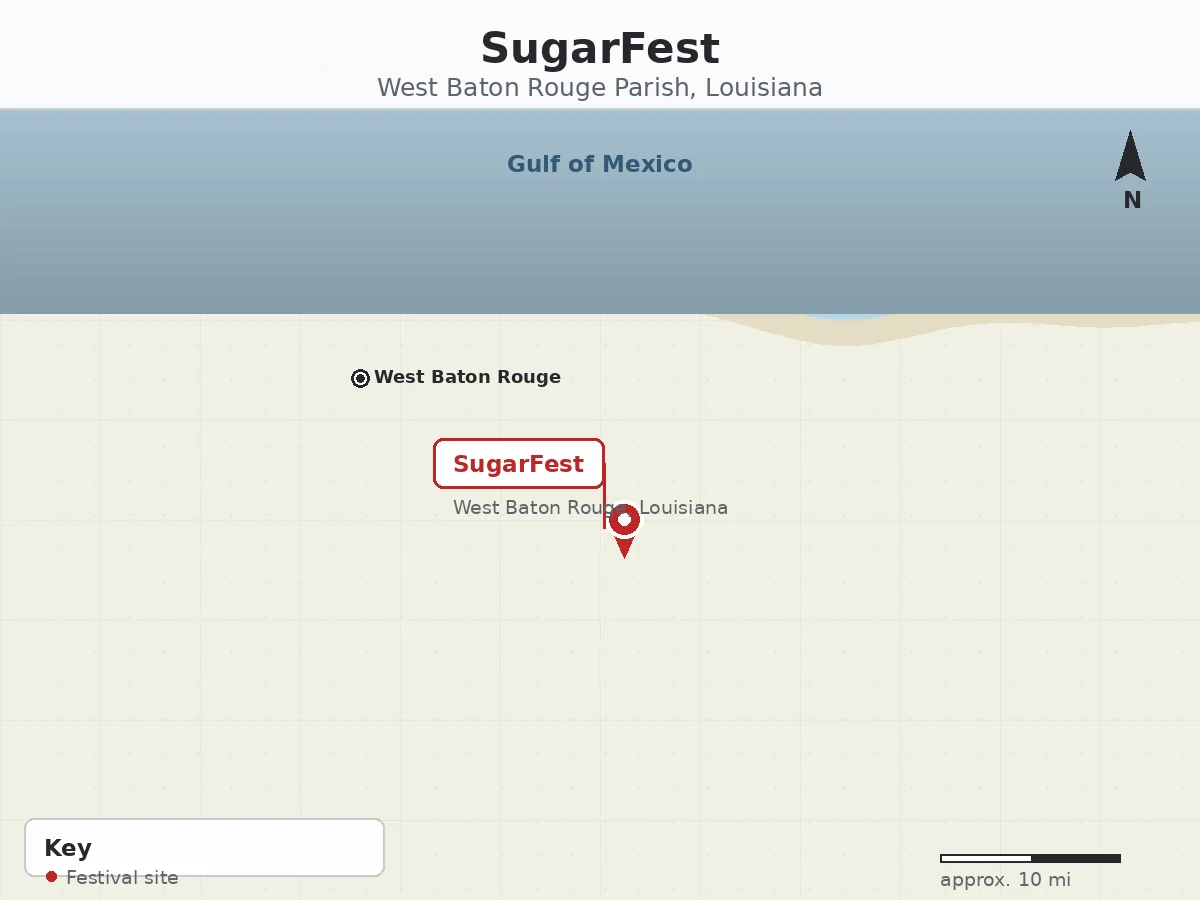
SugarFest takes place in Port Allen, which a reference layer states expressly is the parish seat of West Baton Rouge Parish. The venue throughout the documented editions is the West Baton Rouge Museum, which is also the organiser, with the parish historical association supporting the jambalaya lunch and the sweets booth. The sheet title, with its doubled “Fest Festival” element, is never printed exactly in the layers read; the event appears as “SugarFest” and as “Sugar Fest”, and this article uses those published forms.
The celebration is built around the sugarcane harvest. Mule-driven cane grinding sits at the centre of the day, alongside cane cutting and syrup boiling demonstrations, praline making, blacksmithing and woodworking. Visitors can chew sugarcane and drink cane juice, join a jambalaya lunch, enter or watch the Sweets Contest, try the cake walk, and play historic games. Live music runs across jazz, spirituals, folk, Cajun, zydeco and blues, and the museum galleries stay open, with rooms showing Blue Dog paintings.
Six dated editions run through the layers read, from 3 October 2021 through the 2026 edition printed by a parish CVB layer. A news layer records more than two hundred guests at the 29th annual edition in October 2024. The 2023 edition ran eleven in the morning to four in the afternoon, and the CVB layer prints the 2026 edition with the same hours. Admission is described as free in the layers that state it — a 2023 magazine listings layer and a student newspaper layer, the latter putting it as “everything is free” — and one CVB layer notes that admission details may vary year to year, so the free position is fenced to those layers.
Quick Facts
| Detail | Information |
| Published name | SugarFest / Sugar Fest |
| Host town | Port Allen, the parish seat |
| Venue | West Baton Rouge Museum |
| Organiser | West Baton Rouge Museum, with the parish historical association supporting the jambalaya lunch and sweets booth |
| 28th annual edition | Sunday 1 October 2023, eleven in the morning to four in the afternoon |
| 29th annual edition | Sunday 6 October 2024, more than two hundred guests |
| 2025 edition | Sunday 5 October 2025 |
| 2026 edition | Sunday, October 5, 2026, eleven in the morning to four in the afternoon, as printed by a parish CVB layer |
| Admission | Free per the 2023 magazine listings layer and the student newspaper layer |
| Signature demonstrations | Mule-driven cane grinding, syrup boiling, praline making, blacksmithing, woodworking |
History
The history of SugarFest, as the layers state it, is a record of annual billings rather than a founding story. The 28th annual edition fell on Sunday 1 October 2023, and the 29th followed in October 2024, dated Sunday 6 October 2024 by a parish CVB newsletter layer. No founding year is derived from those billings, and none is stated in the layers read. The earliest dated edition is 3 October 2021, described in a student newspaper layer; a CVB newsletter layer dates an edition to 2 October 2022, a parish CVB layer records Sunday 5 October 2025, and the same kind of layer prints the 2026 edition as Sunday, October 5, 2026, eleven in the morning to four in the afternoon.
For a useful comparison, see the Webster Parish Louisiana Scene It Trunk-or-Treat Festival for another county festival.
What the record shows, edition after edition, is a steady gathering at the same museum grounds, the parish historical association supporting the jambalaya lunch and the sweets booth. Sugarcane is the thread running through the whole history: the parish grew up around cane fields, mills and the river trade that carried sugar to market, and the festival’s demonstrations — grinding, cutting, boiling — re-enact the work that shaped the place. The galleries and grounds keep the parish’s past within reach of the celebration, and visitors who come for the music or the food end up standing beside a working cane mill, watching a process that once employed whole communities along the river.
A 28th annual edition in 2023 and a 29th in 2024 suggest a long-running event, but the layers read do not state a founding year, and this article does not calculate one. The programme has stayed consistent across the documented editions: cane work, crafts, food, music and open galleries, with the Sweets Contest and the jambalaya lunch recurring as fixtures of the day.
What to Expect
The first thing you are likely to notice is the cane mill. Mules drive the grinding, and the cut cane goes through the press while visitors watch the juice run. Nearby, demonstrators cut cane and boil syrup, and the smell of the boiling juice carries across the grounds. Praline making draws a crowd of its own, and the blacksmith and woodworker stations show hand skills from the same working past as the cane harvest. These are demonstrations rather than displays behind glass: the work happens in front of you, and the people doing it talk through what they are doing.
Food anchors the middle of the day. The jambalaya lunch, supported by the parish historical association, is the main meal, and the sweets booth and Sweets Contest give the day its baking contest. A cake walk runs alongside the food stalls, and historic games offer something for children who want to play rather than watch. Sugarcane chewing and cane juice are the simplest pleasures of the day — a stalk of cane, a cup of juice, and a place to sit in the shade.
Music runs through the afternoon in a wide mix: jazz, spirituals, folk, Cajun, zydeco and blues. The layers do not name individual performers for the documented editions, so this article does not list a lineup; the mix itself is the point, and it changes with the year. Between sets, the museum galleries stay open, including rooms showing Blue Dog paintings, for anyone who wants to step out of the sun and the crowd.
Planning Your Visit
Port Allen sits across the river from Baton Rouge, and the West Baton Rouge Museum is the address to aim for. The documented editions run on a Sunday in early October, and the hours printed for the 2023 and 2026 editions are eleven in the morning to four in the afternoon. Arrive near opening to see the cane grinding from the start, since the mill work sets the tone for the whole day.
Admission is described as free in the layers that state it — a 2023 magazine listings layer and a student newspaper layer. One CVB layer notes that admission details may vary year to year, so check the museum’s current listing before you travel. Food, the jambalaya lunch and the sweets booth are part of the day’s spending.
Wear comfortable shoes for grass and gravel, and bring sun protection and water for an October afternoon outdoors. The museum galleries offer shade and seating if you need a break, and the grounds are compact enough that the demonstrations, the food stalls and the music are all within easy walking distance. If you are coming from outside the parish, give yourself time for the river crossing, and check the museum calendar for the current year’s date before setting out.

A Sample Itinerary
A good day at SugarFest starts at the cane mill. Arrive close to eleven in the morning and head for the grinding demonstration first, while the mules are working and the juice is running. Watch the cane cutting and syrup boiling beside it, then move on to the praline making and the blacksmith and woodworker stations while the morning is cool.
Around midday, join the jambalaya lunch and pick up cane juice or a stalk of cane to chew. Spend the early afternoon at the Sweets Contest and the sweets booth, try the cake walk, and let children take a turn at the historic games. Drift between the music sets as the afternoon warms up.
Late in the afternoon, step inside the museum galleries for a slower hour among the exhibits and the Blue Dog paintings. Finish the day back outside for the last music, and leave before the four o’clock close.
How SugarFest Compares
SugarFest belongs to a family of Louisiana harvest celebrations, but its shape is its own. A midway-style fair fills its grounds with rides and a carnival atmosphere; SugarFest fills its grounds with working demonstrations, and the cane mill is the centre of the day rather than a sideshow. A music-only festival builds its programme around a stage and a lineup; here the music is one thread among many, and the layers read do not name the performers, because the day does not depend on any single act.
The museum setting is the other difference. Many harvest events take place on fairgrounds or town streets, and their history is told on signs. At SugarFest the history is in the building itself: the museum’s galleries and grounds hold the parish’s past, and the demonstrations re-enact work that once filled the parish’s fields. The Sweets Contest and the jambalaya lunch give the day a community-table feeling, and the free entry described in the layers that state it keeps the day open to anyone who wants to come.
Checklist
- Check the museum calendar for the current year’s Sunday date before you travel
- Arrive near eleven in the morning to catch the cane grinding from the start
- Wear comfortable shoes for grass and gravel, and bring sun protection and water
- Bring something to carry purchases from the food and craft stalls
- Plan time for the jambalaya lunch and the Sweets Contest
- Step inside the museum galleries for shade, seating and the Blue Dog paintings
- Allow time for the river crossing if you are travelling from Baton Rouge
- Keep the afternoon free until four o’clock so you can hear the last music
Beyond the Festival
Port Allen rewards a slower look after the festival ends. The town is the parish seat, and its riverfront position across from Baton Rouge has shaped its whole history. The museum itself is worth a return visit on a quieter day, when the galleries can be walked without the festival crowd and the parish’s story — cane fields, river trade, small-town life — can be taken in at leisure.
The wider parish is sugarcane country, and the fields around the town are the same fields whose harvest the festival celebrates. Driving the parish roads in October, with cane standing tall, gives the museum demonstrations a context that no single day can provide. The festival is one Sunday in the year; the landscape it celebrates is there all year.
Why SugarFest Matters
SugarFest matters because it keeps a working past visible. Sugarcane built West Baton Rouge Parish, and the festival lets visitors watch the work — grinding, cutting, boiling — rather than reading about it on a plaque. The mule-driven mill, the forge, the praline pot and the woodworker’s bench are all parts of a single story about how people in this parish once made a living from the land, told with hands and noise and smell rather than words alone.
It matters as a community gathering, too. The museum grounds bring together the parish historical association, the museum’s staff, local cooks, musicians and craftspeople, and the more than two hundred guests recorded at the 2024 edition. The Sweets Contest and the jambalaya lunch are shared tables in the plainest sense, and the music carries the parish’s mixed heritage in a single afternoon. A festival that charges nothing at the gate, as the layers that state it describe, opens that gathering to everyone.
Frequently Asked Questions
What makes SugarFest different from other Louisiana harvest events?
The cane work is the difference. Mule-driven grinding, cane cutting and syrup boiling happen live on the museum grounds, and the blacksmithing, woodworking and praline making around them belong to the same working past. The galleries stay open during the event, so the celebration and the parish’s history share the same ground.
Is SugarFest a good fit for children?
Yes. Historic games, the cake walk, cane chewing and cane juice all suit younger visitors, and the demonstrations are easy to watch without any special knowledge. The museum galleries give families a shaded place to rest, and the grounds are compact enough for children to move between the mill, the food stalls and the music without long walks.
Can I watch the cane grinding up close?
Yes. The mule-driven grinding is a demonstration rather than a display behind glass, and visitors gather around the mill to watch the cane go through the press and the juice run. The cane cutting and syrup boiling demonstrations work the same way, and the people running them talk through the process.
What should I bring to the museum grounds?
Comfortable shoes, sun protection and water cover most of the day, since the grounds are outdoors and the October sun is still strong. Bring something to carry purchases from the food and craft stalls, and check the museum calendar for the current year’s date before you set out.
What to Expect From the Next West Baton Rouge Parish Louisiana SugarFest Festival
How often is West Baton Rouge Parish Louisiana SugarFest Festival held?
SugarFest comes around once each autumn, on a Sunday in early October at the West Baton Rouge Museum. The documented editions run from 3 October 2021 through the 2026 edition printed by a parish CVB layer, with the 28th annual edition in 2023 and the 29th in 2024.
When is the next West Baton Rouge Parish Louisiana SugarFest Festival?
The parish CVB layer prints the 2026 edition as Sunday, October 5, 2026, eleven in the morning to four in the afternoon. For editions after that, the museum calendar is the place to confirm the date, since the Sunday shifts within early October from year to year.
Will the dates change?
The Sunday has moved within early October across the documented editions — 1 October in 2023, 6 October in 2024, 5 October in 2025, and 5 October in 2026 as printed by the CVB layer — so the date is best treated as an early-October Sunday rather than a fixed day. Check the museum calendar as the autumn approaches for the current year’s date.
SugarFest is a small festival with a clear purpose: to show, rather than tell, how sugarcane shaped West Baton Rouge Parish. The mill, the forge, the praline pot, the jambalaya lunch and the music all belong to the same story, and the museum grounds hold it in one place for a single Sunday each October. Come for the cane grinding, stay for the music, and leave with a better sense of the parish the harvest built.