Terrebonne Parish Louisiana Voice of the Wetlands Festival
Houma listens to its bayous the way other towns listen to a town clock, and every autumn the Terrebonne Parish Louisiana Voice of the Wetlands Festival turns that listening into a weekend of music, food and plain talk about the coast. The gathering takes its name from the wetlands that shape daily life across Terrebonne Parish, and it wears that name honestly: the stages carry blues, Cajun and zydeco, the food booths serve the cooking of the bayou country, and the whole weekend doubles as a public lesson in what the marshes give and what they are losing. The result is a festival that feels rooted rather than staged, a weekend where the entertainment and the message share the same ground. People who have never set foot in Terrebonne Parish leave knowing how the parish sounds, tastes and thinks, and people who live there find their home described back to them in a language they recognise.
About
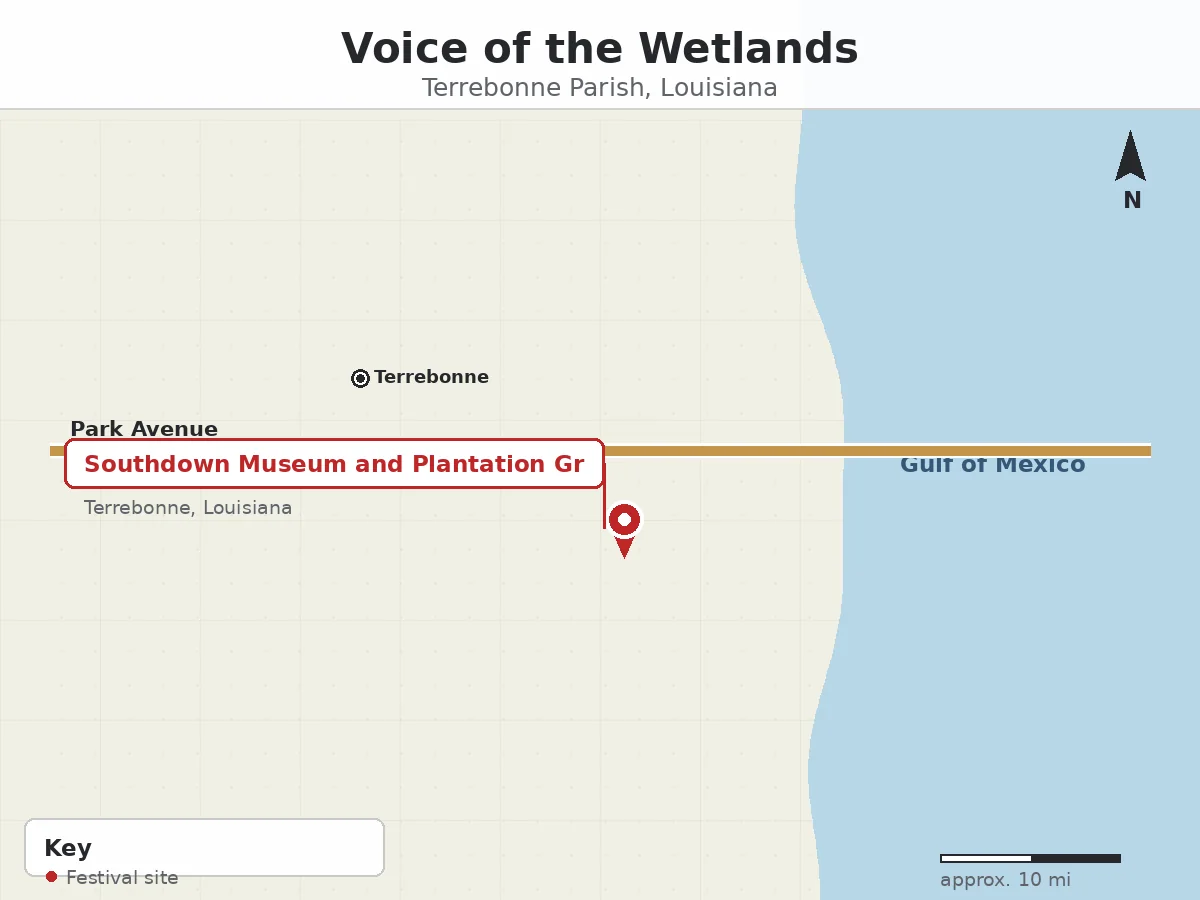
The Voice of the Wetlands Festival is a music and culture gathering held in Houma, the parish seat of Terrebonne Parish, and organised by the Voice of the Wetlands foundation, a nonprofit organisation. The festival was launched in two thousand four by Tab Benoit, a Houma native and blues musician whose name is the documented fact of the festival’s founding, and it has been held in the parish ever since. Its home in recent editions is the Ponderosa, on West Park Avenue in Houma, a site with room for two stages, an art market, a children’s area and space for RV and tent camping. Earlier editions were held in downtown Houma and at the Southdown Museum and Plantation Grounds, so the festival has moved around its home town while keeping its identity intact. The Friday Night Guitar Fights, headlined by the founder, give the opening night a competitive edge, with guitarists trading solos while the crowd decides whose playing carries the room. Admission is free and open to the public, per the organiser’s own site and a music-magazine layer.
Quick Facts
| Field | Detail |
| Festival | Terrebonne Parish Louisiana Voice of the Wetlands Festival |
| Published name | Voice of the Wetlands Festival |
| Host town | Houma, the parish seat of Terrebonne Parish |
| Venue | The Ponderosa, West Park Avenue, Houma |
| Organiser | Voice of the Wetlands foundation, a nonprofit organisation |
| Founded | Two thousand four, by Tab Benoit |
| First edition | Nine and ten October two thousand four, downtown Houma |
| Recent editions | Twelfth to fourteenth October two thousand eighteen, eleventh to thirteenth October two thousand nineteen |
| Admission | Free and open to the public |
| Programme | Blues, Cajun and zydeco music, Cajun cuisine, art market, children’s area, camping |
History
The festival began in two thousand four, when Tab Benoit, a blues musician born in Houma, launched a weekend that would put music to work for the wetlands he had grown up beside. The first festival ran on the ninth and tenth of October two thousand four in downtown Houma, and a government newsletter layer records that opening edition as the start of the gathering. From the beginning the idea was straightforward: bring people together with the music of south Louisiana and use the crowd, the stage and the attention to talk about coastal land loss. After the downtown opening, editions were held at the Southdown Museum and Plantation Grounds, a site that anchors the festival in the parish’s plantation past, before the weekend settled at the Ponderosa on West Park Avenue, where the grounds could hold two stages, camping and a bigger art market. The edition of the twelfth to fourteenth of October two thousand eighteen was billed the fifteenth annual, and the edition of the eleventh to thirteenth of October two thousand nineteen was billed the sixteenth annual. Those billings are recorded as printed, and no founding year is derived from them, since the launch year of two thousand four is documented on its own.
What to Expect
Arrive expecting music that starts early and keeps going after dark. Two stages carry the weekend, with blues, Cajun and zydeco acts rotating through the day, so there is rarely a quiet hour between the first set and the last. Families will find a children’s area set aside for younger visitors, and the grounds at the Ponderosa leave room for RV and tent camping, which means some visitors settle in for the whole weekend rather than driving in and out each day. The Friday Night Guitar Fights give the opening night its centrepiece, with the founder headlining a session in which guitarists trade licks and the crowd follows every exchange. The festival’s other current is the wetlands message, carried in displays and conversation rather than lectures, so a visitor can learn about coastal land loss between sets without leaving the music behind. Expect a crowd that mixes parish residents with visitors from across Louisiana and beyond, and expect the weekend to feel communal rather than commercial, with free admission keeping the gates open to anyone who wants to come.
Planning Your Visit
Because admission is free and open to the public, there is no ticket to buy in advance, and visitors can plan around the music rather than around a box office. Check the organiser’s own site before travelling for the current year’s dates and stage times, since the weekend’s exact dates are set edition by edition. The programme runs across the day and into the night, with the Friday Night Guitar Fights anchoring the opening evening and the late-night jam sessions running after the main stages close, so an overnight stay makes sense for anyone who wants the full weekend. RV and tent camping on the grounds gives visitors a way to stay close to the music, and Houma’s hotels and guest houses cover those who prefer a bed in town. Bring sun protection and rain gear, since October weather in south Louisiana can turn warm, humid or wet without much warning, and wear shoes suited to grass and open ground. Parking fills as the day goes on, so arriving earlier in the afternoon is the simplest way to secure a close spot.
For a useful comparison, see the Terrebonne Parish Louisiana Good Earth 4th of July Festival for another county festival.
Sample Itinerary
A first-time visitor can shape the weekend around the music and the message in equal measure. Arrive on Friday afternoon, settle into the grounds at the Ponderosa, and walk the art market before the evening programme begins. Find a spot near one of the two stages for the first sets, then move to the Friday Night Guitar Fights as the night’s centrepiece, staying for the founder’s headline turn and the guitar exchanges that follow. Take time between sets to visit the displays about coastal land loss, which give the festival’s name its meaning and reward a quiet half hour. As evening comes, claim a place for the headline sets, then stay for the late-night jam sessions, where the musicians play looser and the crowd gathers close. Sunday can be a gentler day: a final walk through the art market, a last plate of Cajun cooking, and a closing set before the drive home.
Comparison
Set beside other Louisiana music festivals, the Voice of the Wetlands Festival stands out for the way it ties its programme to a single place and a single cause. Many festivals in the state celebrate a food, a crop or a town, and this one celebrates a landscape, which gives it a different weight. The free admission sets it apart from ticketed weekends, opening the gates to anyone in the parish and to visitors who might not otherwise attend a music festival. Where some festivals treat their setting as a backdrop, this one treats the wetlands as the subject, and the displays and conversations about coastal land loss are part of the programme rather than an addition to it. The art market and children’s area keep the weekend broad, so it reads as a family gathering as much as a concert, and the late-night jam sessions give musicians a space that the scheduled stages cannot. A visitor comparing weekends across the parish will find this one the most deliberate about its purpose, and the most direct in asking its audience to carry something home beyond the music.

Checklist
- Confirm the current year’s dates and stage times on the organiser’s own site before travelling
- Plan for free admission and carry cash for food and art booths
- Bring sun protection, rain gear and shoes suited to grass and open ground
- Carry a folding chair for the stretches between sets
- Arrive early in the afternoon for the closest parking
- Set aside time between sets for the displays about coastal land loss
- Stay for the Friday Night Guitar Fights on the opening night
- Book camping on the grounds or a room in Houma well ahead of the weekend
Beyond the Festival
Houma rewards visitors who stay past the last set, and the parish around it gives the festival’s subject a physical form. The bayous and marshes that the weekend talks about are minutes from the Ponderosa, and a drive along the water shows why the festival treats the wetlands as something worth defending rather than something abstract. A longer stay can take in the parish’s fishing villages and waterways, where the working life of the coast is still visible in boats, docks and processing sheds. The festival’s message lands differently after a morning on the water, since the land loss it describes is visible in the changing shoreline and the open water where marsh once stood. Visitors who pair the weekend with a day on the bayous leave with a fuller sense of what the music is about, and residents who already know the water find the festival’s message sharpened by the setting. The weekend is a good doorway into the parish, but the parish itself is the larger story.
Significance
The festival matters because it gives a public voice to a landscape that is disappearing in plain sight. Coastal land loss in Louisiana is measured in acres and in communities, and Terrebonne Parish sits at the centre of that change, where marsh turns to open water and where the ground beneath homes and businesses grows less certain each year. A music festival cannot stop that process, but it can make it visible to people who might never read a report about it, and the Voice of the Wetlands Festival has done that work since two thousand four. The founder’s decision to build the weekend around blues, Cajun and zydeco music was a practical one: music gathers a crowd that a lecture cannot, and a crowd that has come for the guitars will stay for the conversation about the coast. The free admission widens that crowd, and the family programme widens it further, so the message reaches children as well as adults. Its significance is not measured in a single edition but in the run of editions, each one restating the same claim: that the wetlands are worth hearing about, worth singing about and worth keeping.
Frequently Asked Questions
What makes this festival different from other Louisiana music weekends?
The festival pairs its music with a clear purpose, raising awareness of coastal land loss in Terrebonne Parish, so the wetlands are the subject of the weekend rather than a backdrop. Two stages carry blues, Cajun and zydeco, the food booths serve Cajun cooking, and displays about the coast sit alongside the music, which gives the gathering a weight that a concert alone would not carry.
Can families with children enjoy the whole weekend?
Yes, the festival includes a children’s area during the daytime, and the art market, food booths and music are open to all ages. Families often plan around the daytime programme and the children’s area, then decide whether to stay for the louder late-night jam sessions, which run after the main stages close.
Is there anywhere to stay on the festival grounds?
RV and tent camping is available on the grounds at the Ponderosa, which lets visitors stay close to the music through the weekend. Houma also has hotels and guest houses for visitors who prefer a room in town, and the grounds are easy to reach from anywhere in the parish seat.
How did the festival begin?
The festival was launched in two thousand four by Tab Benoit, a Houma native and blues musician, with the first edition held on the ninth and tenth of October that year in downtown Houma. The weekend was built from the start around the music of south Louisiana and the cause of the wetlands, and the nonprofit Voice of the Wetlands foundation has organised it since.
What to Expect From the Next Terrebonne Parish Louisiana Voice of the Wetlands Festival
How often is Terrebonne Parish Louisiana Voice of the Wetlands Festival held?
The festival is an annual weekend, with editions documented in two thousand four, two thousand eighteen and two thousand nineteen, and the programme built around a single gathering each year rather than a run of separate dates. The annual rhythm is the shape the layers describe, with one weekend carrying the music, the food and the wetlands message together.
When is the next Terrebonne Parish Louisiana Voice of the Wetlands Festival?
No later edition date is printed in the layers read, so the next edition should be confirmed on the organiser’s own site before travelling. The documented editions fell in October, in two thousand four, two thousand eighteen and two thousand nineteen, which gives the autumn season as the pattern to watch without fixing a date that the layers do not print.
Will the dates change?
The festival’s editions have all fallen in October, from the first weekend in downtown Houma to the later editions at the Ponderosa, so the autumn season has held steady across the documented record. Exact dates are set edition by edition, so checking the organiser’s own site ahead of the weekend is the reliable way to confirm the current year’s dates.
The Terrebonne Parish Louisiana Voice of the Wetlands Festival is a weekend that asks its audience to listen twice: once to the music and once to the marshes behind it. Houma provides the setting, the Ponderosa provides the grounds, and the Voice of the Wetlands foundation provides the purpose, while Tab Benoit’s founding idea still shapes the programme two decades on. Visitors come for blues, Cajun and zydeco, for Cajun cooking and for the Friday Night Guitar Fights, and they leave with a clearer sense of what the wetlands mean to the parish that hosts them. That is the festival’s achievement, and the reason it endures: it turns a weekend of music into a public act of attention, and it does so without charging admission or asking anything of its audience beyond showing up and listening.